Dr. Patrick Michel Directeur de Recherches au CNRS Rudy Valette, - - PowerPoint PPT Presentation

dr patrick michel
SMART_READER_LITE
LIVE PREVIEW

Dr. Patrick Michel Directeur de Recherches au CNRS Rudy Valette, - - PowerPoint PPT Presentation

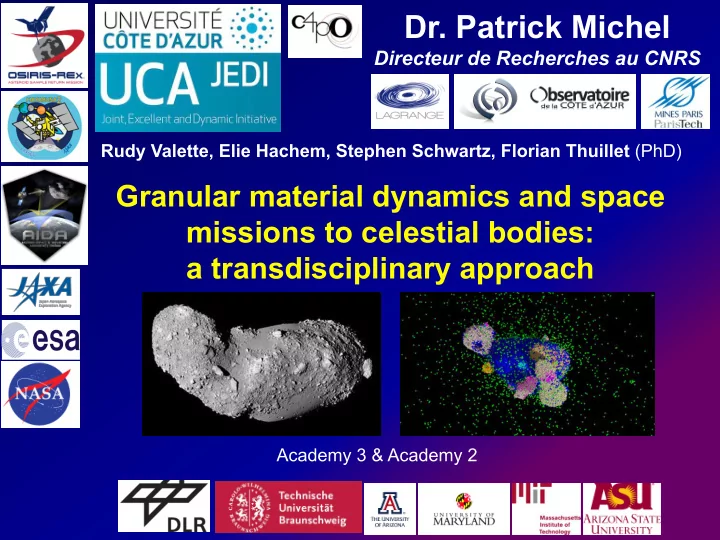
Dr. Patrick Michel Directeur de Recherches au CNRS Rudy Valette, Elie Hachem, Stephen Schwartz, Florian Thuillet (PhD) Granular material dynamics and space missions to celestial bodies: a transdisciplinary approach Academy 3 & Academy 2


slide-1
SLIDE 1
  • Dr. Patrick Michel

Directeur de Recherches au CNRS

Granular material dynamics and space missions to celestial bodies: a transdisciplinary approach

Rudy Valette, Elie Hachem, Stephen Schwartz, Florian Thuillet (PhD) Academy 3 & Academy 2

slide-2
SLIDE 2

The main asteroid belt

(7561) PatrickMichel

slide-3
SLIDE 3

ASTEROiDS:

Great diversity in sizes, shapes, composition

Image: NASA/JPL-Caltech/JAXA/ESA

950 km 320 m

slide-4
SLIDE 4

Granular material is present on all visited asteroid surfaces

Image: JAXA Image: Miyamoto et al, 2007

Asteroid Itokawa (320 m)

  • Visited by Hayabusa in 2005
  • Sample returned to Earth on June 13, 2010
slide-5
SLIDE 5

OSIRIS-REx & Hayabusa2 2018-2020

Bennu 535 m

Images of 2 new worlds (need good interpretations) Lander deployment Two kinds of sampling methods

slide-6
SLIDE 6

Project goal

Compare two approaches used to model granular material dynamics:

– The continuum approach (Ecole des Mines ParisTech) – The soft-sphere discrete element method (OCA)

Apply the two approaches (separated or combined) to model:

– Lander bouncing on asteroid surfaces (Hayabusa2) – Sampling of asteroid surfaces – Asteroid regolith surface processes

slide-7
SLIDE 7

First Comparison continuum versus discrete approach: Split Shear Cell Experiment

Courtesy: Martin van Hecke

slide-8
SLIDE 8

Split Shear Cell Experiment Soft-Sphere Discrete Element Method

Modeling of grains as discrete elements solving for all contact forces (sliding rolling, twisting …)

slide-9
SLIDE 9

Split Shear Cell Experiment Soft-Sphere Discrete Element Method

ß Experiment à ß Simulation à

Colored grains (a) Initial state (b) Further in time Width of the shear band

slide-10
SLIDE 10

Actual models fail for low shear rates and close to walls, free surfaces, or discontinuities The wide shear bands may be predicted by adding nonlocality in continuum models

Split Shear Cell Experiment Continuum Approach

Henann & Kamrin (2013), PNAS 425, 256. wide shear band Fenistein et al. (2004), PRL 92-9, 094301.

The shear band is way too wide and gets wider and wider (no finite shear band)

slide-11
SLIDE 11

Current investigations

Landslide experiments

Goal: reproduce the avalanche angle with both the continuum and the soft-sphere approaches

slide-12
SLIDE 12

Perspectives

Applications of Continuum versus Soft- Sphere to space mission devices and asteroid surface processes

Decision tool for: sampling site selections, lander detection, inference of regolith properties

slide-13
SLIDE 13

Interactions within UCA and

  • utside

Within UCA:

– Ecole des Mines ParisTech, GéoAzur

Outside UCA:

– NASA, JAXA, ESA, DLR – Univ. Maryland – Technische Universität Braunschweig – Arizona State University – MIT – Tsuangh University – John Hopkins University – Chyba Institute of Technology

slide-14
SLIDE 14

Students

Florian Thuillet (SupAéro Engineer, Bourse UNS), Lagrange Lab. Clara Maurel (SupAéro Engineer) MIT, co- tutelle in project with UNS Yun Zhang, Tsuangh University, China

  • Note: F. Thuillet & Y. Zhang are award winners for the

best presentations at the Planetary Defense Conference (Tokyo, May 2017)

slide-15
SLIDE 15

Publications

Communications in international conferences:

– Schwartz, S.R., Maurel, C., Ballouz, R.L., Richardson, D.C., Michel, P., Valette, R., Hachem, E. 2017. Vibration-driven segregation of regolith on low-gravity asteroids. Asteroids comets Meteors 2017, oral presentation, Montevideo (Uruguay) – Thuillet, F., Maurel, C., Michel, P., Biele, J., Ballouz, R.-L., Richardson, D.C. 2017. Numerical modeling of interactions of a lander with low-gravity asteroid regolith

  • surfaces. Planetary Defense Conference 2017, best presentation, Tokyo (Japan)

– Thuillet, F., Maurel, C., Michel, P., Biele, J., Ballouz, R.-L., Richardson, D.C. 2017. Simulations of regolith response to a low-speed impact of a lander in a low-gravity environment: application to the lander MASCOT on Hayabusa2. Oral presentation at the Japan Geophysical Union-American Geophysical Union meeting, Chyba (Japan) – Thuillet, F., Maurel, C., Michel, P., Biele, J., Ballouz, R.-L., Richardson D.C. 2017. Numerical simulations of surface package landing on a low-gravity granular surface: Application to the landing of mascot onboard Hayabusa2. Lunar and Planetary Science Congress (LPSC) 2017, The Woodlands (Texas).