Dmitry Lyumkis National Resource for Automated Molecular Microscopy - - PowerPoint PPT Presentation

dmitry lyumkis
SMART_READER_LITE
LIVE PREVIEW

Dmitry Lyumkis National Resource for Automated Molecular Microscopy - - PowerPoint PPT Presentation

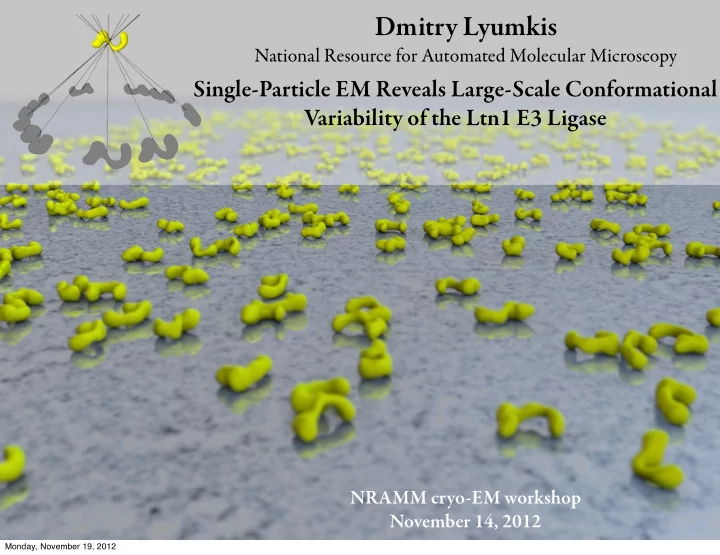
Dmitry Lyumkis National Resource for Automated Molecular Microscopy Single-Particle EM Reveals Large-Scale Conformational Variability of the Ltn1 E3 Ligase NRAMM cryo-EM workshop November 14, 2012 Monday, November 19, 2012 E3 ubiquitin


slide-1
SLIDE 1

Single-Particle EM Reveals Large-Scale Conformational Variability of the Ltn1 E3 Ligase

Dmitry Lyumkis

National Resource for Automated Molecular Microscopy NRAMM cryo-EM workshop November 14, 2012

Monday, November 19, 2012
slide-2
SLIDE 2

E3 ubiquitin ligases

E3 E2

substrate NH2 S O Ub

E3 E2

substrate NH SH Ub O

  • 1. proteasome-mediated protein degradation
  • 2. progression of the cell cycle
  • 3. apoptosis
  • 4. DNA transcription and repair
  • 5. ... and virtually every process in the cell

target protein poly-ubiquitin

Komander, D. and M. Rape (2012). "The ubiquitin code." Annu Rev Biochem 81: 203-229

E3

substrate NH Ub O Ub Ub Ub

E2

SH

Monday, November 19, 2012

slide-3
SLIDE 3

Bengtson, M. H. & Joazeiro, C. A. Nature 467, 470-473 (2010)

Ltn1 is a RING-E3 ubiquitin ligase that is responsible for protein quality control in eukaryotes

negative stain micrograph of Ltn1

200 Å

Monday, November 19, 2012

slide-4
SLIDE 4

untilted micrograph region (0°, 2um def, 2% UF) tilted micrograph region (55°, 2um def, 2% UF)

data collection and particle extraction

200 Å 200 Å

Monday, November 19, 2012

slide-5
SLIDE 5

reference-free / reference- based alignment & classification

iterative

1

RCT reconstruction from tilted particles corresponding to each untilted class

2

combine reconstructions from similar volumes (different is >10° change in terminus rotation)

3

if RCT volume is adequate, remove reconstructed particles from data & repeat 1-3

4

final volume: conformation 1 final volume: conformation 2

alignment, classification, & 3D reconstruction

Monday, November 19, 2012

slide-6
SLIDE 6

automated RCT infrastructure in Appion

database records

  • original particle in stack
  • alignment parameters

(rot, shx, shy, mirror)

  • class correspondence
  • 1. tilted particle

counterpart

  • 2. tilted micrograph
  • 3. tilt angle

database record class correspondence iterative translational refinement using established Euler angles RCT volume

Monday, November 19, 2012

slide-7
SLIDE 7

automated RCT results

Monday, November 19, 2012

slide-8
SLIDE 8

column merges row merges 200 Å

hinge 2: terminus-2 rotation hinge 1: terminus-1 flexing

Ltn1 shows extensive conformational variability about two hinge regions

Monday, November 19, 2012

slide-9
SLIDE 9

RING E3s are responsible for two functions: (1) substrate recognition (2) recruitment of E2-Ub conjugate

Ltn1 contains 2 conserved termini

sequence conservation between orthologs domain analysis

Monday, November 19, 2012

slide-10
SLIDE 10

... so we made a truncated protein to orient the termini

micrograph portion of ∆N-Ltn1 (amino acids 477-1562)

Monday, November 19, 2012

slide-11
SLIDE 11

∆N-Ltn1 Class Average

(amino acids 477-1562)

Ltn1 Class Average

(amino acids 1-1562)

∆N-Ltn1 3D reconstruction

(amino acids 477-1562)

Ltn1 3D reconstruction

(amino acids 477-1562)

  • verlay

Orientation of Ltn1ʼs N and C termini

C1 C2 C3 C4

RING E3s are responsible for two functions: (1) substrate recognition, (2) recruitment of E2-Ub conjugate

200 Å

Monday, November 19, 2012

slide-12
SLIDE 12

Ltn1 in vitreous ice

Does the same mobility occur in a more native environment?

Monday, November 19, 2012

slide-13
SLIDE 13

(1) recalculate 10,000 volumes by bootstrap resampling (2) calculate variance primary variance within data (intra-model heterogeneity) variance between reconstructed volumes (inter-model heterogeneity) 1 model 4 models

Mobility of Ltn1ʼs termini is present in frozen hydrated preparations (cryo-EM)

(1) Ltn1 exhibits similar heterogeneity in ice as it does in stain, and its basic architecture is preserved (2) predominant heterogeneity within the structure accounts for the mobility of its C- terminus

Scheres, S. H. (2012)." J Struct Biol Penczek, P. A., M. Kimmel, et al. (2011). Structure 19(11): 1582-1590 Monday, November 19, 2012

slide-14
SLIDE 14

Ltn1 is similar to CRL E3s in overall shape and size

RCT reconstruction 1 RCT reconstruction 2

  • verlay

MD fit to 1 MD fit to 2 MD simulations (1) The employed strategy using negative stain is identifying real mobility within the protein (2) Ltn1ʼs mobility cannot be simply explained by its large size and extended shape

Liu, J. and R. Nussinov (2011). JBC 286(47): 40934-40942 Zheng, N., et al. (2002). Nature 416(6882): 703-709

Monday, November 19, 2012

slide-15
SLIDE 15

relevance of flexibility within the ribosomal context of protein quality control

Monday, November 19, 2012

slide-16
SLIDE 16

(1) mediate poly-ubiquitylation (2) recognize different target lysines in a heterogeneous and dynamic environment specific to protein quality control

Model of Ltn1 E3 function within the context of protein quality control

protein structures drawn to scale

Monday, November 19, 2012

slide-17
SLIDE 17

validation / optimization of RCT results

  • 3. effects of specimen flattening: different structure by RCT may not always

mean different conformation and/or composition

  • 1. look at the particles within your class
  • 2. minor things - careful tilt-pair matching (especially when it is done

automatically), FSC value, curve, etc.

homogeneous class heterogeneous class

Cheng, Y., E. Wolf, et al. (2006). "Single particle reconstructions of the transferrin- transferrin receptor complex obtained with different specimen preparation techniques." J Mol Biol 355(5): 1048-1065

Monday, November 19, 2012

slide-18
SLIDE 18

conclusions

  • 1. Ltn1 is a highly dynamic protein and this may have functional implications for

its role in protein quality control

  • 2. Growing evidence that flexibility plays an important role in E3 ubiquitin ligases
  • 3. RCT as a robust methodology for sorting heterogeneity in single-particle data
  • fair amount of automation (record keeping!)
  • data collection in stain ~= RCT
  • 4. public availability of the negative stain dataset: http://maskiton.scripps.edu

Monday, November 19, 2012

slide-19
SLIDE 19

anks to ...

Principal Investigators

Bridget Carragher Clinton Potter Ron Milligan Claudio Joazeiro

Collaborators

Claudio Joazeiro Mario Bengtson Joong-Won Lee Chris Lima Selom Doamekpor Matt Petroski Tasha B. Toro

AMI / Joazeiro groups

see below

Monday, November 19, 2012