SLIDE 1
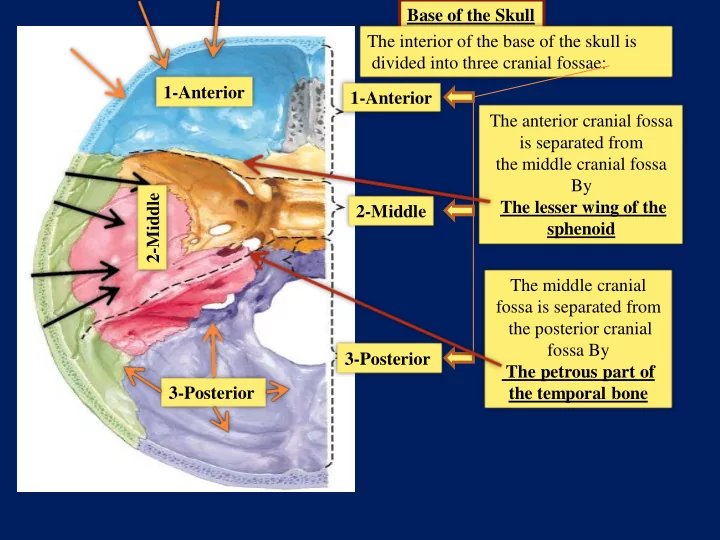
The middle cranial fossa is separated from the posterior cranial fossa By The petrous part of the temporal bone 1-Anterior 2-Middle 3-Posterior Base of the Skull The interior of the base of the skull is divided into three cranial fossae: The anterior cranial fossa is separated from the middle cranial fossa By The lesser wing of the sphenoid 2-Middle 3-Posterior 1-Anterior
SLIDE 2
Contains the frontal lobes of the cerebral hemispheres
Anterior Cranial Fossa
It is bounded Anteriorly: by the inner surface of the frontal bone In the midline: a crest galli for the attachment of the falx cerebri. Posteriorly :the lesser wing of the sphenoid bone Note: The medial end of the lesser wing of the sphenoid forms The anterior clinoid process gives attachment to the Tentorium cerebelli. The floor of the fossa is formed by: Laterally :orbital plates of the frontal bone Medially: by the cribriform plate of the ethmoid The crista galli is a sharp upward projection of the ethmoid bone in the midline for the attachment of The falx cerebri.
SLIDE 3 formed by: the body of the sphenoid It is bounded
Middle Cranial Fossa
Laterally : the squamous parts of the temporal bones, the greater wings of the sphenoid, and the parietal bones. The floor of each lateral part of the middle cranial fossa is formed by the greater wing of the sphenoid and the squamous and petrous parts of the temporal bone. Posteriorly by :the superior borders of the petrous parts of the temporal bones Anteriorly by: the lesser wings
SLIDE 4 1-The body of the sphenoid :contains the sphenoid air sinuses 2-The optic canal transmits A- The optic nerve B-The ophthalmic artery 3-The superior orbital fissure is a slitlike opening between the lesser and greater wings
- f the sphenoid transmits:
The sphenoid bone
resembles a bat having a centrally placed body with greater and lesser wings that are
SLIDE 5
Lacrimal Frontal Trochlear Superior division of Oculomotor nerve Nasociliary Inferior division of oculomotor nerve Abducent nerves together with the superior ophthalmic vein. Live Free To See No Insult At all
SLIDE 6 4-The foramen rotundum situated behind the medial end of the superior
Transmits the maxillary nerve.
5-The foramen ovale lies posterolateral to the foramen rotundum Transmits the mandibular nerve the lesser petrosal nerve 6-The small foramen spinosum lies posterolateral to the foramen
- vale The foramen transmits
The middle meningeal artery
7-Foramen lacerum lies between the apex of the petrous part of the temporal bone and the sphenoid bone in life is filled by cartilage and fibrous tissue, and only small blood vessels pass through this tissue from the cranial cavity to the neck.
8-The carotid canal Transmits: The internal carotid artery 9- Meckl’s cave: impression on the apex of the petrous part of the temporal bone for the trigeminal ganglion
SLIDE 7
10-The median part of the middle cranial fossa is formed by: the body of the sphenoid bone In front of it is The sulcus chiasmatis which is related to the optic chiasma and leads laterally To THE OPTIC CANAL On the superior aspect of the body is a depression called The sella turcica which CONTAIN THE PITUITARY GLAND The sella turcica is bounded posteriorly by a square plate of bone called
THE DORSUM SELLAE
The superior angles of the dorsum sellae have two tuberclescalled The posterior clinoid processes which give attachment to the fixed margin of The tentorium cerebelli.
SLIDE 8 Posterior Cranial Fossa
Contains the parts of the hindbrain: The cerebellum, Pons, and Medulla
The roof is formed by: a fold of dura THE TENTORIUM CEREBELLI which intervenes between the cerebellum below And the occipital lobes of the cerebral hemispheres above Is bounded by: Anteriorly: the petrous part of the temporal bone Posteriorly : the internal surface of the squamous part of the occipital bone The floor is formed by:Parts of the occipital bone The mastoid part of the temporal bone
SLIDE 9 1-The internal acoustic meatus pierces the posterior surface of the petrous part
It transmits: A- THE VESTIBULOCOCHLEAR NERVE B- THE FACIAL NERVE. 3- Groove for the transverse sinus: On each side of the internal occipital protuberance 2-The internal occipital protuberance attached to it the small falx cerebelli
SLIDE 10
4-the sigmoid sinus 4-the sigmoid sinus
SLIDE 11 5-The foramen magnum
- ccupies the central area of the floor
Transmits A- The medulla oblongata and its surrounding meninges B- The ascending spinal parts of the accessory nerves C-The two vertebral arteries 6-The hypoglossal canal is situated above the anterolateral boundary
Transmits the hypoglossal nerve
SLIDE 12
7-The jugular foramen It transmits the following structures: from before backward: A-The inferior petrosal sinus B-The 9th, 10th, and 11th cranial nerves C- The large sigmoid sinus D-The inferior petrosal sinus E-The sigmoid sinus turns down through the foramen to become the internal jugular vein
SLIDE 13 Inferior View of the Skull 1-The hard palate whic is made of: A-The palatal processes of the maxillae (vertical) B-The horizontal plates of the palatine bones 2-Incisive fossa and foramen 3-The greater and lesser palatine foramina 4-The choanae (posterior nasal apertures). 5-The vomer 6-Medial and lateral pterygoid plates
SLIDE 14
9-The spine of the sphenoid LOCATED Posterolateral to the foramen spinosum is The greater wing of the sphenoid is pierced by the large 7-foramen ovale 8-foramen spinosum 10-The mandibular fossa of the temporal bone and the articular tubercle form the upper articular surfaces for the temporomandibular joint.
SLIDE 15
12-Tympanic plate of the temporal bone 11-The styloid process of the temporal bone 14-The opening of the carotid canal 15- Foramen lacerum 13-the external auditory meatus
SLIDE 16
16- The stylomastoid foramen In the interval between the styloid and mastoid processe 17-jugular foramen 18-Hypoglossal canal Superior to the occipital condyle for transmission of the hypoglossal nerve
SLIDE 17 19-The basilar part of the
20-The occipital condyles 21-The external
protuberance. 22- The superior nuchal lines :posterior to the foramen magnum in the midline