Disclosure No relevant financial Robert B. Baron, MD MS - - PowerPoint PPT Presentation

disclosure no relevant financial
SMART_READER_LITE
LIVE PREVIEW

Disclosure No relevant financial Robert B. Baron, MD MS - - PowerPoint PPT Presentation

Robert Baron MD, MS Management of Lipid Disorders MANAGEMENT OF LIPID DISORDERS: Maximizing Benefits and Minimizing Harms Disclosure No relevant financial Robert B. Baron, MD MS relationships Professor and Associate Dean UCSF School of


slide-1
SLIDE 1

Management of Lipid Disorders 1

Robert Baron MD, MS

MANAGEMENT OF LIPID DISORDERS:

Maximizing Benefits and Minimizing Harms

Robert B. Baron, MD MS Professor and Associate Dean UCSF School of Medicine

baron@medicine.ucsf.edu

Disclosure No relevant financial relationships

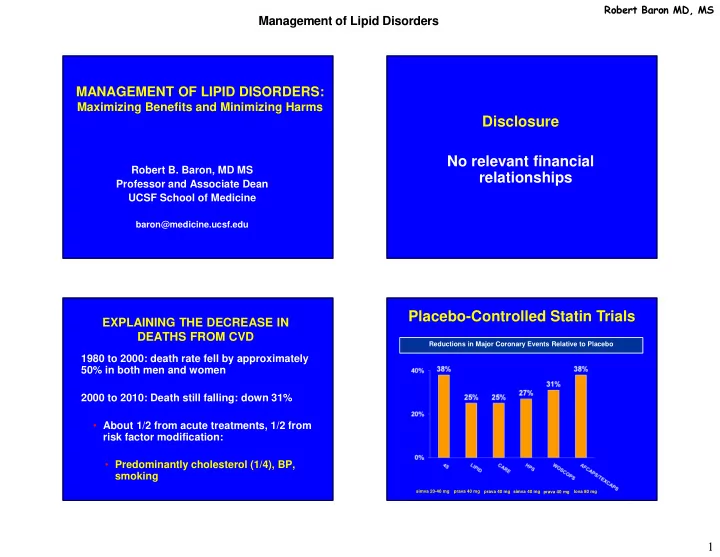
EXPLAINING THE DECREASE IN DEATHS FROM CVD

1980 to 2000: death rate fell by approximately 50% in both men and women 2000 to 2010: Death still falling: down 31%

  • About 1/2 from acute treatments, 1/2 from

risk factor modification:

  • Predominantly cholesterol (1/4), BP,

smoking

Reductions in Major Coronary Events Relative to Placebo

Placebo-Controlled Statin Trials

simva 20-40 mg prava 40 mg prava 40 mg simva 40 mg prava 40 mg lova 80 mg

slide-2
SLIDE 2

Management of Lipid Disorders 2

Robert Baron MD, MS

Baseline Feature LDL (mg/dL) <100 ≥100 <130 ≥130 ALL PATIENTS Statin Placebo (10,269) (10,267) 285 360 670 881 1087 1365 2042 2606 (19.9%) (25.4%) 0.4 0.6 0.8 1.0 1.2 1.4 24% reduction (p<0.00001)

Heart Protection Study: Vascular Events by Baseline LDL-C

Risk Ratio and 95% Cl Statin better Statin worse

  • No. Events

2013 ACC/AHA Guidelines

What is New? 4 groups of patients who benefit from statins Identifies high and moderate intensity statins No LDL treatment targets Non-statin therapies no not provide acceptable risk reduction Estimate 10-year ASCVD risk with new equation

2013 ACC/AHA Guidelines

Four Groups of Patients Who Benefit From Statins Individuals with clinical ASCVD Individuals with primary elevations of LDL ≥190 Individuals age 40-75 with diabetes and LDL ≥ 70 Individuals without ASCVD or diabetes, age 40-75, with LDL ≥ 70, and 10 year risk 7.5% or higher

2013 ACC/AHA Guidelines

Importance of Lifestyle Recommendations Heart healthy diet Regular aerobic exercise Desirable body weight Avoidance of tobacco

slide-3
SLIDE 3

Management of Lipid Disorders 3

Robert Baron MD, MS

Heart Healthy Diet 2016 Two dietary factors increase LDL: Saturated fat Total Calories Restriction of dietary cholesterol is no longer recommended (Dietary Guidelines 2015) Saturated Fat 2016

Observational studies: no association between sat fat and CVD But: RCTs that replace sat fat with unsat fat reduce total and LDL cholesterol and CVD events and mortality And: replacing sat fat with carb reduces total and LDL cholesterol but increases triglycerides and HDL and does not lower CVD events

2013 ACC/AHA Guidelines

What Statin for Each Group?

Individuals with clinical ASCVD:

Treat with: high intensity statin, or moderate intensity statin if > age 75

Individuals with primary elevations of LDL ≥190:

Treat with: high intensity statin

2013 ACC/AHA Guidelines

What Statin for Each Group? Individuals 40-75 with diabetes and LDL ≥ 70: Treat with: moderate intensity statin, or high intensity statin if risk over 7.5% Individuals without ASCVD or diabetes, 40- 75, with LDL ≥ 70, and 10 year risk 7.5% or higher:

Treat with: moderate-to-high intensity statin

slide-4
SLIDE 4

Management of Lipid Disorders 4

Robert Baron MD, MS

2013 ACC/AHA Guidelines

High Intensity vs. Moderate Intensity Statin High Intensity: lowers LDL by >50%

Atorvastatin 40 - 80 Rosuvastatin 20 - 40

Moderate Intensity: lowers LDL by 30-50%

Atorvastatin 10 - 20 Rosuvastatin 5 – 10 Simvastatin 20 - 40 Pravastatin 40 – 80 Lovastatin 40

How Best To Calculate 10 Year Risk?

Pooled Cohort Risk Assessment Equations: hard CHD events and stroke http://my.americanheart.org/professional/State mentsGuidelines/PreventionGuidelines/Preventi

  • n-Guidelines_UCM_457698_SubHomePage.jsp

Pooled Cohort Risk Assessment Equations

  • Age
  • Gender
  • Race (White/African American)
  • Total cholesterol (170 mg/dl)
  • HDL cholesterol (50 mg/dl)
  • Systolic BP (110 mmHg
  • Yes/no meds for BP
  • Yes/no DM
  • Yes/no cigs
  • Outcome: 10-year risk of total CVD (fatal and non-fatal MI and

stroke)

Do the Pooled Cohort Risk Assessment Equations Overestimate Risk?

slide-5
SLIDE 5

Management of Lipid Disorders 5

Robert Baron MD, MS

Percent of U.S. Adults Who Would Be Eligible for Statin Therapy for Primary Prevention, According to Set of Guidelines and Age Group.

Pencina, N Engl J Med 2014

How Best To Calculate 10 Year Risk?

Baron Approach Spring 2016

Use both CHD (hard end points) calculator and new CV risk calculator Include both in shared decision- making discussion How Best To Calculate 10 Year Risk?

Mayo Clinic Statin Choice Decision Aid: http://statindecisionaid.mayoclinic.org/ind ex.php/statin/index?PHPSESSID=0khk8n m14h9vubjm3423e6h6b2

63 yo woman; s/p MI LDL 115 HDL 45 TG 160

slide-6
SLIDE 6

Management of Lipid Disorders 6

Robert Baron MD, MS

The best next step in lipid management is:

  • A. Atorvastatin 40 mg
  • B. Rosuvastatin 10 mg
  • C. Pravastatin 40 mg
  • D. Simvastatin 40 mg
  • E. Lovastatin 40 mg
  • F. Whatever works to get her LDL

below 70 mg/dl

A t

  • r

v a s t a t i n 4 m g R

  • s

u v a s t a t i n 1 m g P r a v a s t a t i n 4 m g S i m v a s t a t i n 4 m g L

  • v

a s t a t i n 4 m g W h a t e v e r w

  • r

k s t

  • g

e t . . .

89% 1% 8% 1% 1% 0%

2013 ACC/AHA Guidelines

What Statin for Each Group?

Individuals with clinical ASCVD:

Treat with: high intensity statin, or moderate intensity statin if > age 75

The best next step in lipid management is:

  • 1. Atorvastatin 40 mg
  • 2. Rosuvastatin 10 mg
  • 3. Pravastatin 40 mg
  • 4. Simvastatin 40 mg
  • 5. Lovastatin 40 mg
  • 6. Whatever works to get her LDL below 70 mg/dl

63 yo woman; s/p MI. On atorvastatin 80. LDL 95 HDL 40 TG 200

slide-7
SLIDE 7

Management of Lipid Disorders 7

Robert Baron MD, MS

The best next step in lipid management is:

  • A. Continue current therapy
  • B. Switch to rosuvastatin 40 mg
  • C. Add fenofibrate
  • D. Add fish oil
  • E. Add niacin
  • F. Add ezetimibe

C

  • n

t i n u e c u r r e n t t h e r a p y S w i t c h t

  • r
  • s

u v a s t a t i n . . A d d f e n

  • f

i b r a t e A d d f i s h

  • i

l A d d n i a c i n A d d e z e t i m i b e

68% 8% 4% 2% 12% 6%

Summary Lipid-Lowering Drugs

  • Statins are treatment of choice based on RCT

to decrease risk

  • No evidence to support adding niacin or

fibrates to statins

  • If completely statin-intolerant, niacin may

reduce CVD risk (weak evidence)

  • Fibrates appear to lower MI risk, but no other

CVD endpoints

Summary Lipid-Lowering Drugs

  • Ezetimibe study: (IMPROVE-IT)

18,000 ACS patients (40% from North America) RCT: Simvastatin vs simvastatin + ezetimibe. Took 7 years. Death, MI, Stroke Simvastatin: 34.7% vs Simva/ezetimibe 32.7% (270 fewer events over 7 years)

PCSK9 Inhibitors

Evolocumab (Repatha) and alirocumab (Praluent)—monoclonal antibodies that reduce liver LDL-receptor degradation Reduce LDL by 50%. Injectable Q2 – 4 weeks Approved for FH or patients with CVD “who need additional LDL lowering.” Unproven cardiovascular benefits

slide-8
SLIDE 8

Management of Lipid Disorders 8

Robert Baron MD, MS

The best next step in lipid management is:

  • 1. Continue current therapy
  • 2. Switch to rosuvastatin 40 mg (Also potentially

correct, but medication still on patent) 3. Add fenofibrate 4. Add fish oil 5. Add niacin 6. Add ezetimibe

63 yo woman, no traditional risk factors LDL 155 HDL 55 TG 160 SBP 120 No BP meds No DM Nonsmoker

The best next step in lipid management is to calculate 10 year risk and:

  • A. Continue current therapy (no meds)
  • B. Begin atorvastatin 40
  • C. Begin atorvastatin 10
  • D. Begin simvastatin 20
  • E. Begin sustained release niacin
  • F. Begin red yeast rice

C

  • n

t i n u e c u r r e n t t h e r a p . . . B e g i n a t

  • r

v a s t a t i n 4 B e g i n a t

  • r

v a s t a t i n 1 B e g i n s i m v a s t a t i n 2 B e g i n s u s t a i n e d r e l e a s e n . . . B e g i n r e d y e a s t r i c e

64% 6% 0% 0% 1% 30%

63 yo woman, no risks

LDL 155, HDL 55, TG 160 SBP 120, No BP meds Nonsmoker, No DM

10 yr CHD risk (old calculator): 2%… 10 yr CV risk (new calculator): 4.5%… Therefore no medication recommended

slide-9
SLIDE 9

Management of Lipid Disorders 9

Robert Baron MD, MS

63 yo man, no traditional risk factors LDL 155 HDL 55 TG 160 SBP 120 No BP meds No DM Nonsmoker

The best next step in lipid management is to calculate 10 year risk and:

  • A. Continue current therapy (no meds)
  • B. Begin atorvastatin 40
  • C. Begin atorvastatin 10
  • D. Begin simvastatin 20
  • E. Begin sustained release niacin
  • F. Begin red yeast rice

C

  • n

t i n u e c u r r e n t t h e r a p . . . B e g i n a t

  • r

v a s t a t i n 4 B e g i n a t

  • r

v a s t a t i n 1 B e g i n s i m v a s t a t i n 2 B e g i n s u s t a i n e d r e l e a s e n . . . B e g i n r e d y e a s t r i c e

17% 19% 0% 0% 1% 63%

63 yo man, no risks

LDL 155, HDL 55, TG 160 SBP 120, No BP meds Nonsmoker, No DM

10 yr CHD risk (old calculator): 10%… 10 yr CV risk (new calculator): 10.8%… “Toss-up.” Shared decision making. If start statin (per new guidelines), can start with moderate intensity statin

slide-10
SLIDE 10

Management of Lipid Disorders 10

Robert Baron MD, MS

The best next step in lipid management is to calculate 10 year risk and:

  • 1. Continue current therapy (no meds)- old (but

toss-up)

  • 2. Begin atorvastatin 40-new (but still close call)
  • 3. Begin atorvastatin 10-new (but still close call)
  • 4. Begin simvastatin 20-new (but still close call)
  • 5. Begin sustained release niacin
  • 6. Begin red yeast rice

Key is shared decision-making

Other Factors That Could Affect Treatment Decisions

LDL ≥ 160 mg/dl or evidence of genetic disorder Family history of premature ASCVD (<55 in first degree male relative, <65 in first degree woman) hs-CRP ≥2mg/dl CAC score ≥ 300 (or ≥75% for age, sex, ethnicity Ankle brachial index <0.9 Elevated lifetime risk of ASCVD

The Good and The Controversial of the New Cholesterol Guidelines

  • Focus on healthy lifestyle is good
  • Focus to use statins (and not other agents) is good
  • Focus to treat patients at high risk is good
  • Focus to treat all patients with LDL <190 mg/dl and

treat patients with DM/existing CV disease is good

  • Not having target LDL is controversial
  • Adults with no DM or heart disease and 10-year

calculated risk >7.5% (using new risk calculator) to be treated – controversial

Conclusions I

Statins are effective and cost effective in selected groups of patients Screen most patients (shared decision-making) at age 21 (to identify those > LDL 190, other genetic lipid disorders)

slide-11
SLIDE 11

Management of Lipid Disorders 11

Robert Baron MD, MS

Conclusions II

Use statins in patients with ASCVD, LDL ≥190 and diabetes For those without ASCVD and diabetes, calculate 10 year risk, and treat those with risk greater than 7.5% (or maybe 10% or even 15%). Use shared decision making. Use appropriate intensity statin (high and moderate)

Conclusions III

Monitor adherence, but do not treat to specific LDL goal Do not treat those over age 75 (unless ASCVD),

  • n dialysis or moderate/severe CHF

Do not treat with other lipid-modifying drugs in addition to statins (but may need if truly statin intolerant) Avoid other factors that raise risk as much as statins lower it (i.e. NSAIDS)