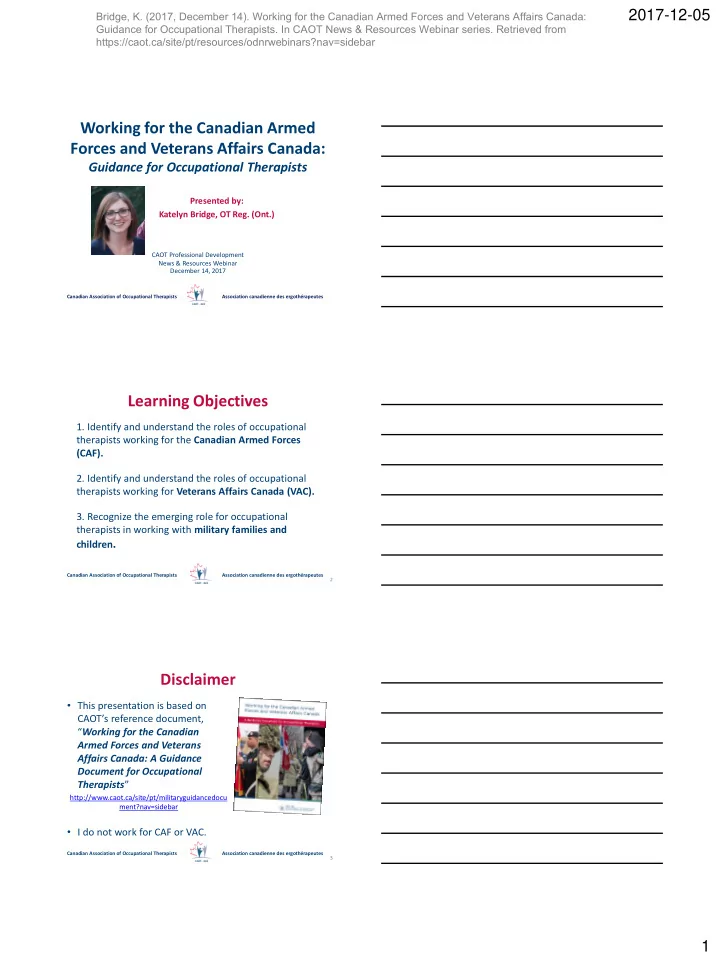
Disclaimer This presentation is based on CAOTs reference document, - - PDF document

disclaimer
SMART_READER_LITE
LIVE PREVIEW

Disclaimer This presentation is based on CAOTs reference document, - - PDF document

2017-12-05 Bridge, K. (2017, December 14). Working for the Canadian Armed Forces and Veterans Affairs Canada: Guidance for Occupational Therapists. In CAOT News & Resources Webinar series. Retrieved from


slide-1
SLIDE 1

2017-12-05 1

Association canadienne des ergothérapeutes Canadian Association of Occupational Therapists 1

CAOT Professional Development News & Resources Webinar

Association canadienne des ergothérapeutes Canadian Association of Occupational Therapists

Working for the Canadian Armed Forces and Veterans Affairs Canada:

Guidance for Occupational Therapists

Presented by: Katelyn Bridge, OT Reg. (Ont.)

December 14, 2017

Association canadienne des ergothérapeutes Canadian Association of Occupational Therapists 2

Learning Objectives

  • 1. Identify and understand the roles of occupational

therapists working for the Canadian Armed Forces (CAF).

  • 2. Identify and understand the roles of occupational

therapists working for Veterans Affairs Canada (VAC).

  • 3. Recognize the emerging role for occupational

therapists in working with military families and children.

Association canadienne des ergothérapeutes Canadian Association of Occupational Therapists 3

Disclaimer

  • This presentation is based on

CAOT’s reference document, “Working for the Canadian Armed Forces and Veterans Affairs Canada: A Guidance Document for Occupational Therapists”

http://www.caot.ca/site/pt/militaryguidancedocu ment?nav=sidebar

  • I do not work for CAF or VAC.

Bridge, K. (2017, December 14). Working for the Canadian Armed Forces and Veterans Affairs Canada: Guidance for Occupational Therapists. In CAOT News & Resources Webinar series. Retrieved from https://caot.ca/site/pt/resources/odnrwebinars?nav=sidebar

slide-2
SLIDE 2

2017-12-05 2

Association canadienne des ergothérapeutes Canadian Association of Occupational Therapists 4

Recent Developments

  • CAOT has been working closely with the CAF and

VAC to promote occupational therapy as an essential service for the health and well being of military personnel, Veterans, and their families.

  • At the 2017 CIMVHR Forum, the CAF announced

that they will be hiring 30 new occupational therapists – an increase from their current number

  • f 4.

– Reiterated at the 2017 Family Medicine Forum

Association canadienne des ergothérapeutes Canadian Association of Occupational Therapists 5

Working with Members of the Canadian Armed Forces

Occupational therapists work with active military personnel in two different roles:

– OTs may work directly on base for the Department of National Defence (DND) as a DND Rehabilitation Occupational Therapist (DND OT). *** – Occupational therapists can also register to be Blue Cross service providers and work in the community as Blue Cross Occupational Therapists (Blue Cross OTs).

Association canadienne des ergothérapeutes Canadian Association of Occupational Therapists 6

Unique Considerations

  • When working with members of the CAF,

whether as a DND OT or a Blue Cross OT, there are some unique considerations:

– The overarching goal of occupational therapy interventions with CAF members is return to duty. – Rehabilitation outcomes with CAF personnel are strongly tied to motivation, effort, and support. – An injured CAF member is seen a recovering athlete who must be provided with an appropriate level of challenge to reach their rehabilitation goals.

(National Defence and the Canadian Armed Forces, 2011)

Bridge, K. (2017, December 14). Working for the Canadian Armed Forces and Veterans Affairs Canada: Guidance for Occupational Therapists. In CAOT News & Resources Webinar series. Retrieved from https://caot.ca/site/pt/resources/odnrwebinars?nav=sidebar

slide-3
SLIDE 3

2017-12-05 3

Association canadienne des ergothérapeutes Canadian Association of Occupational Therapists 7

DND Occupational Therapists

  • DND OTs work on military bases as team

members on the Canadian Forces Health Services Physical Rehabilitation Team.

– Primary goal: Return injured personnel to their previous duty as soon as medically possible. – When return to duty cannot be accomplished through a physical rehabilitation program, the secondary goal is to prepare CAF personnel for alternative military employment. – If this too is not a realistic goal, the tertiary goal is to prepare CAF members for an optimal transition to civilian life.

(Besemann, 2011)

Association canadienne des ergothérapeutes Canadian Association of Occupational Therapists 8

DND OTs: Commonly Addressed Issues

  • DND OTs commonly work with CAF members

who may be experiencing the following:

  • orthopedic problems
  • musculoskeletal

problems

  • sleep disorders
  • amputations
  • chronic pain
  • traumatic brain injury
  • need for mobility aids
  • need for assistive

devices/equipment

  • needs for home

adaptations

  • need for vehicle

adaptations

  • dysregulated routines

and habits

Association canadienne des ergothérapeutes Canadian Association of Occupational Therapists 9

DND OTs: Commonly Used Assessment Tools

  • The following list is an example of occupational therapy

assessments used on one of the CAF bases:

  • Beck Anxiety Inventory (BAI)
  • Beck Depression Inventory (BDI)
  • Behavioral Assessment of Dysexecutive

Syndrome (BADS)

  • Box and Block Test (BBT)
  • Brain Injury Visual Assessment Battery for

Adults (biVABA)

  • Canadian Occupational Performance

Measure (COPM)

  • Contextual Memory Test (CMT)
  • Headache Impact Test (HIT-6)
  • Insomnia Severity Index (ISI)
  • Jebsen Hand Function Test (JHFT)
  • Montreal Cognitive Assessment (MoCA)
  • Motor-Free Visual Perception Test (MVPT)
  • Neurobehavioral Symptom Inventory (NSI)
  • Patient Health Questionnaire-9 (PHQ-9)
  • Pittsburgh Sleep Quality Index (PSQI)
  • Purdue Peg Board
  • Rivermead Behavioural Memory Test

(RBMT)

  • Standardized Concussion Assessment Tool

3 (SCAT3)

  • Tampa Scale of Kinesiophobia (TSK)
  • Test of Everyday Attention (TEA)

Bridge, K. (2017, December 14). Working for the Canadian Armed Forces and Veterans Affairs Canada: Guidance for Occupational Therapists. In CAOT News & Resources Webinar series. Retrieved from https://caot.ca/site/pt/resources/odnrwebinars?nav=sidebar

slide-4
SLIDE 4

2017-12-05 4

Association canadienne des ergothérapeutes Canadian Association of Occupational Therapists 10

Working for the Canadian Armed Forces

Keep an eye out for the online application process for the recently announced positions. www.jobs.gc.ca https://bts.calian.com/en/career_jobs/index.asp They will also be advertised on www.caot.ca

Association canadienne des ergothérapeutes Canadian Association of Occupational Therapists 11

Blue Cross Occupational Therapists

  • OTs working in the community or private

practice can register with Medavie Blue Cross to become Blue Cross service providers, making them eligible to provide direct service to CAF members requiring occupational therapy.

https://www.medaviebc.ca/en/health- professionals/register

Association canadienne des ergothérapeutes Canadian Association of Occupational Therapists 12

Blue Cross Occupational Therapists

“Outsourcing” is the term used when a CAF member is referred to a Blue Cross OT. CAF members may be referred to Blue Cross OTs for a variety

  • f reasons including:
  • When no on-site occupational therapy services are available on base.
  • The DND OT is unable to see a client within the required priority

timeline.

  • The member requires specialized assessment or treatment that is not

available on-site (e.g. hand therapy, functional capacity evaluation).

  • The member lives/works at a distance from the primary DND OT

location.

Bridge, K. (2017, December 14). Working for the Canadian Armed Forces and Veterans Affairs Canada: Guidance for Occupational Therapists. In CAOT News & Resources Webinar series. Retrieved from https://caot.ca/site/pt/resources/odnrwebinars?nav=sidebar

slide-5
SLIDE 5

2017-12-05 5

Association canadienne des ergothérapeutes Canadian Association of Occupational Therapists 13

Blue Cross Occupational Therapists

  • Services provided by Blue Cross OTs are typically provided within

the military member’s home.

  • The initial home assessment should be comprehensive and

include:

  • home safety
  • medication and health management
  • accessibility of home space
  • mobility (essential transfers and

movement)

  • cognitive screenings and/or

assessment

  • social support
  • caregiver physical/mental health

requirements

  • comparisons of present versus past

ability to function in everyday roles and routines

  • fit between home environment and

member’s current functional abilities

Association canadienne des ergothérapeutes Canadian Association of Occupational Therapists 14

Blue Cross OTs – Process Overview

1. DND OT/referral source speaks with Blue Cross OT to ensure that the OT can meet the required priority timeline. 2. Appropriate information is provided to the Blue Cross OT including: client referral, reporting standards, and any other important information. 3. Blue Cross OT contacts CAF member to arrange initial assessment. 4. Blue Cross OT and CAF member meet. 5. Blue Cross OT writes an initial report. 6. Blue Cross OT submits the reports to the referral source. 7. The recommendations on the occupational therapy report are reviewed by the referring health care provider. Recommendations are addressed and funding options are considered.

Association canadienne des ergothérapeutes Canadian Association of Occupational Therapists 15

Working with Veterans and Veterans Affairs Canada

  • Veterans are defined as “Canadian Armed Forces

members who meet the Department of National Defence’s military occupational classification requirements and have been released from the Canadian Armed Forces with an honourable discharge” (Department of National Defence, 2015, p. 130)

Bridge, K. (2017, December 14). Working for the Canadian Armed Forces and Veterans Affairs Canada: Guidance for Occupational Therapists. In CAOT News & Resources Webinar series. Retrieved from https://caot.ca/site/pt/resources/odnrwebinars?nav=sidebar

slide-6
SLIDE 6

2017-12-05 6

Association canadienne des ergothérapeutes Canadian Association of Occupational Therapists 16

The Transition to Veteran Status

  • There are components of military life that may

make the transition to Veteran status more difficult:

– Military life is very structured – Loss of comradery – Lack of experience with everyday tasks, such as:

  • Applying for jobs
  • Finding housing
  • Managing a budget
  • Registering for a health card

Association canadienne des ergothérapeutes Canadian Association of Occupational Therapists 17

VAC Client Base: Commonly Addressed Issues

  • Chronic pain
  • Physical limitations
  • Need for mobility aids
  • Need for home adaptations
  • Need for assistive devices

and equipment

  • Depression
  • Anxiety
  • Post-traumatic stress

disorder (PTSD)

  • Substance abuse
  • Dysregulated routines and

habits

  • Social isolation
  • Issues resulting from a

traumatic brain injury (TBI)

Association canadienne des ergothérapeutes Canadian Association of Occupational Therapists 18

Working for Veterans Affairs Canada

  • VAC employs occupational therapists in four

capacities:

1) Field Occupational Therapy Services Officers (FOTSO) 2) Case Managers 3) Field Occupational Therapists 4) Clinical Care Managers (CCM) Bridge, K. (2017, December 14). Working for the Canadian Armed Forces and Veterans Affairs Canada: Guidance for Occupational Therapists. In CAOT News & Resources Webinar series. Retrieved from https://caot.ca/site/pt/resources/odnrwebinars?nav=sidebar

slide-7
SLIDE 7

2017-12-05 7

Association canadienne des ergothérapeutes Canadian Association of Occupational Therapists 19

Field Occupational Therapy Services Officers (FOTSOs)

  • Work within a VAC office, where their primary

roles are as a consultant who coordinates

  • ccupational therapy referrals, and as a member
  • f an interdisciplinary team.
  • Do not provide direct treatment to clients.

– Act as an intermediary between other VAC staff, Case Managers, and community therapists to help ensure VAC clients receive occupational therapy services to meet their needs.

Association canadienne des ergothérapeutes Canadian Association of Occupational Therapists 20

FOTSOs - Key Duties

  • Reviews the client’s concerns and functional issues, and sends

a referral to a Field OT in the community.

  • After assessment by the Field OT, the FOTSO reviews the report

and recommendations made by Field OT.

– The FOTSO then makes their own recommendations based on the client’s needs, the Field OTs recommendations, VAC policies, and VAC benefits that the client may be eligible for.

  • Reviewing financial quotes generated by Field OTs.
  • Provide a comprehensive package (recommendations, funding

info) to decision makers – goal is to obtain approval for recommendations.

Association canadienne des ergothérapeutes Canadian Association of Occupational Therapists 21

Case Managers

  • Role is not exclusive to occupational therapists.
  • VAC Case Managers assist Veterans and their

families with the transition from active military personnel to civilian life.

– Not all Veterans require case management; it is a service designed to assist those who may be finding it particularly difficult to navigate the transition. – Military are personnel are screened for case management needs when they are transitioning out

  • f active duty.

Bridge, K. (2017, December 14). Working for the Canadian Armed Forces and Veterans Affairs Canada: Guidance for Occupational Therapists. In CAOT News & Resources Webinar series. Retrieved from https://caot.ca/site/pt/resources/odnrwebinars?nav=sidebar

slide-8
SLIDE 8

2017-12-05 8

Association canadienne des ergothérapeutes Canadian Association of Occupational Therapists 22

Case Managers – Key Duties

  • Work with a caseload of clients on a one-on-one

basis to identify potential barriers to engagement in civilian life and to coordinate and approve services.

  • Do not provide direct treatment to clients.

– Refer them to services in the community, support them through VAC Rehabilitation Program.

  • Clients continue to work with a Case Manager until

they have met their identified goals, which can take several years (especially in the case of vocational goals).

Association canadienne des ergothérapeutes Canadian Association of Occupational Therapists 23

Interested in Working as a Case Manager?

  • Knowledge and skills to have to excel in this

role:

– General knowledge of physical health issues and treatment strategies – General knowledge of mental health issues and treatment strategies – Knowledge of assessment and intervention for chronic pain – Knowledge of available community resources – Experience in vocational rehabilitation (specifically interpreting Functional Capacity Evaluation results) – Motivational interviewing skills – Knowledge of suicide prevention intervention strategies

Association canadienne des ergothérapeutes Canadian Association of Occupational Therapists 24

Field Occupational Therapists

  • Occupational therapists working in the

community or private practice can register with Medavie Blue Cross to become Blue Cross service providers, making them eligible to provide direct service to VAC clients. http://www.veterans.gc.ca/eng/services/ health/treatment-benefits/info-providers

Bridge, K. (2017, December 14). Working for the Canadian Armed Forces and Veterans Affairs Canada: Guidance for Occupational Therapists. In CAOT News & Resources Webinar series. Retrieved from https://caot.ca/site/pt/resources/odnrwebinars?nav=sidebar

slide-9
SLIDE 9

2017-12-05 9

Association canadienne des ergothérapeutes Canadian Association of Occupational Therapists 25

Field Occupational Therapists

  • Field Occupational Therapists provide services to VAC

clients in their homes and within the community.

  • They work closely with the FOTSOs.
  • In the Veterans Affairs context, occupational therapists

are viewed as external providers.

– Decisions are made at the administrative and funding level of VAC, meaning that not all the occupational therapist’s recommendations may be funded and implemented.

Association canadienne des ergothérapeutes Canadian Association of Occupational Therapists 26

Field Occupational Therapists – Process Overview

  • VAC FOTSO will send a referral to the Field Occupational

Therapist. – A comprehensive assessment is completed and

recommendations are generated for the client.

  • The assessment report is then sent back to VAC for

approval.

– VAC will approve a designated amount of time for the therapist to work with the client towards their identified goals.

  • VAC requires progress reports at the halfway and end point
  • f the allotted time.

Association canadienne des ergothérapeutes Canadian Association of Occupational Therapists 27

Clinical Care Managers (CCMs)

  • CCMs provide short-term, intensive case

management services to VAC clients who are experiencing complex health needs.

  • Clients who work with CCMs often have serious

mental health symptoms, comorbid conditions, are disconnected from social and community supports, and struggle with various areas of their daily lives including housing or employment.

Bridge, K. (2017, December 14). Working for the Canadian Armed Forces and Veterans Affairs Canada: Guidance for Occupational Therapists. In CAOT News & Resources Webinar series. Retrieved from https://caot.ca/site/pt/resources/odnrwebinars?nav=sidebar

slide-10
SLIDE 10

2017-12-05 10

Association canadienne des ergothérapeutes Canadian Association of Occupational Therapists 28

Clinical Care Managers (CCMs)

Duties of a CCM can include (Hutton 2010):

  • building supportive relationship with

the client and/or family;

  • assisting with follow through on the

case plan objectives;

  • being a personal link to community

resources;

  • promoting access to necessary

treatment services;

  • providing regular support to the client;
  • collaborating with the VAC Case

Manager;

  • consulting with other health care

providers

  • advocating for clients

Association canadienne des ergothérapeutes Canadian Association of Occupational Therapists 29

Interested in Working as a CCM?

  • Must be registered with Blue Cross
  • Minimum of 5 years experience working in mental

health

  • Other assets:

– knowledge of community resources including funding options and public transportation – flexibility; must be able to think “on the spot” as role can be unpredictable – ability to advocate for clients – ability to research to find needed information – comfort in a variety of situations where client may need support (e.g. meeting with banks, professors, realtors)

Association canadienne des ergothérapeutes Canadian Association of Occupational Therapists 30

Working with Military Families & Children

  • Military families are most likely to access
  • ccupational therapy services within the local

communities where they live through publicly funded or private systems.

– Occupational therapists work with military families in the same settings as they would with civilians, including contexts such as acute care, outpatient clinics, and school-based services (Edgelow & Cramm, 2015). Bridge, K. (2017, December 14). Working for the Canadian Armed Forces and Veterans Affairs Canada: Guidance for Occupational Therapists. In CAOT News & Resources Webinar series. Retrieved from https://caot.ca/site/pt/resources/odnrwebinars?nav=sidebar

slide-11
SLIDE 11

2017-12-05 11

Association canadienne des ergothérapeutes Canadian Association of Occupational Therapists 31

The Impact of Mobility, Risk & Separation

  • Mobility

– Military families are required to geographically relocate on a recurring basis, relocating three to four times more often than civilian families (Cramm et al., 2015).

  • Separation

– Canadian Armed Forces members are frequently required to be away from their families during training missions and deployments.

  • Risk

– The effects of the risk associated with being a member of the CAF extends beyond the military member themselves, and has a significant impact on their family members.

Association canadienne des ergothérapeutes Canadian Association of Occupational Therapists 32

Accessing Health Care

  • Frequent relocations lead to the need to repeatedly

navigate access to a family physician and any required specialists. – Many military families do not have family doctors.

  • Because of this, families may miss periodic health

assessments, routine screenings, immunizations, and preventive care (College of Family Physicians of Canada, 2016).

  • When moving among provinces, military families must

apply for new health cards, which often involves a waiting period.

Association canadienne des ergothérapeutes Canadian Association of Occupational Therapists 33

Accessing Health Care

  • Lack of consistency in the

transfer of medical records from location to location further impacts quality of care.

  • Civilian physicians working with military families may be unaware
  • f the unique aspects of military life and their impact on the

prevalence of certain health conditions. – Increased physical health issues, sleep issues and stress have been identified in military children (DND/CF Ombudsman, 2013).

Bridge, K. (2017, December 14). Working for the Canadian Armed Forces and Veterans Affairs Canada: Guidance for Occupational Therapists. In CAOT News & Resources Webinar series. Retrieved from https://caot.ca/site/pt/resources/odnrwebinars?nav=sidebar

slide-12
SLIDE 12

2017-12-05 12

Association canadienne des ergothérapeutes Canadian Association of Occupational Therapists 34

Accessing Educational Supports

  • With each relocation, children must adapt to

new curriculums, new classroom expectations, and the challenges of socializing with new peers and classmates.

  • Children with disabilities or learning needs from

military families often face difficulties accessing educational accommodations at their new school.

Association canadienne des ergothérapeutes Canadian Association of Occupational Therapists 35

Accessing Educational Supports

Association canadienne des ergothérapeutes Canadian Association of Occupational Therapists 36

Military Families: Moving Forward

  • Military families are becoming a more prevalent

topic of research.

– There will likely be more information available on how to best meet their needs in the coming future. – At present, the most important consideration when working with military families is to simply be aware that military families exist, and to consider them as their own special population, with unique needs and considerations. Bridge, K. (2017, December 14). Working for the Canadian Armed Forces and Veterans Affairs Canada: Guidance for Occupational Therapists. In CAOT News & Resources Webinar series. Retrieved from https://caot.ca/site/pt/resources/odnrwebinars?nav=sidebar

slide-13
SLIDE 13

2017-12-05 13

Association canadienne des ergothérapeutes Canadian Association of Occupational Therapists 37

Key Points

  • Occupational therapists are well-suited to support

military personnel, Veterans, and their families.

  • There are a wide range of roles for occupational

therapists within the Canadian Armed Forces and Veterans Affairs Canada.

  • We must continue to advocate for the value of
  • ccupational therapy services and the importance of

hiring more occupational therapists within these

  • rganizations.

Association canadienne des ergothérapeutes Canadian Association of Occupational Therapists 38

Additional Information

  • To download the full PDF version of Working for

Canadian Armed Forces and Veterans Affairs Canada: A Guidance Document for Occupational Therapists please visit: http://www.caot.ca/site/pt/militaryguidancedocu ment?nav=sidebar

(aussi disponible en français)

Association canadienne des ergothérapeutes Canadian Association of Occupational Therapists 39

References

Besemann, M. (2011). Physical rehabilitation following polytrauma. The Canadian Forces Physical Rehabilitation Program 2008-2011. Canadian Journal of Surgery, S135. https://dx.doi.org/10.1503/cjs.025511 College of Family Physicians of Canada. (2016). Family physicians working with military

  • families. Retrieved from

http://cfpc.ca/uploadedFiles/Military%20Family%20Physician%20Guide_E.pdf Cramm, H., Norris, D., Tam-Seto, L., Eichler, M., & Smith-Evans, K. (2015). Making military families in Canada a research priority. Journal of Military, Veteran and Family Health, 1(2), 8-12. https://dx.doi.org/10.3138/jmvfh.3287 Department of National Defence and Canadian Forces Ombudsman. (2013). On the homefront: Assessing the wellbeing of Canada’s military families in the new millennium. Retrieved from http://www.ombudsman.forces.gc.ca/assets/OMBUDSMAN_Internet/docs/en/mf-fm- eng.pdf

Bridge, K. (2017, December 14). Working for the Canadian Armed Forces and Veterans Affairs Canada: Guidance for Occupational Therapists. In CAOT News & Resources Webinar series. Retrieved from https://caot.ca/site/pt/resources/odnrwebinars?nav=sidebar

slide-14
SLIDE 14

2017-12-05 14

Association canadienne des ergothérapeutes Canadian Association of Occupational Therapists 40

References Cont.

Department of National Defence. (2015). Canadian Armed Forces 101 for civilians. Retrieved from https://www.cfmws.com/en/AboutUs/MFS/ResourcesMFRCs/Documents/Military%2010 1%20for%20civilians/CAF%20101%20For%20Civilians,%20Aug%2016.pdf Edgelow, M. & Cramm, H. (2015). Occupational therapy leadership in military, Veteran and family health. Occupational Therapy Now, 17(5), 23. Hutton, M. (2010). Occupational therapists as clinical care managers with Veterans Affairs

  • Canada. Occupational Therapy Now, 12(6), 14.

National Defence and the Canadian Armed Forces. (2011). Canadian Forces Physical Rehabilitation Program. Retrieved from http://www.forces.gc.ca/en/news/article.page?doc=the-canadian-forces- physicalrehabilitation-program/hnps1vcf

Association canadienne des ergothérapeutes Canadian Association of Occupational Therapists 41

Questions?

Katelyn Bridge kbridge@caot.ca THANK YOU

Association canadienne des ergothérapeutes Canadian Association of Occupational Therapists 42

In an effort to continue to improve our webinars, registrants will receive an email with a link to a feedback form. We’d greatly appreciate any feedback you can provide. Registrants will receive a certificate of attendance by email with the feedback form, which may be completed with their name in order to attest their participation in this webinar and to keep for their records. *Only those that have registered for this webinar should complete the certificate of attendance.

Bridge, K. (2017, December 14). Working for the Canadian Armed Forces and Veterans Affairs Canada: Guidance for Occupational Therapists. In CAOT News & Resources Webinar series. Retrieved from https://caot.ca/site/pt/resources/odnrwebinars?nav=sidebar