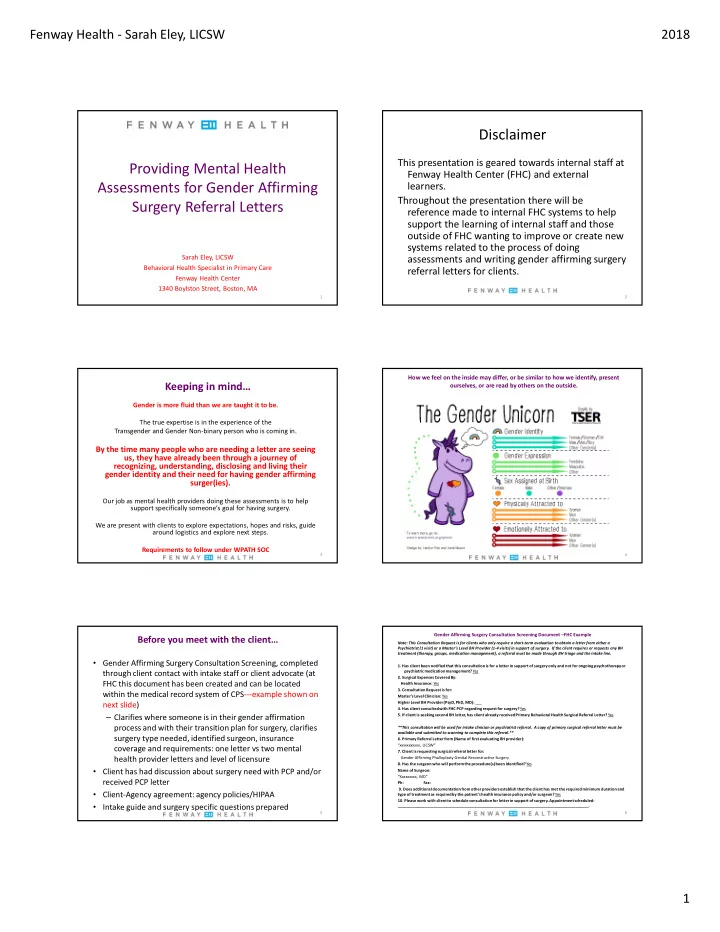
Disclaimer This presentation is geared towards internal staff at - - PDF document

disclaimer
SMART_READER_LITE
LIVE PREVIEW

Disclaimer This presentation is geared towards internal staff at - - PDF document

Fenway Health - Sarah Eley, LICSW 2018 Disclaimer This presentation is geared towards internal staff at Providing Mental Health Fenway Health Center (FHC) and external Assessments for Gender Affirming learners. Throughout the presentation


slide-1
SLIDE 1

Fenway Health - Sarah Eley, LICSW 2018 1

Providing Mental Health Assessments for Gender Affirming Surgery Referral Letters

Sarah Eley, LICSW Behavioral Health Specialist in Primary Care Fenway Health Center 1340 Boylston Street, Boston, MA

1

Disclaimer

This presentation is geared towards internal staff at Fenway Health Center (FHC) and external learners. Throughout the presentation there will be reference made to internal FHC systems to help support the learning of internal staff and those

  • utside of FHC wanting to improve or create new

systems related to the process of doing assessments and writing gender affirming surgery referral letters for clients.

2

Keeping in mind…

Gender is more fluid than we are taught it to be. The true expertise is in the experience of the Transgender and Gender Non-binary person who is coming in.

By the time many people who are needing a letter are seeing us, they have already been through a journey of recognizing, understanding, disclosing and living their gender identity and their need for having gender affirming surger(ies).

Our job as mental health providers doing these assessments is to help support specifically someone’s goal for having surgery. We are present with clients to explore expectations, hopes and risks, guide around logistics and explore next steps. Requirements to follow under WPATH SOC

3

How we feel on the inside may differ, or be similar to how we identify, present

  • urselves, or are read by others on the outside.

4

Before you meet with the client…

  • Gender Affirming Surgery Consultation Screening, completed

through client contact with intake staff or client advocate (at FHC this document has been created and can be located within the medical record system of CPS---example shown on next slide) – Clarifies where someone is in their gender affirmation process and with their transition plan for surgery, clarifies surgery type needed, identified surgeon, insurance coverage and requirements: one letter vs two mental health provider letters and level of licensure

  • Client has had discussion about surgery need with PCP and/or

received PCP letter

  • Client-Agency agreement: agency policies/HIPAA
  • Intake guide and surgery specific questions prepared

5

Gender Affirming Surgery Consultation Screening Document –FHC Example

Note: This Consultation Request is for clients who only require a short-term evaluation to obtain a letter from either a Psychiatrist (1 visit) or a Master’s Level BH Provider (1-4 visits) in support of surgery. If the client requires or requests any BH treatment (therapy, groups, medication management), a referral must be made through BH triage and the intake line.

  • 1. Has client been notified that this consultation is for a letter in support of surgery only and not for ongoing psychotherapy or

psychiatric medication management? Yes

  • 2. Surgical Expenses Covered By:

Health Insurance: Yes

  • 3. Consultation Request is for:

Master’s Level Clinician: Yes Higher Level BH Provider (PsyD, PhD, MD): ___

  • 4. Has client consulted with FHC PCP regarding request for surgery? Yes
  • 5. If client is seeking second BH letter, has client already received Primary Behavioral Health Surgical Referral Letter? Yes

**This consultation will be used for intake clinician or psychiatrist referral. A copy of primary surgical referral letter must be available and submitted to scanning to complete this referral.**

  • 6. Primary Referral Letter from (Name of first evaluating BH provider):

“xxxxxxxxxxx, LICSW”

  • 7. Client is requesting surgical referral letter for:

Gender Affirming Phalloplasty Genital Reconstructive Surgery

  • 8. Has the surgeon who will perform the procedure(s) been identified? Yes

Name of Surgeon: “Xxxxxxxxx, MD” Ph: Fax:

  • 9. Does additional documentation from other providers establish that the client has met the required minimum duration and

type of treatment as required by the patient's health insurance policy and/or surgeon? Yes

  • 10. Please work with client to schedule consultation for letter in support of surgery. Appointment scheduled:

________________________________________________________________________________________. 6

slide-2
SLIDE 2

Fenway Health - Sarah Eley, LICSW 2018 2

Intake-Letter vs. Intake-Therapy-Letter Writing first letter or second?

What if the person is requesting only a letter from the intake?

  • If person is seeing you only for purposes of getting a letter:

1-4 BH visits for intake evaluation and surgery readiness assessment----depends on surgery type and client need What if the person is requesting a letter and therapy?

  • At FHC: Complete the intake evaluation and readiness assessment, present the case and add person to the
  • waitlist. Depending on person’s timeline needed for having surgery, you can offer to complete the

assessment for the letter. The person can remain on the waitlist during that time. Outside of FHC: Complete intake evaluation per agency or practice policy and assessment of readiness for surgery, continue in process for therapy according to practice/agency policy. What about if the person is in therapy with me already?

  • An evaluation of readiness for surgery can take place without the person having to redo the intake/initial

evaluation process.

  • In some cases, portions of the assessment may have been incorporated into the therapy already
  • In other cases, a conversation will be needed to start the gather information needed within an assessment

What about if the person needs two mental health letters for lower surgery?

  • Seen internally for 1st letter: see you for second letter, no intake evaluation required
  • Seen externally for 1st letter: intake evaluation required, same process as above
  • Required to have 2nd mental health letter form a PhD, PsyD, or MD: intake evaluation required and (within

FHC) referral to schedule with internal Psychiatrist Alex Keuroghlian, MD MPH, (if outside of FHC), referral to agency/practice high level licensure clinician. How long do I allow to write the letter and send it off?

  • Allow yourself at least two weeks to realistically make the time to write the letter, receive feedback from

the client and send the letter to the surgeon

7

Beginning the Clinical Assessment Process with Transparency and Acknowledging the Power Differential…

  • Providers practicing in the managed health care system are inherently in a gate

keeping role with people who are seeking care from us.

  • Pathologizing gender, gender oppression and transphobia continue to intensify

the experience for both the provider and the client.

  • The process of being required to have an evaluation prior to getting one’s needs

met (in this case having surgery), for some, can be re-traumatizing and can impact emotional well being *Acknowledging the power dynamic in the room is important*

  • “It’s not always easy to come to a medical/mental health office

and share details about the needs you have around your body and identity with a stranger.”

  • “I imagine you have thought through/been through

a lot to get to this point already.”

  • “I don’t take this process lightly and invite you to let me know if there is something I say or do is making

you uncomfortable.”

8

As we move forward in the process…

  • Gender affirming surgeries are

experienced as life savers and as life changing for many--Having surgery is super meaningful!

  • History of transgender and gender non-

binary folks getting sub-par healthcare because providers are not well-trained— we have an opportunity to be excellent and give them better, informed care!

  • Using clinical supervision for exploring the

power differential, the impact of gate- keeping and our own biases.

9

Categories of the Assessment

  • 1. Introductions & acknowledgment of power differential
  • 2. Review of estimated outline for anticipated number of sessions
  • 3. Gather basic surgery information and client’s understanding of

(anticipated timeline for having surgery, surgery type, who’s the surgeon, pre-op requirements, and insurance coverage and requirements)

  • 4. Personal vision: client’s expectations, hopes, permanency, expectations,

loss

  • 5. Discuss social supports, anticipated healing plan for recovery process
  • 6. Logistical planning for before, during and after surgery
  • 7. Therapy recommended to begin or continue?
  • 8. Obtain Release of Information needed for surgeon(s)
  • 9. Write letter, email draft, review, finalize, send off to surgeon

10

Surgery-Type-Specific Reminders

*Ask people what type of surgery they are planning to have and to review surgeon specific requirements: **Is stopping gender affirming hormone replacement therapy (HRT) a requirement prior to having surgery? **Are there weight requirements by the particular surgeon or related to specific surgery type? Trans masculine gender affirming surgeries:

  • Chest Reconstructive surgery AKA “top surgery”:
  • binders, drains, nipple tattoos, scarring, minimal lifting post-surgery
  • Genital Reconstructive Surgery (GRS) Metoidioplasty, AKA “bottom or lower surgery”
  • Genital Reconstructive Surgery (GRS) Phalloplasty, AKA “bottom or lower surgery”
  • Hystorectomy

Trans feminine gender affirming surgeries:

  • Full Genital Reconstructive Surgery (GRS) vaginoplasty, AKA “bottom or lower surgery”:
  • electrolysis often required, dilation requirements
  • Breast Augmentation Surgery
  • Orchiectomy:
  • Choice to have an orchiectomy prior to full GRS
  • Literal, emotional and physical costs/benefits
  • Facial Feminization Surgery: full FFS, trachial shave

**While we are covering medical information in a mental health context, refer back to PCPs and Surgeons for these areas. Encourage honest discussion with surgeon at consult and with PCP, we can guide people around preparing for these discussions.** 11

Gathering Basic Surgery Info & Client Understanding

  • Who is your surgeon and where are you having surgery?
  • Which surgery are planning to have? (be specific)
  • How do you for-see the surgery helping to affirm your

gender?

  • Can you tell me what you know so far about the surgery itself

and what to expect?

  • What are the pre-op requirements and expectations?
  • If you are currently receiving gender affirming hormone

treatment, will it be required to stop hormone tx beforehand? How do you feel about this?

12

slide-3
SLIDE 3

Fenway Health - Sarah Eley, LICSW 2018 3

Personal Vision of the Process: Exploring permanency, expectations, hopes, loss

  • How do you imagine your life with or without surgery?
  • Are there any anticipated or unanticipated feelings of

(physical and/or emotional) loss that may arise for you?

13

Social Supports, Anticipated Healing Plan for Recovery Process

Practical & Logistical

  • Financial
  • Time off form work or school
  • Housing options/living environment
  • Dilation schedule planning
  • Possible 2nd step/revision surgery dates or follow-up medical visits

Emotional & Social

  • Immediate environment
  • Friends, partner(s), housemates, family, coworkers, wider community
  • Complications?
  • Current coping skills for depression and anxiety, un/anticipation of post-

surgery mood changes

Where are the strengths, where are the risks?

14

Assessment Complete, Talking about Next Steps

  • Let the client know you are ready to write the letter and your

approximate timeline to write the letter

  • Discuss language that will be used in the letter, explore feelings

related to this

– Does the gender listed on the person’s insurance card match the person’s identified gender? – How does the client feel about gender pronoun usage in letter?

  • Discuss with your client how they want to be involved in letter

reviewing process before sending, and if they want a copy for themselves

  • Get ROI for surgeon(s)
  • Where to find templates at FHC:

MH shared folder-THP folder-Surgery-Letters

  • (at FHC) there is CPS quick text for surgeon fax numbers

15

Letter Template (example shown on next slide)

  • Create a template:
  • Vary each template according to client’s stated

pronoun use

  • Surgery type
  • At FHC templates can be found in the Mental Health

shared folder under: – Trans-Health Program

  • -Surgery

–Letters

16 DATE Sugeon’s Office address RE: CLIENT PREFERRED NAME (IF HAS LEGAL NAME which is different or different NAME ON INSURANCE CARD, put here in perenthesis) CLIENT DOB Dear SURGEON, I am writing on behalf of my client __PREFERRED NAME/DOB_(LEGAL NAME/NAME AS LISTED ON INSURANCE CARD), whom I would like to refer for gender affirmation SURGERY TYPE (EXAMPLE: METOIDIOPLASTY) surgery. _PREFERRED NAME_ has been seeing me for therapy since _____/was evalautaed by me on: _______. _CLIENT PREFERRED NAME__is being followed in primary care by _PCP/ENDOCRINOLOGIST___ and has received gender affirming hormone treatment (IF APPLICABLE) since ______. CLIENT PREFERRED NAME____ identifies as FEMALE/MALE/GENDER NON-BINARY both socially and psychologically. CLIENT PREFERRED NAME____ has been living HIS/HER/THEIR life fully and openly as___MALE/FEMALE/GENDER NON-BINARY_ for __XX AMOUNT of TIME__. __CLIENT_PREFERRED NAME__ presents full time as _IDENTIFIED GENDER__ and has had a positive experience with initial FEMINIZATION/MSCULINAZATION through hormone treatment (IF APPLICABLE). However, despite _HIS/HER/THEIR____ confidence as a WOMAN/MAN/GENDER NON-BINARY PERSON, _CLIENT PREFERRED NAME__ continues to experience significant emotional distress due to ___ body not fully aligning with gender identity. It is my professional opinion that in this way, __CLIENT_PREFERRED NAME__meets the criteria for having Gender Dysphoria (ICD 10: F64.1). Having the gender affirmation__SURGERY TYPE_ procedure is the next appropriate step to enable _CLIENT PREFERRED NAME ___ to continue living as MALE/FEMALE/GENDER NON-BINARY, the role in which _HE/SHE/THEY__ most comfortably and effectively functions. CLIENT PREFERRED NAME_ has demonstrated understanding of the permanence, costs, recovery time, and possible complications of this surgical gender affirmation procedure. __CLIENT PREFERRED NAME_is fully capable of making an informed decision about the

  • surgery. __CLIENT PRFERRED NAME___ is reasonably expected to follow pre and post-surgical treatment recommendations

responsibly. It is this therapist’s opinion that _CLIENT PREFERRED NAME_is emotionally and practically ready for this gender affirmation SURGERY TYPE provided you find HIM/HER/THEM____ medically fit. If you would like to discuss CLIENT PREFERRED NAME’s case in more detail, please call me at: (xxx)-xxx-xxxx_. Sincerely, 17

Let’s recap:

  • 1. Introductions & acknowledgment of power differential
  • 2. Review of estimated outline for anticipated number of sessions
  • 3. Gather basic surgery information and client’s understanding of

(anticipated timeline for having surgery, surgery type, who’s the surgeon, pre-op requirements, and insurance coverage and requirements)

  • 4. Personal vision: client’s expectations, hopes, permanency,

expectations, loss

  • 5. Discuss social supports, anticipated healing plan for recovery

process

  • 6. Logistical planning for before, during and after surgery
  • 7. Therapy recommended to begin or continue?
  • 8. Obtain Release of Information needed for surgeon(s)
  • 9. Write letter, email draft, review, finalize, send off to surgeon

18

slide-4
SLIDE 4

Fenway Health - Sarah Eley, LICSW 2018 4

Resources for Providers and Clients

World Professional Association for Transgender Health: www.wpath.org www.transstudent.org

19