Disclaimer This presentation was prepared as a tool to assist - - PDF document

disclaimer
SMART_READER_LITE
LIVE PREVIEW

Disclaimer This presentation was prepared as a tool to assist - - PDF document

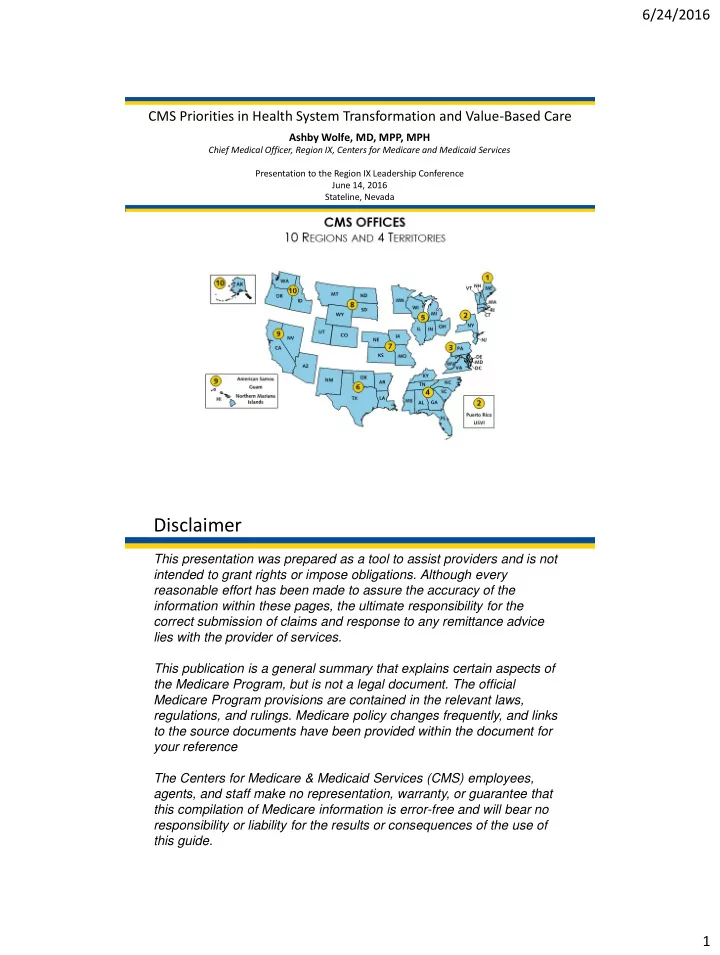
6/24/2016 CMS Priorities in Health System Transformation and Value-Based Care Ashby Wolfe, MD, MPP, MPH Chief Medical Officer, Region IX, Centers for Medicare and Medicaid Services Presentation to the Region IX Leadership Conference June 14,


slide-1
SLIDE 1

6/24/2016 1 CMS Priorities in Health System Transformation and Value-Based Care

Ashby Wolfe, MD, MPP, MPH

Chief Medical Officer, Region IX, Centers for Medicare and Medicaid Services Presentation to the Region IX Leadership Conference June 14, 2016 Stateline, Nevada

This presentation was prepared as a tool to assist providers and is not intended to grant rights or impose obligations. Although every reasonable effort has been made to assure the accuracy of the information within these pages, the ultimate responsibility for the correct submission of claims and response to any remittance advice lies with the provider of services. This publication is a general summary that explains certain aspects of the Medicare Program, but is not a legal document. The official Medicare Program provisions are contained in the relevant laws, regulations, and rulings. Medicare policy changes frequently, and links to the source documents have been provided within the document for your reference The Centers for Medicare & Medicaid Services (CMS) employees, agents, and staff make no representation, warranty, or guarantee that this compilation of Medicare information is error-free and will bear no responsibility or liability for the results or consequences of the use of this guide.

Disclaimer

slide-2
SLIDE 2

6/24/2016 2

  • Encourage the integration and coordination of services
  • Improve population health
  • Promote patient engagement through shared decision

making

Incentives

  • Create transparency on cost and quality information
  • Bring electronic health information to the point of care for

meaningful use

Care Delivery

Information

  • Promote value-based payment systems

– Test new alternative payment models – Increase linkage of Medicaid, Medicare FFS, and other payments to value

  • Bring proven payment models to scale

CMS Priorities in health system transformation: Better Care, Smarter Spending, Healthier People

Source: Burwell SM. Setting Value-Based Payment Goals ─ HHS Efforts to Improve U.S. Health Care. NEJM 2015 Jan 26; published online

The Innovation Center portfolio aligns with transformation focus areas

Focus Areas CMS Innovation Center Portfolio* Deliver Care

  • Learning and Diffusion

‒ Partnership for Patients ‒ Transforming Clinical Practice ‒ Community-Based Care Transitions

  • Health Care Innovation Awards
  • State Innovation Models Initiative

‒ SIM Round 1 ‒ SIM Round 2 ‒ Maryland All-Payer Model

  • Million Hearts Cardiovascular Risk Reduction Model

Distribute Information

  • Information to providers in CMMI models
  • Shared decision-making required by many models

Pay Providers

  • Accountable Care

‒ Pioneer ACO Model ‒ Medicare Shared Savings Program (housed in Center for Medicare) ‒ Advance Payment ACO Model ‒ Comprehensive ERSD Care Initiative ‒ Next Generation ACO

  • Primary Care Transformation

‒ Comprehensive Primary Care Initiative (CPC) ‒ Multi-Payer Advanced Primary Care Practice (MAPCP) Demonstration ‒ Federally Qualified Health Center (FQHC) Advanced Primary Care Practice Demonstration ‒ Independence at Home Demonstration ‒ Graduate Nurse Education Demonstration ‒ Home Health Value Based Purchasing (proposed)

  • Bundled payment models

‒ Bundled Payment for Care Improvement Models 1-4 ‒ Oncology Care Model ‒ Comprehensive Care for Joint Replacement (proposed)

  • Initiatives Focused on the Medicaid population

‒ Medicaid Emergency Psychiatric Demonstration ‒ Medicaid Incentives for Prevention of Chronic Diseases ‒ Strong Start Initiative ‒ Medicaid Innovation Accelerator Program

  • Dual Eligible (Medicare-Medicaid Enrollees)

‒ Financial Alignment Initiative ‒ Initiative to Reduce Avoidable Hospitalizations among Nursing Facility Residents

  • Other

‒ Medicare Care Choices ‒ Medicare Advantage Value-Based Insurance Design model

Test and expand alternative payment models Support providers and states to improve the delivery of care Increase information available for effective informed decision-making by consumers and providers * Many CMMI programs test innovations across multiple focus areas
slide-3
SLIDE 3

6/24/2016 3

Models of interest at the CMS Innovation Center

  • Million Hearts Cardiovascular Disease Risk Reduction Model will reward

population-level risk management

– Pay-for-outcomes approach with disease risk assessment payment

  • One time payment to risk stratify eligible beneficiary
  • $10 per beneficiary

– Care management payment

  • Monthly payment to support management, monitoring, and care of

beneficiaries identified as high-risk

  • Amount varies based upon population-level risk reduction
  • Accountable Health Communities Model addresses health-related social

needs

– Systematic screening of all Medicare and Medicaid beneficiaries to identify unmet health-related social needs – Testing the effectiveness of referrals and community services navigation on total cost of care using a rigorous mixed method evaluative approach – Partner alignment at the community level and implementation of a community- wide quality improvement approach to address beneficiary needs

https://innovation.cms.gov/initiatives

  • Participating FQHCs receive a monthly

care management fee of $6.00 for each Medicare beneficiary attributed to their practice

  • This fee was in addition to the usual

all-inclusive payment FQHCs receive for providing Medicare covered services

  • Technical assistance provided to help

transform into a person-centered, coordinated, seamless primary care practice

  • Designed to evaluate the effect of the

advanced primary care practice model https://innovation.cms.gov/initiatives/fqhcs/ 3-year Demonstration (ended 2014)

slide-4
SLIDE 4

6/24/2016 4

3 1

7

Comprehensive Primary Care Plus (“CPC+”)

Advance care delivery and payment to allow practices to provide more comprehensive care that meets the needs of all patients, particularly those with complex needs. Up to 20 Regions

Selection based on payer interest and coverage

5

Years

Beginning 2017, progress monitored quarterly

2

Accommodate practices at different levels of transformation readiness through two program tracks, both offered in every region. Achieve the Delivery System Reform core objectives of better care, smarter spending, and healthier people in primary care.

https://innovation.cms.gov/initiatives/Comprehensive-Primary-Care-Plus Payer Solicitation Period: April 15 – June 1 Practice Application Period: July 15 – September 1

8

CPC+ Practices Will Enhance Care Delivery Capabilities

Track 1

24/7 patient access

Comprehen- siveness and Coordination Access and Continuity

Assigned care teams E-visits Expanded office hours Identification of high volume/cost specialists serving population Follow-up on patient hospitalizations Behavioral health integration Psychosocial needs assessment Examples for

Track 2

Additional examples for

Care Management

Short and long-term risk- stratified care management Follow-up on patient ED visits Care plans for high-risk chronic disease patients

slide-5
SLIDE 5

6/24/2016 5

ACO Participation

ACO-Assigned Beneficiaries by County

9

  • CMS is testing the ability of state governments to utilize policy and

regulatory levers to accelerate health care transformation

  • Primary objectives include
  • Improving the quality of care delivered
  • Improving population health
  • Increasing cost efficiency and expand value-based payment

State Innovation Model grants have been awarded in two rounds

  • Six round 1 model test states
  • Eleven round 2 model test states
  • Twenty one round 2 model design states
slide-6
SLIDE 6

6/24/2016 6

Recent Medicaid Developments

  • Updates to the enrollment process

– Most people apply on line, by phone, or at a convenient location – One-stop enrollment with technology that allows enrollee information to be verified electronically

  • Access to high quality physicians and other care providers

– Final rule take additional steps that will more tightly align payment with better, more cost-effective care – Creates accountability to ensure access to care is sufficient in key specialties

  • Quality care to strengthen health outcomes

– Use of population based payments, episodes of care, and quality-based payments to pay for health services

  • Support for delivery system reform

– Improvements to the coordination of patient care, states, with the support

  • f CMS, are working to update legacy IT systems to ones that leverage proven

IT methods

  • Medicaid Moving Forward: http://federalregister.gov/a/2016-09581

Key CMS Priorities in health system transformation

Affordable Care Act MACRA

slide-7
SLIDE 7

6/24/2016 7

MACRA is part of a broader push towards value and quality.

In January 2015, the Department of Health and Human Services announced new goals for value-based payments and Alternative Payment Models in Medicare

13

What is “MACRA”?

MACRA stands for the Medicare Access and CHIP Reauthorization Act of 2015, , bipartisan legislation signed into law on April 16, 2015. What does it do?

  • Repeals the Sustainable Growth Rate (SGR) Formula
  • Changes the way that Medicare pays clinicians and

establishes a new framework to reward clinicians for value over volume

  • Streamlines multiple quality reporting programs into 1 new

system (MIPS)

  • Provides bonus payments for participation in eligible

alternative payment models (APMs)

14

slide-8
SLIDE 8

6/24/2016 8

Proposed Rule released April 27, 2016

  • Major Provisions of

MIPS program

  • Proposed models

that qualify as Advanced APMs

  • Timelines &

Reporting Requirements

Qualit ity Payment Program: Affect cts s clinician icians who bill MEDIC ICARE RE PART B

slide-9
SLIDE 9

6/24/2016 9

slide-10
SLIDE 10

6/24/2016 10

Public Comment period April 27th – June 26th 2016

Independent PFPM Technical Advisory Committee

PFPM = Physician-Focused Payment Model

Goal to encourage new APM options for Medicare clinicians

20

Technical Advisory Committee Submission of model proposals

* G 2

11 appointe inted care re delivery experts that review proposals, submit recommendations to HHS Secretary Secretary comments

  • n CMS website, CMS

considers testing proposed model

slide-11
SLIDE 11

6/24/2016 11

The Health Care Payment Learning and Action Network (HCP-LAN)

  • Serve as a convening body to facilitate joint implementation of new models
  • f payment and care delivery
  • Identify areas of agreement around movement toward alternative payment

models and how best to analyze data and report on these new payment models

  • Collaborate to generate evidence, share approaches, and remove barriers
  • Develop common approaches to core issues such as beneficiary attribution,

financial models, benchmarking, quality and performance measurement, risk adjustment, and other topics raised for discussion

  • Create implementation guides for payers, purchasers, providers, and

consumers. https://innovation.cms.gov/initiatives/Health-Care-Payment-Learning-and- Action-Network/

Measure Alignment Efforts

  • CMS Quality Measure Development Plan

– Highlight known measurement gaps and develop strategy to address these – Promote harmonization and alignment across programs, care settings, and payers – Assist in prioritizing development and refinement of measures – Public Comment period closed March 1st, final report published May 2nd

  • Core Measures Sets released February 16th

– ACOs, Patient Centered Medical Homes (PCMH), and Primary Care – Cardiology – Gastroenterology – HIV and Hepatitis C – Medical Oncology – Obstetrics and Gynecology – Orthopedics

  • CMS is already using measures from the each of the core sets
  • Commercial health plans are rolling out the core measures as part of their

contract cycle

https://www.cms.gov/Medicare/Quality-Initiatives- Patient-Assessment-Instruments/QualityMeasures/Core- Measures.html

slide-12
SLIDE 12

6/24/2016 12

Transforming Clinical Practice Initiative

Support more than 140,000 clinicians in their practice transformation work Improve health outcomes for millions of Medicare, Medicaid and CHIP beneficiaries and other patients Reduce unnecessary hospitalizations for 5 million patients Generate $1 to $4 billion in savings to the federal government and commercial payers Sustain efficient care delivery by reducing unnecessary testing and procedures Build the evidence base on practice transformation so that effective solutions can be scaled

Ashby Wolfe, MD, MPP, MPH Chief Medical Officer, Region IX Centers for Medicare and Medicaid Services 90 Seventh Street, Suite 5-300 San Francisco, CA 94103 (Ph) 415.744.3631 ashby.wolfe1@cms.hhs.gov

Questions?