
SLIDE 1
AKORA Resources - Investor Presentation, August 2020
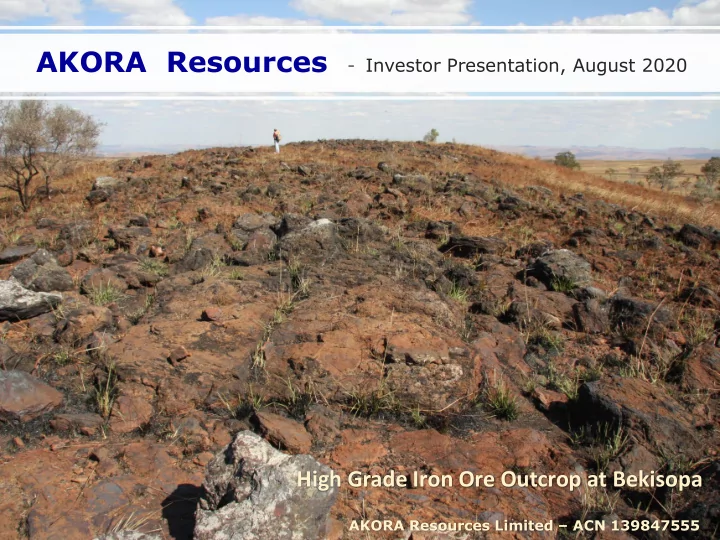
High Grade Iron Ore Outcrop at Bekisopa
AKORA Resources Limited – ACN 139847555
Disclaimer Forward Looking Statements T his corporate presentation - - PowerPoint PPT Presentation
AKORA Resources - Investor Presentation, August 2020 High Grade Iron Ore Outcrop at Bekisopa AKORA Resources Limited ACN 139847555 Disclaimer Forward Looking Statements T his corporate presentation contains forward looking statements which
AKORA Resources - Investor Presentation, August 2020
High Grade Iron Ore Outcrop at Bekisopa
AKORA Resources Limited – ACN 139847555
Disclaimer – Forward Looking Statements
This corporate presentation contains forward looking statements which constitute “forward looking information” within the meaning of securities legislation and “Forward Looking Statements”. All statements included herein, other than statements of historical fact, are Forward Looking Statements and are subject to a variety of known and unknown risks and uncertainties which could cause actual events or results to differ materially from those reflected in the Forward Looking Statements. The Forward Looking Statements in this corporate presentation may include, without limitation, statements about the company’s plans for its exploration projects and future exploration, evaluation and development including drilling activities, quantification of mineral resources, feasibility studies, the construction and development of the Bekisopa Project, the company’s business strategy, plans and outlook; the merit of the company’s mineral properties; mineral exploration potential, timelines; the future financial or operating performance of the company and cost guidance; expenditures; approvals and
Often, but not always, these Forward Looking Statements can be identified by the use of words such as “estimate”, “estimated”, “potential”, “planned”, “open”, “future”, “assumed”, “projected”, “calculated”, “used”, “detailed”, “has been”, “gain”, “upgraded”, “expected”, “offset”, “limited”, “contained”,“reflecting”,“containing”,“conduct”,“increasing”,“remaining”,“to be”, “periodically”, or statements that events, “could” or“ should” occur or be achieved and similar expressions, including negative variations. Forward Looking Statements involve known and unknown risks, uncertainties and other factors which may cause the actual results, performance or achievements of the company to be materially different from any results, performance or achievements expressed or implied by the Forward Looking Statements. Such uncertainties and factors include, among others, changes in general economic conditions and financial markets; changes in commodity prices; technological and operational hazards in mine development activities; risks inherent in mineral exploration; uncertainties inherent in the estimation of mineral reserves, mineral resources, and metal recoveries; construction delays, the timing and availability of financing; governmental and other approvals; political unrest or instability in countries where IPR is active; labour relations issues; as well as those factors discussed under “Risk Factors” in the Company's Subscription Deed. Although the Company has attempted to identify important factors that could cause actual actions, events or results to differ materially from those described in Forward Looking Statements, there may be other factors that cause actions, events or results to differ from those anticipated, estimated or intended. Forward Looking Statements contained herein are based on the assumptions, beliefs, expectations and opinions of management, including but not limited to estimates of future exploration success; expectations on economic viability
be in accordance with the company’s public statements and stated goals; that there will be no material adverse change affecting the company or its properties; that all required approvals will be obtained; that there will be no significant disruptions affecting operations, including the development and construction of the Bekisopa Project or any other project the Company seeks to advance, and such other assumptions as set out herein. Forward Looking Statements are made as of the date hereof and the Company disclaims any obligation to update any Forward Looking Statements, whether as a result of new information, future events or results or otherwise, except as required by law. There can be no assurance that Forward Looking Statements will prove to be accurate, as actual results and future events could differ materially from those anticipated in such statements. Accordingly, investors should not place undue reliance on Forward Looking Statements. This corporate presentation also refers to non-IFRS financial measures, such as future guesstimate of cash cost per tonne of processed ore and guesstimates of operating cash flow. These measures do not have a standardized meaning or method of calculation, even though the descriptions of such measures may be similar.
New name - reinvigorated focus
The Company formed in 2009 to find projects in the Indian or Pacific Ocean regions. Acquired several upgradable iron ore (BIF) tenements in Madagascar. Since 2019 the focus has shifted importantly to the high grade 65% iron direct shipped lump iron ore project - Bekisopa.
With listing on the Australian Securities Exchange, ASX, in late September the time is right to reinvigorate the effort and change the company name.
Malagasy for iron is Vy and for iron ore is Akora Vy.
Akora Resources means Ore Resources
a fitting, generic name that accommodates commodity and country diversity. In Greek Akora means Maiden, funds raised on listing Akora Resources will be directed to delivering a significant Maiden Resource at Bekisopa.
Multi asset iron ore portfolio
Short term resource target of +100Mt DSO at Bekisopa
Multi asset iron ore portfolio with Short term resource target of +100Mt DSO at Bekisopa STRONG ASSET BASE
SUBSTANTIAL WORK
SUPPORTIVE LOCATION
HIGHLY EXPERIENCED TEAM IRON ORE MARKET REMAINS STRONG
Experienced and incentivised Management team focussed on delivery
Paul Bibby – Executive Chairman
24 years across Rio Tinto organisations including Kaltim Prima Coal (Indonesia) and Hamersley Iron (as Mineral Processing Manager), Zinifex, Nyrstar (Chief Development Officer), OceanGold (CEO) and as CEO to smaller ASX listed Companies John Madden - Chief Financial Officer
22 years across Rio Tinto Finance and Business Analysis including Freeport (Irian Jaya), Morobe Consolidation Goldfields, Indophil Resources NL, Ok Tedi Mining. Founding Director of Indian Pacific Resources. Stephen Fabian - Non-Executive Director
Previous roles with County Natwest, Ferrous Resources, South American Ferro Metals
Prospective iron ore tenements across three project areas in Madagascar
Flagship Project
Bekisopa
High Grade Lump Iron Ore prospect Tratramarina and Ambodilafa are upgradable BIF magnetite iron
Madagascar - mineral rich with a
developing Mining Industry
400km off the east coast of Mozambique
markets in India, Middle East, Asia and China
code revised in 1999
Sumitomo, Kores and Wuhan Iron & Steel
supportive government, at both national and local levels
Company Project Mineral
Rio Tinto Fort Dauphin Ilmemite Sumitomo Corporation Ambatovy Nickel, Cobalt Bass Metals Graphmada Graphite Base Resources Toliara Minerals Sands Wuhan Iron & Steel Soalala Iron Ore
Drilling at Tratramarina in 2011
Iron Ore benchmark Price remains strong
and high-grade premium maintained
High Grade 65% fines at ~U$130 plus Lump premium for High Grade ore as seen at Bekisopa. 65% iron ore price strong as China demands HG ore for lower steel making costs and improved environmental outcomes. Iron ore price strengthens during COVID due to increased Chinese demand.
65%Fe Fines price
Iron Ore demand driven by World Steel Production.
1.22bnt on a 62% Fe basis
for quality high grade iron
increasing as China looks to maximise efficiency, reduces emissions and replaces tonnage from closed domestic mines.
economy and steel production as China is the main importer of iron ore. China’s steel production remains strong in 2020.
strongly, currently producing 132Mt and is the second largest consumer
steel products and growing at 7% pa.
500 1000 1500
2013 2014 2015 2016 2017 2018 2019 2020 Imports Production
China’s iron ore imports and production
600 800 1000
2014 2015 2016 2017 2018 2019 2020
Consumption Production China’s Steel Consumption and Production
Sources: World Steel Association (2018) and Bloomberg (2018)
mt mt
Project pipeline with rapid development path
Bekisopa
Area: 93.5km2 4 permits
Ownership: 100%
220km from coast
Drill Ready Project
~7km strike ~65% DSO iron ore Ore at Depth Potential for significant high-grade tonnage
FLAGSHIP PROJECT Tratramarina
Area: 162.5km2 5 permits Ownership: 100% 16km from coast
~35% upgradable iron ore ~2.5km strike
Low CAPEX and OPEX
Potential for high grade iron concentrate
Next Project Ambodilafa
Area: 52.3km2 3 permits Ownership: 90% 45km from coast
~35% upgradable iron ore
5km strike
Future Opportunity
Bekisopa Business Case
Targeting +100 Mt of high-grade DSO
HISTORICAL WORK EXTENSIVE MINERALISATION HIGH GRADE DSO MINERAL RESOURCE FAVOURABLE STRIPING RATIO
15km strike in adjacent tenements not explored – excellent tonnage upside
to produce a lump DSO iron ore. Low operating and capital costs.
~600m. At surface drill results; 19m@65%Fe, 12m@66%Fe, 18m@65%Fe.
Confirms presence of an iron orebody.
Recent Geology and Magnetic Survey
Magnetics show extensive anomaly extending +500m below surface.
Original Detailed BRGM geological site map with trench and drill results shown
Massive Magnetite mineralisation
Massive Hematite mineralisation
Massive Hematite outcrop Massive Magnetite mineralisation
Aero mag survey confirms strong magnetic anomaly at Bekisopa
High grade iron ore trench results along strike and drill intercepts in extensive outcropping southern area.
Historical Trench results Historical Drill results
2006 - World Bank sponsored airborne magnetic survey at 500m spacing showed high magnetic intensity at locations of proven high grade iron ore
2014 - Verification rock chip sampling program of 118 rocks taken along strike near historical pits and trenches resulted in average grade of 66.7% Iron (maximum 69.8%Fe with 21 rocks >69%Fe)
low impurities – 1.5% SiO₂ , 1.0% Al₂O₃ , 0.075% P and 0.06% S Legend - Magnetic Intensity: Red is magnetic high = Magnetite and Blue is magnetic low
General Bekisopa landscape showing outcropping high grade +65% iron ore on gentle undulating land Lump high grade +65% Iron Ore on surface and Identified in pits and trenches down to ~19m
The layers of magnetite-hematite are traceable over the entire 7km extent of the tenement Features suggesting an early structural origin Field observations show that the massive layers of magnetite-hematite could not have formed from weathering More logical and likely that the layers were formed pre-weathering as part of the alteration of a sedimentary stratigraphic package.
Outcrop of Magnetite with some Hematite Alteration, near Trench 42
The host rock contains relatively coarse disseminated magnetite and hematite and forms a halo to the massive magnetite-hematite bands.
Geological study completed in Oct 2019
and three iron ore products observed
1 – Bekisopa High Grade DSO lump iron ore
Trench 39E, Looking south shows steep west dip
1 - Bekisopa High Grade DSO Lump Geology
The mineralisation is interpreted as being a series of parallel layers of massive magnetite-hematite, with host rock containing magnetite between those high-grade layers. The northern area is relatively simple with 3 to 5 steeply westerly dipping layers (50-70˚) which can be traced
The southern area is structurally more complex with many small offsets and large-scale folding.
Magnetite/Hematite with Fractures and Alteration Selvedges, near Trench 42
Based on the observations it is suspected that the iron was introduced as a hydrothermal fluid Therefore, the Bekisopa deposit has affinities to the metasomatic/skarn style deposits such as those seen in South Australia (Iron Knob), Russia and Sweden (Kiruna), rather than being a typical BIF style deposit.
Based on this assessment, potential for around
100Mt @ ~60% Fe can be seen to a depth of
Clearly this near surface mineralisation should be readily upgradable by simple coarse crushing, screening and magnetic separation to a saleable ~65% iron direct ship premium lump iron ore product.
1 - Bekisopa High Grade DSO Lump Geology, continued
Between and adjacent to the massive magnetite-hematite layers is disseminated magnetite-hematite mineralisation in the country rock. ~0.5-2mm magnetite particles distributed through the country rock which grades around 30 to 50% Fe.
Drilling and mineral processing assessments required to determine the extent of this mineralisation and the potential to be upgradeable to a saleable high-grade iron product.
Estimate a factor of 2-10 times the tonnage of the massive mineralisation potential for 500 – 1000 million tonnes.
Disseminated Magnetite in Bekisopa Country Rock, Disseminated Magnetite in Country Rock, Trench 16
Potential short-term tonnage can be seen in the extensive lateritic soil. Estimate is difficult, however, assuming a strike of 7km, width of 1km and thickness of 3m, potential for around 30Mt seems reasonable. This liberated magnetite should be readily separated using magnetic separation as shown by using a hand magnet in the field.
Lateritic Soil with Liberated Magnetite Particles on Surface Magnetite from Lateritic Soil on Hand Magnet
3 - Liberated Magnetite in Laterite soils.
Bekisopa Laterite Soils
Bekisopa –
2019 Ground Magnetic Survey
Over 350-line kilometres of magnetic survey data were walked in October 2019 traversing the Bekisopa tenement each 50m Results show a relatively consistent magnetised body extends over approximately 7km of strike Thickening in the south due to structural complications mainly due to folding
Magnetic Image with Magnetite-Hematite Outcrop Superimposed, the black markings.
Superimposing the outcropping and sub cropping massive magnetite – hematite bodies on the magnetic survey image shows this mineralisation is either directly associated with magnetic highs or slightly offset probably due to dip and depth occurrences
Bekisopa – 2019 Ground Magnetic Survey continued
Magnetite-Hematite bearing stratigraphy plus rock chip sample locations superimposed on the Magnetic Image. Three locations marked for further evaluation.
Superimposing the magnetite-hematite outcrop stratigraphy (cross hatched areas) and the 2014 rock chip sample data (coloured dots) on the magnetic image shows;
southern area the stratigraphy is folded and faulted and generally can be traced using a combination of outcrop and sub-crop mapping and the magnetics
magnetic anomaly
Three traverses (the yellow lines) were selected for further geophysical modelling to better understand the magnetic expression, two in the north the other in the southern area.
Bekisopa – Transverse Geophysical Modelling Northern and Central Sections
Northern transverse line – geophysical modelling
depth extent of at least 500m, possible width of ~150m and dipping to the west
suggests excellent depth and a simple geometry for mining
is slightly more complex and modelled as a sphere, width ~150m, and a steeply west dipping body with depth extent of at least 300m and possible width of 40m.
agrees with the geological interpretation of between one and five sub-parallel magnetic layers dipping to the west. The sphere may represent a fold nose.
Central transverse line – geophysical modelling
in the magnetics, ie; a magnetic low rather than a high
interpretation of an anticline plus a central syncline
least 500m depth and the eastern limb extends to 200m depth.
may be repeated near surface and could form a large high-grade shallow zone of iron mineralisation.
Southern transverse line – geophysical modelling
Bekisopa – Transverse Geophysical
Modelling Southern Area
Survey results show excellent depth continuity. It remains to be seen what the iron mineralisation looks like at depth, the fact that many of the pits finished in massive mineralisation grading plus 65% Fe, especially in the broad southern area, suggests good potential for significant tonnages of high-grade magnetite-hematite mineralisation. The structural complexity in the south suggests this mineralisation may be repeated near surface and could form a large, high grade, shallow zone of mineralisation.
Geological Interpretation - Combining BRGM Trench
Data with AKORA Geology and Magnetic Survey Data
Overlaying geological and magnetic survey data builds an understanding of the deposit.
Trench 19 cross-section Base
Assays
Rock Chip Sample Assays
Areas of high magnetics coincides with high grade outcrops, rock chips and trench data.
Geological Interpretation - Combining BRGM Trench
Data with AKORA Geology and Magnetic Survey Data, continued Trench 19 cross-section Base
Assays
Interpreted Massive high Grade Magnetite-Hematite Mineralisation Combined widths >35m Disseminated Magnetite Mineralisation Combined widths >130m
Geological Model - Multiple high-grade iron ore layers dipping to the west, with disseminated magnetite between grading 40 to 55% Fe.
High Grade Lump Ore Resource estimate in first 100m is ~ 100mt. Magnetics indicate orebody extends down +500m, ? Resource Potential.
WAI - Competent Persons Report - Summary
High Grade iron ore outcrops over a 7 km, north – south strike Orebody dips to the west and extends to +500m below surface Conventional mining and screening to produce a marketable DSO product Bekisopa’s features resembles that of the massive Kiruna Sweden orebody
(4km strike, depth 2000m, width 80m, over 120-year operation produced +950mt)
Possibility for three iron ore products from the Bekisopa Tenement
Realistic exploration target +100 million tonnes
2. Disseminated iron ore, upgradable to high grade fines
potentially 500 to 1000 million tonne resource
3. Liberated Magnetite in the Laterite soils
potentially ~30 million tonnes
Low capex and opex potential
16 kms from coast and adjoins the Mangoro River.
1360m of drilling with significant drilling intercepts
geophysical survey in 2004-06 highlighted
305 samples averaging 40.05% Fe
intersected economically significant BIF magnetite iron ore - ~35 to 40% Fe
28m at 34.6% Fe; and 35m at 35.7% Fe. Near surface intersection - 6m at 42.5% Fe
estimates ~50Mt resource at 35% Fe
16km from the coast
BIF – Banded Iron Formation Massive BIF Outcrop Tratramarina 2011 Drilling Campaign
Future project after Tratramarina
Strong Magnetic Anomaly 421 rock chip samples collected averaged 44% Fe 2013
drill holes completed which intersected BIF horizons; 42m @ 30.8% Fe, 12m @ 37.18% Fe, near surface intersections of 54m @ 35.39%Fe.
Large magnetic anomaly (red area)
a 5km strike length and interpreted as extending to a depth
Drill ready to define Maiden Resource
2019 2020 2020 2020 2020 2021 2021
December Quarter March Qrt June Qrt September Quarter December Quarter March Qrt June Qrt
Data interpretation Magnetic surveys Geological mapping
Camp & Drilling
Arranged
Covid Virus Delay
Drilling & Analysis
Trench sampling
Wet Season Delay
Completed Delay Planned Road Works Village Water Well Village Support Projects Community Projects
Logging & Interpretation
Drilling was due to commence in April 2020, delayed due to COVID, now rescheduled for September 2020, 8 weeks drilling for some 2000 m to confirm grade and tonnes.
Exposure to the resilient iron ore market
High grade iron ore project Drill Ready ~65% Iron DSO Lump Ore Focussed development programme ~500Mt resource target Short-term revaluation potential Excellent location Proven delivery team Shareholder support
ASX IPO listing late September 2020 raising A$3.5m at 25cps.
Contacts
Bekisopa Trench 5 Massive High Grade iron ore
Management
Paul Bibby Executive Chairman paul.bibby@indpacific.com John Madden Chief Financial Officer john.madden@indpacific.com Stephen Fabian Non-Executive Director stephen@slfabian.com
AKORA Resources
211 McIllwraith Street Princes Hill Melbourne, Victoria 3054 Australia
AKORA Resources camp - October 2019 for Geology and Magnetic Survey work.