
SLIDE 1
DISCLAIMER DI The information contained in this presentation is - - PowerPoint PPT Presentation
DISCLAIMER DI The information contained in this presentation is proprietary and strictly confidential. This material has been prepared solely for informational purposes and is not an offer to sell or a solicitation of an offer to purchase any
The information contained in this presentation is proprietary and strictly confidential. This material has been prepared solely for informational purposes and is not an offer to sell or a solicitation of an offer to purchase any interests or shares in funds managed by Allagash Opportunity Zone Partners LLC (“Allagash”). Any such offer will be made only pursuant to an offering memorandum and the documents relating thereto describing such securities (the “Offering Documents”) and to which prospective investors are referred. The Offering Documents contain additional information about the investment objectives, terms and conditions of an investment in such funds and also contain important risk disclosures and tax information that must be considered prior to any investment decision regarding the funds. These materials are subject to and qualified in their entirety by reference to the Offering Documents. No person has been authorized to make any statement concerning the funds other than as set forth herein, and any such statements, if made, may not be relied upon. Investment in funds managed by Allagash carries certain risks, including without limitation the risk of loss of principal. No guarantee or representation is made that a fund will achieve its investment objective or that investors will not lose all or substantially all of their investment in the fund. Past performance is no guarantee of future results and no representation is made that results similar to those shown can be achieved. Certain market and economic events having a positive impact on performance may not repeat themselves. Estimated performance results are presented net of fees and expenses payable in connection with any investment. The information contained in this presentation is believed to be reliable but Allagash makes no representation or warranty as to its accuracy or completeness. This presentation may not be modified, reproduced or redistributed in whole or in part without the prior written consent of Allagash. In making an investment decision, you must rely on your own examination of the respective fund and the terms of the offering. You should not construe the contents of this presentation as legal, tax, investment or other advice. Certain information contained herein constitutes “forward-looking statements” which can be identified by the use of forward-looking terminology such as “may,” “will,” “should,” “expect,” “anticipate,” “target,” “intent,” “continue,” or “believe,” or the negatives thereof or other variations thereon or comparable terminology. Due to various risks and uncertainties, actual events or results or the actual performance of any fund may differ materially from those reflected or contemplated in such forward-looking statements. Model portfolios are sometimes constructed to determine whether a manager’s investment approach, philosophy, or style is successful, especially when compared to the overall market or market segments or sectors. Allowing clients or potential clients to see such models can help them understand how the manager approaches investment decisions and how manager expects those decisions to translate to returns for a potential client. No investment decision, including the one under consideration, should be based on any single consideration, including this model portfolio. Your decision should be based upon a range of factors, including your risk tolerance, experience in investing, your need for cash in the near future, your current financial condition, and other important matters. A model portfolio is NOT an actual portfolio, and the performance indicated is NOT actual performance. That is, the model performance is not the performance of any actual Allagash client
portfolio, there is always the possibility of significant gains and significant losses, and actual returns are highly unlikely to be completely accurately represented by model returns. The model was constructed with multiple objectives: creating the highest total return for investors, preserving investor capital, and maximizing the tax advantages associated with the Opportunity Zone program. The model portfolio results contained herein are based on the following assumptions: (i) the model portfolio record does not account for a complete set of deductions for all of the potential transactions expenses that could be incurred in an actual client account or by a fund; (ii) the model does not reflect the reinvestment of dividends and/or other earnings; (iii) the returns for the term of the investment portrayed by the model are based upon assumptions, as indicated herein, for the performance of the market over that term; (iv) the model assumes purchase and sale prices believed to be attainable, but in actual trading, the prices attained may or may not be the same as those assumed in the model; (v) the model assumes no change(s) in investment strategy or changes in the types of securities or other financial instruments concerning which Allagash provides investment advice; and (vi) the model portfolio results portray some but not all of the tax implications arising from the sale or purchase of assets, which will have an impact on gains and losses experienced by an investor, and those tax implications may not be, and in all likelihood will not be exactly, the implications experienced by any individual investor, and every investor must consult their own tax advisor. If the model were an actual account having been invested and managed over a specific previous time period, it is uncertain what actions Allagash would have taken in the face of the wide range of economic, political, or market conditions specific to that period. Those actions could have been significantly different from what is assumed in the model. If you have further questions about the model, please feel free to contact the Allagash Opportunity Zone Partners at the contact information provided herein, and they will be happy to assist. Reproduction, duplication, or redistribution of this material in any form without prior written consent is strictly prohibited.
DI DISCLAIMER
Confidential
TH THE ALLAGASH MISSION
Utiliz Utilize ou
exper ertise, e, ex exper erienc ence, e, an and di dilige gence to to im imple lement ou
time-te teste ted in investment pr process ss to to cr create top top-ti tier Co Commercial Re Real Es Esta tate te (“ (“CRE”) Qua Qualified ed Op Opportuni unity Fund Funds (“ (“QOFs”)1 wh which se seek to to:
v Pr
Preserve ca capital,
v Ge
Genera rate te co compelling pr pre-ta tax re returns,
v Ma
Maximize af after-ta tax we wealth ge generation us using ng Op Opportuni unity Zo Zone ne (“ (“OZ”) Pr Program be benefits, s,
v Pr
Provide po posi sitively im impactful ca capital to to th the Low Low- an and Mo Moderate In Income (“ (“LMI”) co communities2.
TH THE ALLAGASH INVESTO TOR
Alla Allagash QOFs QOFs’ ca can be be at attrac active to to an any in investor; al alternat ative or
traditi tion
instit itutio ional or
indiv ivid idual; lo lookin ing fo for su supe perior re returns wi without ex exces ess ri risk fr from an an asse asset cl class wi with mu much lo lower co correlation to to th the ma major ma markets th than tra traditi tion
real es estate, e, in inclu ludin ing:
v In
Institutional in investors se seeking hi high le levels ls of
scal alabl able, re repeatable al alpha, a,
v Ta
Taxable in investors se seeking to to fu fully ca capitalize on
the ta tax be benefits of
the OZ OZ Pr Program, m,
v An
Any in investors se seeking co compelling re returns wi within a So Socially Re Respon
Investment ma mandate.
Confidential 1
AL ALLAG AGAS ASH OPPORTUN UNITY ZONE PAR ARTNERS
Alla Allagash de defines a “c “compelling” re return ex expec ectation fo for a Pr Private Eq Equity ty Re Real Es Esta tate te (“ (“PERE”) Fund Fund, wh whether QOF QOF or
stan andar dard fu fund, as as re reaching at at le least 15 15% IR IRR wi with on
low pr proba babi bility of
loss.
1 For a full description of the Opportunity Zone Program and Qualified Opportunity Funds, see Appendix pages B1-B3
2 See Note #1 on. Page A1 of the Appendix for the definition of LMI communities.
MA MANAGEME MENT REQUIREME MENTS
In Investing in into a fu fund or
prope perty th that is is a QOF QOF tod today do does no not au automat atical ally re result in in in investors re receiving th their ex expec ected ed ta tax be benefits or
LMI co communities ex exper erienc encing ng ec econo nomic or
infrastructure be benefits.
Onl Only pr professi ssional ex exper erienc enced ed an and ex exper ert ma manageme ment, wh which Alla Allagash st strives to to pr provide de in investors, su suppo pported by by top top-ti tier se service pr provide ders, s, wh which th the Fund Fund em employs, ca can pr provide de in investors th the co confidence ce th that th they wi will ac achieve th their in investment go goals.
ST STRUCTURAL ADVANTAGES S OF F A MULTI-PR PROPE PERTY TY QOF
A Mu Multi-Pr Property QOF QOF is is st structural ally su supe perior to to a si singl gle-pr prope perty QOF QOF.
A mu mult lti-pr prope perty QOF is inherently di diversified, d, which should d redu duce risk even versus a po portfolio of singl gle-pr prope perty QOFs.
A mu mult lti-pr prope perty QOF enabl bles Allaga gash to actively manage ge assets, seeking g the be best pr prope perties and d selling g unde derpe performers.
A mu mult lti-pr prope perty QOF can layer on addi dditional tax be benefits in ways not availabl ble to a singl gle-pr prope perty QOF.
A mu mult lti-pr prope perty QOF will enabl ble Allaga gash to seek the be best exit pr price for each asset whether by by po portfolio or indi dividu dual sale.
DE DESIGNING & MANAGING A TOP-TI TIER QOF
Confidential 2
1 See Note #2 on page A1 of the Appendix for a description of Community Development Entities.
Alla Allagash is is in in pr process ss of
registering wi with th the SE SEC as as a Re Registe tered In Investment Ad Advis iser (“ (“RIA”) an and wi with th the CD CDFI Fund Fund at at th the U.S. Tr Treasury as as a Co Community Dev Devel elopment ent En Enti tity ty (“ (“CDE”)1.
Given the granularity of target properties in their pipeline, Allagash expects portfolio characteristics and Fund returns to be consistent for Fund sizes from $10 million up to the $500 million investor equity cap.
A A NEW W CR CRE OPPORTUN UNITY SET: A A Better Risk-Re Reward d Prof
Confidential 3
Th The Opportunity Zone Pr Program m does mo more than create tax benefi fits fo for investors. It It illuminates profitable investment opportunities in previously disregarded, lower-pr priced d locations. s.
Pictures represent post-renovated properties and finishes.
In Instead of
chasing Cl Class B+ B+/A-/A /A CR CRE pr prope perties in in th the la largest me metropolises ar around th the U.S. at at ca cap ra rate tes ap approac aching tr treasury ry ra rate tes, in investors ca can pu purchase se lo low-pr priced wo working-cl class1 mu multifa fami mily re residential pr prope perties in in a hi highl hly pr profitabl ble, hi highl hly sc scal alabl able, lo lower ri risk, an and tru truly im impactful wa way.
Allagash estimates about $2 trillion in existing operating properties are located within Opportunity Zones, of which almost $1 trillion are multifamily properties. About $100 billion of those properties exist within the Fund’s Mid-Atlantic target region with approximately $50 billion of underperforming multifamily properties available for investment.
1 See Note #3 on page A1 of the Appendix for a definition of “working-class communities”
1,2,3,4,5,6,7,8 See Notes #4-11 on page A1 of the Appendix for attribution and notes.
Confidential 4
TH THE SE SECTO TOR: Working ing-Cl Class Ho Housing in the Mid-At Atlantic Region
similar amount over the next 10 years.1
represent almost 50% of the U.S. population.2
PO POPU PULATI TION GROWTH TH & INCOME DISTR TRIBUTI TION
such households.3 (Housing is “affordable” when rent costs less than 30% of gross household income.)
afford other necessities like food or clothing, increases if household residual income is considered instead of total income.4
than two million units are at risk of loss over the next decade.”5
and [the] ability to survive the market cycles”7 as a result of the supply-demand imbalance.
HO HOUSING SUPPLY CONTRACTION HI HISTORICAL WORKING-CL CLASS HOUSING PERFORMANCE CE
both Year-on-Year and over the last 10 years, and this growth is projected to continue over the next 10 years.
sector expansion, has lower unemployment rates than the U.S. generally, and this trend is projected to continue as well.
MI MID-AT ATLANTIC REGION DEMOGRAPHIC, ECONOMIC, AND HOUSING ENVIRONMENT 8
Confidential 5
TH THE OPPO PPORTU TUNITY TY: Und nder erper erforming ing Working ing-Cl Class Multifamily Property
v Ex Existing CR CRE pr prope perties in in LM LMI co communities trad trade at at na natur ural 10 10%-40 40% di discounts to to gr ground up up de developm pment (“r (“replac acement”) ”) co costs of
250,000 000-$350 350,000 000 pe per uni unit, whi while und under er-pe performing pr prope perties trad trade at at di discounts of
as mu much as as 60 60%-90 90%, ev even en whi while a sh shortag age of
affordab able ho hous using ng ha has ov
million
working ng-cl class ho hous useho eholds th that at ea earn ov
$40 40,000 000/y /year pa paying mor more th than an 30 30% of
their gr gross in income on
rent.1,2 v Within the multifamily property universe, this shortage has been caused by the combination of
treat the property as free cashflow have not been re-investing into the physical property.
result of high construction costs, low potential rents, and equity capital funding requirements. v As a result of the physical state of these properties,
maintain any semblance of reasonably full occupancy.
v As the combination of low revenue and high expenses push profits (Net Operating Income/“NOI”) down by 50%-75% below well-operated properties, a property’s price drops commensurately, into the range of $30,000-$90,000 per unit. v Even after fully renovating a property, as both the physical state of the property and the OZ Program guidelines require, the cost basis of the fully-renovated property should still be in the range of $100,000-$175,000, ie. 35%-70% below the cost of ground-up development. v As As a re result of
this lo low po post-re renovation co cost ba basis an and ef efficient ent pr prope perty ma manageme ment, re rents ca can be be ma maintained at at le levels ls th that at ar are af affordab able to to cu current wo working ng-cl class co community me memb mbers whi while st still ge generating co compelling re returns fo for in investors.
1
The projected property pricing contained herein is provided for illustrative purposes only and is not intended to serve as and must not be relied upon by any person as a guaranty, an assurance, a prediction of a definitive statement of fact or a probability. Actual events and circumstances are difficult or impossible to determine and may differ from assumptions. Actual property performance and subsequent rent levels will depend on, among
described herein may differ materially from the projected values. As a sophisticated investor, you accept and agree to use such information only for the purpose of discussing with Allagash your preliminary interest in investing in the Fund. The model used to derive these results is available from Allagash upon request subject to an NDA.
2 See Note #11 on Page A1 of the Appendix for attribution and notes.
Confidential 6
AL ALLAG AGAS ASH OPPORTUN UNITY ZONE CR CRE FUN UND I
1
The projected performance contained herein is provided for illustrative purposes only and is not intended to serve as and must not be relied upon by any person as, a guaranty, an assurance, a prediction of a definitive statement of fact or a probability. Actual events and circumstances are difficult or impossible to determine and may differ from assumptions. No representation or warranty is made as to the reasonableness of the assumptions made with respect to determining the projected performance or that all assumptions used in determining the projected performance have been stated or fully considered. Such projected performance was not prepared with a view towards public disclosure or compliance with any published guidelines. Actual performance and realized returns will depend on, among other factors, future operating results, the value of the assets and market conditions at the time of disposition, legal and contractual restrictions, any related transaction costs and the timing and manner of sale, all of which may differ from the assumptions on which the projected valuations used in any performance data contained herein are based. The actual performance and realized returns of any company or transaction described herein may differ materially from the projected returns. As a sophisticated investor, you accept and agree to use such information only for the purpose of discussing with Allagash your preliminary interest in investing in the Fund. The model used to derive these projected returns is available from Allagash upon request subject to an NDA.
The Allagash Opportunity Zone CRE Fund I is targeting investor equity commitments
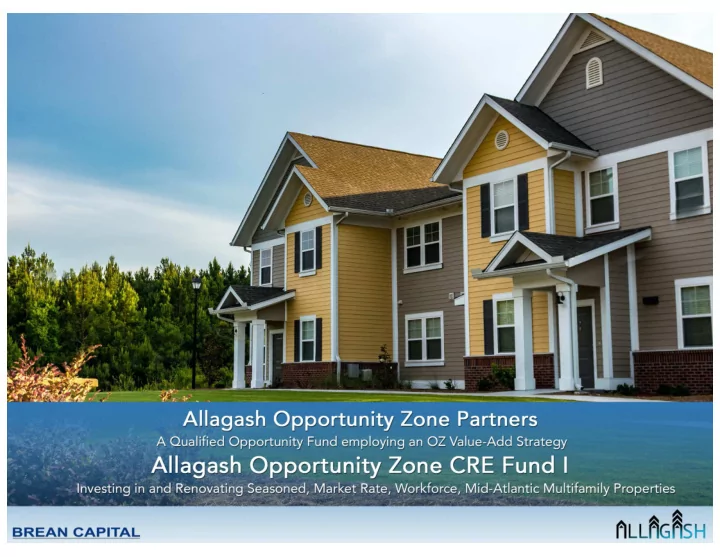
$100-$300 million to opportunistically purchase, intelligently renovate and improve, and efficiently assemble and manage a multi-property portfolio of seasoned, underperforming, working-class, multifamily rental properties located in Qualified Opportunity Zones (“QOZs”) in the U.S. Mid-Atlantic region.
Al Allagash Fund return projections do not rely upon gentrification to generate returns.
Because most QOFs perform ground-up development, the profitability of their projects rely upon charging rents above the current rent range for the neighborhoods into which they are developing. As a result, they rely upon gentrification leading wealthier residents to displace current residents, thereby moving those current residents even farther from the centers of economic activity. If this gentrification does not develop, then the projects are likely to fail.
PR PROJE JECTE TED RETU TURNS 16% 16% Pre-Ta Tax Net IRR / 3.8x After-Ta Tax Net MOIC
1
Wh While the OZ Program requires a 10-ye year hold to maxi ximize tax x benefits, the Allagash Opportunity y Zone CR CRE Fund I projects to fully return invested capital within 6 years – si similar ar to other PERE Funds. ds.
“P “Plan ans th that em empha hasize ho hous using ng pr prese servation ra rath ther th than new new co construct ction of
the mo most co cost-ef effec ective so solutions to to ho hous using ng sh shortage ages.”
Ben Criswell & Alice Guin Why Preserving Affordable Housing Can Be More Important that Building it International Center for Appropriate and Sustainable Technology 5/15/2017
Th The Fund Fund’s re renovation an and im improvement of
under erper erforming ng, und under er-ma maintained wo working-cl class mu multifa fami mily pr prope perties ca can di directly im impact te tens of
thou
peopl ple liv livin ing in in th these LM LMI co communities by by enha enhanc ncing ng ho hous using ng st stabi ability, pr promoting ar area re resilience, an and st stimulat ating ec econo nomic ac activity.
Confidential 7
FU FUND IMPACT: LMI Communit unity Dev evelo elopment ent Thr Throug ugh h Hous using ing St Stabilit ility
TARGET INDICATOR FUND ACTIVITY
11.1 Ensure access for all to adequate, safe and affordable housing… 11.1.1 Proportion of urban population living in... Inadequate housing The Fund’s CapEx budget directly addresses housing facility adequacy. 11.3 Enhance inclusive and sustainable urbanization… 11.3.1 Ratio of land consumption to population growth 11.3.2 Proportion... with a direct participation… in urban planning Where possible, property improvements will include an increase in available units. As a Community Development Entity, Allagash will be including community members on its Advisory Board. 11.7 Provide... access to safe, inclusive and accessible, green and public spaces… 11.7.1 Average Share of the built-up area
Fund development plans include developing and improving community
v In 2015, the U.N. established 17 Sustainable Development Goals (“SDG”s) with 169 targets and 1-3 indicators per target. The goals were intended to increase an individual’s human capabilities and "advance the means to a productive life.” v While the Fund activities directly apply to UN SDG #11.1 (“Ensure access for all to adequate, safe and affordable housing and basic services and upgrade slums”), the planned improvements to LMI housing stock should address multiple aspects of the 2030 Agenda.
To Tony Barkan Ma Mark Hall Peter Tzelios David Mc McClean
CE CEO Co Co-CI CIO Co Co-CI CIO Ch Chief Co Compl plaince Officer So Sour urcing ng & St Strateg egy Cons nstruc uction n & Fi Fina nanc nce.
nsul ultant nt)
Pr Previously, Co-Fo Found unding ng Princ ncipal Prev evious usly, Sr Sr, Direc ector Prev evious usly, y, Co-Fo Found under er Pr Previously, Sr. Managing Director He Head of CRE Investing St Strateg egic Account unts Group up Chi Chief ef Oper erating ng Officer er Chi Chief ef Co Complianc nce e Officer er Seer Seer Ca Capital Mana nagem ement ent GE GE Real Estate Silverpeak Re Real Es Estate Finance Sa Sailfish h Ca Capital Partner ners
31 31 Yea ears Exper erienc ence* e* 37 37 Yea ears Exper erienc ence* e* 31 31 Yea ears Exper erienc ence* e* 35 35 Yea ears Exper erienc ence*
1 Full biographies in the Appendix on pages D1-D5
SP SPECIFI FIC ST STRATEGY EXPERIENCE
v From 2010-2015 while at Seer, Tony Barkan opportunistically purchased over 1,000 units of deteriorating residential property in LMI communities, then renovated, rented, and managed these properties with the help of 3rd party construction and property management teams. The results of this investment led directly to the creation of the Fund’s investment thesis and process. v Mark Hall has been both the Head of Acquisitions and the Head of Development for the purchase and development of almost $500 million in thousands of multifamily units, often in LMI communities, like those of the Fund properties. v Peter Tzelios has been directly involved with the purchase, underwriting, or workout of billions of dollars of multifamily properties throughout the U.S.
AL ALLAG AGAS ASH TEAM AM: 100+ Years of Experience / Billions in CR CRE Transactions
Confidential 8
Alla Allagash’s te team is is com
rs with ith th the full ll ra range of
exper ertises es an and sp specific experience re require red to successfully accomplish the firm’s mission.
1
Alla Allagash als lso
right-of
first-re refusal (“ROFR”) contract with the ROSS Companies re reserving both ac access ss to pipeline as as well as as to their top tier const struction an and property man anag agement se services. s.
Ad Addition itionally lly, work
ing-cl class housing was one of the best performing assets through the Great Rece cession. Pr Property cashfl flows never experienced signifi ficant reductions, so property pricing rebounded quickly.
TH THE ADVANTAGES S OF F OZ Z RENOVATI TION OVER LMI DEVELOPM PMENT
Confidential 9
Ne New Gr Ground-Up Up De Development in in LM LMI: Le Less Pr Profitable an and Ri Riskier
v With little investment capital having been focused on LMI CRE over the last few decades, market pressures have caused owners to offer even solidly performing properties at 10%-40% discounts to ground-up development costs. v As a result, new developments in LMI communities are consequently forced to be the high rent provider of space across CRE sectors in order to generate acceptable returns on their property ownership. v Subsequently, the investment economics of new LMI development relies upon prospective gentrification to attract higher income residents and larger companies in order for the new development achieve full occupancy at high rents. v Because members of the community are often displaced as a result of gentrification, LMI community animosity can manifest as
Th The Al Allagash LM LMI Va Value-Ad Add St Strateg egy: Pr Project cting Hi High Pr Profits an and Lo Lower Ri Risk
v In contrast, Allagash’s entire strategy for the Fund is premised on increasing the supply of stable, quality affordable housing for current members of the communities into which the Fund is investing. v Consequently, LMI communities generally welcome and support renovation projects thereby greatly enhancing the probability
Confidential 10
MU MULTIFACETED CAPITAL PRESERVATION
Alla Allagash st strives to to pr prese serve in investor ca capital th throu
investment fo focus, ex exec ecut ution, n, an and ri risk ma manageme ment.
v In addition to the downside protection afforded by a portfolio of underperforming working-class multifamily properties:
as demand from large institutional investors (REITs, private equity, sovereign wealth…) has been consistently strong.
employment trends are above national averages and multifamily properties are performing exceptionally.1
able to reduce risk both through diversification and from avoiding the uncertainty concerning the economic viability
v By establishing a right-of-first-refusal (“ROFR”) agreement with the Ross Companies; the Fund’s preferred acquisition, construction, and property manager and a premier vertically-integrated working-class multifamily real estate service provider in the Mid-Atlantic region; the portfolio’s execution risk should be greatly diminished. v Risk management is an integral part of Allagash’s fund management processes.
A si sign gnifican ant ad additional al st stabi abilizi zing fa factor fo for in investors in in th the Fund Fund is is th the ex expec ectation of
receiving a fu fully ta tax-sh sheltered (b (by de depr preciation2) av averag age an annual al in income yi yield ov
10% pr projected to to re return ov
100% of
in invested ca capital fr from in income al alone, in inclu ludin ing eno enoug ugh by by 2026 2026 to to co cove ver th the OZ OZ Pr Program de deferred ta tax pa payment wh when th that is is du due.1
1 See Note #11on page A1 of the Appendix for attribution and notes.
Confidential 11
AL ALLAG AGAS ASH CO COMPETITIVE AD ADVAN ANTAG AGES
Allagash will seek to execute the optimal exit strategy for investors, ideally providing investors with the liquidity of a listed equity while allowing the continuation of tax- advantaged growth.
EX EXIT
Multiple Options
From initial strategic planning to managing each property’s idiosyncrasies, principal preservation and risk management is key to all
RI RISK MAN ANAG AGEM EMEN ENT
Integrated Management
EX EXEC ECUT UTION
Allagash is utilizing extensive industry and local contacts, including a ROFR with the ROSS Companies, to source properties with the target characteristics for inclusion in the Fund portfolio.
SO SOURCING
In Place Pipeline
The fund is designed to focus on underperforming working-class multifamily properties in the Mid-Atlantic in order to provide identifiable and reliable value as well as porfolio diversification.
FO FOCUS
Clear and Direct Vision
Allagash’s LMI Value-Add Strategy and property- specific construction plan projects to provide investors with outsized returns while limiting risk.
Comprehensive Plan
Alla Allagash seeks to to ou
tperf rfor
ring every ry ste tep in in th the in investm tment t proc
1 Further details on the ROSS Companies and the ROFR as well as a list of Ross’s previous transaction with returns is available upon request
Confidential 12
PO PORTFO TFOLIO FO FOCUS S CHOSE SEN FO FOR HIGH RETU TURN PO POTE TENTI TIAL
Mi Mid-At Atlantic MSAs As
§ Stable government-driven economy § Excellent technology sector growth § Positive demographic trends
Op Opportunity Zones
§ Properties in LMI areas offer value as investment capital has avoided these opportunities § Investors perception: low investment capacity in stagnant areas § Investment reality: significant
high growth potential
Mu Multifamily Sector
§ Most stable CRE sector § Value-Add is a proven strategy with particularly excellent prospects in LMI areas § Annual rent repricing in market rate properties allows for fast valuation growth
RO ROSS Com
panies’ RO ROFR1
§ Numerous successful acquisitions § Over 35,000 cumulative multifamily units under property management § Award–winning development & management
Exce Exception
Returns
Should be expected of successful investment managers investing into lower priced properties with:
Ad Additional Sourcing Ch Channels
§ Local owner and agent contacts § Other working-class multifamily real estate service companies § Municipal and community representatives
Confidential 13
SO SOURCING IS S UNDERWAY
As Assets ts ar are id identif ifie ied, ta targete ted, an and, in in so some ca cases, al alread ady neg negotiated ed. Allagash Opportunity Zone CRE Fund I has a very focused portfolio-creation mandate: to
Atlantic region of the U.S. (primarily Virginia, North Carolina, Maryland, South Carolina, Delaware, and D.C.) built before 2000 which have rents in the bottom quartile of their respective submarkets. Despite such a focused target asset, Allagash estimates that the universe of potential portfolio properties still approaches $50 billion in market value. Allagash, with the help of ROSS and other members and real estate professionals in the target region, initially began assembling a database of potential portfolio purchases in June 2018. Over $1 billion in properties have already been targeted for potential purchase by the Fund with Allagash working to maintain an active pipeline of $250-$500 million in assets at any time. Potential sellers of property to the Fund are extremely enthusiastic about their opportunity to sell. As
to development properties,
existing underperforming properties are not experiencing a significant uptick in demand as a result of the OZ Program.
The The Fund Fund’s fo focused mu multi-pr prope
portfol
approac ach sh should pr prov
de in investors wi with a hi higher her le level of
confidence ce wi with re respect to to re returns an and ex exit st strategy th than an an unf unfocus used ed mu multi-pr prope
portfol
which ma may ha have de developm
renovation pr proj
spread th throughout th the co country an and ac across th the ent entire ra range of
CRE.
Confidential 14
TH THE RENOVATI TION AND IMPR PROVEMENT T PL PLAN
Pr Property re renovations an and im improvements ar are de desi sign gned to to in increase re revenue an and de decrease se op
rati ting co costs wh while enha enhanc ncing ng pe perso sonal an and co communal qu quality of
life an and im improvin ing env environm nment ental ef efficienc ency. v Pe Personal re residency im improvements ca can in inclu lude:
replacing dated appliances
countertops and wood flooring; improving light fixtures
v Co Community life improvements can include:
management provide community communications to support youth and elderly tenants.
management updates with law enforcement; having a regular presence of property management
v En Environ
tal and energy-ef efficienc ency improvem ement ents can n inc nclud ude: e:
appliances; installing solar panels
“We met with a small group of residents who shared their stories of how safe and affordable housing had improved their lives: stability in school for their children (#4), a short commute to work (#11.2), a safe place for a grandmother to care for her granddaughter (#3). We spoke with a neighborhood store owner who told us how business had improved (#1) and crime had dropped (#16.3) in the years since the redevelopment project was completed.”
Catherine Godschalk, Calvert Impact Capital 4/24/2018 Dear Impact Investors: Consider Affordable Housing (with Allagash additions of UN SDGs)
0% 11% 22% 33% 44% 8.25%
1% 7% 11% 13% 15%
7.25%
5% 10% 12% 15% 16%
6.25%
8% 12% 16% 17% 18%
5.25%
11% 14% 17% 18% 19%
4.25%
13% 16% 18% 20% 21%
Sale Cap Rate Rent Increase Resulting From CapEx
IRR SENSITIVITY
If OZ sub-market rent growth rates drop to 0%: 6% If Operational Efficiencies have no effect on Net Income: 9% If the Average Purchase Cap Rate drops to 4.75%: 10% If Interest Rates jump 2% immediately: 12% If land on purchases account for 0% of Price Paid: 12% If Vacancy Rates do not improve: 12% If Non-OZ Property concentration doubles: 14% If Loss-to Lease doubles: 14%
SINGLE EVENT RISKS IRR
Confidential 15
RI RISK MANAGEM EMEN ENT
Ri Risk Manage gement du during g the sou
g ph phase of
ging g the Fund d include des ide dentifying g the risk variabl bles and d th those v vari riables p pote tenti tial b behavior fo r for e r each i individual p property rty a as w well a as fo for th r the p portfo rtfolio a as a a w whole. . Ri Risk ma manageme ment ov
the Te Term of
the Fund Fund in inclu ludes tra tracking ri risk va variables an and be being pr prepa pared an and ab able to to se sell pr prope
whose se und under erper erformanc nce or
deterior
credit pr prof
places in investor ca capital at at ri risk.
1
The projected performance contained herein is provided for illustrative purposes only and is not intended to serve as and must not be relied upon by any person as a guaranty, an assurance, a prediction of a definitive statement of fact or a probability. Actual events and circumstances are difficult or impossible to determine and may differ from assumptions. No representation or warranty is made as to the reasonableness of the assumptions made with respect to determining the projected performance or that all assumptions used in determining the projected performance have been stated or fully considered. Such projected performance was not prepared with a view towards public disclosure or compliance with any published guidelines. Actual performance and realized returns will depend on, among other factors, future operating results, the value of the assets and market conditions at the time of disposition, legal and contractual restrictions, any related transaction costs and the timing and manner of sale, all of which may differ from the assumptions on which the projected valuations used in any performance data contained herein are based. The actual performance and realized returns of any company or transaction described herein may differ materially from the projected returns. As a sophisticated investor, you accept and agree to use such information only for the purpose of discussing with Allagash your preliminary interest in investing in the Fund. The model used to derive these projected returns is available from Allagash upon request subject to an NDA.
1
1) Continuing their investment by converting their Fund shares into REIT shares. 2) Liquidating their investment for cash.
Preferred Liquidation Strategy: UPREIT IPO
the Fund is selling the property portfolio, then selling the property portfolio to an existing REIT should offer the best way for investors to capitalize on the high price that REITs, Sovereign Wealth Funds, Large PE Funds, Pensions and similar large institutional investors often pay for strong performing multifamily properties in mid-sized MSAs.
Base Case Liquidation Strategy: Portfolio Sale
all points in the real estate or macro-economic cycles.
should have little impact on investor IRRs.
Potential Additional Liquidation Strategy: Individual Property Sales
1
Investor returns are based upon the sale of properties at a 6.25% average Cap Rate, at the wider end of the 3.3-7.8% historic range for the 12-month moving average of REIT yields since 1/1/2000 as per the Monthly Index Value published by NARIET and also at the wide end of the 4.8-6.7% range for multifamily cap rates across the U.S. since 2002 as per the ARA (a Newmark Company) Multifamily Market Overview published in Q1 2018.
Confidential 16
MU MULTIPLE EXIT SCENARIOS
1
While an UPREIT transaction is preferable, various sale strategies could be employed to maximize returns.
Fi First closing ngs for the he Fund Fund are e sched hedul uled ed for Q1 1 2019 2019 to facilitate e complianc nce e with h OZ Z reg egul ulations ns, and nd closing ngs wi will occur on a rolling basi sis s throughout 2019 in order to accommodate various s invest stor timing limitations. s.
Confidential 17
FU FUND TI TIMING PR PROJECTI TIONS
…
May 2019 Mar 2020 Dec 2020 Dec 2030 Jun 2024 Strategy Formation/Funding Property Identification Property Due Diligence Property Closings Property Renovation Strategy Liquidation Oct 2018
“I “I th think th there wi will be be ov
100 bi billion
dollars in in pr private ca capital th that wi will be be in invested in in Op Opportunity Zo Zones nes.”
U.S. Secretary of the Treasury Steven Mnuchin in The Hill, September 28, 2018
Dec 2021
Fund Fund Mana nager er Allagash Opportunity Zone Partners LLC Fund Fund St Status us Investing Committed Capital & Accepting Additional Commitments Sub Subscription n Per eriod June 2019 – December 2020 (subscriptions accepted on a rolling basis) Co Commitment Format 100% of Subscription Amount due at time of Subscription Ta Targeted / Maximum Equity Raise $100-$300 Million / $500 Million Mi Minimum Subscription Amount
(As per 3(c)7 & 506(c), Qualified Purchasers Only)
$250,000 for independent investors $5 million for investment platforms subject to a $100,000 individual minimum Fund Fund Ho Horizon 10-years from final close plus three 1-year extensions for portfolio sales An Annual l Por
ment Charge 1.50% (paid upfront for year 1 then paid quarterly as a share of net income) Fund Fund Mana nagem ement ent Inc ncent entive e Fee Fee
(Inquire about Break Points for management and incentive fee discounts upon attaining certain levels of investment)
11% above 7% IRR (no catch-up) 22% above 14% IRR (no catch-up) 33% above 21% IRR (no catch-up) Ad Admin minis istrator
SS&C GlobeOp Au Audit itor
EisnerAmper LLP Ba Banking & & C Cash M Management
. Morgan/Chase Fund Fund Couns unsel el Purrington Moody Weil LLP
Confidential 18
AL ALLAG AGAS ASH OPPORTUN UNITY ZONE CR CRE FUN UND I: Parties & & Details
Alla Allagash ha has de desi sign gned ad adjust stments to to th the in incentiv ive fe fee st structure to to mo more fu fully al align Fund Fund Ma Management be behavior wi with in investor’s ob
tive of
generating th the mo most af after-ta tax we wealth.
Confidential 19
CO CONTACT ACT
Al Allagash Opportunity Zone Partners LLC To Tony Barkan Ch Chief Exe Execu cuti tive ve Office cer tb tbark rkan@allagashoz.com (6 (646) ) 946-0482 0482 33 33 Irving ng Place 2nd
nd Fl
Floor Ne New York, Ne New York 10003
Confidential A1
Te Term Definition, Context Notes, and Data Attributions
1. Page 1 Note 2: For Allagash Opportunity Zone CRE Fund I, LMI neighborhoods are given the same definition as is used for the Qualified Opportunity Zone Program and the Community Reinvestment Act: census tracts with poverty rates of at least 20% and average household income less than 80% of average household income for the state in which the tract resides. 2. Page 2 Note 1: A Community Development Entity is a company or partnership certified by the CDFI Fund at the U.S. Department of the Treasury formed with an explicit goal of providing capital to LMI communities for community development and which has a Board of Advisors with at least 20% community members or civic leaders representing the communities into which the CDE is investing and/or experts in the form of community development that the CDE seeks to create. 3. Page 3 Note 1: For Allagash Opportunity Zone CRE Fund I, “working-class communities” are a subset of LMI communities in which residents’ median income generally ranges from 60% of U.S. Median Income and 120% of Area Median Income. This range can loosely be equated to median community income for the areas into which the Fund invests of $40,000-$100,000. 4. Page 4 Note 1: from the Census Bureau 5. Page 4 Note 2: from Thompson, W. & Hickey, J. (2005 Pearson, Allyn & Bacon). So Societ ety in in Fo Focus us & Beeghley, L. (2004 Pearson, Allyn & Bacon). Th The St Struc uctur ure of
Social St Stratification in in th the Un Unit ited St States es. 6. Page 4 Note 3: from National Low Income Housing Coalition, March 2017, Th The GA GAP: A Sho Shortage of
Affor
le Ho Homes es 7. Page 4 Note 4: from Stone, M.E. (1993 Temple University Press). Shel Shelter er po poverty: Ne New id ideas on
hous using ng af affordab ability ty. 8. Page 4 Note 5: from FNMA (May 2017). Th The Cr Crisis in in Af Affor
le Ho Hous using ng. 9. Page 4 Note 6: from CBRE (August 2018). No North rth Ame Americ ican Ca Cap Ra Rate Sur Survey ey calling multifamily CRE, “an asset class widely considered to be an investment safe haven.” 10. Page 4 Note 7: from Adam Kaufman of the Arbor family of companies including Arbor Realty Trust, a publicly traded REIT in an interview published 11/14/2018 in Nati National al Re Real Es Estate In Inve
The Cr Crisis in in Af Affor
le Ho Hous using ng. 11. Page 4 Note 8: from Capstone Apartment Partners through CoStar Group in their reports for Richmond, Charlotte, Norfolk, and Raleigh MSAs & Moody’s Analytics Data 12. Page 5 Note 2: from Habitat for Humanity, 2019 2019 St State of
the Nati Nation’s Ho Hous using ng Re Repor
Lack of
Affor
le Ho Hous using ng
Confidential B1
A A ONCE CE/DECAD CADE OPPORTUN UNITY, A A ONCE CE/LIFETIME PROGRAM AM
Ea Each de decade de, th the go government im imple lements a pr progr gram th that al allows in investors to to cr create ou
tsized re returns. As As pa part of
the Ta Tax Cu Cuts & Jo Jobs Ac Act of
2017, th the go government ha has cr created th the Op Opportuni unity Zo Zone ne Pr Program.
1980s 1980s Hi High h Int nter eres est Rates es 2000s 2000s Te Term ABS Loan Fa Facility (“TALF” F”)
1990s 1990s
Re Resol
Co Corp.
C”) 2010s 2010s Opportunity Zone Program
Fed raises rates, and 20-year Government Guaranteed Zero-Coupon Bonds trade @ $0.04. Government creates RTC and sells $394 billion of low priced risk- reduced assets. Government empowers Fed to make $1 trillion in loss-limited loans at near zero interest rates.
Government creates LMI community development in incentiv ive by provid idin ing the most wid ide-ra ranging and po potentially subs bstantial tax be benefit in U.S. history
The Pr Program functions as a lever on QOF returns.
Inves estor after er-ta tax wealth th genera rati tion can be incre reased by by 100%-200% 200% over er a 10 10-ye year holding period.
Ha Having tra traded RT RTC bo bonds ds at at Sa Salomon Br Brothers an and cr created an and ma managed a TA TALF fu fund at at Seer Seer Ca Capital, Co Co-Fo Found under er & CE CEO To Tony Ba Barkan is is es establishi hing ng Alla Allagash as as a le leader in in Op Opportuni unity Zo Zone ne in investin ing.
Investors can receive tax benefits by investing capital gains into a Qualified Opportunity Fund.
§ Investors qualify for significant tax benefits if they re-invest capital gains from the sale of an asset into a QOF either: (i) within 180 days of the asset sale if they were the direct owner of the asset or (ii) within 180 days of the end of the partnership year if the capital gains were generated by a partnership or an LLC owned or invested into by the investor. § A QOF portfolio must have at least 90% of its assets in Qualified Opportunity Zone Assets (“QOZAs”). § QOZAs are investments into either (i) existing or new commercial real estate properties located in an Opportunity Zone or (ii) existing or new operating companies located and doing business in Opportunity Zones. § Opportunity Zones were selected by each state from census tracts that have at least a 20% poverty rate and average household income less than 80% of that state’s average household income. § Investing into CRE requires that the properties either be Original Use developments or be significantly renovated, while investments into companies require that the companies be newly founded or the investment be working capital.
Commercial Real Estate investments require added development funds.
§ Any CRE QOZA must be renovated and improved by an amount at least $1 greater than the amount allocated for the purchase of the depreciable property (ie. the building but not the land) (such amount generally representing 70-90% of the total price paid for the property). § Any portion of the purchase, as well as any or all development costs, may be financed with debt.
Current capital gains taxes are deferred and reduced over time.
§ No taxes are currently due on any capital gains invested into a QOF on a timely basis (as per the top section above). § Deferred capital gains taxes become due upon the earlier of any sale of Fund Interests by the investor or 12/31/2026. § If Investors remain in the Fund for 5 years, deferred capital gains taxes should be reduced by 10%. § If Investors remain in the Fund for 7 years, deferred capital gains taxes should be reduced by an additional 5% (15% total).
Appreciation of Fund Interests can be entirely tax free.
§ If Investors remain in the Fund for at least 10 years, they should qualify for elimination of taxation on gains realized upon the sale of the QOF portfolio assets or the liquidation of their Fund Interests.
2026 tax payments may be financed using Fund interests as collateral.
§ Upon request, Allagash Opportunity Zone Partners will use commercially reasonable efforts to assist investors seeking to finance deferred tax liabilities when due in 2026.
Capital gains, either long term or short term from any type of asset sale (equity, LLC interests, properties, art, cryptocurrency, etc…), are eligible for OZ Program tax benefits if re-invested in a qualifying manner.
OP OPPOR ORTUNITY ZON ONE PROG OGRAM GENERAL INFOR ORMATION ON
Confidential B2
Investors can receive tax benefits by investing capital gains into a Qualified Opportunity Fund.
§ Investors qualify for significant tax benefits if they re-invest capital gains from the sale of an asset into a QOF either: (i) within 180 days of the asset sale if they were the direct owner of the asset or (ii) within 180 days of the end of the partnership year if the capital gains were generated by a partnership or an LLC owned or invested into by the investor. § A QOF portfolio must have at least 90% of its assets in Qualified Opportunity Zone Assets (“QOZAs”). § QOZAs are investments into either (i) existing or new commercial real estate properties located in an Opportunity Zone or (ii) existing or new operating companies located and doing business in Opportunity Zones. § Opportunity Zones were selected by each state from census tracts that have at least a 20% poverty rate and average household income less than 80% of that state’s average household income. § Investing into CRE requires that the properties either be Original Use developments or be significantly renovated, while investments into companies require that the companies be newly founded or the investment be working capital.
Commercial Real Estate investments require added development funds.
§ Any CRE QOZA must be renovated and improved by an amount at least $1 greater than the amount allocated for the purchase of the depreciable property (ie. the building but not the land) (such amount generally representing 70-90% of the total price paid for the property). § Any portion of the purchase, as well as any or all development costs, may be financed with debt.
Current capital gains taxes are deferred and reduced over time.
§ No taxes are currently due on any capital gains invested into a QOF on a timely basis (as per the top section above). § Deferred capital gains taxes become due upon the earlier of any sale of Fund Interests by the investor or 12/31/2026. § If Investors remain in the Fund for 5 years, deferred capital gains taxes should be reduced by 10%. § If Investors remain in the Fund for 7 years, deferred capital gains taxes should be reduced by an additional 5% (15% total).
Appreciation of Fund Interests can be entirely tax free.
§ If Investors remain in the Fund for at least 10 years, they should qualify for elimination of taxation on gains realized upon the sale of the QOF portfolio assets or the liquidation of their Fund Interests.
2026 tax payments may be financed using Fund interests as collateral.
§ Upon request, Allagash Opportunity Zone Partners will use commercially reasonable efforts to assist investors seeking to finance deferred tax liabilities when due in 2026.
Capital gains, either long term or short term from any type of asset sale (equity, LLC interests, properties, art, cryptocurrency, etc…), are eligible for OZ Program tax benefits if re-invested in a qualifying manner.
5 10 15 20 25 30 35 OZ Investor Non-OZ Investor
Confidential B3
TA TAX SAVINGS: LONG TERM WEALTH MAXIMIZATION
Tax-advantaged investors in the Fund are projected to develop from 80%-200% more after-tax wealth compared to non-tax-advantaged investors in the Fund.1
1 The projected performance contained herein is provided for illustrative purposes only and is not intended to serve as, and must not be relied upon by any person as, a guaranty, an assurance, a prediction of a definitive
statement of fact or a probability. For further information about Fund returns see the more detailed Note #1 at the bottom of page 1
2 After-tax projections are projected to result in 100% more wealth generation for the average U.S. taxpayers assuming 44% combined federal and state income tax rate, 23.8% federal capital gains tax rate, 8.2% state capital
gain tax rate, and full Opportunity Zone Fund tax benefits on both federal and state capital gains taxes. Additionally, after-tax income received over the life of the investment is assumed to be held as cash rather than
v Investors who invest pre-tax capital gains into the Fund can invest more money than if they had paid taxes before investing, effectively borrowing from the government (with a negative interest rate if they hold for at least 5 years). v Fund investors can pay the deferred taxes when they become due either by (1) using other saved capital, (2) aggregating the annual distributions from the Fund which are projected to be more than enough to cover the tax amount,
v Tax-advantaged Fund investors who hold their investment for the entire Fund term of at least 10 years also qualify for the elimination of capital gains taxes on the capital gains generated by the Fund. v Investing full pre-tax capital gains into the Fund projects to a final after-tax MOIC of 3.1x on the full capital gain compared to an after-tax MOIC of 2.7x on the smaller after-tax invested amount, ie. only 1.9x on the full initial pre-tax capital gain.
EX EXAMPLE: An average taxable investor with $1mm in long term capital gains can (i) pay taxes leaving $0.7mm to invest into the Fund or (ii) invest $1 million pre-tax directly into the Fund. At the expected conclusion of the Fund in Year 11, the investor who invested $0.7mm after-tax is projected to have $1.9 million after-tax while the investor who invested $1mm pre-tax is projected to have $3.1 million after-tax.
Fund Investment TermRelative Wealth Generation
Projected Total Capital Returned Initial Investment Amount1
Confidential C1
IN INVESTMENT STRUCTURE
Despite OZ program complexities, Allagash Opportunity Zone Fund I is designed similarly to a standard Real Estate Private Equity Fund.
Allagash Opportunity Zone Partners LLC Fund Limited Partners
Qualified Opportunity Zone Businesses (“QOZB”): Property-specific LLCs & Property Portfolio-owning LLCs (as appropriate)
AOZCREI GP LLC
Investment Manager Fund General Partner QOZB Managing Member Property LLC Manager
Allagash Opportunity Zone CRE Fund I LP
Source of Funds
Equity $ 150 million Debt $ ~450 million
* Reserves include:
* Fund Formation Costs include:
* Due Diligence Costs include:
* Property Closing Costs include:
* The projected total size of the capital improvements and the number of construction projects are based on investor equity icommitments of $150 million.
FU FUND SO SOURCES S & USE SES S PR PROJECTI TIONS*
Confidential C2 $2 $2 $5 $5 $334 $334 $15 $15 $200 $200 $38 $38
Due Diligence Costs Formation Costs Purchase Value Closing Costs Renovation Spending Reserves
Use of Funds1
1 All numbers in millions
96% of expenditures are projected to be directly related to the purchase, construction, or management of real estate. Only the 5mm of Formation Costs and $2mm of Fund-level Reserves are not real estate-related.
To Tony Barkan – Co Co-Ma Managing Principal Ch Chief Executive Officer
Prior to founding Allagash Opportunity Zone Partners, Mr. Barkan was one of five Founding Principals and Investment Committee Members at Seer Capital Management from 2008-2015. Beginning as Head of Trading and Co-Head of Real Estate Investments, Mr. Barkan immediately recognized the compelling opportunity offered by the government’s Term Asset-Backed Securities Loan Facility (“TALF”) upon its inception and developed and managed Seer’s uniquely successful TALF investing franchise. As the firm grew AUM to over $2 billion and regulatory assets to almost $4 billion, he concentrated his focus on Real Estate-based investments. As the Head of Commercial Real Estate, Mr. Barkan ran all aspects of the portfolio – credit, analytics, trading, and risk. He planned and executed Seer’s working-class housing rehabilitation and rental strategy growing that portfolio to 1,000 units in the Southeastern U.S. He also initiated, developed, and ran the second largest CMBS B-Piece investment business globally, driving deals and approving loans backed by over $20 billion of US CRE properties. In addition, Mr. Barkan sourced, negotiated and purchased significant Mezzanine CRE Loan risk and was one of the most active traders in the mezzanine US CMBS Bond marketplace. Prior to Seer Capital, Mr. Barkan built and ran profitable fund investment platforms at Sailfish Capital Partners, Harbert Investment Management, and The Clinton Group from 2001-2008. Over that span, Mr. Barkan built and led investment, research, trading, operations, and risk management teams with as many as 20 people and managed portfolios across the full range of fixed income and real estate sectors with peak investor equity
identifier of the real estate-led economic crisis. By the beginning of 2007, he had migrated his hedge fund portfolio to be entirely short. From 1997-2001, Mr. Barkan was the Senior Portfolio Manager responsible for Commercial MBS, Residential MBS, and ABS and was a founding member of the Fixed Income Investment Committee at Pareto Partners (originally Forstmann-Leff). He helped Pareto become a top decile Core and Core-Plus Fixed Income Manager by initiating a short MBS sector allocation versus benchmarks in advance of Russia's default and the Long- Term Credit crisis and then reversed that positioning by purchasing cheap deep-credit Mortgage-Backed Securities once the market had bottomed. From 1988-1997, Mr. Barkan began his career as a sell-side trader at Salomon Brothers, Goldman Sachs, and ED&F Man Group trading a range of real estate debt, commodity products, and currencies.
worked with Cristo Rey Brooklyn High School to help students with lower income backgrounds develop financial literacy, comfort with personal financial issues, and an understanding of professional opportunities within the financial markets.
member of the Triple Nine Society. Confidential D1
Ma Mark Hall – Co Co-Ma Managing Principal Co Co-Ch Chief Investment Officer
management across the U.S., as well as a consultant to a Chicago-based SEC registered investment adviser with $3B under management. For Inner Circle, Mr. Hall has consulted on investment, development, and operational activities. He was responsible for arranging acquisition financing for and leading the actual acquisition of the majority of Inner Circle’s property portfolio. Subsequent to acquisition of Inner Circle’s older, full- service mid-market hotels, Mr. Hall conceptualized the repositioning of these properties by converting upper floors to apartments and upgrading lower floors to a boutique higher-end hotel product. The projects at Inner Circle that were guided by Mr. Hall achieved significant success for investors by maximizing asset value by eliminating the issue of high vacancy rates for such outdated larger hotels. Mr. Hall continues to provide some consulting services for Inner Circle. From 2010-2017, Mr. Hall was a Managing Director and the Senior Investment Banker for Private Equity Commercial Real Estate transactions for Brean Capital LLC. In addition to banking private equity transactions, he supported the trading floor on any purchases of CMBS or whole loan participations. From 1996 to 2009, Mr. Hall was a Senior Director in GE Real Estates’ Strategic Accounts Group. In this role, he had responsibility for commercial lending and equity investments in US-based opportunity funds and public REITs/Companies including investing in numerous CRE value-add and development projects alongside GE’s premier clients and counterparties including Carlyle, Starwood, Apollo, and Colony Capital. He also bought billions of loans and properties for GE in secondary markets. In 2008, Mark was selected for and successfully completed GE’s Crotonville, NY Senior Management Training, a highly acclaimed rigorous training program for GE’s Senior Management personnel. Mr. Hall started at GE as a Senior Banker in the Commercial Mortgage-Backed Securities Large Loan Group where in his four years, he generated 90% of the net income for the entire group. Prior to joining GE, Mr. Hall was Director of Originations and a member of the Board of Directors of Wingate Capital (now CW Capital) from 1991-
transactions, and supervised billions in GNMA backed Project Loan closings. Prior to 1990, Mr. Hall helped manage and was the top producer for the Kidder Peabody/Wingate equity funds which exclusively invested in multifamily real estate by wrapping a participation around “commercial” GNMA securities. From 1983-1986, he was Head of Development for the Hanover Companies, a multifamily housing developer.
Confidential D2
Pet Peter er Tz Tzelio elios – Co Co-Ma Managing Principal Co Co-Ch Chief Investment Officer
debt, equity, asset management, and capital markets functions across a variety of projects, including new construction, redevelopment, condo conversion, net lease, distressed asset rehabilitation. Most recently, Mr. Tzelios has been running an investment business which invests in a variety
In 2014, Mr. Tzelios co-founded and became the Chief Operating Officer of Silverpeak Real Estate Finance LLC (“SPREF”), a privately owned commercial real estate lender focused on providing financing solutions to owners of commercial real estate throughout the United States. He was responsible for real estate, finance, and internal operations as SPREF grew from a new company to one with over $2 billion of originations. Prior to SPREF, Mr. Tzelios co-founded Full Stack Capital LLC (“FSC”) and Wythe Capital LLC where he made a variety of proprietary and client- funded CRE investments including direct purchase and management of real estate assets, acquisition of defaulted notes, acquisition and disposition of REO properties, mortgage finance, and land development. At FSC, he established and operated an out-sourced CMBS originations and underwriting platform with Barclays Bank. From 2003-2008, Mr. Tzelios was a Managing Director and Deputy General Manager of the U.S. business of Eurohypo AG, a leading international specialist bank focused on real estate and public finance with assets of over Euro $225B. Mr. Tzelios was instrumental in the establishment of Eurohypo’s U.S. platform. He oversaw over $30 billion of successful commercial real estate financing transactions. Mr. Tzelios sat on Eurohypo’s Credit Committee, Investment Committee, and Management Committee and was responsible for strategic planning and implementation as well as the workout of the bank’s troubled asset portfolio. As Deputy General Manager he also oversaw all operational matters including portfolio management, risk management, reporting, treasury/funding, asset liability management, legal, compliance, HR, IT, and BCP. Prior to joining Eurohypo, Peter was a member of GE Capital Real Estate’s specialized REIT financing practice. He joined GE in 1997 as a founding member of its Commercial Mortgage-Backed Securities practice. Prior to joining GE, Peter practiced law in the real estate group of Thacher Proffitt & Wood where he represented major portfolio and securitization lenders.
Confidential D3
Da David McClean (through DM DMA Consulting Group) Ch Chief Co Compliance Officer
and Research, and Aladdin Capital Management. He served as Chief Compliance Officer at Sailfish Capital Partners during Mr. Barkan’s tenure at that firm. His consultancy, DMA Consulting Group, which he established in 1992, focuses on regulation, governance, and enterprise risk. DMA has consulted to dozens of businesses, from hedge funds to broker-dealers. In 2017, Dr. McClean established Business and Government Ethics International (“BGEI”), which focuses on assisting organizations of all types – including government agencies – live up to their commitments to proper conduct and integrity, by helping them to develop integrity programs and targeted internal communications about standards and ethics.
including Wall Street: Reforming the Unreformable: An Ethical Perspective (Routledge, 2015), Climate Change: The Moral and Political Imperatives (self-published in 2017 to make it widely available for free), and most recently The Integrated Ethics Reader (Cognella, 2019), which covers a wide range of topics, from business ethics to climate change. Dr. McClean is a member of the board of governors of The New School for Social Research and is a trustee of The New School, in New York City. He is also a member of the board of directors of Impact@Africa, an impact investing facilitator and information hub seeking to attract social impact investment into and across Africa. He is also a Senior Lecturer at Rutgers University, Newark (New Jersey), where he teaches business and professional ethics, environmental ethics, and other courses. Confidential D4