Direct Search for Dark Matter WIMPS Complementary experimental - - PowerPoint PPT Presentation

direct search for dark matter wimps
SMART_READER_LITE
LIVE PREVIEW

Direct Search for Dark Matter WIMPS Complementary experimental - - PowerPoint PPT Presentation

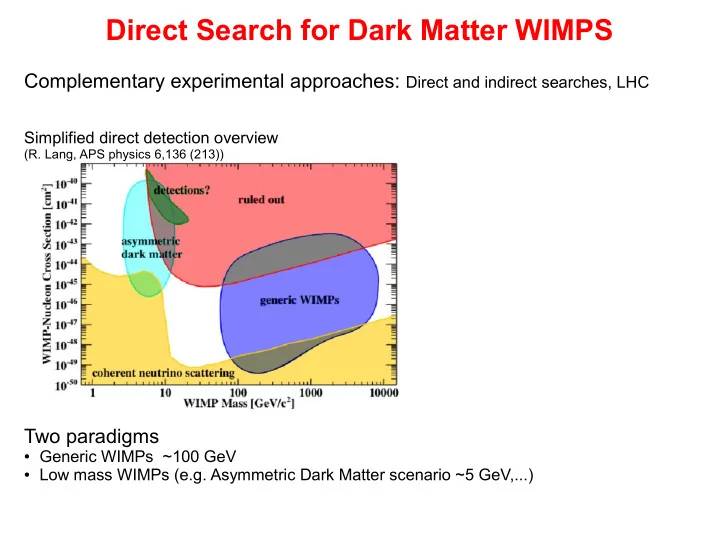
Direct Search for Dark Matter WIMPS Complementary experimental approaches: Direct and indirect searches, LHC Simplified direct detection overview (R. Lang, APS physics 6,136 (213)) Two paradigms Generic WIMPs ~100 GeV Low mass WIMPs


slide-1
SLIDE 1

Direct Search for Dark Matter WIMPS

Complementary experimental approaches: Direct and indirect searches, LHC

Simplified direct detection overview

(R. Lang, APS physics 6,136 (213))

Two paradigms

  • Generic WIMPs ~100 GeV
  • Low mass WIMPs (e.g. Asymmetric Dark Matter scenario ~5 GeV,...)
slide-2
SLIDE 2

High Mass Frontier

Strategy: Increase exposure no background

  • “Natural” weak scale WIMPS 10-9 -10-10 pb /nucleon
  • Irreducible neutrino background at 10-12 pb from coherent scattering of

atmospheric neutrinos Which detector technology ?

  • Noble liquids probably most natural choice for ton scale detectors

(Xe requires background improvement of a few 1000 to reach 10-12 pb)

  • Cryogenic detectors may also play a useful role for weak scale WIMPs

Need a few 100 kg to reach 10-10 pb/nucleon Complementary: Very different backgrounds and detection mechanism Different nuclei and experiments needed for confirmation of signal

  • Several target materials are needed (isospin violating coupling)
slide-3
SLIDE 3

Direct detection limits

Snowmass Summary Report 2013

  • WIMP-nucleon cross section, assuming σ ~ A2 to allow comparison of experiments
  • Xe is dominating the high mass range (LUX ~10-9 pb)
slide-4
SLIDE 4

Low Mass Frontier

expected recoil spectrum: Xe, 5 GeV WIMP

Need excellent signal to noise

– recoils mostly below 1 keV – threshold much more important than mass – kg scale detectors sufficient

Which detector technology ?

cryogenic detectors: – excellent S/N makes them most natural choice for low threshold CDMSlight: use Neganov-Luke and give up discrimination 0.176 keVee / 0.84 keVnr threshold

CRESST: 600 eV recoil threshold – detectors with light nuclei most useful

CMDS Si CaWO4, Al2O3 ??

Noble liquids:

– Large uncertainty of recoil energy scale (Leff , energy and field dependence of electric field quenching)

– S2 only might be useful, no fiducialization, no convincing idea for calibration of recoil energy scale

slide-5
SLIDE 5

Low Mass region

Confusing situation:

– Several hints and one claim (DAMA), excluded by others

– Unsuspected backgrounds, systematic uncertainties in nuclear recoil energy scale ? – Isospin violating coupling may considerably relax tension

(rate on nucleus depends on fn/fp, drastic reduction possible)

slide-6
SLIDE 6

CRESST Present Run

α and 210Pb recoil background completely suppressed in all new types of detector modules (strongly reduced in conventional)

slide-7
SLIDE 7

181W 179Ta 179Ta 181W

CRESST Present Run

  • New self grown crystals (TUM) ~10 times lower β/γ background
  • Energy resolution and accuracy of calibration at sub keV level
  • Some detectors run at 0.6 keV threshold (lowest of all DM searches)
slide-8
SLIDE 8

CRESST and Future

  • Run for ~ 2 years and collect 2000 kg days of data
  • Grow new set of radiopure crystals in Munich and prepare detectors modules of

the new type and replace conventional ones as soon as possible

  • R&D for detector modules with M>1kg.
  • Upgrade CRESST set-up at Gran Sasso to house ~50 kg detectors
  • Develop common tower structure for integrating CRESST type detectors in

EURECA/SuperCDMS

slide-9
SLIDE 9

Conclusion

Detector technology pioneered at MPI with excellent potential for making a useful contribution in DM search, especially for low mass WIMPs Excellent energy resolution and perfect discrimination of alpha backgrounds at high energies makes this detector technology an excellent choice for a next generation of neutrinoless double beta decay searches (Federica's talk) Other attractive (high risk/high gain) applications in neutrino physics: Calorimetric measurement of electron capture in 163Ho for next generation of direct neutrino mass experiments with sensitivity mν< 0.1 eV

slide-10
SLIDE 10