Developing Indigenous management outcomes from dugong research in - - PowerPoint PPT Presentation

developing indigenous management outcomes from dugong
SMART_READER_LITE
LIVE PREVIEW

Developing Indigenous management outcomes from dugong research in - - PowerPoint PPT Presentation

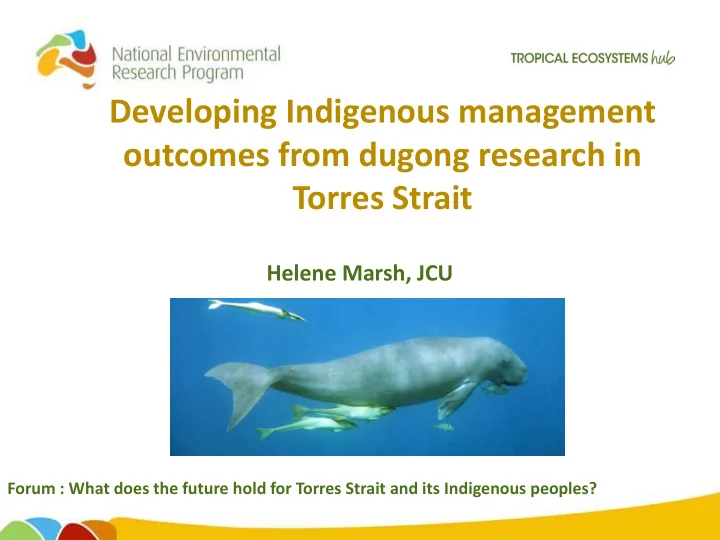
Developing Indigenous management outcomes from dugong research in Torres Strait Helene Marsh, JCU Forum : What does the future hold for Torres Strait and its Indigenous peoples? Lifespan similar to humans > 70 years First calf at 7-17 years


slide-1
SLIDE 1

Helene Marsh, JCU

Forum : What does the future hold for Torres Strait and its Indigenous peoples?

Developing Indigenous management

  • utcomes from dugong research in

Torres Strait

slide-2
SLIDE 2

2

First calf at 7-17 years

Nurse for at least 18 months

Mandy Etpison photograph

Lifespan similar to humans > 70 years

slide-3
SLIDE 3

3

Low sustainable human-caused mortality

Survival of adults must be > 95% p.a. to maintain a dugong population Modeling in 2004 suggested harvest may not be sustainable New research suggests this result not correct

<130 10000 <13 1000 100

Sustainable human-caused mortality per year* Dugong population size

*using PBR technique mandatory in US

slide-4
SLIDE 4

Moreton Bay Hervey Bay Central Qld N Qld Torres Strait NT WA

Torres Strait dugongs genetically healthy and connected with east and western Australia

Mitochondrial DNA Moreton Bay Microsatellite DNA

David Blair et al. data

slide-5
SLIDE 5

Year Dugong density per km2

Marsh et al. 2011

5

Torres Strait dugong population apparently stable over 25 years

Slow declines hard to detect: need good catch data

slide-6
SLIDE 6

Dugongs

Seagrass

Western Torres Strait: Australia’s: largest continuous seagrass meadow discovered by QDPI/TSRA in 2010

Seagrass map Helen Taylor; dugong map Alana Grech

slide-7
SLIDE 7

7

Large scale aerial surveys have enabled spatial models of dugong distribution and abundance at huge spatial scales Map drawn by Alana Grech

Torres Strait: dugong capital

slide-8
SLIDE 8

62% of best dugong areas rarely hunted

Grayson (2011) Dugong Sanctuary

8

35 40% 22% Dugong Sanctuary 38% hunted 40% unofficial sanctuary Community based management Grayson and Grech data

slide-9
SLIDE 9

Tracking dugongs from space

Mabuiag and Biogu rangers and community members involved in all aspects Islanders provided expert advice and assisted with catching.

slide-10
SLIDE 10

Informing dugong management by studying dugong movements

Caught on Orman Reef the dugongs moved widely showing need for co-ordination of management across communities and countries

Fuentes et al.

slide-11
SLIDE 11

Catch monitoring

  • TSRA established data base and developing catch

monitoring as part of Community Management plans

  • Research by Dr Jillian Grayson shows that using trained

Indigenous rangers to monitor catches by interview can reduce reporting burden on hunters and provide accurate results

  • Methodology being refined in consultation with Professor

Ken Pollock

slide-12
SLIDE 12

What next?

TSRA consulting with Islander leaders and PNG about implementing research recommendations. especially expanding Dugong Sanctuary into PNG waters