Deterministic Effects and Time Specificity Effects on Fetuses - - PowerPoint PPT Presentation

deterministic effects and time specificity
SMART_READER_LITE
LIVE PREVIEW

Deterministic Effects and Time Specificity Effects on Fetuses - - PowerPoint PPT Presentation

Deterministic Effects and Time Specificity Effects on Fetuses Period when important organs are formed Period requiring careful attention to the use of drugs Period when fetuses are vulnerable to radiation Preimplantation


slide-1
SLIDE 1

Deterministic Effects and Time Specificity

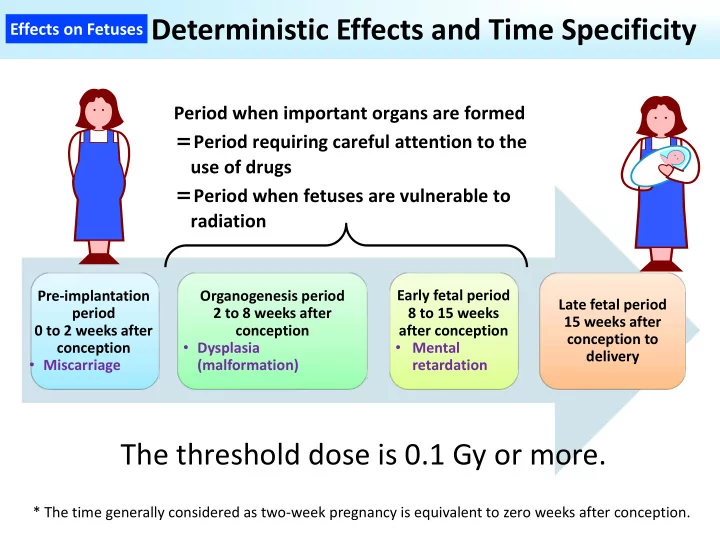
Period when important organs are formed =Period requiring careful attention to the use of drugs =Period when fetuses are vulnerable to radiation

The threshold dose is 0.1 Gy or more.

* The time generally considered as two‐week pregnancy is equivalent to zero weeks after conception. Pre‐implantation period 0 to 2 weeks after conception

  • Miscarriage

Organogenesis period 2 to 8 weeks after conception

  • Dysplasia

(malformation) Early fetal period 8 to 15 weeks after conception

  • Mental

retardation Late fetal period 15 weeks after conception to delivery

Effects on Fetuses

slide-2
SLIDE 2

Mental Retardation

Source: Prepared based on "Physical and Mental Development of Children Exposed to Radiation in Their Mothers' Wombs" on the website

  • f the Radiation Effects Research Foundation(https://www.rerf.or.jp/programs/roadmap/health_effects/uteroexp/physment/)

Risks of a severe intellectual disability (%) 10 20 30 40 50 60 70 80 0.0 0.5 1.0 1.5 Doses within mothers' wombs (Gy) All ages in weeks 8 to 15 weeks 16 to 25 weeks

Data on Atomic Bomb Survivors

Effects on Fetuses

slide-3
SLIDE 3

Survey targets (i) 138 children who were exposed to radiation in the womb and their parents(a group of

children exposed to radiation in the womb: exposed group)

(ii) 122 children in non‐contaminated regions in Belarus and their parents(control group:

non‐exposed group)

○ A significant difference in mental development was observed between the exposed group and the control group, but there was no correlation between exposed doses and intelligence quotients. Therefore, the difference was considered to be attributable to social factors associated with forced evacuation. ○ There was correlation between parents' extreme anxiety and their children's emotional disorders.

It is considered that radiation exposure during pregnancy does not directly affect intelligence quotients of fetuses and children after growth.

Children's mental development When aged 6 to 7 When aged 10 to 11

(i) Exposed group (ii) Control group (i) Exposed group (ii) Control group

Difficulty in speech

18.1% 8.2% 10.1% 3.3%

Disorder of emotion

20.3% 7.4% 18.1% 7.4%

IQ=70〜79

15.9% 5.7% 10.1% 3.3%

Source: Kolominsky Y et al., J Child Psychol Psychiatry, 40 (2): 299‐305, 1999

Survey on children born from mothers who were pregnant at the time

  • f the Chernobyl accident

Effects on Children ‐ Chernobyl Nuclear Accident ‐

Effects on Fetuses

slide-4
SLIDE 4

Knowledge on Malformation Induction

‐ Chernobyl Accident ‐

European Surveillance of Congenital Anomalies (EUROCAT): 18 regions in 9 countries: No change in incidence of malformations before and after the accident

Comparison of European congenital malformation/twin registry database between before and after the Chernobyl accident

Has the Chernobyl accident increased malformation? Finland, Norway, Sweden: No change in incidence of malformations before and after the accident Ukraine: participated in EUROCAT in this century Increase in neural tube defects in an isolated Polish community in the Rivne province It is necessary to evaluate the influences of folate depravation, alcoholism, consanguineous marriage, etc., in addition to radiation.* 2 Belarus: Increase in registration of malformations of aborted fetuses regardless

  • f whether from the contaminated areas or not

Possibility of reporter bias* 1

Source︓*1:Stem Cells 15 (supple 1): 255, 1997 *2 :Pediatrics 125:e836, 2010

Effects on Fetuses