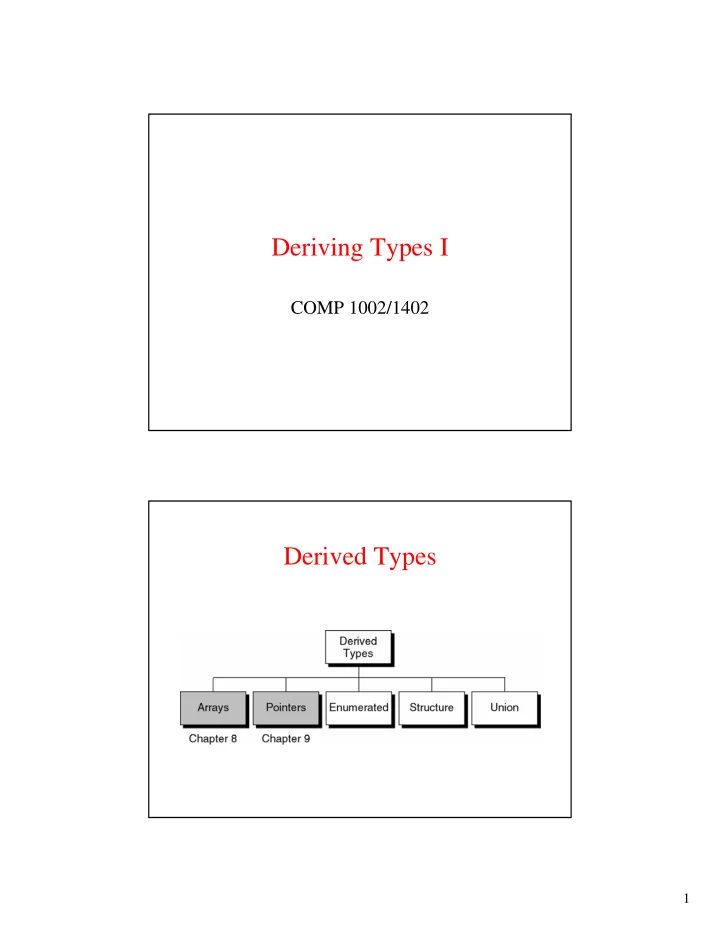
SLIDE 1
1
Deriving Types I
COMP 1002/1402
Derived Types
SLIDE 2
2
The Type Definition
typedef – complex types defined as a different name
typedef
Examples: typedef unsigned int ASIZE; char *stringPtrAry[20]; Replace with: typedef char* STRING;
/* STRING is a “type” - a ptr to a char */
STRING stringPtrArray[20];
SLIDE 3
3
Enumerations
Identifies symbols with integers Built on top of integers
enum
SLIDE 4
4
enum
Defining a single enumeration variable:
enum {sun, mon, tue, wed, thur, fri, sat} days; days = mon; if (days == mon) printf("I don’t like Mondays\n");
enum
Technically: sun is 0, mon is 1, tue is 2, … Therefore: days = 1; /* This is valid */ Careful! C does no range checking!
SLIDE 5
5
enum
How to assign different associated numbers?
enum {sun=1, mon=2, tue=3, wed=4, thur=5,
fri=6, sat=7} days;
Or enum {sun=1, mon, tue, wed, thur, fri, sat} days;
Enumerations
Caution: ISO/ANSI C is not strict with enum Don’t mix enum symbols with integer variables Even if possible This, of course, depends on the compiler. Use: enum symbols to replace constants!
SLIDE 6
6
enum
Defining Multiple enumeration variables with the same values!
enum DaysOfWeek {sun=1, mon, tue, wed, thur, fri, sat}; enum DaysOfWeek today; enum DaysOfWeek yesterday;
typedef & enum
SLIDE 7
7
Structures
A structure is a collection of related elements A field is the smallest element of named data that has meaning An array has elements of the same type A structure can have elements of different types
Examples of Structures
SLIDE 8 8
- Def. : Single Structure Variables
student Variable
struct { char id[10]; char name[26]; int gradePoints; } student;
SLIDE 9
9
Multiple Structure Variables student Variables
struct student { char id[10]; char name[26]; int gradePoints; }; struct student aStudent; struct student topStudent; void printStudent (struct student Stu);
SLIDE 10
10
Defining Structure Types STUDENT type
typedef struct { char id[10]; char name[26]; int gradePoints; } STUDENT; STUDENT aStudent; STUDENT topStudent; void printStudent (STUDENT Stu);
SLIDE 11
11
struct Summary Initializing
SLIDE 12
12
Accessing
Given the aStudent variable, access its fields : Use the . Operator aStudent.id aStudent.name aStudent.gradePoints
if (sam2.u == 'A') sam2.x += sam2.y; scanf("%d %d %f %c", &sam2.x, &sam2.y, &sam2.t, &sam2.u); sam2.x++; sam2.y++;
SLIDE 13 13
Comments on Precedence
- The . Operator has a very high precedence
sam.x++ ++sam.x &sam.x Are equivalent to: (sam.x)++ ++(sam.x) &(sam.x)
Example Using Structs
#include<stdio.h> typedef struct { int numerator; int denominator; } FRACTION; /* write multiplyFraction (...)*/
SLIDE 14
14
Structure Operations
Assignment works on whole structures!
sam2 = sam1;
/* copies contents of sam1 into sam2!! */
Can’t do Comparison
== would compare all bits in structure But some hardware require items start on word boundaries! floats must start at address divisible by ?6? ints must start at address divisible by ?4?
SLIDE 15
15
Structures Aren’t Packed!
A Structure and its bytes: a string bytes 0-24 bytes 25-29 (nothing but noise) a float in bytes bytes 30-35 (Divisible by 6) a char in byte 36 bytes 37-39 (nothing but noise) an int in bytes 40-43 (Divisible by 4)
Pointers to Structures
SLIDE 16
16
Pointers to Structures
(*ptr).x (*ptr).y (*ptr).t (*ptr).u Don’t forget these parentheses!!!! Common mistake : It’s deadly. Why ???
Dereference ptr.x (if ptr is a var : precedence !!!)
Pointers to Structures
SLIDE 17
17
An Easier Way (Selection)
(*pointerName).fieldName Is the same as: pointerName->fieldName
Pointer Selection Operator
SLIDE 18
18
Precedence of Selection
Precedence of -> Is Identical to . This implies they are equally high !
Example
typedef struct { int hr; int min; int sec; } CLOCK; void increment(CLOCK *clock); void show(CLOCK *clock);