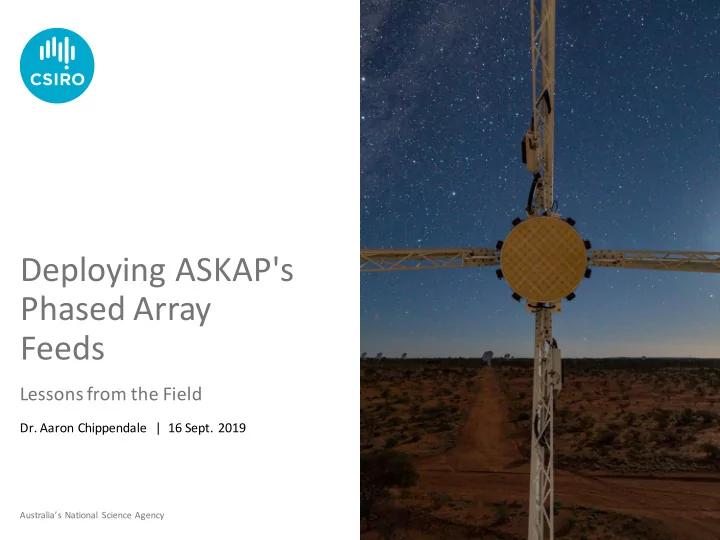
Deploying ASKAP's Phased Array Feeds Lessons from the Field Dr. - - PowerPoint PPT Presentation

deploying askap s phased array feeds
SMART_READER_LITE
LIVE PREVIEW

Deploying ASKAP's Phased Array Feeds Lessons from the Field Dr. - - PowerPoint PPT Presentation

Deploying ASKAP's Phased Array Feeds Lessons from the Field Dr. Aaron Chippendale | 16 Sept. 2019 Australias National Science Agency 36 Reflector Antennas Australian Square 12 m diameter aperture Kilometre Array 22 m to 6 km baselines


slide-1
SLIDE 1

Australia’s National Science Agency

Deploying ASKAP's Phased Array Feeds

Lessons from the Field

  • Dr. Aaron Chippendale | 16 Sept. 2019
slide-2
SLIDE 2

Australian Square Kilometre Array Pathfinder

(...and most complex) World's fastest survey radio telescope 36 Reflector Antennas

12 m diameter aperture 22 m to 6 km baselines 3-axis mounts

Phased Array Feeds

188 receptors per reflector 6,768 radio signals × 600 MHz bandwidth Radio frequency over fibre

Digital Signal Processing

6,912 direct sampled inputs 72 beams × 36 PAFs × (336 × 1 MHz) 3,690 DSP FPGAs, 130 Tbps raw IO, 210 kW

Data rate of a megacity!

slide-3
SLIDE 3

BYO water, electricity, hum

slide-4
SLIDE 4

Key lessons

… in building large, complex systems with major subsystems that are first of kind Prototypes

Things that work in prototypes cause less trouble.

Staging

Plan a design refresh after deploying and

  • perating a 10% system
  • r risk a drastic pivot.

Plan and heed robust reviews.

Test Systems

Complete 1-antenna and partial 3-antenna test platforms are indispensable.

Scaling

Scaling to production before prototype integration causes

  • headaches. Expect new

problems at full scale.

Flexibility

Flexibility of subsystems can inhibit full-system

  • flexibility. Specify

standard modes and configs early or risk delays.

Automation

Continuously integrate, test and deploy

  • everything. Script, log,

visualise and learn from everything.

slide-5
SLIDE 5

Synchronisation challenges over 36 PAFs

Massive distributed systems dictate asynchronous data transport.

Advantages:

  • opportunity for COTS hardware
  • free running clocks don't correlate

But data synchronisation is:

  • far more complex
  • harder as system scales

Problems manifest as:

  • setup/hold violations on FIFO resets
  • buffer over/under-runs
  • clock-domain crossing issues
  • intermittent and distributed issues

that don't show up until the system reaches a certain size We are working to reduce the likelihood of errors and automate their detection and correction with an on-dish noise source.

slide-6
SLIDE 6
  • 95% work fine!
  • 1.7% failed LNAs (lightning)
  • Replacing 2-channel receiver module (domino) fixes most issues

RF Link Problems for 36 PAFs (10 Apr 19)

slide-7
SLIDE 7

LNA Failures for 36 PAFs (10 Apr 19)

'Red' leg 4 (service)

  • LNA bias abnormally high

(by 13 mA)

  • Distorted bandpass
  • Confirmed lightening event on

worst affected antenna

  • Affects edge elements
  • Low impact on FOV
  • Letting it be for now
slide-8
SLIDE 8
  • Domino RF TX power suddenly high/low on many ports
  • Affects approximately 1 of 36 PAFs each day
  • Some antennas affected more frequently
  • Automatically flag affected antennas
  • Planning to automatically restart affected PAFs
  • Investigating root cause (power/comms glitches?)

RFoF Transmitter Dropouts

slide-9
SLIDE 9

Comms Issues

  • Production/deployment

commenced before completing design of the PSU and TEC subsystems -> several modifications required

  • Now losing comms to about
  • ne PAF/PSU/TEC unit every

few months

  • RFoF control link to PAF meets
  • riginal temperature spec but

controlling rack temperatures has been harder than expected

  • Designed bespoke linear PSUs

for the PAFs and TECs, minimising transmission losses and amount of equipment in antenna pedestals

  • Backtracked to a COTS

switched-mode lab supply for the TEC subsystem

  • A COTS PAF PSU would have

significantly reduced debugging time at the cost of higher ongoing electricity use

COTS vs Bespoke PSU

slide-10
SLIDE 10
slide-11
SLIDE 11

GAMA-23 Multi-beam Image interactive version

Galaxy and Mass Assembly, 215 megapixels, 2 ×8 h, 36 antennas

slide-12
SLIDE 12

3D Image of a Complex Field

50 TB raw data, 36 antennas, 10 h, 7 galaxies rich in HI,

slide-13
SLIDE 13

Australia’s National Science Agency

Astronomy and Space Science

  • Dr. Aaron Chippendale

Group Leader, Signal Processing Technologies +61 2 9372 4296 Aaron.Chippendale@csiro.au csiro.au/cass

Thank you