SLIDE 1
1
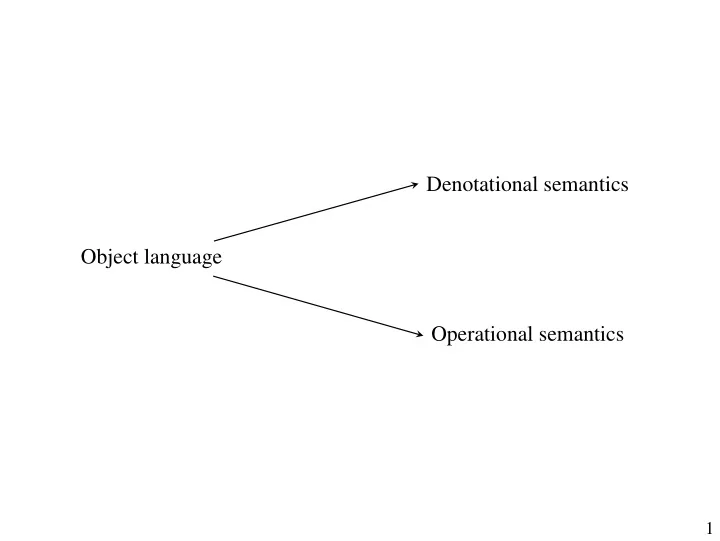
Denotational semantics Object language Operational semantics
SLIDE 2
1
Cheating?
State passing save, load Add register
SLIDE 3
1
Cheating?
State passing save, load set! Add register
SLIDE 4
1
Cheating?
Continuation passing catch, throw, both, someone, everyone reset shift abort Add metacontext
SLIDE 5
1
The rest of this course
Multi-level continuations Donkey anaphora: scope and binding reset shift Quotation
Day 3 Day 5 Day 4
SLIDE 6
2
Donkey anaphora is in-scope binding
Chris Barker and Chung-chieh Shan ESSLLI, 6 August 2008 Semantics and Pragmatics 1(1):1–42, 2008
SLIDE 7
3
Donkey anaphora
If a donkey eats, it sleeps. Every farmer who owns a donkey beats it.
SLIDE 8
3
Donkey anaphora
If a donkey eats, it sleeps. Every farmer who owns a donkey beats it. A donkey pronoun is a pronoun that lies outside the antecedent of a conditional (or the restrictor of a quantifier) yet covaries with an indefinite (or some other quantifier) inside it.
SLIDE 9
3
Donkey anaphora
If a donkey eats, it sleeps. Every farmer who owns a donkey beats it. A donkey pronoun is a pronoun that lies outside the antecedent of a conditional (or the restrictor of a quantifier) yet covaries with an indefinite (or some other quantifier) inside it.
SLIDE 10
3
Donkey anaphora is in-scope binding
If a donkey eats, it sleeps. Every farmer who owns a donkey beats it. A donkey pronoun is a pronoun that lies outside the antecedent of a conditional (or the restrictor of a quantifier) yet covaries with an indefinite (or some other quantifier) inside it. Our claim: the indefinite takes scope over and binds the donkey pronoun as usual. Every boy loves his mother.
SLIDE 11
4
Why not?
Quantifier scope is clause-bound? But not indefinites. A donkey eats. It sleeps.
SLIDE 12
4
Why not?
Quantifier scope is clause-bound? But not indefinites. A donkey eats. It sleeps. Binding requires c-command? Just evaluation order. Every boy’s mother loves him.
SLIDE 13 4
Why not?
Quantifier scope is clause-bound? But not indefinites. A donkey eats. It sleeps. Binding requires c-command? Just evaluation order. Every boy’s mother loves him. How to get the right truth conditions? not ∃d. (donkey d)∧
SLIDE 14 4
Why not?
Quantifier scope is clause-bound? But not indefinites. A donkey eats. It sleeps. Binding requires c-command? Just evaluation order. Every boy’s mother loves him. How to get the right truth conditions? not ∃d. (donkey d)∧
- (eats d) → (sleeps d)
- but
¬∃d. (donkey d)∧(eats d)∧¬(sleeps d) A donkey takes scope over the entire conditional but under if. A donkey sleeps if it eats.
SLIDE 15
5
Our account
Compositional truth conditions: if, every, most, usually, strong/weak. Key: multiple levels of continuations Plan: Everyone loves someone. (surface scope) Everyone loves his mother. If a donkey eats, it sleeps.
SLIDE 16
5
Our account
Compositional truth conditions: if, every, most, usually, strong/weak. Key: multiple levels of continuations Plan: Everyone loves someone. (surface scope) Everyone loves his mother. If a donkey eats, it sleeps. Everyone loves someone. (inverse scope) If a farmer owns a donkey, he beats it. Every farmer who owns a donkey beats it. Most farmers who own a donkey beat it.
SLIDE 17
6
A expression x Lift = ⇒ B (AB) expression λc. c(x)
SLIDE 18
6
A expression x Lift = ⇒ B (AB) expression λc. c(x) C ((A/B)D) left L D (BE) right R = ⇒ C (AE) left right λc. L(λf. R(λx. c(fx)))
SLIDE 19
6
A expression x Lift = ⇒ B (AB) expression λc. c(x) C ((A/B)D) left L D (BE) right R = ⇒ C (AE) left right λc. L(λf. R(λx. c(fx))) C (BD) left L D ((B\A)E) right R = ⇒ C (AE) left right λc. L(λx. R(λf. c(fx)))
SLIDE 20
6
A expression x Lift = ⇒ B (AB) expression λc. c(x) A (SS) expression F Lower = ⇒ A expression F(λx. x) C ((A/B)D) left L D (BE) right R = ⇒ C (AE) left right λc. L(λf. R(λx. c(fx))) C (BD) left L D ((B\A)E) right R = ⇒ C (AE) left right λc. L(λx. R(λf. c(fx)))
SLIDE 21
7
Linear notation Tower notation B (AC) B C A S (DPS) S S DP
SLIDE 22
7
Linear notation Tower notation B (AC) B C A S (DPS) S S DP λc. f[c(x)] f[ ] x λc. ¬∃x. c(mother x) ¬∃x. [ ] mother x
SLIDE 23
8
A expression x Lift = ⇒ B (AB) expression λc. c(x) A (SS) expression F Lower = ⇒ A expression F(λx. x) C ((A/B)D) left L D (BE) right R = ⇒ C (AE) left right λc. L(λf. R(λx. c(fx))) C (BD) left L D ((B\A)E) right R = ⇒ C (AE) left right λc. L(λx. R(λf. c(fx)))
SLIDE 24
8
A expression x Lift = ⇒ B B A expression [ ] x A S S expression f[ ] x Lower = ⇒ A expression f[x] C D A/B left g[ ] f D E B right h[ ] x = ⇒ C E A left right g[h[ ]] f(x) C D B left g[ ] x D E B\A right h[ ] f = ⇒ C E A left right g[h[ ]] f(x)
SLIDE 25
8
A expression x Lift = ⇒ B B A expression [ ] x A S S expression f[ ] x Lower = ⇒ A expression f[x] C D A/B left g[ ] f D E B right h[ ] x = ⇒ C E A left right g[h[ ]] f(x) C D B left g[ ] x D E B\A right h[ ] f = ⇒ C E A left right g[h[ ]] f(x) DP⊲B B DP he λy. [ ] y
SLIDE 26
8
A expression x Lift = ⇒ B B A expression [ ] x A S S expression f[ ] x Lower = ⇒ A expression f[x] C D A/B left g[ ] f D E B right h[ ] x = ⇒ C E A left right g[h[ ]] f(x) A B DP expression f[ ] x Bind = ⇒ A DP⊲B DP expression f([ ]x) x C D B left g[ ] x D E B\A right h[ ] f = ⇒ C E A left right g[h[ ]] f(x) DP⊲B B DP he λy. [ ] y
SLIDE 27
8
A expression x Lift = ⇒ B B A expression [ ] x A S S expression f[ ] x Lower = ⇒ A expression f[x] C D A/B left g[ ] f D E B right h[ ] x = ⇒ C E A left right g[h[ ]] f(x) A B DP expression f[ ] x Bind = ⇒ A DP⊲B DP expression f([ ]x) x C D B left g[ ] x D E B\A right h[ ] f = ⇒ C E A left right g[h[ ]] f(x) DP⊲B B DP he λy. [ ] y S S (S/S)/S if ¬[ ] λpλq. p∧¬q
SLIDE 28
9
Every farmer who owns a donkey beats it
S S N farmer who owns a donkey ∃y. (donkey y)∧ [ ] λz. (farmer z)∧(owns y z)
SLIDE 29
9
Every farmer who owns a donkey beats it
S DP⊲S N farmer who owns a donkey ∃y. (donkey y)∧([ ] y) λz. (farmer z)∧(owns y z)
SLIDE 30 9
Every farmer who owns a donkey beats it
S S S S DP
every ¬∃x. [ ] λP. Px∧¬[ ] x S DP⊲S N farmer who owns a donkey ∃y. (donkey y)∧([ ] y) λz. (farmer z)∧(owns y z)
SLIDE 31 9
Every farmer who owns a donkey beats it
S S S S DP
every ¬∃x. [ ] λP. Px∧¬[ ] x S DP⊲S N farmer who owns a donkey ∃y. (donkey y)∧([ ] y) λz. (farmer z)∧(owns y z) DP⊲S S S S DP\S beats it λw. [ ] [ ] beats w
SLIDE 32 9
Every farmer who owns a donkey beats it
S S S S DP
every ¬∃x. [ ] λP. Px∧¬[ ] x S DP⊲S N farmer who owns a donkey ∃y. (donkey y)∧([ ] y) λz. (farmer z)∧(owns y z) DP⊲S S S S DP\S beats it λw. [ ] [ ] beats w ¬∃x∃y. donkey y∧((farmer x∧owns y x)∧¬(beats y x))
SLIDE 33 10
Most farmers who own a donkey beat it
S S S S DP
most
MOST(λxλp. [ ])
λP. Px∧(p∨[ ]) x
MOST(F)
= #{x | F(x)(FALSE)} #{x | F(x)(TRUE)} > 1 2
SLIDE 34 10
Most farmers who own a donkey beat it (weak)
S S S S DP
most
MOST(λxλp. [ ])
λP. Px∧(p∨[ ]) x
MOST(F)
= #{x | F(x)(FALSE)} #{x | F(x)(TRUE)} > 1 2
SLIDE 35 10
Most farmers who own a donkey beat it (strong)
S S S S DP
most
MOST(λxλp. [ ])
λP. Px∧(p∨¬[ ]) x
MOST(F)
= #{x | F(x)(FALSE)} #{x | F(x)(TRUE)} < 1 2