Delerium and Dementia Sadly, I have nothing to disclose John - - PDF document

delerium and dementia
SMART_READER_LITE
LIVE PREVIEW

Delerium and Dementia Sadly, I have nothing to disclose John - - PDF document

Disclosures Delerium and Dementia Sadly, I have nothing to disclose John Engstrom, M.D. Professor of Neurology April 2017 Mental Status Assessment Screening Mental Status If the patient can give a completely Orientation-time,


slide-1
SLIDE 1

1

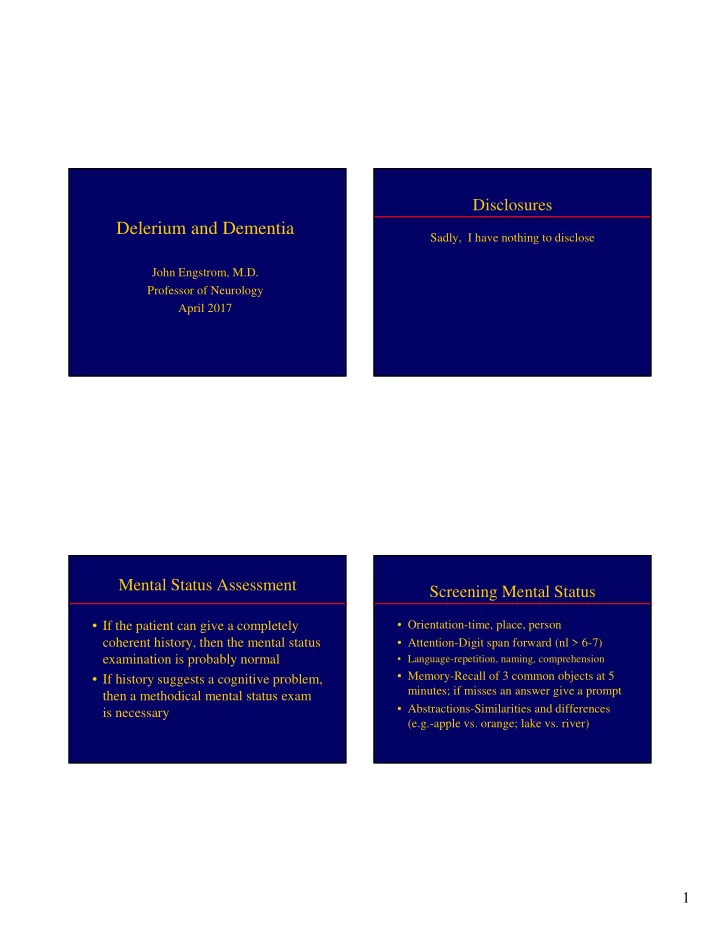
Delerium and Dementia

John Engstrom, M.D. Professor of Neurology April 2017

Disclosures

Sadly, I have nothing to disclose

Mental Status Assessment

  • If the patient can give a completely

coherent history, then the mental status examination is probably normal

  • If history suggests a cognitive problem,

then a methodical mental status exam is necessary

Screening Mental Status

  • Orientation-time, place, person
  • Attention-Digit span forward (nl > 6-7)
  • Language-repetition, naming, comprehension
  • Memory-Recall of 3 common objects at 5

minutes; if misses an answer give a prompt

  • Abstractions-Similarities and differences

(e.g.-apple vs. orange; lake vs. river)

slide-2
SLIDE 2

2

Q1: Which part of an abnormal mental status exam negates testing for memory?

1) Abstractions 2) Attention span 3) Orientation 4) Visual fields

Screen Attention First

  • Attention-requires input of numbers and

immediate recall

– Everyone must remember a numerical sequence – Exceptions: deafness, ESL, no education

  • Memory-input of numbers, hold memory of

numbers for five minutes, and then recall

  • Screen attention first (or after orientation)

Delerium-Defining Features

  • Poor attention-Digit span forward < 6-7
  • Subacute onset
  • Other cognitive abnl (e.g.-disorientation)
  • Not explained by another neurologic dz
  • Evidence that the delirium is caused by a

“metabolic” disorder

Pathological Basis of Delerium: Impaired Attention

  • Inattention-malfunction cerebrum/brainstem
  • Arousal and attention centers in the

brainstem (RAS)

  • Bilateral cerebral regions that receive

sensory inputs, process and interpret information, and react to inputs

– Diffuse circuit network (white matter) – Integration centers (gray matter)

slide-3
SLIDE 3

3 Delerium-Practical Clinical Features

  • History provided by family, friends, co-

workers who know the patient well

– Establish pre-morbid mental baseline – Review medications and “substances” – Review medical comorbidities

  • Call/interview someone who knows history

Delerium-Clinical Accompaniments

  • Fluctuation over minutes-hours-lethargy or

hyperactivity based on many observations

  • Vital signs

– Tachycardia/hypersympathetic state-infection, substance use, substance withdrawal – New hypertension/hypotension – Fever-risk of infection

  • Meningismus-Resistance to neck flexion
  • Exam features above normal in dementia

Q2: Which neuro exam finding helps distinguish delerium from dementia?

1) Fine, postural tremor 2) Asterixis 3) Myoclonus 4) Focal neurol findings (hemiparesis) 5) All of the above

Neurologic exam findings that help distinguish delerium from dementia

  • Fine postural tremor-Acute/subacute onset-
  • ften sign of hypersympathetic state
  • Asterixis-Loss of tone with wrist extension

– Classic with renal or hepatic failure – Seen in many metabolic conditions

  • Myoclonus-sudden discharge of motor cells

producing an asymmetric jerk-metabolic

slide-4
SLIDE 4

4

Delerium-Metabolic Causes/Evaluation

Metabolic Causes Laboratory Studies

Hyponatremia, hypernatremia Na Renal failure BUN, Cr Hypoxia, ischemia PO2 Hypoglycemia, hyperglycemia Glucose Hypothyroidism, hyperthyroidism Thyroid function tests Substance use/withdrawal Toxicology screen Alcohol intoxication/withdrawal Alcohol level Medication overuse or withdrawal Review medications; consider drug level Hypercalcemia, hypermagnesemia Calcium, magnesium Hyperphosphatemia Phosphate Hepatic Failure LFTs; ammonia

Delerium – Common Causes and Evaluation

Infectious Causes Laboratory Studies Sepsis Cultures, CBC, Chest X-Ray, UA Meningitis Lumbar puncture (LP), Cultures, CBC, CXR, UA Neurologic Causes Subarachnoid hemorrhage Head CT, LP Cerebral infarction Head CT or MRI Seizures, post-ictal state Consider head CT/MRI, EEG

Pitfalls in the Outpatient Assessment of Delerium

  • The delerium is a post-ictal state and the

intermittent seizures are not obvious

– Get more history from observers re poss sz – Patient has pre-existing brain dz (e.g.-stroke)

  • The patient is malnourished and has

thiamine deficiency (e.g.-Wernicke’s)

  • No neuro exam-uncooperative patient

Neuro Exam for Focality in the Delerium (Uncooperative) Patient

  • Cranial Nerve Examination
  • Facial asymmetry on command or with grimace
  • Lower 2/3 face-upper motor neuron
  • Entire face-facial nerve or brainstem
  • Brainstem reflexes

– Pupils-midbrain: asymmetric, reactive? – Corneals-pons: asymmetric, reactive – Breathing/pulse-medulla: normal/abnormal

slide-5
SLIDE 5

5 Neuro Exam for Focality in the Delerium (Uncooperative) Patient

  • Motor-grade best strength; note asymmetry

– Moves arms/legs symmetrically vs. gravity? – Able to stand with/without assistance? – Able to walk with/without assistance – If unable to stand/walk-due to focal weakness, focal sensory loss, or focal leg imbalance

  • Sensory-Symmetry of withdrawal of arms
  • r legs to pain stimulus of equal intensity

More Pitfalls in the Outpatient Assessment of Delerium

  • Delerium dx as depression in setting of

somnolence or reduced responsiveness

– Use somatic neurologic signs as above – EEG nl depression, diffusely slow in delerium

  • An undiagnosed neurodegenerative disease

is present (e.g.-Alzheimer’s dz)

– Slower recovery from delerium/post-ictal state – Establish baseline mental function

Q3: What is Not Routinely Useful in Managing Improving Delerium after Hospital Discharge

1) Use of anti-psychotic to control behavior 2) Use of prescribed eyewear 3) Use of prescribed hearing aids 4) Frequent reorientation of the patient in a familiar environment 5) Encourage falling asleep on a schedule

Non-Pharmacologic Prevention and Management of Delerium

  • Especially at hospital discharge
  • Frequent reorientation of the patient
  • Using eyeglasses and hearing aids
  • Early PT/mobilization
  • Sleep hygiene

– Prevent daytime naps – Encourage falling asleep on a schedule

slide-6
SLIDE 6

6

Pharmacologic Management of Delerium

  • Melatonin for sleep-plausible, safe,

unproven

  • Available clinical data do not support the

routine use of anti-psychotics for prevention

  • r treatment of delerium

Delerium-Conclusions

  • If the patient can give a completely coherent

history, then the mental status examination is almost always normal

  • Initial assessment of suspected delerium

should include:

– Establish pre-morbid mental baseline – Rev medication or substance use and disuse – Review medical comorbidities

Delerium-Conclusions

  • Distinguishing delerium from dementia

depends on the results of the general exam, especially vital signs, and the presence or absence of focal signs on neurologic exam

  • Non-pharmacologic measures are proven to

enhance mental functioning in delerium pts

slide-7
SLIDE 7

7

Dementia vs. Delerium: A Family Perspective

  • Dementia-“lights are on but nobody home”

– Patients preserve social graces until late – Mental baseline not normal once probed – Recent memory/abstract thinking impaired consistently with little fluctuation

  • Delerium-“lights are flickering on and off”

– Attention span is impaired and fluctuates – Risks: medical illness, drugs or substances, medical comorbidities, normal mental baseline

Dementia

  • Dementia–a decline in cognition interfering with

daily function and independence

– No disturbance of consciousness – Best assessed as an outpatient

  • Impairment in at least one cognitive domain:

– Memory and learning – Language – Executive function-judgment, planning, reasoning – Social cognition, perceptual –motor function

Goals of Dementia Assessment

  • Establish the presence/absence of dementia
  • Understand areas of cognitive impairment

and the severity of the impairment

  • Understand the functional consequences of

the areas of cognitive impairment

  • Determine the likely etiology

Approach to Patient/Family: Visit One

  • Best history from patient and family/friend
  • General/neuro exams plus limited testing
  • May need separate input from others if

patient is defensive or argumentative

  • Patients often lack insight into the problem

– Denial or excuses-remembering something is not important anymore or too old for an activity – Social and interpersonal skills preserved early

slide-8
SLIDE 8

8 Q4: Which one of the following is important in a dementia history?

1) Recent memory function 2) Executive function 3) Language 4) Assessing impact of cognition on safety risks 5) All of the above

Dementia History-Memory

  • Age Associated Memory Challenges

– Forgetting words or names – Slowing of cognitive processing – Increased difficulty with multitasking

  • Worrisome Memory Deficits

– Forgetting recent conversations – Forgetting appts and plans – Not paying bills on time

Dementia History-Language

  • Reduced volume of language but with

perservation of content words

  • Paraphasic errors-substituting one word for

another that sounds similar but has a different meaning (e.g.-cow for car)

  • Neologisms-sounds that are not words

Dementia History-Executive Function

  • Performing complex tasks
  • Initiating plans
  • Following multistep directions-using a

remote control or computer

  • Visuospatial deficits-difficulty using hands

for a complex task or misjudging the position of objects in space

slide-9
SLIDE 9

9 Dementia History-Functional Assessment

  • Basic ADLs preserved until late-bathing,

eating, dressing, grooming, continence

  • Safety risks-driving, climbing stairs, falling
  • r near falls, car accidents, getting lost,
  • Food preparation, household maintenance
  • Keeping appointments, managing finances

Dementia History-Comorbidities Limiting Function?

  • Special senses-Diminished hearing or vision
  • Conditions limiting mobility-CHF, hip

arthritis, balance (medications, alcohol)

  • 2 story house, steps into the house, home

filled with debris-condition of the home?

  • Home alone-social function, psychological

state, help with challenging home tasks

Screening Mental Status

  • Orientation-time, place, person
  • Attention-Digit span forward (nl > 6-7)
  • Language (aphasia testing)-repetition,

naming, comprehension

  • Memory-Recall of 3 common objects at 5

minutes; if misses an answer give a prompt

  • Abstractions-Similarities and differences

(e.g.-apple vs. orange; lake vs. river)

Cognitive Testing-the MoCA

  • 30 point test-takes 10 minutes to administer
  • Normal score > 25; adjust education level
  • Improvement detecting MCI (mild

cognitive impairment) from MMSE

  • Assesses memory, executive function,

language, visuospatial ability

  • When abnl may indicate AD but other

structural neurologic dz must be considered

  • www.mocatest.org electronic copy of test
slide-10
SLIDE 10

10

Dementia-Cranial Nerve Exam

  • Cranial nerve palsy unexpected in dementia

– Diplopia/impaired eye movts (CN III, IV, or VI)-brainstem – Weakness lower 2/3 face (CNS) or entire face (CN VII palsy or brainstem) – Difficulty swallowing, aspiration (CN X) – Abnormal brainstem reflexes (pupils, corneals) – Any other CN palsy-much less common

Dementia-Motor/Sensory Exam

  • Rigidity or cogwheeling tone-Parkinsonism
  • Spasticity/UMN weakness-Descending

motor tracts (stroke, brain tumor, MS)

  • LMN Weakness-motor neuron disease
  • Unilateral ataxia limb-cerebellum
  • Gait ataxia-cerebellum, sensory loss, sever

focal weakness

  • Unilat sensory loss-ascending sensory tracts

Dementia-Lab Assessment

  • B12, TSH, BUN, Cr, CBC
  • Consider RPR, HIV, methylmalonic acid
  • Brain MRI-subdural hematoma, strokes,

white matter disease, microhemorrhages, and subdural hematoma

  • Amyloid PET imaging-amyloid lesion

burden and distribution in brain

– No routine clinical use-diagnosis of AD vs.

  • ther dementias, prognosis, research biomarker

Q5: Which statement regarding Alzheimer’s disease is false?

1) Most common form of dementia 2) Prevalence is constant in the population after age 70 3) Uncommon before age 60 4) Impaired recent memory is the most common deficit at presentation

slide-11
SLIDE 11

11

Alzheimer’s Dz-Epidemiology

  • Genetic forms are uncommon, except in

patients with early age of onset

  • Prevalence increases with age-up to 40% of

patients over the age of 90 years have AD

  • “The Silent, Slow Epidemic”-As life

expectancy continues to increase the incidence of AD will skyrocket

  • Quality of life decried by family members

Alzheimer’s Disease-Drug Rx

  • Depletion of cortical choline acetyl

transferase leads to decreased acetylcholine and impaired cholinergic function

– Donepezil (rivastigmine, galantamine) – Donepezil 5 mg po/day x 4 weeks, then 10 po – Small benefit MMSE scores in patients with mild-moderate dementia – Diarrhea, nausea, emesis transient in 20% – Effect washes out when drug discontinued

Alzheimer’s Disease-Drug Rx

  • Memantine-NMDA receptor antagonist

– Neuroprotective-Agents that block pathologic stimulation NMDA receptors (vasc dem, AD) – Trials show reduced rates of deterioration on clinical efficacy scales and possibly useful as add-on to donepezil in moderate to severe AD – Infreq side effects-HA, dizziness, confusion – 5 mg/day x 1 week, then increase by 5 mg/wk until taking 10 mg bid

Alzheimer’s Disease-Drug Rx

  • Vitamin E-2000 U/day-mixed results
  • Patients and families will ask you about

what they read on the internet

  • No role for selegiline, estrogen replacement,

antiinflammatory drugs, ginkgo biloba, statins, vitamin B, omega-3 fatty acids

slide-12
SLIDE 12

12

Dementia Management Issues

  • Nutrition-Malnutrition common; oral

supplements may be useful

  • Exercise-slows functional decline but not

cognitive decline

  • Occup Rx-individual sessions training

pts/caregivers on coping strategies and use

  • f aids improved function at 3 months

Dementia-Quality of Life and Survival

  • Mean survival if dx at age 65 is 9 years
  • Mean survival if dx at age 90 is 3 years
  • Prognostication affects eligibility for

hospice Medicare benefit-only estimated survival of < 6 months are eligible

  • Palliative care access should not be guided

by prognosis in AD but family preferences

  • n maximizing comfort and quality of life

Dementia and Sleep Disturbance

  • Insomnia and irregular sleep-wake rhythm
  • Restless legs syndrome
  • Periodic limb movements of sleep
  • REM sleep disorder-acting out dreams
  • Obstructive sleep apnea
  • Excessive daytime somnolence
  • Refer sleep center consultation/sleep study

Approach to Patient/Family: Visit Two

  • Patient and family/significant other
  • Discuss test results and what they mean
  • Describe diagnosis and etiology (if known)
  • Discuss management

– ADLs including driving, finances, safety risks – Drug and non-drug management strategies – Community and social resources – Quality of life and advanced directives

slide-13
SLIDE 13

13

Dementia Conclusions

  • Dementia is a decline in cognition interfer-

ing with daily function and independence

  • The most common domains of impairment

are recent memory, language, and executive function

  • Gen/neurologic exams establish presence or

absence of other medical/neurologic contributions to altered mental status

Dementia Conclusions

  • Approved drug treatments for Alzheimer’s

disease are of modest benefit

  • Personalize care by addressing safety risks,

management of ADLs, minimizing treatable medical problems (e.g.-hearing loss, CHF)

  • Address quality of life issues with the

patient and caregivers (advanced directives and enhance activities that give pleasure)

slide-14
SLIDE 14

John Engstrom, M.D. April 2017

Delerium and Dementia-References

  • 1. Brown EG and Douglas VC. Moving Beyond Metabolic Encephalopathy: An Update on

Delirium Prevention, Workup, and Management. Semin Neurol 2015;35:646-655.

  • 2. Fick DM Agostini JV, InouyeSK. Delerium Superimposed on Dementia: a systematic
  • review. J Am Geriatr Soc 2001;50:1723.
  • 3. Lawlor PG, Gagnon B, Mancini IL et al. Occurrence, cuases and Outcome of delirium in

patients with advanced cancer: a prospective study. Arch Intern Med 2000;160:786.

  • 4. Hshieh TT, Yue J, Oh E, et al. Effectiveness of multicomponent nonpharmacological

delirium interventions: a meta-analysis. JAMA Intern Med2015:175(4):512.

  • 5. Galvin JE, Roe CM, Xiong C, Morris JC. Validity and reliability of the AD8 informat

interview in dementia. Neurology 2006; 67(11):1942-1948.

  • 6. Courtney C, Ferrell D, Gray R et al. Long term donepezil treatment in 565 pateints with

Alzheimer’s disease: randomized double-blind trail. Lancet 2004;363:2105.,

  • 7. Knopman DS, DeKosky ST, Cummings JL et al. Practice parameter: diagnosis of

dementia (an evidence–based review). Report of the Quality Standards Subcommittee of the American Academy of Neurology. Neurology 2001;56(():1143.

  • 8. Reisberg B, Doody R, Stöffler A, et al. Memantine in moderate-to-severe Alzheimer's
  • disease. N Engl J Med 2003; 348:1333.
  • 9. Howard R, McShane R, Lindesay J, et al. Donepezil and memantine for moderate-to-

severe Alzheimer's disease. N Engl J Med 2012; 366:893.

  • 10. Forbes D, Forbes SC, Blake CM, et al. Exercise programs for people with dementia.

Cochrane Database Syst Rev 2015; :CD006489. Answer Key to Questions Q1 Choice 2-attention span Q2 Choice 5-all of the above Q3 Choice 1-use of antipsychotic to control behavior Q4 Choice 5-all of the above Q5 Choice 2-“prevalence is constant in the populations after age 70”; statement is false