
SLIDE 1
GPU-ACCELERATED DEEP LEARNING FRAMEWORK FOR CYBER-ENABLED MANUFACTURING
ADI DITY TYA A BALU SA SAMBIT IT GHADAI AI SO SOUMIK K SA SARKA KAR ADARS RSH H KR KRISH SHNAMUR AMURTHY THY
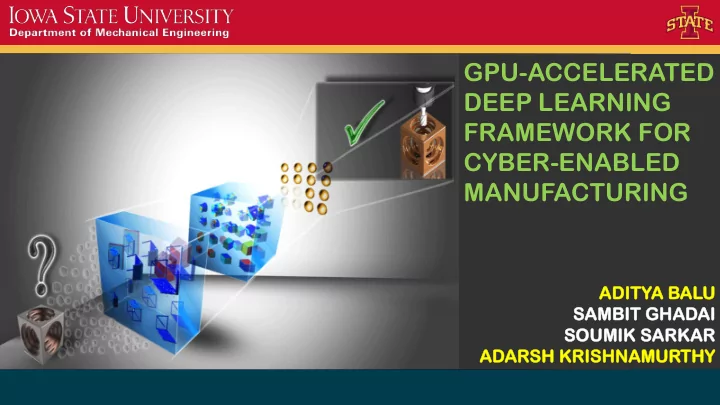
DEEP LEARNING FRAMEWORK FOR CYBER-ENABLED MANUFACTURING ADI DITY - - PowerPoint PPT Presentation
GPU-ACCELERATED DEEP LEARNING FRAMEWORK FOR CYBER-ENABLED MANUFACTURING ADI DITY TYA A BALU SA SAMBIT IT GHADAI AI SO SOUMIK K SA SARKA KAR ADARS RSH H KR KRISH SHNAMUR AMURTHY THY Outline Volumetric Deep Learning based
ADI DITY TYA A BALU SA SAMBIT IT GHADAI AI SO SOUMIK K SA SARKA KAR ADARS RSH H KR KRISH SHNAMUR AMURTHY THY
Design for Manufacturing
Volumetric Representations for CAD Models Deep Learning based Design for Manufacturing Explainable Deep Learning
May 15, 2017 2
Design Manufacturing
INFLUENCE OVER PRODUCT COST
10 20 30 40 50 60 70 80 90 100 Percentage Time Design Production
final product cost
issues early
May 15, 2017 3
Source: David Stienstra (Rose-Hulman)
Design freedom to make change Cost of change Design knowledge DFM
rule based analysis
engineers
processes
Standard Guidelines for Design for Additive Manufacturing
May 15, 2017 4
Design Manufacturing Redesign
manufacturable features in a CAD model
and non-manufacturable models
difficult to codify
May 15, 2017 5
May 15, 2017 6
CAD models
triangles for rendering
volumetric information
May 15, 2017 7
information
convolutional neural network
large number of CAD models
May 15, 2017 8
Design for Manufacturing
Volumetric Representations for CAD Models Deep Learning based Design for Manufacturing Explainable Deep Learning
May 15, 2017 9
the object
voxel bounding-box center points, classify as in or out
. . . . . . . . . . . . . . . . . . . . . . . . . . . . . . . . . . . . . . . . . . . . . . . . . . . . . . . . . . . . . . . . . . . . . . . . . . . . . . . . . . . . . . . . . . . . . . . . . . . . . . . . . . . . . . . . . . . . . . . . . . . . . . . . . . . . . . . . . . . . . . . . . . . . . . . . . . . . . . . . . . . . . . . . . . . . . . . . . . . . . . . . . . . . . . . . . . . . . . . . . . . . . . . . . . . . . . . . . . . . . . . . . . . . . . . . . . . . . . . . . . . . . . . . . . . . . . . . . . . . . . . . . . . . . . . . . . . . . . . . . . . . . . . . . . . . . . . . . . . . . . . . . . . . . . . . . . . . . . . . . . . . . . . . . . . . . . . . . . . . . . . . . . . . . . . . . . . . . . . .
May 15, 2017 10
intersection test
an arbitrary axis
count the number of pixels
corresponds to a grid point in a 2D slice
May 15, 2017 11 View Direction Pixels
Design for Manufacturing
Volumetric Representations for CAD Models Deep Learning based Design for Manufacturing Explainable Deep Learning
May 15, 2017 12
recognition
classification
learning
May 15, 2017 13
[1]. http://dfmpro.geometricglobal.com/files/2017/04/Whitepaper-A-new-approach- to-design-and-manufacturing-collaboration.pdf
May 15, 2017 14
May 15, 2017 15
(a) (b) (c) (d) (e) (f) DLDFM
May 15, 2017 16
May 15, 2017 17 0% 20% 40% 60% 80% 100% DLDFM (binary + normals) DLDFM (Orthogonal Distance Fields) DLDFM (binary)
Representative Test Data Manufacturable
True Positive (Predicted Manufacturable, Actually Manufacturable) False Negative (Predicted Non-Manufacturable, Actually Manufacturable) 0% 20% 40% 60% 80% 100% DLDFM (binary + normals) DLDFM (Orthogonal Distance Fields) DLDFM (binary)
Representative Test Data Non-Manufacturable
True Negative (Predicted Non-Manufacturable, Actually Non-Manufacturable) False Positive (Predicted Manufacturable, Actually Non-Manufacturable)
0% 20% 40% 60% 80% 100% DLDFM (binary + normals) DLDFM (Orthogonal Distance Fields) DLDFM (binary)
Non-Representative Test Data Manufacturable
True Positive (Predicted Manufacturable, Actually Manufacturable) False Negative (Predicted Non-Manufacturable, Actually Manufacturable)
May 15, 2017 18 0% 20% 40% 60% 80% 100% DLDFM (binary + normals) DLDFM (Orthogonal Distance Fields) DLDFM (binary)
Non-Representative Test Data Non-Manufacturable
True Negative (Predicted Non-Manufacturable, Actually Non-Manufacturable) False Positive (Predicted Manufacturable, Actually Non-Manufacturable)
May 15, 2017 19 0% 10% 20% 30% 40% 50% 60% 70% 80% 90% 100% DLDFM (orthogonal distance fields) DLDFM (binary + normals) DLDFM (binary) True Positive (Predicted Manufacturable, Actually Manufacturable) True Negative (Predicted Non-Manufacturable, Actually Non-Manufacturable) False Negative (Predicted Non-Manufacturable, Actually Manufacturable) False Positive (Predicted Manufacturable, Actually Non-Manufacturable)
Design for Manufacturing
Volumetric Representations for CAD Models Deep Learning based Design for Manufacturing Explainable Deep Learning
May 15, 2017 20
Disadvantage: Not class discriminative
References: [1]. Zeiler, Matthew D., and Rob Fergus. "Visualizing and understanding convolutional networks." European conference on computer vision. Springer International Publishing, 2014. [2]. Simonyan, Karen, and Andrew Zisserman. "Very deep convolutional networks for large-scale image recognition." arXiv preprint arXiv:1409.1556 (2014). [3]. Zhou, Bolei, et al. "Learning deep features for discriminative localization." Proceedings of the IEEE Conference on Computer Vision and Pattern Recognition. 2016. [4]. Selvaraju, Ramprasaath R., et al. "Grad-CAM: Why did you say that?." arXiv preprint arXiv:1611.07450 (2016). May 15, 2017 21
Input: Volumetric Representation
Convolutional Layer Convolution Filters 1 Convolution Filters 2 Convolutional Layer Pooling Layer Fully Connected Layer (Yes/No) Interpretation Class Activation Map
Output: Manufacturability
May 15, 2017 22
May 15, 2017 23
One Hole Manufacturable Insight: 3D Grad-CAM is class discriminative
May 15, 2017 24
Two Holes Manufacturable (both)
May 15, 2017 25
Insight: DLDFM can predict manufacturability of multiple features simultaneously
Insight: DLDFM can predict manufacturability of individual features
May 15, 2017 26
Two Holes Non-Manufacturable (due to one of them)
May 15, 2017 27
Insight: DLDFM can predict manufacturability of interacting features by generalizing the rules Two Holes Non-Manufacturable (due to interaction between them)
L-Shaped Block with Hole Non-Manufacturable (close to external face) Insight: DLDFM can predict manufacturability based on a local feature instead of external geometry
May 15, 2017 28
Cylindrical-Shaped Block with Hole Non- Manufacturable (close to external cylindrical face) Insight: DLDFM can predict manufacturability based on a local feature even with complicated external geometry
May 15, 2017 29
May 15, 2017 30
May 15, 2017 31
May 15, 2017 32