Decentralized Stochastic Optimization and Gossip Algorithms with - - PowerPoint PPT Presentation

decentralized stochastic optimization and gossip
SMART_READER_LITE
LIVE PREVIEW

Decentralized Stochastic Optimization and Gossip Algorithms with - - PowerPoint PPT Presentation

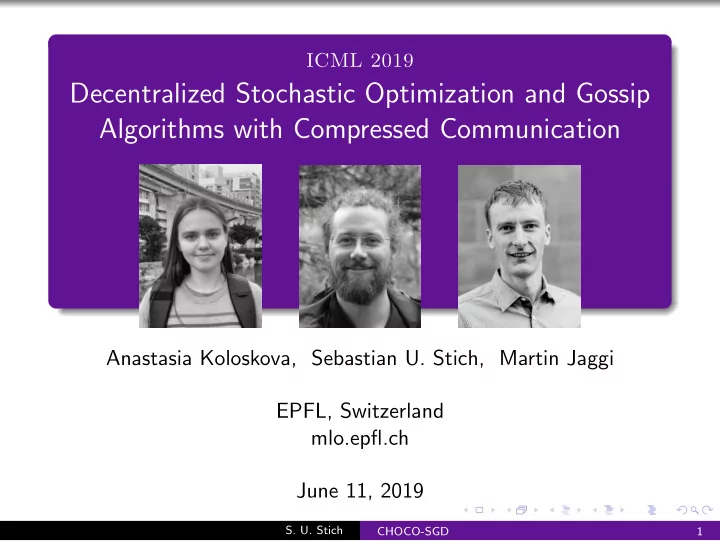
ICML 2019 Decentralized Stochastic Optimization and Gossip Algorithms with Compressed Communication Anastasia Koloskova, Sebastian U. Stich, Martin Jaggi EPFL, Switzerland mlo.epfl.ch June 11, 2019 S. U. Stich CHOCO-SGD 1 Decentralized


slide-1
SLIDE 1

ICML 2019

Decentralized Stochastic Optimization and Gossip Algorithms with Compressed Communication

Anastasia Koloskova, Sebastian U. Stich, Martin Jaggi EPFL, Switzerland mlo.epfl.ch June 11, 2019

  • S. U. Stich

CHOCO-SGD 1

slide-2
SLIDE 2

Decentralized Stochastic Optimization

min

x∈Rd

  • f(x) := 1

n

n

  • i=1

fi(x)

  • fi(x)

fj(x) ← devices ← communication links

each device has oracle access to stochastic gradients gi(x), Egi(x) = ∇fi(x), Var[gi] ≤ σ2

i

  • S. U. Stich

CHOCO-SGD 2

slide-3
SLIDE 3

Decentralized Stochastic Optimization

Applications: servers, mobile devices, sensors, hospitals, ... Advantages:

  • no central coordinator
  • local communication vs. all-reduce
  • data distributed (storage & privacy aspects)

This work: bandwidth restricted setting where communication is a bottleneck

  • S. U. Stich

CHOCO-SGD 3

slide-4
SLIDE 4

Data Compression for Efficient Communication

Communication Compression: Compress models/model updates before sending over the network. This work: Arbitrary compressors, supporting the main SOTA techniques! General Compressor: Q: Rd → Rd can be biased! EQ x − Q(x)2 ≤ (1 − δ) x2 ∀x ∈ Rd Examples: Quantization, rounding, sign, top-k, rank-k

  • S. U. Stich

CHOCO-SGD 4

slide-5
SLIDE 5

Main Contribution: CHOCO-SGD

We propose CHOCO-SGD: a decentralized SGD algorithm with communication compression. Main result: CHOCO-SGD converges at the rate f(¯ xT ) − f⋆ = O ¯ σ2 µnT

linear speedup matches centralized baseline

+ 1 µ2δ2ρ4T 2

  • higher order term, accounting

for topology and compression

  • f µ-strong convex, variance ¯

σ = 1

nσ2 i , spectral gap of topology ρ > 0

  • first scheme with linear speedup for arbitrary compressors
  • improves over previous approach [Tang et al., Neurips 18]
  • S. U. Stich

CHOCO-SGD 5

slide-6
SLIDE 6

Key Technique: CHOCO-Gossip

We propose CHOCO-Gossip: a new algorithm with communication compression for the average consensus problem: ¯ x = 1 n

n

  • i=1

xi classic gossip averaging

+

compression with error feedback [Xiao & Boyd, 04] [Stich et al., NeurIPS 18]

  • linear convergence for arbitrary compressors
  • all previous gossip schemes with compression did not converge

linearly (or not at all) for arbitrary compressors

  • S. U. Stich

CHOCO-SGD 6

slide-7
SLIDE 7

Experimental Results

Example: quantization to 4bits epochs transmitted data

Logistic regression on epsilon dataset, ring topology with n = 9 nodes.

  • S. U. Stich

CHOCO-SGD 7

slide-8
SLIDE 8 ICML, June 10–15, Long Beach CHOCO-SGD: Decentralized Stochastic Optimization & Gossip Algorithms with Compressed Communication {anastasia.koloskova, sebastian.stich, martin.jaggi}@epfl.ch CHOCO-SGD: A new Algorithm for Decentralized Optimization with Communication Compression Decentralized Optimization Problem on n nodes: min x∈Rd  f(x) := 1 n n
  • i=1
fi(x)   fi: Rd → R can be stochastic: fi(x) := EξiFi(x, ξi) In decentralized optimization the communication between worker nodes can be a major bottleneck (for e.g. optimiza- tion on mobile devices over slow or metered connections). Assumptions & Notation:
  • nodes can only communicate with neighbors in network G
  • G = ([n], E), averaging weights Wij ≥ 0 ⇔ {i, j} ∈ E,
W doubly stochastic, spectral gap ρ := 1 − |λ2(W)| > 0.
  • fi: Rn → R µ-strongly convex, L-smooth, κ := L
µ
  • access to gradient oracles, gi: Rd → Rd, s.t. ∀x ∈ Rn:
E gi(x) = ∇fi(x) , E gi2 ≤ G2 , Var gi ≤ σ2 i
  • ¯
σ2 := 1 n n i=1 σ2 i
  • compressor Q: Rd → Rd
EQ Q(x) − x2 ≤ (1 − δ) x2 , ∀x ∈ Rd Device Device (cheap) CHOCO-SGD: compressed (expensive) standard: uncompressed messages Main result: CHOCO-SGD converges at the rate f(¯ xT) − f ⋆ = O   ¯ σ2 µnT linear speedup matches centralized baseline + κG2 µδ2ρ4T 2
  • higher order term, accounting
for topology and compression  
  • first linearly converging gossip algorithm with
arbitrary compression
  • first decentralized SGD algorithm for arbitrary
compression
  • outperforms all baselines in experiments
Worker i Private: xi Public: ˆ xi Worker j Q(xi − ˆ xi) modified gossip averaging with compressed messages Q(xj − ˆ xj) A non-trivial modification of the gossip protocol allows convergence with arbitrary compressed messages. Details Warm-up: Average Consensus Problem ¯ x = 1 n n
  • i=1
xi can be solved with the gossip algorithm: x(t+1) i := x(t) i + γ
  • {i,j}∈E
wij∆(t) ij [Xiao & Boyd, 07] exact gossip: ∆(t) ij = x(t) j − x(t) i converges linearly: X(t+1) − ¯ X2 F ≤ (1 − ρ)2X(t) − ¯ X2 F [Aysal+, 08] quantize 1×: ∆(t) ij = Q
  • x(t)
j
  • − x(t)
i The average is not preserved, 1 n n i=1 x(t) i = ¯ x for t > 0. [Carli+, 07] quantize 2×: ∆(t) ij = Q
  • x(t)
j
  • − Q
  • x(t)
i
  • Preserves average but oscillates around a neighborhood of
¯ x, the quantization error Q(¯ x) − ¯ x ∝ ¯ x ≫ 0. [we:] control quantization noise: γ < 1, ∆(t) ij = ˆ x(t) j − ˆ x(i) i with ˆ x(t+1) i := ˆ x(t) i + Q
  • x(t+1)
i − ˆ x(t) i
  • x(t+1)
i = ˆ x(t) i
  • sum of quantized messages
known to neighbors + e(t+1) i error→0,(t→∞) Algorithm: CHOCO-SGD (quantized gossip + SGD) input: Initial values x(0) i ∈ Rd on each node, consensus stepsize γ SGD stepsize η, mixing matrix W, ˆ x(0) i := 0 ∀i ∈ [n] 1: for t in 0 . . . T − 1 do {in parallel for all workers i ∈ [n]} 2: x(t) i := x (t−1 2) i + γ
  • j:{i,j}∈E wij
  • ˆ
x(t) j − ˆ x(t) i
  • ⊳ modified gossip
3: q(t) i := Q(x(t) i − ˆ x(t) i ) ⊳ compression 4: for neighbors j : {i, j} ∈ E (including {i} ∈ E) do 5: Send q(t) i and receive q(t) j ⊳ communication 6: ˆ x(t+1) j := q(t) j + ˆ x(t) j ⊳ local update 7: end for 8: Sample ξ(t) i , compute gradient g(t) i := ∇Fi(x(t) i , ξ(t) i ) 9: x (t+1 2) i := x(t) i − ηg(t) i ⊳ stochastic gradient update 10: end for 1
  • 2
  • 1 new compressed gossip update
2 standard SGD update xi is the private variable ˆ xi is the public copy available to neighbors and updated using only compressed information Experiments CHOCO-GOSSIP (Compressed Gossip) Gossip averaging: f(x) = 1 n n
  • i=1
xi for vectors xi of epsilon dataset (d = 2000) Topology: ring with 8 nodes. 100 200 300 400 Iteration 10−9 10−7 10−5 10−3 10−1 Error qsgd 8bit (E-G) (Q1-G), qsgd 8bit (Q2-G), qsgd 8bit CHOCO, qsgd 8bit 0.0 0.5 1.0 1.5 2.0 2.5 3.0 Number of transmitted bits 1e8 10−8 10−6 10−4 10−2 100 Error qsgd 8bit (E-G) (Q1-G), qsgd 8bit (Q2-G), qsgd 8bit CHOCO, qsgd 8bit 10000 20000 30000 Iteration 10−9 10−7 10−5 10−3 10−1 101 Error rand1%/top1% (E-G) (Q1-G), rand1% (Q2-G), rand1% CHOCO, rand1% CHOCO, top1% 0.0 0.5 1.0 1.5 2.0 2.5 Number of transmitted bits 1e9 10−9 10−7 10−5 10−3 10−1 101 Error rand1%/top1% (E-G) (Q1-G), rand1% (Q2-G), rand1% CHOCO, rand1% CHOCO, top1% CHOCO-SGD (Decentralized Compressed SGD) Logistic regression: f(x) = 1 n n
  • i=1
log
  • 1 + e−bia⊤
i x + 1 2n x2 for rcv1 test dataset (m = 20242, d = 47236). Topology: ring with 8 nodes. data are sorted by the label and then spitted between workers Theorem (Compressed Consensus): Converges linearly for specific stepsize γ = Θ(ρ2δ): Edt ≤
  • 1 − Θ(ρ2δ)
t d0 , where dt = X(t) − ¯ X2 F + X(t) − ˆ X(t)2 F.
  • linear convergence for all δ > 0
  • for δ → 1 we do not precisely recover the gossip rate
Theorem (Decentralized Compressed SGD): With step- sizes ηt := 4 µ(a+t) for a ≥ max
  • 410
ρ2δ, 16κ
  • and γ as above,
Ef(x(T) avg) − f ⋆=O σ2 µnT + κG2 µδ2ρ4T 2
  • ,
for x(T) avg = 1 ST T−1 t=0 wtx(t), wt = (a + t)2, ST = T−1 t=0 wt.
  • linear speedup in the number of workers
  • the leading term is not affected by the topology and the
compression operator Example (Biased) Compression Operators
  • sparsification: (Rd) randk or topk
δ = k d
  • random quantization: (Rd) For precision (levels) s ∈ N+,
τ = (1 + min{d/s2, √ d/s}) qsgds(x) = sign(x) · x sτ ·
  • s |x|
x + ξ
  • ,
for random variable ξ ∼u.a.r. [0, 1]d δ = 1 τ
  • low-rank approximation: (Rd×d) randk, topk
δ = k d Discussion & Open Problems
  • the rate of compressed consensus might not be tight, as
for δ → 1 there is a small difference to exact gossip: (1 − Θ(ρ))2 ≤ (1 − Θ(ρ2)), this transfers to CHOGO-SGD (ρ4 vs. ρ2)
  • how to set γ robustly in practice?
  • the algorithm is synchronous, if some of the workers are
slow, then others have to wait for these
  • privacy: the (compressed) messages transmitted between
workers can reveal information about the underlying data

Summary

+ compression with error feedback gives drastic reduction in communication, without hurting the convergence + first compressed gossip scheme that converges at linear rate + first decentralized SGD with compressed communication that converges for arbitrary compression (without hampering the rate) Compression for free, by enabling error feedback in the decentralized setting

Poster #197

  • S. U. Stich

CHOCO-SGD 8

Decentralized Stochastic Optimization and Gossip Algorithms with Compressed Communication Anastasia Koloskova * 1 Sebastian U. Stich * 1 Martin Jaggi 1 Abstract We consider decentralized stochastic optimiza- tion with the objective function (e.g. data samples for machine learning tasks) being distributed over n machines that can only communicate to their neighbors on a fixed communication graph. To address the communication bottleneck, the nodes compress (e.g. quantize or sparsify) their model
  • updates. We cover both unbiased and biased com-
pression operators with quality denoted by δ ≤ 1 (δ = 1 meaning no compression). We (i) propose a novel gossip-based stochastic gradient descent algorithm, CHOCO-SGD, that converges at rate O
  • 1/(nT) + 1/(Tρ2δ)2
for strongly convex objectives, where T denotes the number of iterations and ρ the eigengap of the connectivity matrix. We (ii) present a novel gossip algorithm, CHOCO-GOSSIP, for the av- erage consensus problem that converges in time O(1/(ρ2δ) log(1/ε)) for accuracy ε > 0. This is (up to our knowledge) the first gossip algorithm that supports arbitrary compressed messages for δ > 0 and still exhibits linear convergence. We (iii) show in experiments that both of our algo- rithms do outperform the respective state-of-the- art baselines and CHOCO-SGD can reduce com- munication by at least two orders of magnitudes.
  • 1. Introduction
Decentralized machine learning methods are becoming core aspects of many important applications, both in view of scalability to larger datasets and systems, but also from the perspective of data locality, ownership and privacy. We con- sider decentralized optimization methods that do not rely
  • n a central coordinator (e.g. parameter server) but instead
  • nly require on-device computation and local communica-
*Equal contribution 1EPFL, Lausanne, Switzerland. Correspon- dence to: Anastasia Koloskova <anastasia.koloskova@epfl.ch>. Proceedings of the 36 th International Conference on Machine tion with neighboring devices. This covers for instance the classic setting of training machine learning models in large data-centers, but also emerging applications were the com- putations are executed directly on the consumer devices, which keep their part of the data private at all times.1 Formally, we consider optimization problems distributed across n devices or nodes of the form f ⋆ := min x∈Rd
  • f(x) := 1
n n
  • i=1
fi(x)
  • ,
(1) where fi : Rd → R for i ∈ [n] := {1, . . . , n} are the objec- tives defined by the data available locally on each node. We also allow each local objective fi to have stochastic opti- mization (or sum) structure, covering the important case of empirical risk minimization in distributed machine learning and deep learning applications. Decentralized Communication. We model the network topology as a graph where edges represent the communica- tion links along which messages (e.g. model updates) can be exchanged. The decentralized setting is motivated by centralized topologies (corresponding to a star graph) often not being possible, and otherwise often posing a signifi- cant bottleneck on the central node in terms of communica- tion latency, bandwidth and fault tolerance. Decentralized topologies avoid these bottlenecks and thereby offer hugely improved potential in scalability. For example, while the master node in the centralized setting receives (and sends) in each round messages from all workers, Θ(n) in total2, in decentralized topologies the maximal degree of the network is often constant (e.g. ring or torus) or a slowly growing function in n (e.g. scale-free networks). Decentralized Optimization. For the case of determin- istic (full-gradient) optimization, recent seminal theoreti- cal advances show that the network topology only affects higher-order terms of the convergence rate of decentralized
  • ptimization algorithms on convex problems (Scaman et al.,
1Note the optimization process itself (as for instance the com- puted result) might leak information about the data of other nodes. We do not focus on quantifying notions of privacy in this work. 2