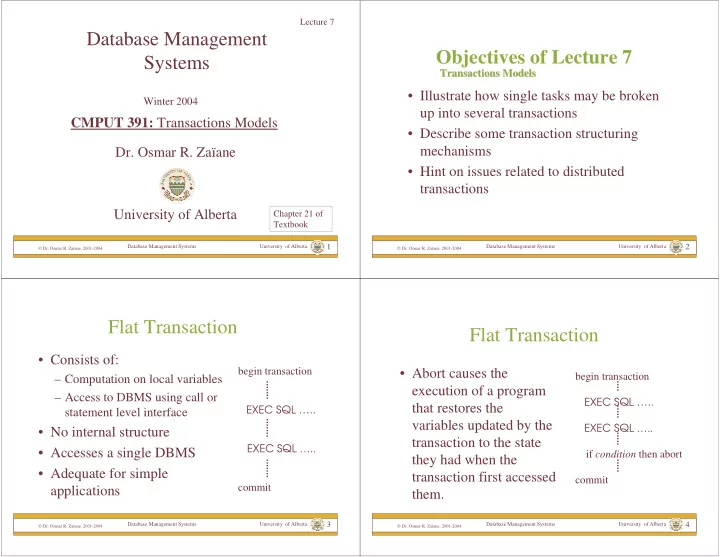
Database Management Objectives of Lecture 7 Systems Transactions - - PowerPoint PPT Presentation

database management objectives of lecture 7 systems
SMART_READER_LITE
LIVE PREVIEW

Database Management Objectives of Lecture 7 Systems Transactions - - PowerPoint PPT Presentation

Lecture 7 Database Management Objectives of Lecture 7 Systems Transactions Models Transactions Models Illustrate how single tasks may be broken Winter 2004 up into several transactions CMPUT 391: Transactions Models Describe some


slide-1
SLIDE 1

Database Management Systems University of Alberta

 Dr. Osmar R. Zaïane, 2001-2004

1

Database Management Systems

  • Dr. Osmar R. Zaïane

University of Alberta

Winter 2004

CMPUT 391: Transactions Models

Chapter 21 of Textbook Lecture 7

Database Management Systems University of Alberta

 Dr. Osmar R. Zaïane, 2001-2004

2

Objectives of Lecture 7

Transactions Models Transactions Models

  • Illustrate how single tasks may be broken

up into several transactions

  • Describe some transaction structuring

mechanisms

  • Hint on issues related to distributed

transactions

Database Management Systems University of Alberta

 Dr. Osmar R. Zaïane, 2001-2004

3

Flat Transaction

  • Consists of:

– Computation on local variables – Access to DBMS using call or statement level interface

  • No internal structure
  • Accesses a single DBMS
  • Adequate for simple

applications

begin transaction EXEC SQL ….. EXEC SQL ….. commit

Database Management Systems University of Alberta

 Dr. Osmar R. Zaïane, 2001-2004

4

Flat Transaction

  • Abort causes the

execution of a program that restores the variables updated by the transaction to the state they had when the transaction first accessed them.

begin transaction EXEC SQL ….. EXEC SQL ….. if condition then abort commit

slide-2
SLIDE 2

Database Management Systems University of Alberta

 Dr. Osmar R. Zaïane, 2001-2004

5

Some Limitations of Flat Transactions

  • Only total rollback (abort) is possible

– Partial rollback not possible

  • All work lost in case of crash
  • Limited to accessing a single DBMS
  • Entire transaction takes place at a single

point in time

Database Management Systems University of Alberta

 Dr. Osmar R. Zaïane, 2001-2004

6

Providing Structure Within a Single Transaction

Database Management Systems University of Alberta

 Dr. Osmar R. Zaïane, 2001-2004

7

Savepoints

  • Problem: Transaction detects condition that

requires rollback of recent database changes that it has made

  • Solution 1: Transaction reverses changes

itself

  • Solution 2: Transaction uses the rollback

facility within DBMS to undo the changes

Database Management Systems University of Alberta

 Dr. Osmar R. Zaïane, 2001-2004

8

Savepoints

  • Rollback to spi causes database updates subsequent

to creation of spi to be undone

  • Program counter and local variables are not rolled

back (why not?)

  • Savepoint creation does not make prior database

changes durable (abort rolls all changes back)

begin transaction S1; sp1 := create_savepoint(); S2; sp2 := create_savepoint(); S3; if (condition) {rollback (sp1); S5}; S4; commit

slide-3
SLIDE 3

Database Management Systems University of Alberta

 Dr. Osmar R. Zaïane, 2001-2004

9

Integration of Applications

  • Problem: Many enterprises consist of

multiple legacy systems doing separate

  • tasks. Increasing automation requires that

these systems be integrated

Billing Application Inventory Application DBMS 2 DBMS 1 withdraw part return part stock level

  • rder part

payment

Database Management Systems University of Alberta

 Dr. Osmar R. Zaïane, 2001-2004

10

Distributed Transactions

  • Incorporate (legacy) transactions at multiple

servers into a single (distributed) transaction

tx_begin;

  • rder_part;

withdraw_part; payment; tx_commit; DBMS 1 DBMS 2 Inventory Application Billing Application Site A Site B Site C

Database Management Systems University of Alberta

 Dr. Osmar R. Zaïane, 2001-2004

11

Distributed Transactions

  • Goal: distributed transaction should be ACID

– Each subtransaction is locally ACID (e.g., local constraints maintained, locally serializable) – In addition the transaction should be globally ACID

  • A: Either all subtransactions commit or all abort
  • C: Global integrity constraints are maintained
  • I: Concurrently executing distributed transactions are

globally serializable

  • D: Each subtransaction is durable

Database Management Systems University of Alberta

 Dr. Osmar R. Zaïane, 2001-2004

12

Banking Example

  • Global atomicity - funds transfer

– Either both subtransactions commit or neither does tx_begin; withdraw(acct1); deposit(acct2); tx_commit;

slide-4
SLIDE 4

Database Management Systems University of Alberta

 Dr. Osmar R. Zaïane, 2001-2004

13

Banking Example (con’t)

  • Global consistency -

– Sum of all account balances at bank branches = total assets recorded at main office

Database Management Systems University of Alberta

 Dr. Osmar R. Zaïane, 2001-2004

14

Banking Example (con’t)

  • Global isolation - local serializability at each site

does not guarantee global serializability

– post_interest subtransaction is serialized after audit subtransaction in DBMS at branch 1 and before audit in DBMS at branch 2 (local isolation), but – there is no global order post_interest audit time ↓ sum balances at branch 1; post interest at branch 1; post interest at branch 2; sum balances at branch 2;

Database Management Systems University of Alberta

 Dr. Osmar R. Zaïane, 2001-2004

15

Multidatabase

  • Set of databases accessed by a distributed

transaction is referred to as a multidatabase (or federated database)

– Each local database retains its local autonomy and might execute local (non-distributed) transactions

  • Multidatabase might have global integrity

constraints

– e.g., Sum of balances of individual bank accounts at all branch offices = total assets stored at main office

Database Management Systems University of Alberta

 Dr. Osmar R. Zaïane, 2001-2004

16

Transaction Hierarchy

  • A distributed transaction invokes

subtransactions.

  • General model: hierarchy of subtransactions.
slide-5
SLIDE 5

Database Management Systems University of Alberta

 Dr. Osmar R. Zaïane, 2001-2004

17

Models of Distributed Transactions

  • Can siblings execute concurrently?
  • Can parent execute concurrently with

children? If yes, can parent communicate with child?

  • Who initiates commit?

Hierarchical Model: No concurrency (hence no communication between subtransactions), root initiates commit Peer Model: Concurrency among siblings and between parent and children, concurrent subtransactions can communicate, any subtransaction can initiate commit

Database Management Systems University of Alberta

 Dr. Osmar R. Zaïane, 2001-2004

18

Distributed Transactions

  • Transaction designer has little control over

the structure. Decomposition fixed by distribution of data and/or exported interfaces

  • Essentially a bottom-up design

Database Management Systems University of Alberta

 Dr. Osmar R. Zaïane, 2001-2004

19

Nested Transactions

  • Problem: Lack of mechanisms that allow:

– a top-down, functional decomposition of a transactional application into subtransactions – individual subtransactions to abort without aborting the entire transaction

  • Although a nested transaction looks similar to a

distributed transaction, it is not conceived of as a tool for accessing a multidatabase

Database Management Systems University of Alberta

 Dr. Osmar R. Zaïane, 2001-2004

20

Characteristics of Nested Transactions

  • (1) Parent can create a set of children

that execute concurrently; parent waits until all children complete (no communication between parent and children).

  • (2) Each subtransaction (together with its descendants) is

isolated with respect to each sibling (and its descendants). Hence, siblings are serializable, but order is not determined and nested transaction is non-deterministic.

  • (3) Concurrent nested transactions are serializable.
slide-6
SLIDE 6

Database Management Systems University of Alberta

 Dr. Osmar R. Zaïane, 2001-2004

21

Characteristics of Nested Transactions

  • (4) A subtransaction is atomic. It can

abort or commit independently of other

  • subtransactions. Commitment is

conditional on commitment of parent. Abort causes abort of all its children.

  • (5) Nested transaction commits when root commits. At

that point updates of committed subtransactions are made durable. (6) Individual subtransactions are not necessarily consistent, but nested transaction as a whole is consistent

Database Management Systems University of Alberta

 Dr. Osmar R. Zaïane, 2001-2004

22

Nested Transaction - Example

Booking a flight from London to Des Moines C C C A C/A A C C C L -- DM L -- NY NY -- DM NY -- Chic -- DM NY -- StL -- DM NY -- Chic Chic -- DM NY -- StL StL -- DM

concurrent sequential concurrent C = commit A = abort stop in Chicago stop in St. Louis concurrent

Database Management Systems University of Alberta

 Dr. Osmar R. Zaïane, 2001-2004

23

Nested Transactions

isolation

isolation

parent of all nested transactions

isolation concurrent