SLIDE 1
1
Entity-Relationship Model From Chapter 5, Kroenke book
Database Design Process
Requirements analysis Conceptual design data model Logical design Schema refinement: Normalization Physical tuning
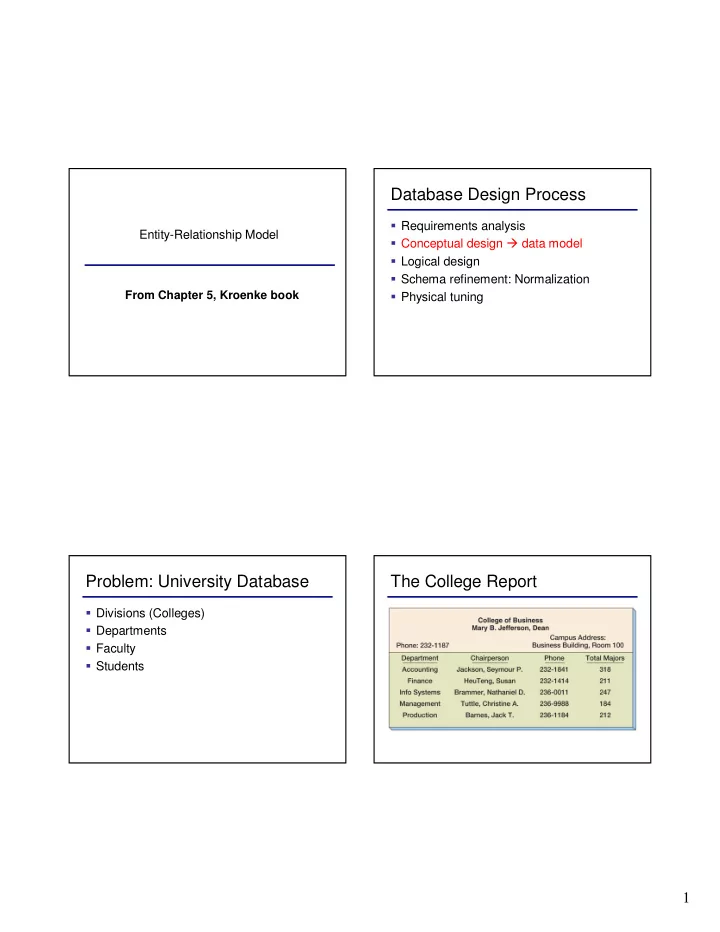
Problem: University Database
Divisions (Colleges) Departments Faculty Students
The College Report
SLIDE 2
2
The Department Report The Department Major Report The Student Acceptance Letter Conceptual Design Overview
Entity-Relationship (ER) Model What are the entities and relationships for given problem? What information about these entities and relationships should we store? What are the integrity constraints or business rules that hold?
SLIDE 3
3
Entities
Something that can be identified and the users want to track
Entity class Entity instance
There are usually many instances of an entity in an entity class.
Attributes
Attributes: describe the characteristics of an entity Entity instances:
Same attributes Different values
Identifiers
Identifiers = attributes that identify entity instances Composite identifiers: Identifiers that consist of two or more attributes
Relationships
Relationships: associations between entities No attributes Relationship degree
SLIDE 4 4
Cardinality
Cardinality means “count” - a number Maximum cardinality Minimum cardinality
Maximum Cardinality
Maximum cardinality: maximum number of entity instances that can participate in a relationship One-to-One [1:1] One-to-Many [1:N] Many-to-Many [N:M]
Minimum Cardinality
Minimum cardinality: minimum number of entity instances that must participate in a relationship. zero [0] optional
HAS-A Relationships
Previous relationships: HAS-A relationships:
Each entity instance has a relationship with another entity instance:
An EMPLOYEE has one BADGE A BADGE has an assigned EMPLOYEE.
SLIDE 5 5 Data Modeling Notation: ERwin
Class Exercise
Give examples of the following relationships:
Maximum cardinality:
One-to-One One-to-Many Many-to-Many
Minimum cardinality
Optional-Optional Mandatory-Optional Mandatory-Mandatory
ID-Dependent Entities
ID-dependent entity: entity (child) whose identifier includes the identifier of another entity (parent) Example:
BUILDING : APARTMENT
Minimum cardinality from the ID- dependent entity to the parent is always
ID-Dependent Entities
A solid line indicates an identifying relationship
SLIDE 6 6
Weak Entities
A weak entity is an entity whose existence depends upon another entity. All ID-Dependent entities are considered weak. But there are also non-ID-dependent weak entities.
The identifier of the parent does not appear in the identifier of the weak child entity.
Weak Entities (Continued)
A dashed line indicates a nonidentifying relationship Weak entities must be indicated by an accompanying text box in Erwin – There is no specific notation for a nonidentifying but weak entity relationship
ID-Dependent and Weak Entities
ID-Dependent entity: Identifier depends (includes) another identifier
Identifying relationship Ex: BUILDING:APARTMENT
Weak entity: existence depends on another entity
Ex: MODEL:CAR
ID-Dependent Weak Weak does NOT imply ID-Dependent
Subtype Entities
Subtype entity: special case of a supertype entity:
STUDENT : UNDERGRADUATE or GRADUATE
Supertype:
all common attributes [discriminator attribute]
Subtypes:
specific attributes
SLIDE 7 7
Subtypes: Exclusive or Inclusive
If subtypes are exclusive, one supertype relates to at most one subtype. If subtypes are inclusive, one supertype can relate to one or more subtypes.
Subtypes: Exclusive or Inclusive
Subtypes: IS-A relationships
IS-A relationships: a subtype IS A supertype. Supertype and subtypes identifiers are identical Use subtypes if
Have attributes that make sense only for subtypes Want to specify a relationship only for subtype
ER Summary
Entities, attributes, identifiers HAS-A Relationships
Degree: binary, ternary Maximum cardinality Minimum cardinality
ID-dependent entities; identifying relationships IS-A Relationships
Inclusive, Exclusive
SLIDE 8
8
Class Exercise
Draw ER diagram for a database used to manage IT360 class (at least 3 entities)
Specify entities, attributes, identifiers Specify relationships Specify cardinalities for relationships
Class Exercise
Drugwarehouse.com has offered you a free life- time supply of prescription drugs (no questions asked) if you design its database schema. Given the rising cost of health care, you agree. Here is the information that you gathered: Patients are identified by their SSN, and we also store their names and age Doctors are identified by their SSN, and we also store their names and specialty Each patient has one primary care physician Each doctor has at least one patient