Data Privacy Compliance in Global Transactions: Navigating Complex - - PowerPoint PPT Presentation

data privacy compliance in global transactions navigating
SMART_READER_LITE
LIVE PREVIEW

Data Privacy Compliance in Global Transactions: Navigating Complex - - PowerPoint PPT Presentation

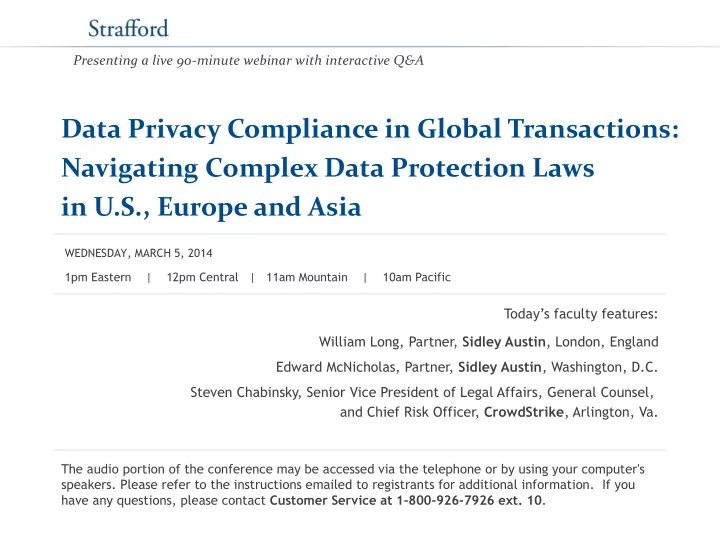
Presenting a live 90-minute webinar with interactive Q&A Data Privacy Compliance in Global Transactions: Navigating Complex Data Protection Laws in U.S., Europe and Asia WEDNESDAY, MARCH 5, 2014 1pm Eastern | 12pm Central | 11am


slide-1
SLIDE 1

Data Privacy Compliance in Global Transactions: Navigating Complex Data Protection Laws in U.S., Europe and Asia

Today’s faculty features:

1pm Eastern | 12pm Central | 11am Mountain | 10am Pacific

The audio portion of the conference may be accessed via the telephone or by using your computer's

  • speakers. Please refer to the instructions emailed to registrants for additional information. If you

have any questions, please contact Customer Service at 1-800-926-7926 ext. 10.

WEDNESDAY, MARCH 5, 2014

Presenting a live 90-minute webinar with interactive Q&A William Long, Partner, Sidley Austin, London, England Edward McNicholas, Partner, Sidley Austin, Washington, D.C. Steven Chabinsky, Senior Vice President of Legal Affairs, General Counsel, and Chief Risk Officer, CrowdStrike, Arlington, Va.

slide-2
SLIDE 2

Sound Quality If you are listening via your computer speakers, please note that the quality

  • f your sound will vary depending on the speed and quality of your internet

connection. If the sound quality is not satisfactory, you may listen via the phone: dial 1-888-601-3873 and enter your PIN when prompted. Otherwise, please send us a chat or e-mail sound@straffordpub.com immediately so we can address the problem. If you dialed in and have any difficulties during the call, press *0 for assistance. Viewing Quality To maximize your screen, press the F11 key on your keyboard. To exit full screen, press the F11 key again.

FOR LIVE EVENT ONLY

slide-3
SLIDE 3

For CLE purposes, please let us know how many people are listening at your location by completing each of the following steps:

  • In the chat box, type (1) your company name and (2) the number of

attendees at your location

  • Click the word balloon button to send

FOR LIVE EVENT ONLY

slide-4
SLIDE 4

Data Privacy Compliance in Global Transactions: Navigating Complex Data Protection Laws in U.S., Europe and Asia

Steven Chabinsky, General Counsel & Chief Risk Officer, CrowdStrike Ed McNicholas and William Long, Partners, Sidley Austin LLP

slide-5
SLIDE 5

Defining “Cyber” and Exploring the Cyber Threat Actor Landscape

5

slide-6
SLIDE 6

Cyber: What is it?

  • Increasingly, businesses are relying solely upon computers

to: – Communicate, whether internally, with business partners,

  • r with customers (email, VoIP, social media, websites)

– Store sensitive information about employees, trade secrets, and customers – Deliver products and services over the Internet – Manufacture products, many of these products also contain computer chips (including biomedical devices) – Control industrial systems, including within the critical infrastructure

6

slide-7
SLIDE 7
  • Spies
  • Criminals
  • Warriors
  • Terrorists
  • Remote

Access

  • Close Access
  • Insider Access
  • Supply Chain
  • Confidentiality
  • Integrity
  • Availability

WHO? WHAT? HOW?

“Everything, All the time”

Where/When?

  • the Eagles

Exploring the Cyber Threat Actor Landscape

  • f information

and Technology enabled systems

Why? If you’re the bad guy, why not?!?

Life in the Fast Lane

7

slide-8
SLIDE 8
  • Slide Contentd

CrowdStrike: 2013 Global Threat Report PRC actors remain the world’s most active and persistent perpetrators of economic espionage. But, the Russians and

  • thers also are in the

economic espionage game.

8

slide-9
SLIDE 9

Organized Crime

  • hack into the systems of global financial institutions,
  • Stole prepaid debit card data, eliminated withdrawal
  • limits. and inflated account balances,
  • Made fraudulent ATM withdrawals in 24 countries

9

slide-10
SLIDE 10

10 specializations in organized cyber crime:

Cybercrime: Really is Organized

  • 1. Coders/Programmers
  • 2. Distributors/Vendors

3. Techies 4. Hackers 5. Fraudsters 6. Hosters 7. Cashers 8. Money Mules 9. Tellers

  • 10. Leaders

10

slide-11
SLIDE 11

Cyber Terrorism: “electronic warfare is one of the important and effective future wars”

Oxford Study: compiled a list of 404 members of violent Islamist groups Engineers are strongly over- represented among graduates in violent Islamic groups

11

slide-12
SLIDE 12

BEIJING BOSTON BRUSSELS CHICAGO DALLAS FRANKFURT GENEVA HONG KONG HOUSTON LONDON LOS ANGELES NEW YORK PALO ALTO SAN FRANCISCO SHANGHAI SINGAPORE SYDNEY TOKYO WASHINGTON, D.C.

U.S. Privacy Update

Edward McNicholas eMcNicholas@sidley.com

slide-13
SLIDE 13

Government Data Collection

  • Snowden revelations continue

– Allegations that NSA monitored calls of 35 world leaders

  • Strong condemnation from Germany, Brazil

– Allegations of access to backbone to collect Google and Yahoo data

  • Google, Microsoft, Facebook, Yahoo! and LinkedIn petitioning FISC to

permit aggregate reports of government data requests and requesting changes in surveillance policies.

  • Shareholder initiative sponsored by NY Comptroller General to force

transparency report from some carriers

  • White House possibly mandating internal NSA changes

– NSA has appointed a CPO – President issues new Signals Directive

  • ACLU et al. v. Clapper et al., 1:13-cv-03994 (S.D.N.Y.)

13

slide-14
SLIDE 14

The Evolution of Privacy

  • Legal definitions of personal information are evolving

– Traditional categories

  • Name, email, address, phone number, SSN, date and place of

birth, biometric records, or other personal info linked to an individual

  • Financial or personal health records, race, religion, ethnicity

considered “sensitive”

  • US COPPA now includes persistent identifiers even where not

associated with individually identifying information

  • EU definition includes any identifier

– Comprehensive online profiles create a “complete picture” – The “Internet of Things” is coming

14

slide-15
SLIDE 15

Sources of U.S. Privacy Law, Regulation and Enforcement

  • United States

– Constitutional Right to Privacy (Fourth Amendment) – Federal Statutes (GLBA, HIPAA, ECPA, CFAA) – Federal Regulations – States Attorneys General / Tort laws / “Mini FTC Acts”

  • Private Litigants / Plaintiffs’ Bar
  • Industry self-regulation
  • Company policies

15

slide-16
SLIDE 16

Federal Trade Commission

  • The FTC entered into settlements with 12 companies that

allegedly represented that they were Safe Harbor-compliant after their certifications had lapsed.

  • FTC Commissioner Julie Brill delivered a speech

highlighting the privacy threats posed by big data analytics.

  • The FTC has launched a seminar series on Big Data, with

the first meeting focused on in-store mobile device tracking.

  • The FTC approved the first new COPPA safe harbor

program after its strengthening of the COPPA Rule in 2013.

  • FTC v. Wyndham challenging expansion of unfair and

deceptive trade practice authorities.

16

slide-17
SLIDE 17

FTC – Internet of Things

  • November 19 Internet of Things FTC Workshop

– Featured panels on privacy and security risks of such technology in homes, automobiles and health and fitness – FTC Chairwoman Edith Ramirez called for the incorporation of Privacy by Design – Panelists echoed calls for Privacy by Design, as well as called for Fair Information Practice Principles for IoT data

  • Recognition of tensions between notice and choice paradigm and

pervasive data collection by sensors without interfaces.

  • Keynote address by Vint Cerf, “Chief Internet Evangelist” at Google

– Suggested privacy as we know it today may be an anomaly – Regulations cannot be a complete solution – Called for development of social conventions that are more respectful of individual privacy

17

slide-18
SLIDE 18

Cybersecurity E.O. and Directive (2/12/13)

  • Congressional stalemate led to Executive Order:

– Development of NIST “Cybersecurity Framework” and programs to encourage voluntary adoption of the framework

  • Framework version 1.0 released February 13, 2014

– DHS designation of CI companies (with right of reconsideration) – Establishment of regulatory standards by agencies with statutory authority – Increased threat information sharing to CI operators

  • Directive (Feb. 12, 2013) names 16 critical infrastructure areas

– CI sectors and their designated SSAs are: Chemical (DHS); Commercial Facilities (DHS); Communications (DHS); Critical Manufacturing (DHS); Dams (DHS); Defense Industrial Base (DoD); Emergency Services (DHS); Energy (Department of Energy); Financial Services (Treasury); Food and Agriculture (Department of Agriculture (USDA) and Department of Health and Human Services (HHS)); Government Facilities (DHS and General Services Administration); Healthcare and Public Health (HHS); Information Technology (DHS); Nuclear Reactors, Materials, and Waste (DHS); Transportation Systems (DHS and Department of Transportation); and Water and Wastewater Systems (Environmental Protection Agency)

18

slide-19
SLIDE 19

SEC Cybersecurity Guidance

  • Corporation Finance guidance issued Oct. 13, 2011 (in response to
  • Sen. Rockefeller)

– 4/9/13: New Rockefeller letter seeking formal rules

  • Disclose cyber-risks if: they “are among the most significant factors that make an

investment in the company speculative or risky”

  • Guidance characterizes cyber-attacks as targeting:

– Financial assets, intellectual property, other sensitive information – Customer or business partner data – Disruption of business operations

  • Cybersecurity included as a priority in the SEC’s National Examination

Program for 2014

  • The SEC will host a public roundtable on cybersecurity issues in

Washington, DC on March 26, 2014.

  • FINRA has launched cybersecurity sweep, public announced on the

FINRA website on February 6, 2014

19

slide-20
SLIDE 20

Data Breach Litigation

  • Target MDL
  • U.S. district court in California allows Sony Data Breach suit

to proceed with allegations of misrepresentation regarding Sony’s security practices and violations of California’s data breach reporting law.

  • LabMD dropped its challenge to FTC’s authority to

regulate data security under Section 5.

  • Resnick v. AvMed Inc., No. 1:10-cv-24513 (S. D. Fla.): $3

Million breach settlement provides compensation for individuals who did not suffer identity theft Non-ID theft victims awarded $10 per year for insurance purchased, capped at $30

20

slide-21
SLIDE 21

Litigation is reshaping U.S. privacy law

  • The Supreme Court granted two important cases on whether evidence collected

from a defendant’s cell phone pursuant to a warrantless search incident to arrest violates Fourth Amendment rights.

  • U.S. district court in California approved a class action settlement that resolved

claims involving violations of the Song-Beverly Credit Cart Act for requesting shoppers’ personal information at point of sale.

  • U.S. district court in Oregon reduced an $18.4 million FCRA punitive damages

award against Equifax to $1.62 million in case involving the negligent association of credit card information with the wrong consumer and failure to address requests to correct.

  • D.C. Circuit limits the impact of the FCC’s TCPA guidance ruling that it lacks

jurisdiction to consider FCC declaratory rulings because such guidance is nonbinding.

  • Ninth Circuit finds standing in FCRA case based on violation of a statutory

right without any showing of actual damages.

  • U.S. district court in California lifted its stay in the multidistrict litigation

against Google for the Google Street View collection of information on Wi-Fi networks.

21

slide-22
SLIDE 22

BEIJING BOSTON BRUSSELS CHICAGO DALLAS FRANKFURT GENEVA HONG KONG HOUSTON LONDON LOS ANGELES NEW YORK PALO ALTO SAN FRANCISCO SHANGHAI SINGAPORE SYDNEY TOKYO WASHINGTON, D.C.

Update on the Proposed EU Data Protection Regulation

March 5, 2014 William Long wlong@sidley.com

slide-23
SLIDE 23

Update on EU Legislative Process

  • Timeline until 2015

– January 2012 European Commission publish proposed EU Data Protection Regulation – Lead European Parliamentary Committee - LIBE (Civil Liberties, Justice and Home Affairs Committee) – LIBE Committee - Jan Philipp Albrecht MEP, Rapporteur (reporting MEP) with Axel Voss (German- EPP), Alexander Alvaro (German – ALDE), Timothy Kirkhope (British – Conservative) and Cornelia Ernst (German – Left party) acting as shadow Rapporteurs – 2013 Opinions published by other European Parliament Committees – June 2013 Council of Ministers publish compromised text – October 2013 LIBE Committee adopted amendments to Proposal – April 2014 European Parliament Plenary Vote still expected but Proposal may not be adopted until new European Parliament in place in 2015

23

slide-24
SLIDE 24

Scope of the Regulation and definition of Personal Data

  • Regulation will apply to a data controller in the EU or outside the EU where

activities aimed at offering goods or services to individuals in the EU or that monitor individuals

  • To determine whether a controller is offering goods or services in the EU it should

be ascertained if it is “apparent” that controller is envisaging offering services to individuals in the EU

  • Regulation now envisages three types of data: personal data, anonymous data

and pseudonymous data

  • Processing of sensitive data such as health data is prohibited unless an

exemption applies such as consent

  • Personal data and pseudonymous data are subject to the Regulation – incentives

included for using pseudonymous data

24

slide-25
SLIDE 25

One stop shop, enforcement, fines and collective redress

  • A 'one stop shop' regulatory regime envisaged so that businesses operating

across the EU would have to engage with just one DPA, in the country of their 'main establishment'. However, there is disagreement about whether to involve DPAs in decisions affecting consumers local to them

  • Fines of up to 5% of the annual worldwide turnover or €100 million for

failing to comply with the proposed Regulation

  • Specific criteria to be taken into account by DPAs when determining level of

sanction such as use of accountability measures

  • Any body, organisation or association acting in the public interest may go to

court on behalf of individuals to seek damages for non-compliance even without their consent as well as seek judicial remedies

  • Damages will now be permitted for non-pecuniary loss such as for distress

25

slide-26
SLIDE 26

Consent and Notices

  • Controller bears burden of proof for obtaining valid consent for specified

purposes

  • Consent in writing must be clearly distinguishable in its appearance from other

information

  • Individual has right to withdraw consent at any time provided that withdrawal

does not affect lawfulness of processing before withdrawal

  • Consent must be purpose limited and is not valid if processing no longer

necessary for carrying out the purposes

  • Processing of data on children under 13 only valid if have parent or guardian

consent

  • Controller must provide easily understandable information on processing of

personal data using symbols and icons and referring to various rights such as access rights, right to object to processing, right to lodge a complaint with a DPA and to bring legal proceedings

26

slide-27
SLIDE 27

Do you know your icons?

27

slide-28
SLIDE 28

Accountability and DPOs

  • Accountability – data controller must have clear and accessible policies and

implement demonstrable technical and organisational measures to show compliance with the Regulation including updated documentation. Data protection by design and by default should be adopted. Policies should be reviewed every 2 years and updated. Reports of public companies must contain a description of the policies

  • Data Protection Officers – obligation to appoint a DPO where process data on more

than 5,000 individuals in any 12 month period OR core activity involves processing of health data. Minimum appointment of DPO for 4 years with direct report to executive

  • management. Obligations on DPO to monitor compliance with the Regulation
  • Data Protection Impact Assessments – requirement to conduct data protection

impact assessments where processing likely to present specific risks such as health data with a compliance review 2 years later

  • Data Security – data security breaches to be notified to DPA without undue delay.

Where breach likely to adversely affect the privacy of the individual also notify the individual without undue delay

28

slide-29
SLIDE 29

Data subject rights

  • Right to object to Profiling – an individual (i.e. a data subject) must be informed in a

“highly visible manner” of their right to object to profiling. Profiling permitted with consent. Where significantly affects the data subject should include human assessment. Profiling that has the effect of discriminating based on race, gender etc. prohibited

  • Right to Erasure – data subject’s have a right to erasure of personal data where

withdraws consent, data no longer necessary or individual objects to processing. Right of erasure does not apply for pharmcovigilance and scientific research

  • Right to Object to Processing – data subject’s have a right to object to processing

where use of the personal data is based on the legitimate interest of the data controller

29

slide-30
SLIDE 30

International Transfers – Safe Harbor and BCRs

  • The Fall of the U.S.- EU Safe Harbor?

– Previous adequacy decisions (including the Safe Harbor) and decisions relating to the EU’s standard contractual clauses for transfer of data in force for only five years after the new regulation – Recent report from European Commission on the functioning of Safe Harbor with 13 recommendations to revise Safe Harbor – German and some other DPAs have been overtly critical of Safe Harbor

  • The Rise of Binding Corporate Rules

– Binding Corporate Rules appear heavily favored, although standard contractual clauses seem stable – Possibility of sector-wide adequacy determinations, such as for regulated sectors of the U.S. economy, such as healthcare, reinstated

30

slide-31
SLIDE 31

Asian Privacy Regimes

  • Asia trends and developments

– New or proposed privacy legislation in many jurisdictions, including China, India, Philippines, Hong Kong

  • Focus on data transfer, interoperability
  • China

– Illegal to sell or unlawfully provide citizen’s personal data to another – Employees’ written consent required for disclosure to third parties

  • India

– Limited scope but imposes specific notice requirements for the collection of sensitive personal information, including password – Requires contractual provisions governing privacy and data security for all vendor contracts

31

slide-32
SLIDE 32

International Access & Data Flows

  • Operations can span multiple continents and their consumers and
  • nline audiences are worldwide

– Online websites and services accessed from multiple jurisdictions – International regulatory regimes apply to protect data provided by their citizens

  • Free flow of data no longer limited by geographic boundaries

– Cloud provider services frequently cross borders

  • International data transfers trigger multiple, varying regulatory

schemes

32

slide-33
SLIDE 33

Jurisdictional Challenges

  • Activities may trigger a plethora of divergent laws and enforcement

approaches around the world – Many are outdated and application to cloud services are unclear

  • Jurisdiction based on various factors

– Physical location of servers used to store and transfer data – Origin of data or location of consumers whose data is at issue – Location of individuals accessing data – Jurisdiction specified in contract?

  • Solutions for global interoperability

– EU: Safe Harbor, Binding Corporate Rules – Asia-Pacific Economic Cooperation Cross-Border Privacy Rules

33

slide-34
SLIDE 34

Information Governance Reference Model Stakeholders:

  • 1. Business
  • 2. Legal
  • 3. RIM
  • 4. IT
  • 5. Privacy &

Security

34

slide-35
SLIDE 35

Beyond The Forms

Accountability and Privacy by Design

Assess new data collection, uses and integrations proactively

Understand and document the business

  • bjectives in

connection with data collection and use

Apply existing law/seek clarification or change in law Document privacy review assessments Develop incident response plans, data security protocols and risk mitigation strategies Educate and train stakeholders 35

slide-36
SLIDE 36

Cybersecurity Enterprise Risk Management Principles

36

slide-37
SLIDE 37

Cybersecurity: A Mature Business Process.

  • The use of Enterprise Risk Management principles to mitigate

significant harms to information and information systems relating to:

– Losses of Confidentiality (perhaps PII or Trade Secrets) – Losses of Integrity (including data accuracy and product reliability) – Losses of Availability (consider service downtime or data loss)

  • Typical ERM cyber strategies include

– Prioritizing what is most important – Implementing technical, administrative, and physical controls using cost/benefit analysis – Accepting residual risk – Being prepared to manage an incident

37

slide-38
SLIDE 38

The NIST Framework:

www.nist.gov/cyberframework (February 12, 2014)

Step 1: Prioritize and Scope. Step 2: Orient. Step 3: Create a Current Profile. Step 4: Conduct a Risk Assessment. Step 5: Create a Target Profile. Step 6: Determine, Analyze, and Prioritize Gaps. Step 7: Implement Action Plan.

38

slide-39
SLIDE 39

The NIST Framework, continued . . .

39

slide-40
SLIDE 40

Data Breach “Technical” Checklist

Before a targeted attack, did you:

  • Consolidate and monitor

Internet egress points

  • Implement a tiered active

directory administration model

  • Implement centralized logging
  • Have an incident response

services retainer in place

  • Identify, isolate and log access

to critical data and systems

  • Patch, patch and patch
  • Subscribe to cyber intelligence

feeds

  • Review Reporting

Requirements Responding to a targeted attack

  • Do not power down
  • Preserve all logs
  • Establish out-of-band

communication channels

  • Include legal counsel

immediately

  • Contact an incident response

services company

  • Scope the incident
  • Remediate the attack
  • Report

40

slide-41
SLIDE 41

Chabinsky@CrowdStrike.com (202) 870-1442 Follow me on : @StevenChabinsky

Questions or Comments?

Steven Chabinsky

  • www. Sidley.com/InfoLaw

William Long Edward McNicholas

This presentation has been prepared as of March 1, 2014 for educational and informational purposes only. It does not constitute legal advice. This information is not intended to create, and receipt of it does not constitute, a lawyer-client relationship. Readers should not act upon this without seeking personalized advice from professional advisers.

41