
SLIDE 1
18TH INTERNATIONAL CONFERENCE ON COMPOSITE MATERIALS
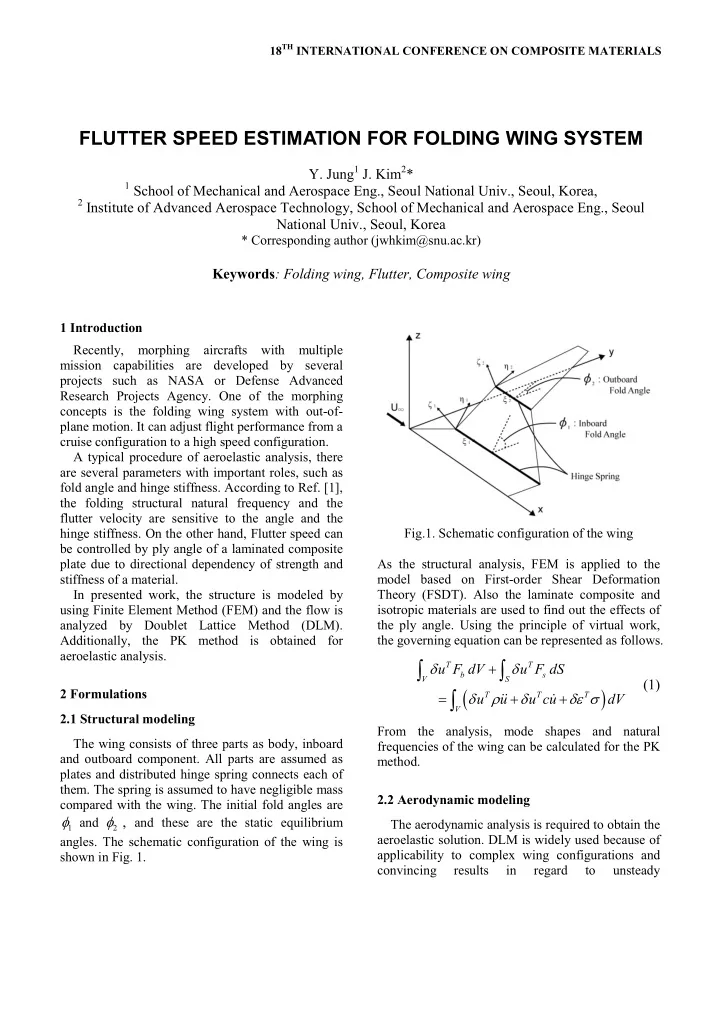
1 Introduction Recently, morphing aircrafts with multiple mission capabilities are developed by several projects such as NASA or Defense Advanced Research Projects Agency. One of the morphing concepts is the folding wing system with out-of- plane motion. It can adjust flight performance from a cruise configuration to a high speed configuration. A typical procedure of aeroelastic analysis, there are several parameters with important roles, such as fold angle and hinge stiffness. According to Ref. [1], the folding structural natural frequency and the flutter velocity are sensitive to the angle and the hinge stiffness. On the other hand, Flutter speed can be controlled by ply angle of a laminated composite plate due to directional dependency of strength and stiffness of a material. In presented work, the structure is modeled by using Finite Element Method (FEM) and the flow is analyzed by Doublet Lattice Method (DLM). Additionally, the PK method is obtained for aeroelastic analysis. 2 Formulations 2.1 Structural modeling The wing consists of three parts as body, inboard and outboard component. All parts are assumed as plates and distributed hinge spring connects each of
- them. The spring is assumed to have negligible mass
compared with the wing. The initial fold angles are
1
f and
2
f , and these are the static equilibrium
- angles. The schematic configuration of the wing is
shown in Fig. 1. Fig.1. Schematic configuration of the wing As the structural analysis, FEM is applied to the model based on First-order Shear Deformation Theory (FSDT). Also the laminate composite and isotropic materials are used to find out the effects of the ply angle. Using the principle of virtual work, the governing equation can be represented as follows.
( )
T T b s V S T T T V
u F dV u F dS u u u cu dV d d d r d de s + = + +
ò ò ò
&& & (1)
From the analysis, mode shapes and natural frequencies of the wing can be calculated for the PK method. 2.2 Aerodynamic modeling The aerodynamic analysis is required to obtain the aeroelastic solution. DLM is widely used because of applicability to complex wing configurations and convincing results in regard to unsteady
FLUTTER SPEED ESTIMATION FOR FOLDING WING SYSTEM
- Y. Jung1 J. Kim2*