Cybercri rcrime S Support rt N Network rk o of West Mich - - PowerPoint PPT Presentation

cybercri rcrime s support rt n network rk o of west mich
SMART_READER_LITE
LIVE PREVIEW

Cybercri rcrime S Support rt N Network rk o of West Mich - - PowerPoint PPT Presentation

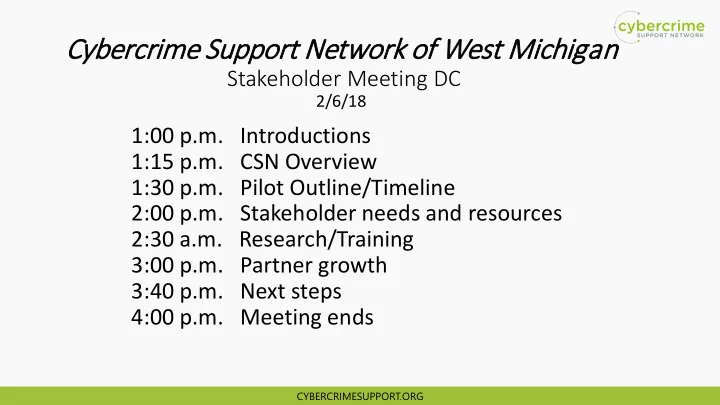
Cybercri rcrime S Support rt N Network rk o of West Mich chigan Stakeholder Meeting DC 2/6/18 1:00 p.m. Introductions 1:15 p.m. CSN Overview 1:30 p.m. Pilot Outline/Timeline 2:00 p.m. Stakeholder needs and resources 2:30 a.m.


slide-1
SLIDE 1

CYBERCRIMESUPPORT.ORG

Cybercri rcrime S Support rt N Network rk o

  • f West Mich

chigan

Stakeholder Meeting DC

2/6/18

1:00 p.m. Introductions 1:15 p.m. CSN Overview 1:30 p.m. Pilot Outline/Timeline 2:00 p.m. Stakeholder needs and resources 2:30 a.m. Research/Training 3:00 p.m. Partner growth 3:40 p.m. Next steps 4:00 p.m. Meeting ends

slide-2
SLIDE 2

CYBERCRIMESUPPORT.ORG

Introductions

How does your organization support cybercrime victims currently? What could the future look like with federal, state and local collaboration?

slide-3
SLIDE 3

CYBERCRIMESUPPORT.ORG

Cybercrime Support Network

The Cybercrime Support Network (CSN) – is the first and only nonprofit, public-private partnership to meet the unsupported needs of cybercrime victims by connecting victims to resources and increasing crime victim

  • reporting. CSN’s mission is to foster collaboration, provide training and

create resources so victims are supported by federal, state and local agencies in a coordinated manner. For over three years, CSN has convened a coalition of federal, state and local law enforcement, academia, private sector and national-nonprofit leadership to plan, gain an understanding of, and develop an approach for addressing the unmet needs of law enforcement and the public as it relates to cybercrime.

slide-4
SLIDE 4

CYBERCRIMESUPPORT.ORG

The Problem

American citizens young and old are falling victim to cybercrime and struggling to find resources they need to report crimes and recover. At the state and local level, 911 dispatch centers report cybercrime as an increasing problem, and there can be frustration on the part of dispatchers who have little resources to offer victims. With the rise of computer viruses, data breaches and ransomware, the public needs (and deserves) a centralized place to report and seek remediation for these criminal acts.

slide-5
SLIDE 5

CYBERCRIMESUPPORT.ORG

The Solution

Goals of the pilots include:

  • Working with partners, trainers and the community to build and execute

the program

  • Creating and maintaining a website for the community to utilize in

learning about prevention and recovery resources

  • Creating content for 911/211 staff on agreed upon, localized processes

and resources

  • Enhancing existing 211 software to allow program implementation
  • Heightening community awareness of new resources through partners

and traditional and social media. In 2018, CSN will launch pilots to inform, educate and instruct the public and law enforcement responders about managing instances of cybercrime.

slide-6
SLIDE 6

CYBERCRIMESUPPORT.ORG

Vision

By 2021, calling 2-1-1 for cybercrime assistance will be as commonplace as calling 9-1-1 when needing an ambulance.

slide-7
SLIDE 7

CYBERCRIMESUPPORT.ORG

Guiding Principles

  • Bringing a voice to and serving the victims of cybercrime
  • Ensuring victims are connected to local, state and federal law

enforcement when needed

  • Working within existing law enforcement and victim assistance

systems to enhance service, collaboration and reporting

  • Providing effective training based on adult learning principles
  • Promoting education and awareness for all citizens
slide-8
SLIDE 8

CYBERCRIMESUPPORT.ORG

Program Participants

CSN has brought together the following organizations to advise and/or support our programming to ensure the outcomes meet the needs of victims, law enforcement and nonprofit victim service organizations.

NATIONAL ORGANIZATIONS National White Collar Crime Center National Cyber Security Alliance National Crime Victim Law Institute United Way World Wide National 211 Identity Theft Resource Center National Cyber-Forensics & Training Alliance Call for Action AARP FEDERAL AGENCIES Federal Bureau of Investigation/ Office for Victim Assistance Internet Crime Complaint Center Federal Trade Commission United States Secret Service Congressional Leadership STATE AGENCIES/ORGANIZATIONS Michigan Cyber Command Michigan United Way Michigan 211 Michigan State Police 911 Elder Law of Michigan, Inc. New York State Governor’s Office TRAINING AND RESEARCH Harvard Berkman Klein Center Professor, Arun Vishwanath Michigan State University Criminal Justice Professor, Thomas Holt National Computer Forensics Institute Cardinal Group II LOCAL AGENCIES/ORGANIZATIONS New York City District Attorney’s Office Heart of West Michigan United Way Kent County Sheriff’s Office West Michigan Cyber Consortium Region 6 Homeland Security Board (MI) Area Agency on Aging of West Michigan Heart of Florida United Way (Orlando)

(Formal agreements have not been signed with all listed)

slide-9
SLIDE 9

CYBERCRIMESUPPORT.ORG

Pilot Outline/Timeline

Jurisdiction Mapping

slide-10
SLIDE 10

CYBERCRIMESUPPORT.ORG

Built foundation

  • f partners

 2016-2017 Begin pilot programs in 1- 3 states  Feb. 2018 Robust victim website launched  August 2018 Pilot results drive expansion  January 2019 Program expansion in 5-8 states  Dec. 2019 First victims call 2-1-1 to receive help  July 2018 Program research drives process improvement  August 2018 Federal funding to support cybercrime victims established  January 2019

Timeline

slide-11
SLIDE 11

CYBERCRIMESUPPORT.ORG

With the rise of cybercrime, the public needs (and deserves) a place to report and seek remediation for these criminal acts.

  • Lack of unified response to

serve cybercrime victims

  • Lack of federal funding to

support cybercrime victim services directly

  • Lack of centralized

reporting

  • Create system to triage

cybercrime victims

  • Train 911 and 211 to

use process to serve victims

  • Measure and categorize

cybercrime to impact program, practice, and policy decisions

  • Build national

coalition partners to support cybercrime victims in a coordinated manner

  • Train 911/211

front line and supervisory staff to triage, refer, and educate victims

  • Cybercrime victims

are supported by federal, state, local law enforcement, and nonprofit programs

  • Cybercrime

victims increase awareness, prevention and reporting

Problem Subproblems Activities Output Measures Outcome Measures Short Term Long Term Activities Goals Objectives

Enhance the current 2-1-1 national network hotline and text capabilities to provide one contact place for cybercrime victims to report and access resources.

Logic Model

slide-12
SLIDE 12

CYBERCRIMESUPPORT.ORG

Research

1) The assessment of the interaction from a victim point of view. Including: satisfaction, willingness to report in the future; recommendation to others, and such. Answering the questions: Does the program lead to a police interaction? How was that interaction? 2) Assessment of police outcomes because of this program. Answering questions: How many calls for service does it lead to on their part? Is there a change in officer perceptions of cybercrime/cybercrime victimization? 3) How the reporting is taking place. Answering questions: What is being reported (actual vs. suspected), How is it being reported (device/app used), Who is doing the reporting (new vs. existing 211 users). 4) How they found out about the service: awareness levels, barriers to use 5) Whether the issue was redressed (or the degree to which it was) and the time it took from discovery to remediation. 6) The handling of the data internally at 211 and whether the problem coding and recording is reliable for deployment across the nation.

slide-13
SLIDE 13

CYBERCRIMESUPPORT.ORG

Training

Intermediate Objectives

Following completion of this training participants will:

  • Utilize the Cybercrime Victim Services Program software for cybercrime data collection.
  • Correctly classify cybercrimes, allowing for accurate data collection and reporting.
  • Gather adequate information from victims of cybercrime for data collection and referral.
  • Provide victims of cybercrime with “best practices” designed to minimize re-

victimization.

  • Make appropriate service referrals to victims of cybercrimes.
slide-14
SLIDE 14

CYBERCRIMESUPPORT.ORG

Stakeholder Needs and Resources

How can the CSN program support your work? What resources do you have to offer to support the CSN program?

slide-15
SLIDE 15

CYBERCRIMESUPPORT.ORG

Partner Growth

Who are we missing?

slide-16
SLIDE 16

CYBERCRIMESUPPORT.ORG

Let’s Make a Difference TOGETHER!

Cybercrime Support Network Board of Directors Kristin Judge, Cybercrime Support Network CEO/President Vice President Barbara Hiemstra, Privacy Engineer, Steelcase Secretary/Treasurer James Ellis, F/Lt. Commander of Michigan Cyber Command Center Ben de Bont, Chief Information Security Officer, IBM Cloud and Watson Tim Smith, Executive Director of Ottawa County Central Dispatch Authority