CSE 417 c 12% Compression Example d 16% e 9% Algorithms f - - PowerPoint PPT Presentation

cse 417
SMART_READER_LITE
LIVE PREVIEW

CSE 417 c 12% Compression Example d 16% e 9% Algorithms f - - PowerPoint PPT Presentation

a 45% b 13% CSE 417 c 12% Compression Example d 16% e 9% Algorithms f 5% 100k file, 6 letter alphabet: Winter 2006 File Size: ASCII, 8 bits/char: 800kbits 2 3 > 6; 3 bits/char: 300kbits Huffman Codes:


slide-1
SLIDE 1

1

1

CSE 417 Algorithms Winter 2006

Huffman Codes: An Optimal Data Compression Method

CSE 417, Wi ’06, Ruzzo 2

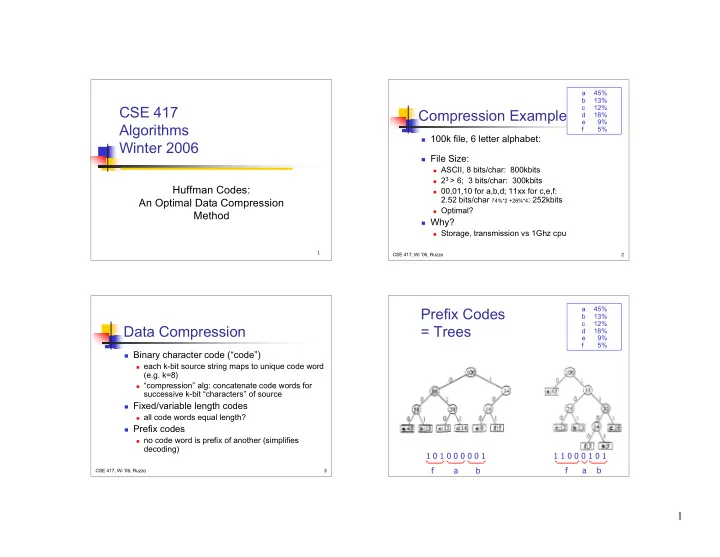
Compression Example

 100k file, 6 letter alphabet:  File Size:

 ASCII, 8 bits/char: 800kbits  23 > 6; 3 bits/char: 300kbits  00,01,10 for a,b,d; 11xx for c,e,f:

2.52 bits/char 74%*2 +26%*4: 252kbits

 Optimal?

 Why?

 Storage, transmission vs 1Ghz cpu

a 45% b 13% c 12% d 16% e 9% f 5%

CSE 417, Wi ’06, Ruzzo 3

Data Compression

 Binary character code (“code”)

 each k-bit source string maps to unique code word

(e.g. k=8)

 “compression” alg: concatenate code words for

successive k-bit “characters” of source

 Fixed/variable length codes

 all code words equal length?

 Prefix codes

 no code word is prefix of another (simplifies

decoding)

Prefix Codes = Trees

f a b

a 45% b 13% c 12% d 16% e 9% f 5%

1 0 1 0 0 0 0 0 1 1 1 0 0 0 1 0 1 f a b

slide-2
SLIDE 2

2

CSE 417, Wi ’06, Ruzzo 5

Greedy Idea #1

 Put most frequent

under root, then recurse …

a 45% b 13% c 12% d 16% e 9% f 5%

a:45 100

. . . . .

CSE 417, Wi ’06, Ruzzo 6

Greedy Idea #1

 Put most frequent

under root, then recurse

 Too greedy:

unbalanced tree

.45*1 + .16*2 + .13*3 … = 2.34

not too bad, but imagine if all freqs were ~1/6: (1+2+3+4+5+5)/6=3.33 a:45 100 d:16 55 b:13 29

. . .

a 45% b 13% c 12% d 16% e 9% f 5%

CSE 417, Wi ’06, Ruzzo 7

Greedy Idea #2

 Divide letters into 2

groups, with ~50% weight in each; recurse

(Shannon-Fano code)

 Again, not terrible

2*.5+3*.5 = 2.5

 But this tree

can easily be improved! (How?)

100 50

a 45% b 13% c 12% d 16% e 9% f 5%

a:45 50 f:5 b:13 25 c:12 d:16 25 e:9

CSE 417, Wi ’06, Ruzzo 8

Greedy idea #3

 Group least frequent

letters near bottom

100 f:5 14

. . .

e:9 c:12 25 b:13

. . .

a 45% b 13% c 12% d 16% e 9% f 5%

slide-3
SLIDE 3

3

.45*1 + .41*3 + .14*4 = 2.24 bits per char

CSE 417, Wi ’06, Ruzzo 11

Huffman’s Algorithm (1952)

Algorithm:

insert node for each letter into priority queue by freq while queue length > 1 do remove smallest 2; call them x, y make new node z from them, with f(z) = f(x)+f(y) insert z into queue

Analysis: O(n) heap ops: O(n log n) Goal:

Minimize

Correctness: ???

B(T ) = freq(c)*depth(c)

cC

  • CSE 417, Wi ’06, Ruzzo

12

Correctness Strategy

 Optimal solution may not be unique, so

cannot prove that greedy gives the only possible answer.

 Instead, show that greedy’s solution is

as good as any.

slide-4
SLIDE 4

4

Claim: If we flip an inversion, cost never increases. Why? All other things being equal, better to give more frequent letter the shorter code. before after I.e. non-negative cost savings. Defn: A pair of leaves is an inversion if depth(x) ≥ depth(y) and freq(x) ≥ freq(y) (d(x)*f(x) + d(y)*f(y)) - (d(x)*f(y) + d(y)*f(x)) = (d(x) - d(y)) * (f(x) - f(y)) ≥ 0

CSE 417, Wi ’06, Ruzzo 14

The 2 least frequent letters might as well be siblings at deepest level

 Let a be least freq, b 2nd  Let u, v be siblings at

max depth, f(u) ≤ f(v) (why must they exist?)

 Then (a,u) and (b,v) are

  • inversions. Swap them.

Lemma 1:

“Greedy Choice Property”

CSE 417, Wi ’06, Ruzzo 15

Let (C, f) be a problem instance: C an n-letter alphabet with letter frequencies f(c) for c in C. For any x, y in C, let C’ be the (n-1) letter alphabet C - {x,y} ∪ {z} and for all c in C’ define Let T’ be an optimal tree for (C’,f’). Then is optimal for (C,f) among all trees having x,y as siblings

Lemma 2:

“Optimal Substructure”

z c if f(y), f(x) z y, x, c if f(c), (c) f' = +

  • =

T’ x y z T =

) ( ' ) ( ' ) ( ) ( ' ) 1 ) ( ( ) ( ' ) ( )) ( ) ( ( ) ( ) ' ( ) ( ) ( ) ( ) (

' ' '

z f z f z d z f z d z f z d y f x f x d T B T B c f c d T B

T T T T C c T

=

  • +

=

  • +
  • =
  • =

Proof: Suppose (having x & y as siblings) is better than T, i.e. Collapse x & y to z, forming ; as above: Then: Contradicting optimality of T’

' ˆ T

) ' ( ) ( ' ) ( ) ( ' ) ˆ ( ) ' ˆ ( ) ( ' ) ' ˆ ( ) ˆ ( T B z f T B z f T B T B z f T B T B =

  • <
  • =

=

  • T

ˆ

B( ˆ T ) < B(T ).

slide-5
SLIDE 5

5

CSE 417, Wi ’06, Ruzzo 17

Theorem:

Huffman gives optimal codes

Proof: induction on |C|

 Basis: n=1,2 – immediate  Induction: n>2  Let x,y be least frequent  Form C’, f’, & z, as above  By induction, T’ is opt for (C’,f’)  By lemma 2, T’→T is opt for (C,f) among trees

with x,y as siblings

 By lemma 1, some opt tree has x, y as siblings  Therefore, T is optimal.

CSE 417, Wi ’06, Ruzzo 18

Data Compression

 Huffman is optimal.  BUT still might do better!

 Huffman encodes fixed length blocks. What if we

vary them?

 Huffman uses one encoding throughout a file.

What if characteristics change?

 What if data has structure? E.g. raster images,

video,…

 Huffman is lossless. Necessary?

 LZW, MPEG, …

CSE 417, Wi ’06, Ruzzo 19

David A. Huffman, 1925-1999

CSE 417, Wi ’06, Ruzzo 20

slide-6
SLIDE 6

6

CSE 417, Wi ’06, Ruzzo 21