
CSE 341 Programming Languages
Racket Datatype Style Programming Zach Tatlock Spring 2014
The Goal
In ML, we often define datatypes and write recursive functions over them – how do we do analogous things in Racket? – First way: With lists – Second way: With structs [a new construct]
- Contrast helps explain advantages of structs
2
Life without datatypes
Racket has nothing like a datatype binding for one-of types No need in a dynamically typed language: – Can just mix values of different types and use primitives like number?, string?, pair?, etc. to “see what you have” – Can use cons cells to build up any kind of data
3
Mixed collections
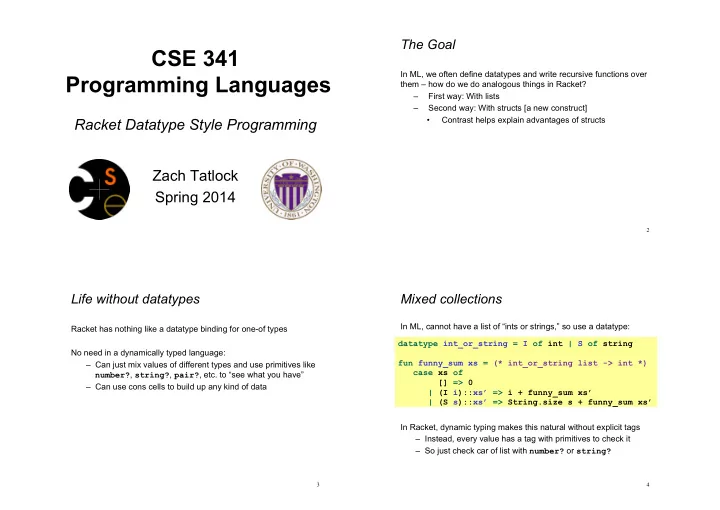
In ML, cannot have a list of “ints or strings,” so use a datatype: In Racket, dynamic typing makes this natural without explicit tags – Instead, every value has a tag with primitives to check it – So just check car of list with number? or string?
4
datatype int_or_string = I of int | S of string fun funny_sum xs = (* int_or_string list -> int *) case xs of [] => 0 | (I i)::xs’ => i + funny_sum xs’ | (S s)::xs’ => String.size s + funny_sum xs’