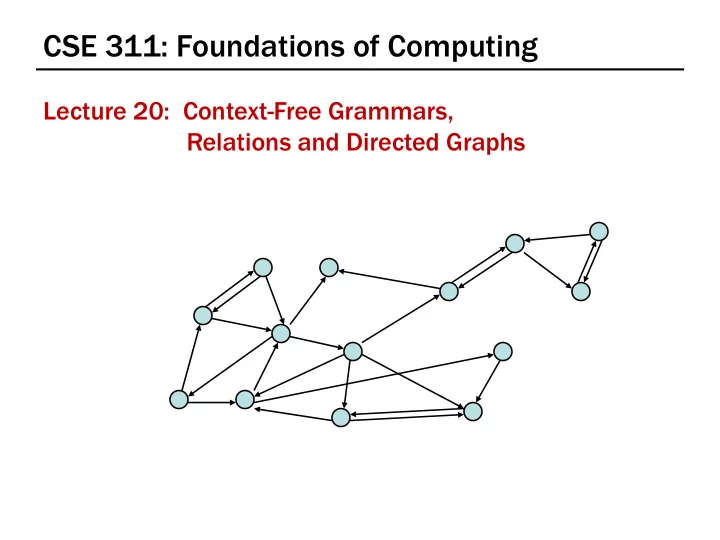
SLIDE 1
CSE 311: Foundations of Computing
Lecture 20: Context-Free Grammars, Relations and Directed Graphs
SLIDE 2 Parse Trees
Suppose that grammar G generates a string x
- A parse tree of x for G has
– Root labeled S (start symbol of G) – The children of any node labeled A are labeled by symbols of w left-to-right for some rule A w – The symbols of x label the leaves ordered left-to-right
S 0S0 | 1S1 | 0 | 1 | S S S 1 1 1
Parse tree of 01110
SLIDE 3
Simple Arithmetic Expressions
E E+E | E∗E E | (E) | x | y | z | 0 | 1 | 2 | 3 | 4 | 5 | 6 | 7 | 8 | 9 Two parse trees for 2+3∗4 E E E
+ ∗
E E 2 3 4
∗ +
E E 2 E E E 3 4
SLIDE 4 Building precedence in simple arithmetic expressions
- E – expression (start symbol)
- T – term F – factor I – identifier N - number
E T | E+T T F | T∗F F (E) | I | N I x | y | z N 0 | 1 | 2 | 3 | 4 | 5 | 6 | 7 | 8 | 9
SLIDE 5 Building precedence in simple arithmetic expressions
- E – expression (start symbol)
- T – term F – factor I – identifier N - number
E T | E+T T F | T∗F F (E) | I | N I x | y | z N 0 | 1 | 2 | 3 | 4 | 5 | 6 | 7 | 8 | 9 E E T
+ ∗
T F 2 F N T 3 F N 4 N
SLIDE 6
Backus-Naur Form (The same thing…) BNF (Backus-Naur Form) grammars
– Originally used to define programming languages – Variables denoted by long names in angle brackets, e.g.
<identifier>, <if-then-else-statement>, <assignment-statement>, <condition> ∷= used instead of
SLIDE 7
BNF for C (no <...> and uses : instead of ::=)
SLIDE 8
Parse Trees
Back to middle school: <sentence>∷=<noun phrase><verb phrase> <noun phrase>∷==<article><adjective><noun> <verb phrase>∷=<verb><adverb>|<verb><object> <object>∷=<noun phrase> Parse: The yellow duck squeaked loudly The red truck hit a parked car
SLIDE 9
Relations and Directed Graphs
SLIDE 10
Relations
Let A and B be sets, A binary relation from A to B is a subset of A B Let A be a set, A binary relation on A is a subset of A A
SLIDE 11
Relations You Already Know!
≥ on ℕ That is: {(x,y) : x ≥ y and x, y ℕ} < on ℝ That is: {(x,y) : x < y and x, y ℝ} = on ∑* That is: {(x,y) : x = y and x, y ∑*}
⊆ on 𝓠(U) for universe U
That is: {(A,B) : A ⊆ B and A, B 𝓠(U)}
SLIDE 12
More Relation Examples
R1 = {(a, 1), (a, 2), (b, 1), (b, 3), (c, 3)} R2 = {(x, y) | x ≡ y (mod 5) } R3 = {(c1, c2) | c1 is a prerequisite of c2 } R4 = {(s, c) | student s has taken course c }
SLIDE 13
Properties of Relations
Let R be a relation on A. R is reflexive iff (a,a) R for every a A R is symmetric iff (a,b) R implies (b, a) R R is antisymmetric iff (a,b) R and a b implies (b,a) ∉ R R is transitive iff (a,b) R and (b, c) R implies (a, c) R
SLIDE 14
Combining Relations
Let 𝑺 be a relation from 𝑩 to 𝑪. Let 𝑻 be a relation from 𝑪 to 𝑫. The composition of 𝑺 and 𝑻, 𝑻 ∘ 𝑺 is the relation from 𝑩 to 𝑫 defined by: 𝑻 ∘ 𝑺 = { (a, c) | b such that (a,b) 𝑺 and (b,c) 𝑻} Intuitively, a pair is in the composition if there is a “connection” from the first to the second.
SLIDE 15
Examples (a,b) Parent iff b is a parent of a (a,b) Sister iff b is a sister of a When is (x,y) Sister ∘ Parent? When is (x,y) Parent ∘ Sister?
S ∘ R = {(a, c) | b such that (a,b) R and (b,c) S}
SLIDE 16
Examples Using the relations: Parent, Child, Brother, Sister, Sibling, Father, Mother, Husband, Wife express: Uncle: b is an uncle of a Cousin: b is a cousin of a
SLIDE 17
Powers of a Relation
𝑺𝟑 = 𝑺 ∘ 𝑺 = { 𝒃, 𝒅 ∣ ∃𝒄 such that 𝒃, 𝒄 ∈ 𝑺 and 𝒄, 𝒅 ∈ 𝑺 } 𝑺𝟏 = { 𝒃, 𝒃 ∣ 𝒃 ∈ 𝑩} “the equality relation on 𝑩” 𝑺𝟐 = 𝑺 = 𝑺𝟏 ∘ 𝑺 𝑺𝒐+𝟐 = 𝑺𝒐 ∘ 𝑺 for 𝒐 ≥ 𝟏
SLIDE 18
Matrix Representation Relation 𝑺 on 𝑩 = {𝑏1, … , 𝑏𝑞}
{ (1, 1), (1, 2), (1, 4), (2, 1), (2, 3), (3, 2), (3, 3), (4, 2), (4, 3) }
1 2 3 4 1 1 1 1 2 1 1 3 1 1 4 1 1
𝒏𝒋𝒌 = 1 if 𝑏𝑗, 𝑏𝑘 ∈ 𝑺 if 𝑏𝑗, 𝑏𝑘 ∉ 𝑺
SLIDE 19
Directed Graphs
Path: v0, v1, …, vk with each (vi, vi+1) in E
Simple Path: none of v0 , …, vk repeated Cycle: v0= vk Simple Cycle: v0= vk , none of v1, …, vk repeated
G = (V, E) V – vertices E – edges, ordered pairs of vertices
SLIDE 20
Directed Graphs
Path: v0, v1, …, vk with each (vi, vi+1) in E
Simple Path: none of v0 , …, vk repeated Cycle: v0= vk Simple Cycle: v0= vk , none of v1, …, vk repeated
G = (V, E) V – vertices E – edges, ordered pairs of vertices
SLIDE 21
Directed Graphs
Path: v0, v1, …, vk with each (vi, vi+1) in E
Simple Path: none of v0 , …, vk repeated Cycle: v0= vk Simple Cycle: v0= vk , none of v1, …, vk repeated
G = (V, E) V – vertices E – edges, ordered pairs of vertices
SLIDE 22
Directed Graphs
Path: v0, v1, …, vk with each (vi, vi+1) in E
Simple Path: none of v0 , …, vk repeated Cycle: v0= vk Simple Cycle: v0= vk , none of v1, …, vk repeated
G = (V, E) V – vertices E – edges, ordered pairs of vertices
SLIDE 23
Representation of Relations
Directed Graph Representation (Digraph)
{(a, b), (a, a), (b, a), (c, a), (c, d), (c, e) (d, e) }
a d e b c
SLIDE 24
Representation of Relations
Directed Graph Representation (Digraph)
{(a, b), (a, a), (b, a), (c, a), (c, d), (c, e) (d, e) }
a d e b c
SLIDE 25
Relational Composition using Digraphs
If 𝑻 = 𝟑, 𝟑 , 𝟑, 𝟒 , 𝟒, 𝟐 and 𝑺 = { 𝟐, 𝟑 , 𝟑, 𝟐 , 𝟐, 𝟒 } Compute 𝑻 ∘ 𝑺
1 3 2 1 3 2
SLIDE 26
Relational Composition using Digraphs
If 𝑻 = 𝟑, 𝟑 , 𝟑, 𝟒 , 𝟒, 𝟐 and 𝑺 = { 𝟐, 𝟑 , 𝟑, 𝟐 , 𝟐, 𝟒 } Compute 𝑻 ∘ 𝑺
1 3 2 1 3 2
SLIDE 27
Relational Composition using Digraphs
If 𝑻 = 𝟑, 𝟑 , 𝟑, 𝟒 , 𝟒, 𝟐 and 𝑺 = { 𝟐, 𝟑 , 𝟑, 𝟐 , 𝟐, 𝟒 } Compute 𝑻 ∘ 𝑺
1 3 2 1 3 2
SLIDE 28
Paths in Relations and Graphs
Let 𝑺 be a relation on a set 𝑩. There is a path of length 𝒐 from a to b if and only if (a,b) 𝑺𝒐 Defn: The length of a path in a graph is the number of edges in it (counting repetitions if edge used > once).
SLIDE 29
Connectivity In Graphs
Let 𝑺 be a relation on a set 𝑩. The connectivity relation 𝑺∗ consists of the pairs (𝑏,𝑐) such that there is a path from 𝑏 to 𝑐 in 𝑺.
Note: The text uses the wrong definition of this quantity. What the text defines (ignoring k=0) is usually called R+
Defn: Two vertices in a graph are connected iff there is a path between them.
SLIDE 30
How Properties of Relations show up in Graphs
Let R be a relation on A. R is reflexive iff (a,a) R for every a A R is symmetric iff (a,b) R implies (b, a) R R is transitive iff (a,b) R and (b, c) R implies (a, c) R R is antisymmetric iff (a,b) R and a b implies (b,a) ∉ R
SLIDE 31
Transitive-Reflexive Closure
Add the minimum possible number of edges to make the relation transitive and reflexive. The transitive-reflexive closure of a relation 𝑺 is the connectivity relation 𝑺*
SLIDE 32
Transitive-Reflexive Closure
Relation with the minimum possible number of extra edges to make the relation both transitive and reflexive. The transitive-reflexive closure of a relation 𝑺 is the connectivity relation 𝑺*
SLIDE 33
𝑜-ary Relations
Let 𝑩𝟐, 𝑩𝟑, … , 𝑩𝒐 be sets. An 𝒐-ary relation on these sets is a subset of 𝑩𝟐𝑩𝟑 ⋯ 𝑩𝒐.
SLIDE 34
Relational Databases
Student_Name ID_Number Office GPA Knuth 328012098 022 4.00 Von Neuman 481080220 555 3.78 Russell 238082388 022 3.85 Einstein 238001920 022 2.11 Newton 1727017 333 3.61 Karp 348882811 022 3.98 Bernoulli 2921938 022 3.21 STUDENT
SLIDE 35
Relational Databases
Student_Name ID_Number Office GPA Course Knuth 328012098 022 4.00 CSE311 Knuth 328012098 022 4.00 CSE351 Von Neuman 481080220 555 3.78 CSE311 Russell 238082388 022 3.85 CSE312 Russell 238082388 022 3.85 CSE344 Russell 238082388 022 3.85 CSE351 Newton 1727017 333 3.61 CSE312 Karp 348882811 022 3.98 CSE311 Karp 348882811 022 3.98 CSE312 Karp 348882811 022 3.98 CSE344 Karp 348882811 022 3.98 CSE351 Bernoulli 2921938 022 3.21 CSE351
What’s not so nice?
STUDENT
SLIDE 36
Relational Databases
ID_Number Course 328012098 CSE311 328012098 CSE351 481080220 CSE311 238082388 CSE312 238082388 CSE344 238082388 CSE351 1727017 CSE312 348882811 CSE311 348882811 CSE312 348882811 CSE344 348882811 CSE351 2921938 CSE351
Better
Student_Name ID_Number Office GPA Knuth 328012098 022 4.00 Von Neuman 481080220 555 3.78 Russell 238082388 022 3.85 Einstein 238001920 022 2.11 Newton 1727017 333 3.61 Karp 348882811 022 3.98 Bernoulli 2921938 022 3.21 STUDENT TAKES
SLIDE 37
Database Operations: Projection
Find all offices: 𝚸𝐏𝐠𝐠𝐣𝐝𝐟 STUDENT
Office 022 555 333
Find offices and GPAs: 𝚸𝐏𝐠𝐠𝐣𝐝𝐟,𝐇𝐐𝐁 STUDENT
Office GPA 022 4.00 555 3.78 022 3.85 022 2.11 333 3.61 022 3.98 022 3.21
SLIDE 38
Database Operations: Selection
Find students with GPA > 3.9 : σGPA>3.9(STUDENT)
Student_Name ID_Number Office GPA Knuth 328012098 022 4.00 Karp 348882811 022 3.98
Retrieve the name and GPA for students with GPA > 3.9: ΠStudent_Name,GPA(σGPA>3.9(STUDENT))
Student_Name GPA Knuth 4.00 Karp 3.98
SLIDE 39
Database Operations: Natural Join
Student_Name ID_Number Office GPA Course Knuth 328012098 022 4.00 CSE311 Knuth 328012098 022 4.00 CSE351 Von Neuman 481080220 555 3.78 CSE311 Russell 238082388 022 3.85 CSE312 Russell 238082388 022 3.85 CSE344 Russell 238082388 022 3.85 CSE351 Newton 1727017 333 3.61 CSE312 Karp 348882811 022 3.98 CSE311 Karp 348882811 022 3.98 CSE312 Karp 348882811 022 3.98 CSE344 Karp 348882811 022 3.98 CSE351 Bernoulli 2921938 022 3.21 CSE351
Student ⋈ Takes