CSE 116: Fall 2019 Introduction to Functional Programming - - PowerPoint PPT Presentation

cse 116 fall 2019
SMART_READER_LITE
LIVE PREVIEW

CSE 116: Fall 2019 Introduction to Functional Programming - - PowerPoint PPT Presentation

CSE 116: Fall 2019 Introduction to Functional Programming Lambda Calculus Owen Arden UC Santa Cruz Based on course materials developed by Ranjit Jhala Your favorite language Probably has lots of features: Assignment (x =


slide-1
SLIDE 1

CSE 116: Fall 2019


Introduction to Functional Programming

Owen Arden UC Santa Cruz

Lambda Calculus

Based on course materials developed by Ranjit Jhala

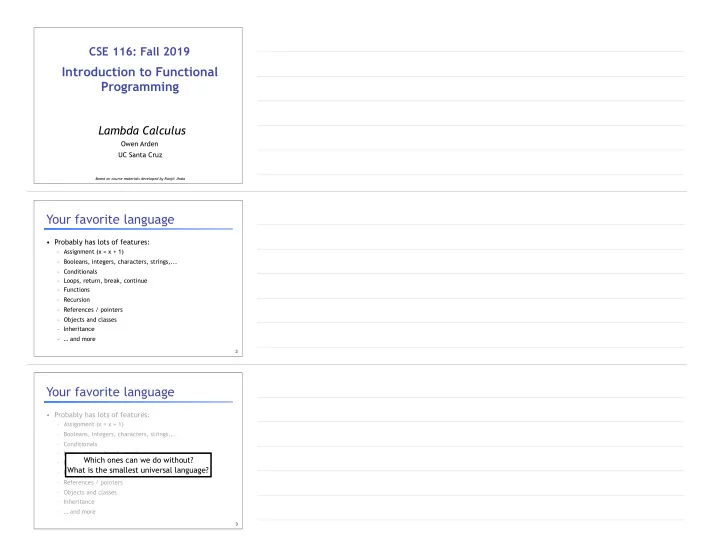
Your favorite language

  • Probably has lots of features:

– ︎Assignment (x = x + 1) – ︎Booleans, integers, characters, strings,... ︎ – Conditionals – ︎Loops,︎ return, break, continue – ︎Functions – ︎Recursion – ︎References / pointers – ︎Objects and classes – ︎Inheritance – … and more

2

Your favorite language

  • Probably has lots of features:

– ︎Assignment (x = x + 1) – ︎Booleans, integers, characters, strings,... ︎ – Conditionals – ︎Loops,︎ return, break, continue – ︎Functions – ︎Recursion – ︎References / pointers – ︎Objects and classes – ︎Inheritance – … and more

3

Which ones can we do without? What is the smallest universal language?

slide-2
SLIDE 2

What is computable?

  • Prior to 1930s

– Informal notion of an effectively calculable function: One that can be computed by a human with pen and paper, following an algorithm

4

What is computable?

  • 1936: Formalization

5

Alan Turing: Turing machines

What is computable?

  • 1936: Formalization

6

Alonzo Church: lambda calculus

e ::= x | \x -> e | e1 e2

slide-3
SLIDE 3

The Next 700 Languages

  • Big impact on language design!

7

Whatever the next 700 languages turn out to be, they will surely be variants of lambda calculus. Peter Landin, 1966

Your favorite language

  • Probably has lots of features:

– ︎Assignment (x = x + 1) – ︎Booleans, integers, characters, strings,... ︎ – Conditionals – ︎Loops,︎ return, break, continue – ︎Functions – ︎Recursion – ︎References / pointers – ︎Objects and classes – ︎Inheritance – … and more

8

The Lambda Calculus

  • Features

– ︎Functions – (that’s it)

9

slide-4
SLIDE 4

The Lambda Calculus

  • Seriously…

– ︎Assignment (x = x + 1) – ︎Booleans, integers, characters, strings,... ︎ – Conditionals – ︎Loops,︎ return, break, continue – ︎Functions – ︎Recursion – ︎References / pointers – ︎Objects and classes – ︎Inheritance – … and more

10

The only thing you can do is: Define a function Call a function

Describing a Programming Language

  • Syntax

– What do programs look like?

  • Semantics

– What do programs mean? – Operational semantics:

  • How do programs execute step-by-step?

11

Syntax: What programs look like

  • Programs are expressions e (also called λ-terms)
  • Variable: x, y, z
  • Abstraction (aka nameless function definition):

– \x -> e “for any x, compute e” – x is the formal parameter, e is the body

  • Application (aka function call):

– e1 e2 “apply e1 to e2” – e1 is the function, e2 is the argument

12

e ::= x | \x -> e | e1 e2

slide-5
SLIDE 5

Examples

  • - The identity function ("for any x compute x")

\x -> x

  • - A function that returns the identity function

\x -> (\y -> y)

  • - A function that applies its argument to
  • - the identity function

\f -> f (\x -> x)

13

Examples

  • - The identity function ("for any x compute x")

\x -> x

  • - A function that returns the identity function

\x -> (\y -> y)

  • - A function that applies its argument to
  • - the identity function

\f -> f (\x -> x)

14

  • How do I define a function with two arguments?
  • e.g. a function that takes x and y and returns y

Examples

  • - The identity function ("for any x compute x")

\x -> x

  • - A function that returns the identity function

\x -> (\y -> y)

  • - A function that applies its argument to
  • - the identity function

\f -> f (\x -> x)

15

  • How do I define a function with two arguments?
  • e.g. a function that takes x and y and returns y

OR: a function that takes two arguments and returns the second one!

slide-6
SLIDE 6

Examples

  • How do I apply a function to two arguments?

– e.g. apply \x -> (\y -> y) to apple and banana?

16

  • - first apply to apple, then apply the result to banana

(((\x -> (\y -> y)) apple) banana)

Syntactic Sugar

  • Convenient notation used as a shorthand for valid

syntax

17

\x y -> y -- A function that that takes two arguments

  • - and returns the second one...

(\x y -> y) apple banana -- ... applied to two arguments

instead of we write

\x -> (\y -> (\z -> e)) \x -> \y -> \z -> e \x -> \y -> \z -> e \x y z -> e (((e1 e2) e3) e4) e1 e2 e3 e4

Semantics: What programs mean

  • How do I “run” or “execute” a λ-term?
  • Think of middle-school algebra:
  • - Simplify expression:

(x + 2)*(3*x - 1) = ???

  • Execute = rewrite step-by-step following simple rules

until no more rules apply

18

slide-7
SLIDE 7

Rewrite rules of lambda calculus

  • 1. α-step (aka renaming formals)
  • 2. β-step (aka function call)

But first we have to talk about scope

19

Semantics: Scope of a Variable

20

  • The part of a program where a variable is visible
  • In the expression \x -> e

– x is the newly introduced variable – e is the scope of x – any occurrence of x in \x -> e is bound (by the binder \x)

Semantics: Scope of a Variable

21

  • For example, x is bound in:

\x -> x \x -> (\y -> x)

  • An occurrence of x in e is free if it’s not bound by an

enclosing abstraction

  • For example, x is free in:

x y -- no binders at all! \y -> x y -- no \x binder (\x -> \y -> y) x -- x is outside the scope

  • - of the \x binder;
  • - intuition: it's not "the same" x
slide-8
SLIDE 8

Free Variables

22

  • An variable x is free in e if there exists a free
  • ccurrence of x in e
  • We can formally define the set of all free variables in

a term like so:

FV(x) = ??? FV(\x -> e) = ??? FV(e1 e2) = ???

Free Variables

23

  • An variable x is free in e if there exists a free
  • ccurrence of x in e
  • We can formally define the set of all free variables in

a term like so:

FV(x) = {x} FV(\x -> e) = FV(e) \ {x} FV(e1 e2) = FV(e1) ∪ FV(e2)

Closed Expressions

24

  • If e has no free variables it is said to be closed
  • Closed expressions are also called combinators

– Q: What is the shortest closed expression?

slide-9
SLIDE 9

Closed Expressions

25

  • If e has no free variables it is said to be closed
  • Closed expressions are also called combinators

– Q: What is the shortest closed expression? – A: \x -> x

Rewrite rules of lambda calculus

  • 1. α-step (aka renaming formals)
  • 2. β-step (aka function call)

26

Semantics: β-Reduction

(\x -> e1) e2 =b> e1[x := e2]

where e1[x := e2] means “e1 with all free occurrences

  • f x replaced with e2”

27

  • Computation by search-and-replace:
  • If you see an abstraction applied to an argument,

take the body of the abstraction and replace all free

  • ccurrences of the formal by that argument
  • We say that (\x -> e1) e2 β-steps to e1[x := e2]
slide-10
SLIDE 10

Examples

(\x -> x) apple =b> apple

Is this right? Ask Elsa!

(\f -> f (\x -> x)) (give apple) =b> ???

28

Examples

(\x -> x) apple =b> apple

Is this right? Ask Elsa!

(\f -> f (\x -> x)) (give apple) =b> give apple (\x -> x)

29

A Tricky One

(\x -> (\y -> x)) y =b> \y -> y

Is this right? Problem: the free y in the argument has been captured by \y! Solution: make sure that all free variables of the argument are different from the binders in the body.

30

slide-11
SLIDE 11

Capture-Avoiding Substitution

31

  • We have to fix our definition of β-reduction:

(\x -> e1) e2 =b> e1[x := e2]

where e1[x := e2] means “e1 with all free occurrences

  • f x replaced with e2”

– e1 with all free occurrences of x replaced with e2, as long as no free variables of e2 get captured – undefined otherwise

Capture-Avoiding Substitution

32

Formally:

x[x := e] = e y[x := e] = y -- assuming x /= y (e1 e2)[x := e] = (e1[x := e]) (e2[x := e]) (\x -> e1)[x := e] = \x -> e1 -- why just `e1`? (\y -> e1)[x := e] | not (y in FV(e)) = \y -> e1[x := e] | otherwise = undefined -- but what then???

Rewrite rules of lambda calculus

  • 1. α-step (aka renaming formals)
  • 2. β-step (aka function call)

33

slide-12
SLIDE 12

Semantics: α-Reduction

\x -> e =a> \y -> e[x := y] where not (y in FV(e))

34

  • We can rename a formal parameter and replace all its
  • ccurrences in the body
  • We say that (\x -> e) α-steps to (\y -> e[x := y])

Semantics: α-Reduction

\x -> e =a> \y -> e[x := y] where not (y in FV(e))

35

  • Example:

\x -> x =a> \y -> y =a> \z -> z

  • All these expressions are α-equivalent

Example

What’s wrong with these?

  • - (A)

\f -> f x =a> \x -> x x

  • - (B)

(\x -> \y -> y) y =a> (\x -> \z -> z) z

  • - (C)

\x -> \y -> x y =a> \apple -> \orange -> apple orange

36

slide-13
SLIDE 13

The Tricky One

(\x -> (\y -> x)) y =a> ???

To avoid getting confused, you can always rename formals, so that different variables have different names!

37

The Tricky One

(\x -> (\y -> x)) y =a> (\x -> (\z -> x)) y =b> \z -> y

To avoid getting confused, you can always rename formals, so that different variables have different names!

38

Normal Forms

A redex is a λ-term of the form (\x -> e1) e2 A λ-term is in normal form if it contains no redexes.

39

slide-14
SLIDE 14

Semantics: Evaluation

40

  • A λ-term e evaluates to e' if
  • 1. There is a sequence of stops

e =?> e_1 =?> ... =?> e_N =?> e’

where each =?> is either =a> or =b> and N >= 0

  • 2. e’ is in normal form

Example of evaluation

(\x -> x) apple =b> apple

(\f -> f (\x -> x)) (\x -> x) =?> ??? 
 (\x -> x x) (\x -> x) =?> ???

41

Example of evaluation

(\x -> x) apple =b> apple

(\f -> f (\x -> x)) (\x -> x) =b> (\x -> x) (\x -> x) =b> \x -> x

(\x -> x x) (\x -> x) =?> ???

42

slide-15
SLIDE 15

Example of evaluation

(\x -> x) apple =b> apple

(\f -> f (\x -> x)) (\x -> x) =b> (\x -> x) (\x -> x) =b> \x -> x

(\x -> x x) (\x -> x) =b> (\x -> x) (\x -> x) =b> \x -> x

43

Elsa shortcuts

44

  • Named λ-terms

let ID = \x -> x -- abbreviation for \x -> x

  • To substitute a name with its definition, use

a =d> step:

ID apple =d> (\x -> x) apple -- expand definition =b> apple -- beta-reduce

Elsa shortcuts

45

  • Evaluation

– e1 =*> e2: e1 reduces to e2 in 0 or more steps

  • where each step is =a>, =b>, or =d>

– e1 =~> e2: e1 evaluates to e2

  • What is the difference?
slide-16
SLIDE 16

Non-Terminating Evaluation

46

(\x -> x x) (\x -> x x) =b> (\x -> x x) (\x -> x x)

  • Oh no… we can write programs that loop back to

themselves

  • And never reduce to normal form!
  • This combinator is called Ω

Non-Terminating Evaluation

47

  • What if we pass Ω as an argument to another

function?

let OMEGA = (\x -> x x) (\x -> x x) (\x -> \y -> y) OMEGA

  • Does this reduce to a normal form? Try it at home!

Programming in λ-calculus

48

  • Real languages have lots of features

– Booleans – Records (structs, tuples) – Numbers – Functions [we got those] – Recursion

  • Let’s see how to encode all of these features with

the λ-calculus.

slide-17
SLIDE 17

λ-calculus: Booleans

49

  • How can we encode Boolean values (TRUE and FALSE)

as functions?

  • Well, what do we do with a Boolean b?

– We make a binary choice

if b then e1 else e2

Booleans: API

50

  • We need to define three functions

let TRUE = ??? let FALSE = ??? let ITE = \b x y -> ??? -- if b then x else y

such that

ITE TRUE apple banana =~> apple ITE FALSE apple banana =~> banana (Here, let NAME = e means NAME is an abbreviation for e)

Booleans: Implementation

51

let TRUE = \x y -> x -- Returns first argument let FALSE = \x y -> y -- Returns second argument let ITE = \b x y -> b x y -- Applies cond. to branches

  • - (redundant, but
  • - improves readability)
slide-18
SLIDE 18

Example: Branches step-by-step

52

eval ite_true: ITE TRUE e1 e2 =d> (\b x y -> b x y) TRUE e1 e2 -- expand def ITE =b> (\x y -> TRUE x y) e1 e2 -- beta-step =b> (\y -> TRUE e1 y) e2 -- beta-step =b> TRUE e1 e2 -- expand def TRUE =d> (\x y -> x) e1 e2 -- beta-step =b> (\y -> e1) e2 -- beta-step =b> e1

Example: Branches step-by-step

53

  • Now you try it!
  • Can you fill in the blanks to make it happen?

– http://goto.ucsd.edu:8095/index.html#?demo=ite.lc

eval ite_false: ITE FALSE e1 e2

  • - fill the steps in!

=b> e2

Example: Branches step-by-step

54

eval ite_false: ITE FALSE e1 e2 =d> (\b x y -> b x y) FALSE e1 e2 -- expand def ITE =b> (\x y -> FALSE x y) e1 e2 -- beta-step =b> (\y -> FALSE e1 y) e2 -- beta-step =b> FALSE e1 e2 -- expand def TRUE =d> (\x y -> y) e1 e2 -- beta-step =b> (\y -> y) e2 -- beta-step =b> e2

slide-19
SLIDE 19

Boolean operators

55

  • Now that we have ITE it’s easy to define other

Boolean operators:

let NOT = \b -> ??? let AND = \b1 b2 -> ??? let OR = \b1 b2 -> ???

Boolean operators

56

  • Now that we have ITE it’s easy to define other

Boolean operators:

let NOT = \b -> ITE b FALSE TRUE let AND = \b1 b2 -> ITE b1 b2 FALSE let OR = \b1 b2 -> ITE b1 TRUE b2

Boolean operators

57

  • Now that we have ITE it’s easy to define other

Boolean operators:

let NOT = \b -> b FALSE TRUE let AND = \b1 b2 -> b1 b2 FALSE let OR = \b1 b2 -> b1 TRUE b2

– (since ITE is redundant) – Which definition to do you prefer and why?

slide-20
SLIDE 20

Programming in λ-calculus

58

  • Real languages have lots of features

– Booleans [done] – Records (structs, tuples) – Numbers – Functions [we got those] – Recursion

λ-calculus: Records

59

  • Let’s start with records with two fields (aka pairs)?
  • Well, what do we do with a pair?

1.Pack two items into a pair, then 2.Get first item, or 3.Get second item.

Pairs: API

60

  • We need to define three functions

let PAIR = \x y -> ??? -- Make a pair with x and y

  • - { fst : x, snd : y }

let FST = \p -> ??? -- Return first element

  • - p.fst

let SND = \p -> ??? -- Return second element

  • - p.snd

such that

FST (PAIR apple banana) =~> apple SND (PAIR apple banana) =~> banana

slide-21
SLIDE 21

Pairs: Implementation

61

  • A pair of x and y is just something that lets you pick

between x and y! (I.e. a function that takes a boolean and returns either x or y)

let PAIR = \x y -> (\b -> ITE b x y) let FST = \p -> p TRUE -- call w/ TRUE, get 1st value let SND = \p -> p FALSE -- call w/ FALSE, get 2nd value

Exercise: Triples?

62

  • How can we implement a record that

contains three values?

let TRIPLE = \x y z -> ??? let FST3 = \t -> ??? let SND3 = \t -> ??? let TRD3 = \t -> ???

Exercise: Triples?

63

  • How can we implement a record that

contains three values?

let TRIPLE = \x y z -> PAIR x (PAIR y z) let FST3 = \t -> FST t let SND3 = \t -> FST (SND t) let TRD3 = \t -> SND (SND t)

slide-22
SLIDE 22

Programming in λ-calculus

64

  • Real languages have lots of features

– Booleans [done] – Records (structs, tuples) [done] – Numbers – Functions [we got those] – Recursion

λ-calculus: Numbers

65

  • Let’s start with natural numbers (0, 1, 2, …)
  • What do we do with natural numbers?
  • 1. Count: 0, inc
  • 2. Arithmetic: dec, +, -, *
  • 3. Comparisons: ==, <=, etc

Natural Numbers: API

66

  • We need to define:

– A family of numerals: ZERO, ONE, TWO, THREE, … – Arithmetic functions: INC, DEC, ADD, SUB, MULT – Comparisons: IS_ZERO, EQ Such that they respect all regular laws of arithmetic, e.g.

IS_ZERO ZERO =~> TRUE IS_ZERO (INC ZERO) =~> FALSE INC ONE =~> TWO ...

slide-23
SLIDE 23

Pairs: Implementation

67

  • Church numerals: a number N is encoded as a

combinator that calls a function on an argument N times

let ONE = \f x -> f x let TWO = \f x -> f (f x) let THREE = \f x -> f (f (f x)) let FOUR = \f x -> f (f (f (f x))) let FIVE = \f x -> f (f (f (f (f x)))) let SIX = \f x -> f (f (f (f (f (f x))))) ...

λ-calculus: Increment

68

  • - Call `f` on `x` one more time than `n` does

let INC = \n -> (\f x -> ???)

  • Example

eval inc_zero : INC ZERO =d> (\n f x -> f (n f x)) ZERO =b> \f x -> f (ZERO f x) =*> \f x -> f x =d> ONE

λ-calculus: Addition

69

  • - Call `f` on `x` exactly `n + m` times

let ADD = \n m -> n INC m

  • Example

eval add_one_zero : ADD ONE ZERO =~> ONE

slide-24
SLIDE 24

λ-calculus: Multiplication

70

  • - Call `f` on `x` exactly `n * m` times

let MULT = \n m -> n (ADD m) ZERO

  • Example

eval two_times_one : MULT TWO ONE =~> TWO

Programming in λ-calculus

71

  • Real languages have lots of features

– Booleans [done] – Records (structs, tuples) [done] – Numbers [done] – Functions [we got those] – Recursion

λ-calculus: Recursion

72

  • I want to write a function that sums up natural

numbers up to n:

\n -> ... -- 1 + 2 + ... + n

slide-25
SLIDE 25

λ-calculus: Recursion

73

  • No! Named terms in Elsa are just syntactic sugar
  • To translate an Elsa term to λ-calculus: replace each name

with its definition

\n -> ITE (ISZ n) ZERO (ADD n (SUM (DEC n))) -- But SUM is

  • - not a thing!
  • Recursion: Inside this function I want to call the same

function on DEC n

  • Looks like we can’t do recursion, because it requires being

able to refer to functions by name, but in λ-calculus functions are anonymous.

  • Right?

λ-calculus: Recursion

74

  • Think again!
  • Recursion: Inside this function I want to call the

same function on DEC n

– Inside this function I want to call a function on DEC n – And BTW, I want it to be the same function

  • Step 1: Pass in the function to call “recursively”

let STEP = \rec -> \n -> ITE (ISZ n) ZERO (ADD n (rec (DEC n))) -- Call some rec

λ-calculus: Recursion

75

  • Step 1: Pass in the function to call “recursively”

let STEP = \rec -> \n -> ITE (ISZ n) ZERO (ADD n (rec (DEC n))) -- Call some rec

  • Step 2: Do something clever to STEP, so that the

function passed as rec itself becomes

\n -> ITE (ISZ n) ZERO (ADD n (rec (DEC n)))

slide-26
SLIDE 26

λ-calculus: Fixpoint Combinator

76

  • Wanted: a combinator FIX such

that FIX STEP calls STEP with itself as the first argument:

FIX STEP =*> STEP (FIX STEP)

(In math: a fixpoint of a function f(x) is a point x, such that f(x) = x)

  • Once we have it, we can define:

let SUM = FIX STEP

  • Then by property of FIX we have:

SUM =*> STEP SUM -- (1)

λ-calculus: Fixpoint Combinator

77

eval sum_one: SUM ONE =*> STEP SUM ONE -- (1) =d> (\rec n -> ITE (ISZ n) ZERO (ADD n (rec (DEC n)))) SUM ONE =b> (\n -> ITE (ISZ n) ZERO (ADD n (SUM (DEC n)))) ONE

  • - ^^^ the magic happened!

=b> ITE (ISZ ONE) ZERO (ADD ONE (SUM (DEC ONE))) =*> ADD ONE (SUM ZERO) -- def of ISZ, ITE, DEC, ... =*> ADD ONE (STEP SUM ZERO) -- (1) =d> ADD ONE ((\rec n -> ITE (ISZ n) ZERO (ADD n (rec (DEC n)))) SUM ZERO) =b> ADD ONE ((\n -> ITE (ISZ n) ZERO (ADD n (SUM (DEC n)))) ZERO) =b> ADD ONE (ITE (ISZ ZERO) ZERO (ADD ZERO (SUM (DEC ZERO)))) =b> ADD ONE ZERO =~> ONE

λ-calculus: Fixpoint Combinator

78

  • So how do we define FIX?
  • Remember Ω? It replicates itself!

(\x -> x x) (\x -> x x) =b> (\x -> x x) (\x -> x x)

  • We need something similar but more involved.
slide-27
SLIDE 27

λ-calculus: Fixpoint Combinator

79

  • The Y combinator discovered by Haskell Curry:

let FIX = \stp -> (\x -> stp (x x)) (\x -> stp (x x))

  • How does it work?

eval fix_step: FIX STEP =d> (\stp -> (\x -> stp (x x)) (\x -> stp (x x))) STEP =b> (\x -> STEP (x x)) (\x -> STEP (x x)) =b> STEP ((\x -> STEP (x x)) (\x -> STEP (x x)))

  • - ^^^^^^^^^^ this is FIX STEP ^^^^^^^^^^^

Programming in λ-calculus

80

  • Real languages have lots of features

– Booleans [done] – Records (structs, tuples) [done] – Numbers [done] – Functions [we got those] – Recursion [done]

Next time: Intro to Haskell

81