CS-5630 / CS-6630 Visualization Data Alexander Lex - - PowerPoint PPT Presentation

cs 5630 cs 6630 visualization data
SMART_READER_LITE
LIVE PREVIEW

CS-5630 / CS-6630 Visualization Data Alexander Lex - - PowerPoint PPT Presentation

CS-5630 / CS-6630 Visualization Data Alexander Lex alex@sci.utah.edu [xkcd] Design Critique CodeSwarm https://goo.gl/0DVhMT Data Terms Dataset Types Tables Networks Fields (Continuous) Geometry (Spatial) Grid of positions Attributes


slide-1
SLIDE 1

CS-5630 / CS-6630 Visualization Data

Alexander Lex alex@sci.utah.edu

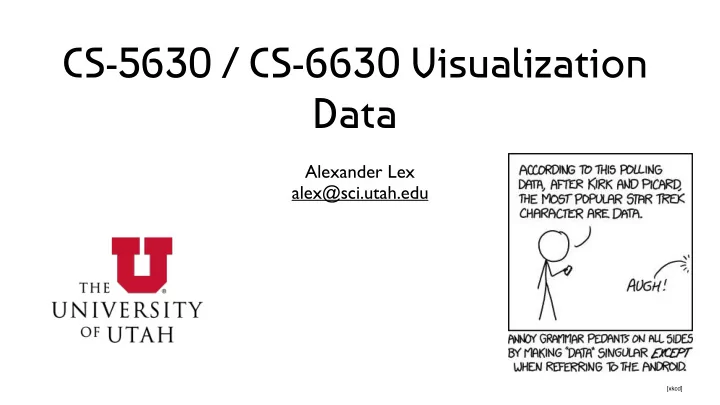
[xkcd]
slide-2
SLIDE 2

Design Critique

slide-3
SLIDE 3

CodeSwarm

https://goo.gl/0DVhMT

slide-4
SLIDE 4

Data

slide-5
SLIDE 5

Terms

Dataset Types

what can be visualized?

Data Types

fundamental units combinations make up Dataset Types

Tables

Attributes (columns) Items (rows) Cell containing value

Networks

Link Node (item)

Trees

Fields (Continuous)

Attributes (columns) Value in cell

Cell

Multidimensional Table

Value in cell

Grid of positions

Geometry (Spatial)

Position

Dataset Types

Data Types Items Attributes Links Positions Grids

slide-6
SLIDE 6

Structure

Structured Data

known data types, semantics

Tables

Attributes (columns) Items (rows) Cell containing value

Networks

Link Node (item)

Trees

Fields (Continuous)

Attributes (columns) Value in cell

Cell

Multidimensional Table

Value in cell

Grid of positions

Geometry (Spatial)

Position

Dataset Types

Unstructured Data

no predefined data model text-heavy, interspersed with facts (dates, times, locations) video, images Translate into structured data Natural Language Processing Text mining (sentiment, keywords, concepts, categories)

slide-7
SLIDE 7

Text Example: Phrase Net

Network Structure derived from pattern “X begat Y” Source: King James Bible

[van Ham, InfoVis 2009]

slide-8
SLIDE 8

Example: Phrase Net

Pattern: “X’s Y” 18th & 19th century 
 novels More in Lecture
 Text & Document Vis

[van Ham, InfoVis 2009]

slide-9
SLIDE 9

Data Semantics

Basil, 7, S, Pear What does it mean? Semantics: real world meaning

Name? City? Fruit? Height? Age? Day of Month? Metadata

slide-10
SLIDE 10

Data Types

structural or mathematical interpretation of data

Item, Link, Attribute, Position, Grid Different from data types in programming!

slide-11
SLIDE 11

Items & Attributes

Item: individual entity, discrete

e.g., Patient, Car, Stock, City “independent variable”

Attribute: measured, observed, logged property

e.g., Patient: height, blood pressure
 Car: horsepower, make “dependent variable”

Item: Person Attributes

Cell

slide-12
SLIDE 12

Other Data Types

Links

Express relationship between two items Friendship on Facebook, Interaction between proteins

Positions

Spatial data -> location in 2D or 3D Pixels in photo, Voxels in MRI scan, latitude/longitude

Grids

Sampling strategy for continuous data How many Voxels in MRI scan, positions of weather stations in the US

slide-13
SLIDE 13

Dataset Types

Tables

Attributes (columns) Items (rows) Cell containing value

Networks

Link Node (item)

Trees

Fields (Continuous)

Attributes (columns) Value in cell

Cell

Multidimensional Table

Value in cell

Grid of positions

Geometry (Spatial)

Position

Dataset Types

slide-14
SLIDE 14

Tables

Flat Table

  • ne item per row

each column is attribute unique (implicit) key no duplicates

Multidimensional Table

indexing based on multiple keys

Item Values Keys Attributes

slide-15
SLIDE 15

Multidimensional Tables

Keys: Patients Keys: Genes

slide-16
SLIDE 16

Visualizing Tables

More in Lecture on Tables & High-Dimensional Data

slide-17
SLIDE 17

Graphs/Networks

A graph G(V,E) consists of a set of vertices (nodes) V and a set of edges (links) E connecting these vertices.

slide-18
SLIDE 18

Graphs/Networks

A simple graph is a graph which contains

No multi-edges No loops

slide-19
SLIDE 19

Special Graphs

A tree is a graph with no cycles A directed graph (digraph) is a graph that distinguishes between edges A-> B and A <- B A hypergraph is a graph with edges 
 connecting any number of vertices

slide-20
SLIDE 20

Special Graphs

A bipar.te graph has vertices that can be partitioned into two independent sets An ar.cula.on point is a Vertex, which if deleted from the graph would break up a connected graph into multiple graphs,or an unconnected graph

slide-21
SLIDE 21

Visualizing Graphs

Node-Link Diagram Matrix Treemap (Implicit Tree Visualization) More in Lecture on Graphs & Trees

slide-22
SLIDE 22

Fields

Attribute values associated with cells Cell contains data from continuous domain

Temperature, pressure, wind velocity

Measured or simulated Sampling & Interpolation

Signal processing & stats

slide-23
SLIDE 23

Fields: Grid Types

Uniform Grid

Geometry & topology can be computed

Rectilinear Grid

Nonuniform sampling

Structured Grid

allows curvilinear grids

Unstructured Grid

full flexibility, store position and connection

[Wikipedia]

slide-24
SLIDE 24

Visualizing Fields

[Bruckner 2007]

More in Part IV - Spatial Data

slide-25
SLIDE 25

Geometry

Shape of items Explicit spatial positions Points, lines, curves, surfaces, regions, volumes Important in Computer Graphics, CAD, … Not a core Vis topic

slide-26
SLIDE 26

Side Note: Academic Trenches

Information Vis “Abstract Data”

Tables, Graphs

Free to choose spatial layout Visual Analytics InfoVis + Stats + Machine learning Applied Work Funding buzzword Scientific Vis “Spatial Data” (Fields) Not free to choose spatial layout Find best way to depict reality

slide-27
SLIDE 27

InfoVis or SciVis?

InfoVis: White Background SciVis: Black Background

slide-28
SLIDE 28

Other Collections

Sets

Unique items, unordered

Lists

Ordered, duplicates allowed

Clusters

Groups of similar items

slide-29
SLIDE 29

Attribute Types

Which classes of values & measurements are there? Categorical (nominal)

Compare equality Fruit, Gender, Movie Genres, File Types

Ordered

Ordinal Great/Less than defined Shirt size, Rankings

Quantitative

Arithmetic possible Length, Weight, Count

Categorical Ordered

Ordinal Quantitative

slide-30
SLIDE 30

Quantitative Data Type: Interval

There are equal differences between successive points on the scale but the position of zero is arbitrary. Does Zero mean none?

Dates: Jan 19; Location: (Lat, Long) Cannot compare directly. Temp in C & F Only differences (i.e., intervals) can be compared

slide-31
SLIDE 31

Quantitative Data Types: Ratio

The relative magnitudes of scores and the differences between them matter. The position of zero is fixed. Zero: there is nothing of the measured entity observed Measurements: Length, Mass, Age, Weight Can measure ratios & proportions

slide-32
SLIDE 32
slide-33
SLIDE 33

On the theory of scales and measurements [S. Stevens, 46]

slide-34
SLIDE 34

Data Types

Nominal (categories, labels)

Operations: =, ≠

Ordinal (ordered)

Operations: =, ≠, >, <

Interval (location of zero arbitrary)

Operations: =, ≠, >, <, +, − (distance)

Ratio (zero fixed)

Operations: =, ≠, >, <, +, −,×, ÷ (proportions)

On the theory of scales and measurements [S. Stevens, 46]

slide-35
SLIDE 35

Quiz!

What type of variable (Nominal, Ordinal, Interval, or Ratio) are the following:

  • 1. 50 meter race times
  • 2. College major
  • 3. Amazon rating for a product
  • 4. IQ Score
  • 5. Product Name
slide-36
SLIDE 36

Sequential & Diverging Data

Sequential:

homogeneous from min to max # people in countries

Diverging:

two or multiple sequences that meet Elevation dataset: above sea level 
 & below sea level

slide-37
SLIDE 37

Other Structure

Cyclic data

time (hours, week, month, year)

Aggregation

might be patterns on multiple levels

Respiratory disease cases. Left: 25 day pattern Right: 28 day pattern [Tominski 2008]

Weekly use of Vis Course website. Daily use of Vis Course website.

slide-38
SLIDE 38

Item/Element/ (Independent) Variable

slide-39
SLIDE 39

Attribute/ Dimension/ (Dependent) Variable/ Feature

slide-40
SLIDE 40

Semantics

slide-41
SLIDE 41

Keys?

slide-42
SLIDE 42

Attribute Types?

slide-43
SLIDE 43

Categorical Ordinal Quantitative

slide-44
SLIDE 44

Data vs. Conceptual Model

Data Model: Low-level description of the data

Set with operations, e.g., floats with +, -, /, *

Conceptual Model: Mental construction

Includes semantics, supports reasoning

Data Conceptual 1D floats temperature 3D vector of floats space

slide-45
SLIDE 45

Data vs. Conceptual Model

From data model...

32.5, 54.0, -17.3, … (floats)

using conceptual model...

Temperature

to data type

Continuous to 4 significant digits (Q) Hot, warm, cold (O) Burned vs. Not burned (N)

slide-46
SLIDE 46

Combinations, Derived Data

Networks can have attributes Attributes have hierarchies Data types can be transformed Real life is complicated…