Control Strategies of Genotoxic Impurities in Drug Substance & - - PDF document

control strategies of genotoxic impurities in drug
SMART_READER_LITE
LIVE PREVIEW

Control Strategies of Genotoxic Impurities in Drug Substance & - - PDF document

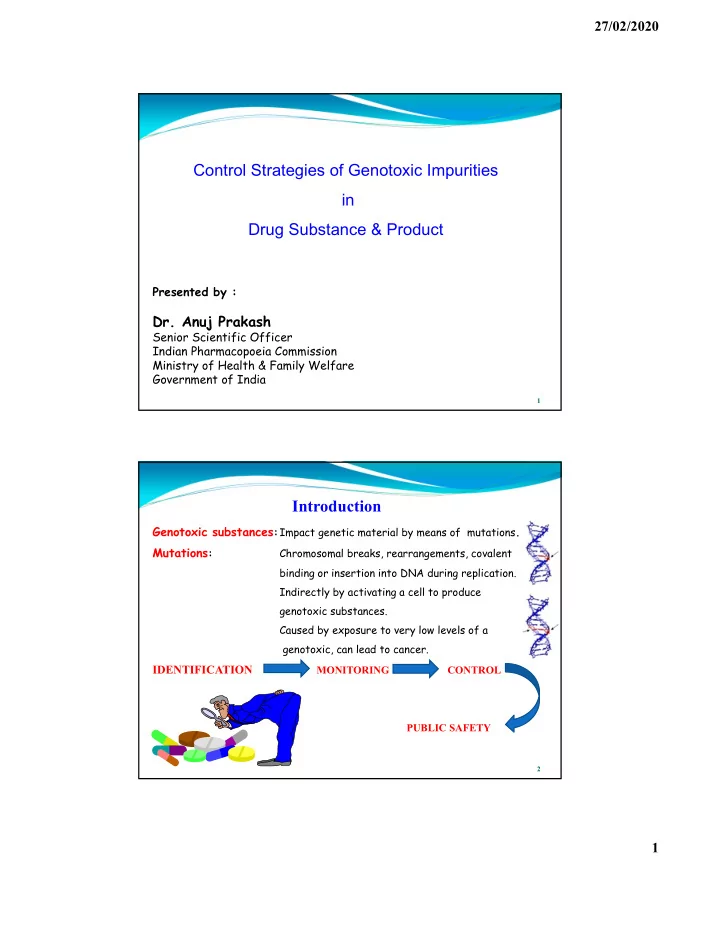
27/02/2020 Control Strategies of Genotoxic Impurities in Drug Substance & Product Presented by : Dr. Anuj Prakash Senior Scientific Officer Indian Pharmacopoeia Commission Ministry of Health & Family Welfare Government of India 1


slide-1
SLIDE 1

27/02/2020 1

Control Strategies of Genotoxic Impurities in Drug Substance & Product

Presented by :

  • Dr. Anuj Prakash

Senior Scientific Officer Indian Pharmacopoeia Commission Ministry of Health & Family Welfare Government of India

1

Introduction

2

Genotoxic substances:Impact genetic material by means of mutations. Mutations:

Chromosomal breaks, rearrangements, covalent binding or insertion into DNA during replication. Indirectly by activating a cell to produce genotoxic substances. Caused by exposure to very low levels of a genotoxic, can lead to cancer.

IDENTIFICATION

MONITORING CONTROL PUBLIC SAFETY

slide-2
SLIDE 2

27/02/2020 2

Guideline and Recommendations

3

 ICH provides guidelines for impurities (Q3A, B and C), but does not specifically provide acceptable levels for those genotoxic in

  • nature. It does address the need of lowered levels for unusually

potent impurities, such as those that are genotoxic.  Guided by genotoxicity data or the present of structure alerts, potential genotoxic impurity may be define.  Acceptance criterion define by Threshold of Toxicological Concern (TTC).  TTC Concept: Maximum intake of 1.5 µg/day of genotoxic impurity over a patient’s lifetime.

Guideline and Recommendations

4

A TTC value of 1.5 ug/day intake of a genotoxic impurity is concern to be associated with an acceptable risk in most pharmaceuticals

slide-3
SLIDE 3

27/02/2020 3

5

Get carried over into the final product

  • Starting materials
  • Reagents
  • Intermediates
  • Solvents
  • Unwanted side reactions from the API synthetic process
  • In addition, the API itself can decompose to form genotoxic

impurities Genotoxic Substances in Pharmaceutics

Genotoxic Impurities

6

Three step scheme: Ascertain alerts based on chemical structure.  Establish qualification strategy based on structural-alert classification.  Establish acceptable impurity limits based on the maximum daily intake

  • f drug substance .
slide-4
SLIDE 4

27/02/2020 4

7

List of structural alerts

8

  • Hydrazine
  • 1,1 dimethylhydrazine
  • Benzaldehyde
  • 3,4-dihydroxybenzaldehyde
  • Formaldehyde
  • Pentanal
  • Hexanal
  • Octanal
  • 1-methyl-4-nitro-3-propylpyrazole-5-carboxlic acid( MNP)
  • Nitro containing intermediate
  • Methylacrylate
  • Acrylonitrile
  • Azo compound

List of some Genotoxic Impurities

slide-5
SLIDE 5

27/02/2020 5

9

Some of the most common Genotoxic Impurity

  • Methyl methanesulfonate
  • C2H6O3S
  • molar mass 110.13 g/mol
  • Ethyl methanesulfonate
  • CH3SO3C2H5
  • molar mass 124.16 g/mol
  • Methyl acrylate
  • CH2 =CHOOCH3
  • molar mass 86.09 g/mol

10

  • Methyl -4-toluene sulfonate
  • CH3C6H4SO3CH3
  • molar mass 186.2 g/mol
  • Ethyl -4-toluene sulfonate
  • CH3 C6H4SO3C2H5
  • molar mass 200.25 g/mol
  • p-toluene sulfonate
  • CH3 C6H4SO3H
  • molar mass 172.2 g/mol
slide-6
SLIDE 6

27/02/2020 6

Strategies to Control / Identification

  • Temperature (50-60℃)
  • Acid Hydrolysis (0.1 N HCl)
  • Base Hydrolysis (0.1 N NaOH)
  • Oxidation (3-30%H2O2)
  • Light (1.2 million lux hours)

“To Establish Stability Indicating Method” Carry out stress studies of API according to the ICH guidelines

Strategies to Control / Identification

12

 Chromatographic separation and evaluation of mass scan of all the degraded impurities with the help of LC/GC-MS ( with high loading injection/concentration)  Establish possible structure of all the degraded impurities and evaluate the degradation structural similarity with the genotoxic alert.  Separation and characterization of degradation products which may be genotoxic as per structure alerts by using prep-HPLC, FTIR, NMR, LC- MS etc  Evaluation the presence of known common genotoxic substances by comparing obtained experimental molecular mass.

slide-7
SLIDE 7

27/02/2020 7

13

Conclusion:

  • These findings may have an impact on the further investigation for

confirmation as genotoxic and thereby control and monitoring in drug products to be fit for human consumption

  • Ames test to confirm or rule out genotoxic potential structures
  • Quantitation of these types of impurities. Using analytical testing to

quantify impurities, build process knowledge, and guide process / formulation development for control

  • Ensure quality of API or drug product throughout product life cycle to

safeguard public health

  • Supportive in Post marketing Adverse Drug Reaction (ADR)
  • This study useful to justify that , Product is free from potential GTIs

‘WHAT IS PURE TODAY MIGHT BE IMPURE TOMORROW’

Analysis of the substances and finish product at the end of the self life, and comparison study with initial data, trend analysis is equally important to monitor the Quality of the medicine.

Let’s Not Forget

slide-8
SLIDE 8

27/02/2020 8

15