Constructive Problem Solving Combining solution elements according - - PowerPoint PPT Presentation

constructive problem solving
SMART_READER_LITE
LIVE PREVIEW

Constructive Problem Solving Combining solution elements according - - PowerPoint PPT Presentation

Constructive Problem Solving Combining solution elements according to some constraints Typical constructive problem solving tasks: planning, design, and certain kinds of diagnosis Planning: solution elements are actions, and


slide-1
SLIDE 1

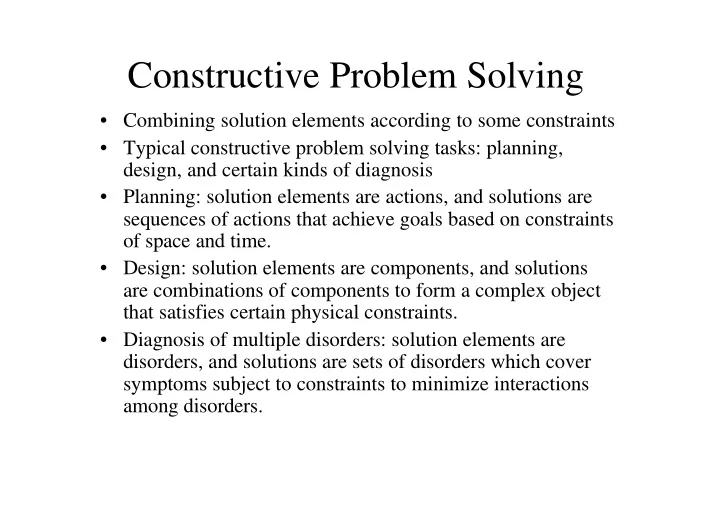
Constructive Problem Solving

  • Combining solution elements according to some constraints
  • Typical constructive problem solving tasks: planning,

design, and certain kinds of diagnosis

  • Planning: solution elements are actions, and solutions are

sequences of actions that achieve goals based on constraints

  • f space and time.
  • Design: solution elements are components, and solutions

are combinations of components to form a complex object that satisfies certain physical constraints.

  • Diagnosis of multiple disorders: solution elements are

disorders, and solutions are sets of disorders which cover symptoms subject to constraints to minimize interactions among disorders.

slide-2
SLIDE 2

R1/XCON

  • R1: a program that configures VAX computer systems by

first checking the order is complete and then determining spatial arrangement of components.

  • XCON: commercial version of R1
  • In contrast to MYCIN which is hypothesis driven, R1 is

data driven

  • R1 is implemented in OPS5, a forerunner of CLIPS.
  • R1 needs two kinds of knowledge

– About components – About constraints

  • R1 contains 10,000 rules, many of which deal with domain

specific control knowledge

slide-3
SLIDE 3

R1’s Configuration Subtasks

  • Check the order and rectify it, if necessary.
  • Configure the CPU
  • Configure the unibus modules
  • Configure the paneling
  • Generate a floor plan
  • Do the cabling
slide-4
SLIDE 4

Contexts for imposing Task Structure

  • In addition to information about components and

constraints, R1’s working memory contains context symbols to determine the order of subtasks.

  • Specificity Strategy:
  • MEA Strategy: Stresses the first condition of a rule when

evaluating rule instantiation for possible execution.

Rule 1 If: X is a bird and X is a penguin Then: X cannot fly Rule 2 If: X is a bird Then: X can fly dominates

slide-5
SLIDE 5

MOLGEN

  • MOLGEN assists the geneticist in planning gene-cloning

experiments in molecular genetics. The system uses knowledge about genetics and the user’s goal to create an abstract plan and then refines it to a set of specific laboratory steps.

  • MOLGEN adopts a multi-layered approach to construction

problem with a Least Commitment Strategy.

  • MOLGEN uses three “planning spaces”, each with its own
  • bjects and operators, which communicate with each other

via message-passing protocols.

slide-6
SLIDE 6

MOLGEN’s Planning Spaces

Strategy steps

Focus Resume Guess Undo

Design steps

Check-Prediction Refine-Operator Propose-Goal

Lab steps

Sort Screen Merge Transform

INTERPRETER META-PLANNING PLANNING

Strategy space Design space Lab space

slide-7
SLIDE 7

Constraint Operations in MOLGEN for Constructive Problem Solving

  • Constraint Formulation creates constraints that limit the

solution space.

  • Constraint propagation passes information between

subproblems which are almost independent of each other.

  • Constraint satisfaction pools constraints from subproblems

as the details of the design are worked out.

slide-8
SLIDE 8

Hierarchical Hypothesis and Test

  • Combination of heuristic classification and constructive

problem solving

  • Combining solution elements into a composite hypothesis
  • Reasoning with an explicit taxonomic representation of the

hypothesis space which is usually a tree whose leaves are solution elements

  • Beneficial when solution space is potentially very large
  • An example of hierarchical hypothesis and test: CENTAUR
slide-9
SLIDE 9

CENTAUR

  • A reconstructed medical expert system from PUFF originally

implemented in EMYCIN.

  • PUFF’s task is to determine presence of lung disease from

measurements of amount of gas in the lungs and the rates of flow of gases in and out of the lungs.

  • CENTAUR contains a frame-like structure as representation
  • f context for reasoning with production rules.
slide-10
SLIDE 10

Frame Structure in CENTAUR

Name: Range of values: Important measure: Procedure: rule set Obstructive Airways Disease Superclass: Pulmonary-Disease Subtype: Bronchitis Severity: Moderately Severe Component 1 Component 2 . . . . Component N Control: meta-knowledge Fact 1 . . . . Fact M . . . . . . . . . PROTOTYPE:

slide-11
SLIDE 11

Rules Embedded in Prototypes

  • Prototype components represent domain specific object-

level knowledge

  • Components are values of slots in the disease prototypes

but they are prototypes in their own right

  • Thus prototypes are embedded in other prototypes
  • Also, rules are embedded in prototypes
  • Five kinds of rules in CENTAUR

– Inference rules – Triggering rules – Fact-residual rules – Refinement rules – Summary rules

slide-12
SLIDE 12

Network of Prototypes in CENTAUR

CONSULTATION PULMONARY-DISEASE RESTRUCTIVE LUNG DISEASE OBSTRUCTIVE AIRWAYS DISEASE DIFFUSION DEFECT MILD MOD MOD- SEVERE SEVERE ASTHMA BRONCHITIS EMPHYSEMA SEVERITY SUBTYPE