Consolidated Slides from 11-8-18 Fraud & Cyber-crime - - PowerPoint PPT Presentation

consolidated slides from 11 8 18 fraud cyber crime
SMART_READER_LITE
LIVE PREVIEW

Consolidated Slides from 11-8-18 Fraud & Cyber-crime - - PowerPoint PPT Presentation

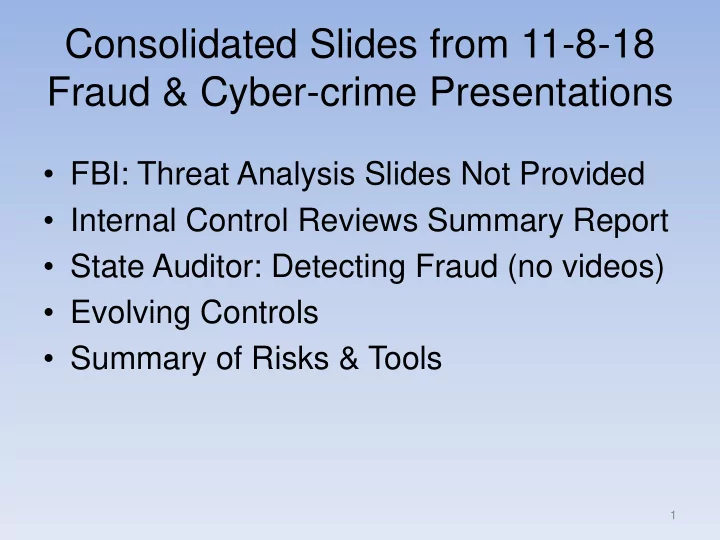
Consolidated Slides from 11-8-18 Fraud & Cyber-crime Presentations FBI: Threat Analysis Slides Not Provided Internal Control Reviews Summary Report State Auditor: Detecting Fraud (no videos) Evolving Controls Summary of


slide-1
SLIDE 1

Consolidated Slides from 11-8-18 Fraud & Cyber-crime Presentations

  • FBI: Threat Analysis Slides Not Provided
  • Internal Control Reviews Summary Report
  • State Auditor: Detecting Fraud (no videos)
  • Evolving Controls
  • Summary of Risks & Tools

1

slide-2
SLIDE 2

Agenda

  • 8:30

Opening by Auditor Greg Kimsey

  • 8:35

FBI Cyber Threat Analysis

  • 9:30

Internal Control Reviews, 2018

  • 9:40

Break

  • 9:55

State Auditor Office: Detect Fraud

  • 10:50

Evolving Controls

  • 11:20

IT Progress Report

  • 11:30

Summary of Risk and Tools

  • 11:40

Closing by Mark Gassaway

2

slide-3
SLIDE 3

Agenda

  • 8:30

Opening by Auditor Greg Kimsey

  • 8:35

FBI Cyber Threat Analysis

  • 9:30

Internal Control Reviews, 2018

  • 9:40

Break

  • 9:55

State Auditor Office: Detect Fraud

  • 10:50

Evolving Controls

  • 11:20

IT Progress Report

  • 11:30

Summary of Risk and Tools

  • 11:40

Closing by Mark Gassaway

1

slide-4
SLIDE 4

Summary of 2018 Auditor’s Unscheduled Internal Control Reviews

Trends, Issues and Recommendations

Tom Nosack, Senior Management Analyst Clark County Auditor’s Office November 8, 2018 v.2

slide-5
SLIDE 5

3

slide-6
SLIDE 6

4

Does it matter how it happened?

slide-7
SLIDE 7

A loss comes from a variety of sources

  • External Attack: Hacking, spoofing, phishing
  • Internal Attack: Theft, Fraud, Curiosity
  • Internal Error: Poor controls, carelessness,

distraction, inadequate separation of duties

5

slide-8
SLIDE 8

Internal Controls

  • Effective internal controls are the best tool

against most risks

  • You need to check your internal controls

regularly to make sure they are effective.

  • Who can you call for help?

6

slide-9
SLIDE 9

Clark County Code

  • Section 2.14 “The auditor is authorized to

examine any office, department, political subdivision or organization which receives appropriations from the board of county commissioners.”

  • Section 2.14.030(a): (The auditor) must

“appraise the adequacy and completeness of internal controls”

7

slide-10
SLIDE 10

How much is at risk?

Clark County holds about $38,000 to $40,000 in cash daily – but much more than this passes through the financial system 2017 pass through: over 455,700 transactions in excess of $245,000,000

8 Treasurer ($201m), CD ($36m) are $237m of $245m

slide-11
SLIDE 11

9

Bob, the amateur Fish Talker

slide-12
SLIDE 12

10

Bob, the Amateur Fish Talker

Auditors want to talk to ME?

slide-13
SLIDE 13

Internal Controls Reviews: the ICR

  • The ICR is not an audit, but checking

internal controls is part of an audit.

  • An ICR is a limited review of your group’s

cash and general security operations.

  • The visit may be a cash count, a review of

cash handling, security procedures or storage standards.

11

slide-14
SLIDE 14

What to Expect from a Visit

  • Auditors arrive and self-identify
  • Verify what is on hand for cash account
  • Reconcile the account to last statement
  • Observe receipting and cash handling
  • Discuss internal controls & issues
  • Written report in 3-5 days

12

slide-15
SLIDE 15

Recent ICR History

2017

  • 22 visits to:

– Auditor – Community Development – Community Services – Clerk – District Court – General Services – Public Health – Public Works – Prosecuting Attorney – Superior Court – Sheriff’s Office – Treasurer

2018

  • 23 visits to:

– Community Development – Community Services – District Court – General Services – Public Works – Prosecuting Attorney – Sheriff’s Office – Treasurer

13

slide-16
SLIDE 16

2018 Summary Results

  • 28 recommendations from 23 visits
  • Overall:

– Policies and procedures need more attention – Management needs more active oversight – Decrease variance in daily account balances

14

slide-17
SLIDE 17

Progress on 2017 Problem Areas

2017

  • Security of valuables
  • Custodian list not accurate
  • Written procedures

inaccurate

  • Too few management

reviews

  • Cash handling variances

2018

  • Improved
  • Improved
  • No Change
  • No Change
  • Needs

Improvement

15

slide-18
SLIDE 18

Who did well in 2018?

16

slide-19
SLIDE 19

Who did well in 2018?

  • 23 visits to:

– Community Development – Community Services – District Court – General Services – Public Works – Prosecuting Attorney – Sheriff’s Office – Treasurer

Two Tactical Detectives Unit Funds Two Drug Task Force Funds

17

slide-20
SLIDE 20

18

A real Fish Talker…

slide-21
SLIDE 21

19

…doesn’t need a fishing pole

slide-22
SLIDE 22

Summary

  • We can help you with planning, deploying,

and testing of internal controls

  • Visits are on a three year rotation, but…
  • Actual visits will vary based on risk

20

A happy fish…

slide-23
SLIDE 23

21

…isn’t on the end of a line - Thank You!

slide-24
SLIDE 24

O f f i c e o f t h e W a s h i n g t o n S t a t e A u d i t o r

Cybersecurity risks: A local government perspective

Aaron Munn, CISSP, ISRM, MSCE – IT Security Team Manager

slide-25
SLIDE 25

O f f i c e o f t h e W a s h i n g t o n S t a t e A u d i t o r

2

  • Role of Auditor’s Office in cybersecurity
  • Weapons and tactics used against local

governments

  • Detecting and defending against cyberattacks

Learning objectives

slide-26
SLIDE 26

O f f i c e o f t h e W a s h i n g t o n S t a t e A u d i t o r

3

Part 1 State Auditor’s Office Role

slide-27
SLIDE 27

O f f i c e o f t h e W a s h i n g t o n S t a t e A u d i t o r

4

  • Audit programs

 Performance audits  Attestations  Accountability

  • Performance Center collaboration

 Phase 1: Develop a list of desired resources and determine if they

already exist or need to be developed in-house

 Phase 2: Evaluate resources that already exist and communicate their

availability

 Phase 3: Develop selected new resources, and post and communicate

their availability

State Auditor’s Office role in cybersecurity

slide-28
SLIDE 28

O f f i c e o f t h e W a s h i n g t o n S t a t e A u d i t o r

5

  • How the Auditor’s Office does it
  • An “all-in” approach
  • Third-party assistance
  • Relationships between departments

Cybersecurity risk assessment

slide-29
SLIDE 29

O f f i c e o f t h e W a s h i n g t o n S t a t e A u d i t o r

6

Part 2 Weapons and tactics used against local governments

slide-30
SLIDE 30

O f f i c e o f t h e W a s h i n g t o n S t a t e A u d i t o r

7

Hackmageddon statistics

slide-31
SLIDE 31

O f f i c e o f t h e W a s h i n g t o n S t a t e A u d i t o r

Malicious actors

8

slide-32
SLIDE 32

O f f i c e o f t h e W a s h i n g t o n S t a t e A u d i t o r

9

Ransomware Cause: System misconfiguration / possible phishing attack Risk: Public safety Possible cost: Reduced response times for first responders Value to thief: High payback if successful

slide-33
SLIDE 33

O f f i c e o f t h e W a s h i n g t o n S t a t e A u d i t o r

10

Ransomware

slide-34
SLIDE 34

O f f i c e o f t h e W a s h i n g t o n S t a t e A u d i t o r

11

Data breach Cause: Employee misuse Risk: Loss of confidential employee records Possible cost: 250,000 records x $75 = $18 million Value to thief: Access to confidential records

slide-35
SLIDE 35

O f f i c e o f t h e W a s h i n g t o n S t a t e A u d i t o r

12

Data breach

slide-36
SLIDE 36

O f f i c e o f t h e W a s h i n g t o n S t a t e A u d i t o r

13

Spear-phishing Cause: Successful phishing attack Risk: Targeting government accounts (usernames and passwords) Possible cost: Currently under investigation Value to thief: Easier than ransomware, access to address book and government network

slide-37
SLIDE 37

O f f i c e o f t h e W a s h i n g t o n S t a t e A u d i t o r

14

Spear-phishing

slide-38
SLIDE 38

O f f i c e o f t h e W a s h i n g t o n S t a t e A u d i t o r

15

Business email compromise Cause: No or ineffective internal controls Risk: Loss of funds (theft) Possible cost: Average loss for BEC victims is $130,000, according to FBI Value to thief: Simple, low overhead, quick return

slide-39
SLIDE 39

O f f i c e o f t h e W a s h i n g t o n S t a t e A u d i t o r

16

Business email compromise

slide-40
SLIDE 40

O f f i c e o f t h e W a s h i n g t o n S t a t e A u d i t o r

17

Phishing attack and data breach Cause: Successful phishing attack Risk: Data breach Cost: Commissioners approved paying $5,000 for the insurance deductible Value to thief: High return on investment

slide-41
SLIDE 41

O f f i c e o f t h e W a s h i n g t o n S t a t e A u d i t o r

18

Phishing attack and data breach

slide-42
SLIDE 42

O f f i c e o f t h e W a s h i n g t o n S t a t e A u d i t o r

19

Business email compromise Cause: Employee sent confidential information to fake City administration email account Risk: Data breach Possible cost: Fraud protection for hundreds of employees, reputational harm Value to thief: Multiple victims, high financial return

slide-43
SLIDE 43

O f f i c e o f t h e W a s h i n g t o n S t a t e A u d i t o r

20

Business email compromise

Manually run video # z1 now

slide-44
SLIDE 44

O f f i c e o f t h e W a s h i n g t o n S t a t e A u d i t o r

21

Business email compromise Cause: Business email compromise Risk: Loss of funds Cost: $49,284 Value to thief: Low risk, quick result

slide-45
SLIDE 45

O f f i c e o f t h e W a s h i n g t o n S t a t e A u d i t o r

22

Business email compromise

slide-46
SLIDE 46

O f f i c e o f t h e W a s h i n g t o n S t a t e A u d i t o r

23

Business email compromise Cause: Employee clicked link in email Risk: Ransomware attack Cost: Almost $10,000 Value to thief: Low risk, quick result

slide-47
SLIDE 47

O f f i c e o f t h e W a s h i n g t o n S t a t e A u d i t o r

24

Business email compromise

slide-48
SLIDE 48

O f f i c e o f t h e W a s h i n g t o n S t a t e A u d i t o r

25

Email spoofing, a simple proposition

Manually run video # z2 now

slide-49
SLIDE 49

O f f i c e o f t h e W a s h i n g t o n S t a t e A u d i t o r

26

  • “… more training for staff using county computers.”
  • Paid the ransom
  • “… no longer allowing wire transfers and switching and

updating equipment and systems like email.”

  • “… offered to pay for fraud protection (for employees)…”
  • “... only paying the cyber security insurance deductible

amount.”

  • “… closed the ability for employees to access work email from

home about a week ago.”

Victim response actions

slide-50
SLIDE 50

O f f i c e o f t h e W a s h i n g t o n S t a t e A u d i t o r

27

Part 3 Detecting and defending against cyberattacks

slide-51
SLIDE 51

O f f i c e o f t h e W a s h i n g t o n S t a t e A u d i t o r

28

Protect Your Password

Manually run video # z3 now

slide-52
SLIDE 52

O f f i c e o f t h e W a s h i n g t o n S t a t e A u d i t o r

29

slide-53
SLIDE 53

O f f i c e o f t h e W a s h i n g t o n S t a t e A u d i t o r

30

Home and work behavior

slide-54
SLIDE 54

O f f i c e o f t h e W a s h i n g t o n S t a t e A u d i t o r

Protect your digital footprint

31

slide-55
SLIDE 55

O f f i c e o f t h e W a s h i n g t o n S t a t e A u d i t o r

32

Security awareness and training

slide-56
SLIDE 56

O f f i c e o f t h e W a s h i n g t o n S t a t e A u d i t o r

33

Documentation

slide-57
SLIDE 57

O f f i c e o f t h e W a s h i n g t o n S t a t e A u d i t o r

34

The bottom line

slide-58
SLIDE 58

O f f i c e o f t h e W a s h i n g t o n S t a t e A u d i t o r

35

Contacts

Websites: www.sao.wa.gov auditconnectionwa.org Facebook: www.facebook.com/WAStateAuditorsOffice Twitter: www.twitter.com/WAStateAuditor

Pat McCarthy

State Auditor (360) 902-0360 Auditor@sao.wa.gov Aaron Munn, CISSP, ISRM, MSCE IT Security Team Manager (360) 725-5418 Aaron.Munn@sao.wa.gov Peg Bodin, CISA Assistant Director of IT Audit (360) 464-0113 Peggy.Bodin@sao.wa.gov

slide-59
SLIDE 59

EVOLVING TECHNOLOGY AND THE DEMANDS ON YOUR INTERNAL CONTROLS

ARNOLD PÉREZ

slide-60
SLIDE 60

Classic Fraud Charges to Accounts

  • Check Fraud
  • Bogus Debit Card Transactions
  • Fraudulent Warrants
slide-61
SLIDE 61

30-Day Rule for Checking Accounts

  • The U.S. Uniform Commercial Code states that
  • rganizations issuing checks normally have a

responsibility to notify the bank about check fraud no later than 30 days after the closing business date shown on the bank statement.

  • Organizations should implement procedures to promptly

identify check fraud thus improving the chances of a successful prosecution of the perpetrator.

  • All organizations should review the bank statements and

their enclosures immediately upon receipt to identify any fraudulent financial transactions such as bogus checks, debit card transactions, or warrants.

slide-62
SLIDE 62

24 Hour Rule for Debit Card Transactions

  • The U.S. Uniform Commercial Code states that

governments, private businesses, and individuals have a short time span to report bogus debit card transactions posted on their bank statements; they must act within 24 hours of the posting.

  • Waiting for the monthly bank statement to arrive simply

isn't good enough when it comes to avoiding losses from bogus debit card transactions.

  • Organizations that ignore this 24-hour rule suffer the

consequence of losses of funds with no possibility of a claim against the bank for reimbursement when bad debit card transactions occur.

slide-63
SLIDE 63

24-Hour Rule for Warrants

  • The U.S. Uniform Commercial Code also applies to
  • warrants. Warrants move through the banking system

just like checks until they reach the organization's bank.

  • Government agencies must report fraudulent warrants to

their banks within 24 hours of presentation.

  • If the government fails to pick up warrants promptly at the

bank and allows the 24-hour period to expire, or if it fails to report warrant fraud to the bank within 24 hours, the bank will deny any claim for losses.

  • In those circumstances, bogus warrants automatically

become the responsibility of the government, which sustains a loss of treasury funds.

slide-64
SLIDE 64

What measures can you take?

  • Account Reconciliations
  • Required by the Office of the Washington State Auditor (SAO)

Budget, Accounting and Reporting System (BARS)

  • Periodically reviewed by the by the Clark County Auditor’s Office,

and

  • As a matter of necessity for fighting fraud!
slide-65
SLIDE 65

BARS 3.8.8: Imprest, Petty Cash and Other Revolving Funds

  • SAO provides guidance on the various accounts and

covers:

  • Purpose
  • Budgeting
  • Accounts
  • Controls
  • Reporting
slide-66
SLIDE 66

BARS: 3.8.8.20.2

  • 2. The governing body or its delegate must

appoint one custodian of each petty cash account who should be independent:

– of invoice processing, – check signing, – general accounting and – cash receipts functions…...

slide-67
SLIDE 67

BARS: 3.8.8.20.4

  • 4. On at least monthly basis, the fund should be:
  • reconciled to the authorized balance and
  • to the actual balance per bank statements or
  • a count of cash on hand.
  • If this reconciliation is done by the custodian, it should be

checked or re-performed periodically by someone other than the custodian.

  • It is recommended that independent checks not be

scheduled with the custodian but be done on a surprise basis.

slide-68
SLIDE 68

Internal Controls: Bank Reconciliation

  • An independent party should receive the unopened bank

statement directly from the bank and promptly perform the bank reconciliation

  • All redeemed checks should accompany the monthly

bank statement so the reviewer can identify check fraud and other check alterations by outsiders and unauthorized checks issued by insiders

slide-69
SLIDE 69

Internal Controls: Bank Reconciliation

  • The independent reviewer should reconcile the bank

statement with the organization's accounting records immediately upon receipt

  • The owner or other designated independent party should

verify and sign off on the completed bank reconciliation with his or her signature and the date of the review

slide-70
SLIDE 70

Evolving Types of Fraud

  • Account-takeover fraud
  • Mobile Fraud:
  • Remote Deposit Capture (RDC)
  • Bluetooth
  • Apps
  • Business E-mail Compromise (BEC)
slide-71
SLIDE 71

Commercially Reasonable Security Protocol

slide-72
SLIDE 72

Internal Controls: Review Terms & Conditions

  • Commercial business account holders have less time to report

cases of fraud, and have more liability and less protection as compared to personal account holders.

  • “We will have no liability to you for acting upon any application,

amendment or other communication purportedly transmitted by you, even if such application, amendment or message:

  • Contains inaccurate or erroneous information
  • Constitutes unauthorized or fraudulent use of Electronic Trade Service
  • Includes instructions to pay money, or otherwise debit or credit any

account

  • Relates to disposition of any money, securities or documents
  • Purports to bind you to any agreement or other arrangement with us or

with other persons or to commit you to any other type of transaction or arrangement.”

  • Read your own bank’s terms and conditions!
slide-73
SLIDE 73

Internal Controls: Response Plan

  • Internet Crime Complaint Center (IC3) & Federal Bureau
  • f Investigation (FBI)
  • Public Service Announcement: I-082715a-PSA
  • If funds are transferred to a fraudulent account, it is

important to act quickly:

  • Contact your financial institution immediately upon discovering the

fraudulent transfer.

  • Request that your financial institution contact the corresponding

financial institution where the fraudulent transfer was sent.

  • Contact your local Federal Bureau of Investigation (FBI) office if the

wire is recent. The FBI, working with the United States Department

  • f Treasury Financial Crimes Enforcement Network, might be able

to help return or freeze the funds.

  • File a complaint, regardless of dollar loss, with www.IC3.gov.
slide-74
SLIDE 74

Internal Controls: Reporting Plan

  • Reporting Losses & Thefts at Clark County
  • Notify a Manager- there is no minimum dollar amount - any loss
  • f cash, equipment or materials needs to be reported promptly.
  • Formal police or Sheriff’s report must be made, the Audit Services

staff will need the police report number.

  • Contact Audit Services- state law requires that we report theft and

losses to the State Auditor’s Office

slide-75
SLIDE 75

Internal Controls: Training

  • Constantly educate staff about cutting-edge fraud

techniques

  • Don’t keep rehashing old security awareness materials

and expect to stop online fraud

  • Update your training as often as you update your

smartphone

  • The best training is brief, frequent and focused on the

issue at hand

slide-76
SLIDE 76

Internal Controls: Risk Assessment

  • Review existing processes, procedures and separation of

duties for financial transfers and other important transactions such as sending sensitive data in bulk to outside entities

  • Add extra controls, if needed
  • Remember that separation of duties and other protections may

be compromised at some point by insider threats, so risk reviews may need to be redone

slide-77
SLIDE 77

Internal Controls: P&Ps

  • Consider new policies related to “out of band”

transactions or urgent executive requests

  • An email from an executive’s Gmail or Yahoo account

should automatically raise a red flag to staff members, but they need to understand the latest techniques being deployed by the dark side

  • You need authorized emergency procedures that are well

understood by all

slide-78
SLIDE 78

Internal Controls: Exercises & Communication

  • Review, refine and test your incident management and

phish reporting systems

  • Conduct a tabletop exercise with management, including

key personnel, on a regular basis

  • Test controls and encourage staff recommendations
  • Remember, online criminals are always changing and

adapting their sophisticated attacks

  • Are you ready?
slide-79
SLIDE 79
  • Clark County Auditor’s Office
  • https://clarknet.clark.wa.gov/audit-services/reporting-losses-thefts
  • Office of the Washington State Auditor- Budget, Accounting

and Reporting System (BARS) www.sao.wa.gov

  • Association of Certified Fraud Examiners www.acfe.com
  • Case History Applications, Cash Disbursement Fraud, Authorization and Approval (Part 1thru 4)
  • May/June 2008 by Joseph R. Dervaes, CFE, ACFE Fellow, CIA
  • July/August 2008 by Joseph R. Dervaes, CFE, ACFE Fellow, CIA
  • September/October 2008 by Joseph R. Dervaes, CFE, ACFE Fellow, CIA
  • November/December 2008 by Joseph R. Dervaes, CFE, ACFE Fellow, CIA
  • FBI ttps://www.ic3.gov/media/2015/150827-1.aspx
  • Government Technology
  • http://www.govtech.com/security/GT-July-2017-3-Ways-to-Stop-Business-Email-Compromise.html
  • National Public Radio- All tech considered
  • https://www.npr.org/sections/alltechconsidered/2015/09/15/440252972/when-cyber-fraud-hits-businesses-banks-may-not-offer-protection

Resources

slide-80
SLIDE 80

Thank you!

Arnold Pérez, MPA, CFE, CGAP Performance Auditor Clark County Auditor’s Office Arnold.Perez@clark.wa.gov

slide-81
SLIDE 81

CLARK COUNTY INFORMATION TECHNOLOGY

Sheri Rugh Technology Services Director

slide-82
SLIDE 82

Summary of Risks and Tools

Larry Stafford, Audit Services Manager Clark County Auditor’s Office

slide-83
SLIDE 83

2

2017 Montgomery County AL Ransomware 2018 Dawson County AL Ransomware 2018 Los Angeles County CA Ransomware 2018 Monroe County FL Ransomware 2018 Palm Beach County FL Cryptojack Info 2018 Coweta County GA Ransomware 2017 Bingham County ID Ransomware 2018 Madison County ID Ransomware 2018 Davidson County NC Ransomware 2018 Onslow County NC Ransomware 2017 Multnomah County OR Cryptojack info 2018 Sevier County TN Ransomware 2018 Enumclaw City WA Cryptojack W2 2018 Longview Port WA Cryptojack Info 2018 Yakima County WA Cryptojack Info 2018 Yarrow (#1) City WA Phishing 2018 Yarrow (#2) City WA Ransomware 2018 Adams County WI Cryptojack Info 2018 Manitowoc County WI Cryptojack Info

slide-84
SLIDE 84

Other Risks: Traditional Fraud

26 fraud reports issued by SAO (2017 -18)

– Misappropriation, personal use of funds – Payroll, overpayments – Failure to safeguard funds held in trust (donations) – Theft of time

3

slide-85
SLIDE 85

Other Risks: Traditional Fraud

Common Control Weaknesses

– Lack of segregation of duties – No independent review – Incorrect reconciliation process – Unsecure safe

4

slide-86
SLIDE 86

Everyone has a role in controls

  • 1. Design
  • 2. Implementation
  • 3. Operating

5

slide-87
SLIDE 87

Internal Control Framework

6

Control Environment

Tone at the Top Ethics and Values Organizational Structure Commitment to recruit, develop, retain staff Accountability

Risk Assessment

Clearly define

  • bjectives

Identify, analyze, respond to risks Consider potential for fraud Identify, analyze, respond to significant changes

Control Activities

Design activities to achieve

  • bjectives and

respond to risks Design activities for information systems Implement by policies

Information and Communication

Use quality information Communicate quality information Internally and externally

Monitoring

Establish and

  • perate activities

to evaluate results Remediate deficiencies on a timely basis

slide-88
SLIDE 88

“It is not the strongest of the species that survives, nor the most intelligent, but the one most responsive to change”

  • Leon C. Megginson
slide-89
SLIDE 89

Report to Audit Services any: Loss of County assets; Known or suspected fraud

arnold.perez@clark.wa.gov tom.nosack@clark.wa.gov larry.stafford@clark.wa.gov

Thank you!