Compiler construction Martin Steffen March 22, 2017 Contents 1 - - PDF document

compiler construction
SMART_READER_LITE
LIVE PREVIEW

Compiler construction Martin Steffen March 22, 2017 Contents 1 - - PDF document

Compiler construction Martin Steffen March 22, 2017 Contents 1 Abstract 1 1.1 Run-time environments . . . . . . . . . . . . . . . . . . . . . . . . . . . . . . . . . . . . . . . . 1 1.1.1 Intro . . . . . . . . . . . . . . . . . . . . . .


slide-1
SLIDE 1

Compiler construction

Martin Steffen March 22, 2017

Contents

1 Abstract 1 1.1 Run-time environments . . . . . . . . . . . . . . . . . . . . . . . . . . . . . . . . . . . . . . . . 1 1.1.1 Intro . . . . . . . . . . . . . . . . . . . . . . . . . . . . . . . . . . . . . . . . . . . . . . . 1 1.1.2 Static layout . . . . . . . . . . . . . . . . . . . . . . . . . . . . . . . . . . . . . . . . . . 3 1.1.3 Stack-based runtime environments . . . . . . . . . . . . . . . . . . . . . . . . . . . . . 4 1.1.4 Stack-based RTE with nested procedures . . . . . . . . . . . . . . . . . . . . . . . . . 15 1.1.5 Functions as parameters . . . . . . . . . . . . . . . . . . . . . . . . . . . . . . . . . . . 18 1.1.6 Virtual methods . . . . . . . . . . . . . . . . . . . . . . . . . . . . . . . . . . . . . . . . 23 1.1.7 Parameter passing . . . . . . . . . . . . . . . . . . . . . . . . . . . . . . . . . . . . . . . 28 1.1.8 Garbage collection . . . . . . . . . . . . . . . . . . . . . . . . . . . . . . . . . . . . . . . 31 1.1.9 Additional material . . . . . . . . . . . . . . . . . . . . . . . . . . . . . . . . . . . . . . 35 2 Reference 38

1 Abstract

Abstract This is the handout version of the slides. It contains basically the same content, only in a way which allows more compact printing. Sometimes, the overlays, which make sense in a presentation, are not fully rendered here. Besides the material of the slides, the handout versions may also contain additional remarks and background information which may or may not be helpful in getting the bigger picture.

1.1 Run-time environments

  • 18. 01. 2017

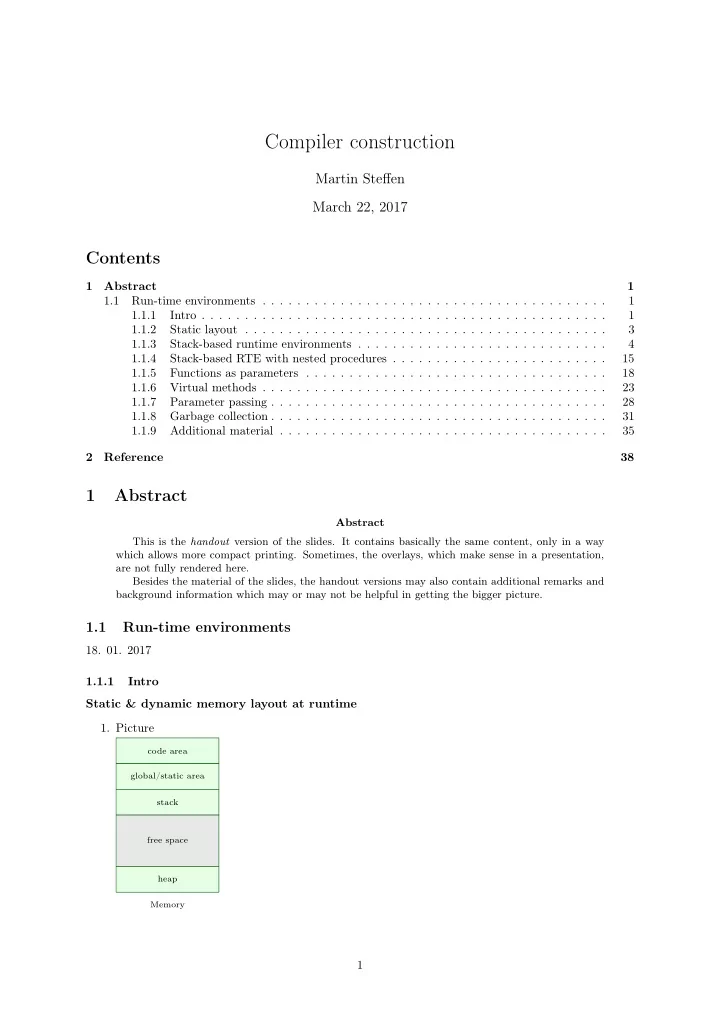
1.1.1 Intro Static & dynamic memory layout at runtime

  • 1. Picture

code area global/static area stack free space heap Memory

1

slide-2
SLIDE 2
  • 2. Text typical memory layout: for languages (as nowadays basically all) with
  • static memory
  • dynamic memory:

– stack – heap Translated program code

  • 1. Picture

code for procedure 1

  • proc. 1

code for procedure 2

  • proc. 2

⋮ code for procedure n

  • proc. n

Code memory

  • 2. Text
  • code segment: almost always considered as statically allocated

⇒ neither moved nor changed at runtime

  • compiler aware of all addresses of “chunks” of code: entry points of the procedures
  • but:

– generated code often relocatable – final, absolute adresses given by linker / loader Activation record

  • 1. Picture

space for arg’s (parameters) space for bookkeeping info, including return address space for local data space for local temporaries Schematic activation record

  • 2. Text
  • schematic organization of activation records/activation block/stack frame . . .
  • goal: realize

– parameter passing – scoping rules /local variables treatment – prepare for call/return behavior

  • calling conventions on a platform

2

slide-3
SLIDE 3

1.1.2 Static layout Full static layout

  • 1. Picture

code for main proc. code for proc. 1 ⋮ code for proc. n global data area

  • act. record of main proc.

activation record of proc. 1 ⋮ activation record of proc. n

  • 2. Text
  • static addresses of all of memory known to the compiler

– executable code – variables – all forms of auxiliary data (for instance big constants in the program, e.g., string literals)

  • for instance: Fortran
  • nowadays rather seldom (or special applications like safety critical embedded systems)

Fortran example

P R O G R A M TEST C O M M O N MAXSIZE I N T E G E R MAXSIZE R E A L TABLE( 1 0 ) ,TEMP MAXSIZE = 10 R E A D ∗ , TABLE( 1 ) ,TABLE( 2 ) ,TABLE(3) CALL Q U A D M E A N(TABLE, 3 ,TEMP) PRINT ∗ ,TEMP E N D S U B R O U T I N E Q U A D M E A N(A, SIZE,Q M E A N) C O M M O N MAXSIZE INTEGERMAXSIZE, SIZE R E A L A(SIZE) ,QMEAN, TEMP I N T E G E R K TEMP = 0.0 IF ( (SIZE .G T.MAXSIZE) .O

  • R. ( SIZE .LT. 1 ) ) G

O T O 99 D O 10 K = 1 , SIZE TEMP = TEMP + A(K)∗A(K) 10 C O N T I N U E 99 Q M E A N = S Q R T(TEMP/SIZE) R E T U R N E N D

Static memory layout example/runtime environment

  • 1. Picture

3

slide-4
SLIDE 4

MAXSIZE global area TABLE (1) (2) . . . (10) TEMP 3 main’s act. record A SIZE QMEAN return address TEMP K “scratch area”

  • Act. record of

QUADMEAN

  • 2. Text in Fortan (here Fortran77)
  • parameter passing as pointers to the actual parameters
  • activation record for QUADMEAN contains place for intermediate results, compiler calculates, how

much is needed.

  • note: one possible memory layout for FORTRAN 77, details vary, other implementations exists

as do more modern versions of Fortran 1.1.3 Stack-based runtime environments Stack-based runtime environments

  • so far: no recursion
  • everything static, including placement of activation records

⇒ also return addresses statically known

  • a very ancient and restrictive arrangement of the run-time envs
  • calls and returns (also without recursion) follow at runtime a LIFO (= stack-like) discipline
  • 1. Stack of activation records
  • procedures as abstractions with own local data

⇒ run-time memory arrangement where procedure-local data together with other info (arrange proper returns, parameter passing) is organized as stack.

  • 2. Rest
  • AKA: call stack, runtime stack
  • AR: exact format depends on language and platform

Situation in languages without local procedures

  • recursion, but all procedures are global
  • C-like languages
  • 1. Activation record info (besides local data, see later)

4

slide-5
SLIDE 5
  • frame pointer
  • control link (or dynamic link)1
  • (optional): stack pointer
  • return address

Euclid’s recursive gcd algo

#include <s t d i o . h> int x , y ; int gcd ( int u , int v ) { i f ( v==0) return u ; else return gcd (v , u % v ) ; } int main ( ) { s c a n f ( "%d%d",&x,&y ) ; p r i n t f ( "%d\n" , gcd (x , y ) ) ; return 0 ; }

Stack gcd

  • 1. Picture

x:15 y:10 global/static area “AR of main” x:15 y:10 control link return address a-record (1st. call) x:10 y:5 control link return address a-record (2nd. call) x:5 y:0 control link fp return address sp a-record (3rd. call) ↓

  • 2. Text
  • control link

– aka: dynamic link – refers to caller’s FP

  • frame pointer FP

– points to a fixed location in the current a-record

  • stack pointer (SP)

– border of current stack and unused memory

  • return address: program-address of call-site

1Later, we’ll encounter also static links (aka access links).

5

slide-6
SLIDE 6

Local and global variables and scoping

  • 1. Code

int x = 2 ; /∗ g l o b a l var ∗/ void g ( int ) ; /∗ prototype ∗/ void f ( int n) { static int x = 1 ; g (n ) ; x− −; } void g ( int m) { int y = m−1; i f ( y > 0) { f ( y ) ; x− −; g ( y ) ; } } int main ( ) { g ( x ) ; return 0 ; }

  • 2. Text
  • global variable x
  • but: (different) x local to f
  • remember C:

– call by value – static lexical scoping Activation records and activation trees

  • activation of a function: corresponds to the call of a function
  • activation record

– data structure for run-time system – holds all relevant data for a function call and control-info in “standardized” form – control-behavior of functions: LIFO – if data cannot outlive activation of a function ⇒ activation records can be arranged in as stack (like here) – in this case: activation record AKA stack frame

  • 1. GCD

main() gcd(15,10) gcd(10,5) gcd(5,0)

  • 2. f and g example

main g(2) f(1) g(1) g(1)

6

slide-7
SLIDE 7

Variable access and design of ARs

  • 1. Layout g
  • fp: frame pointer
  • m (in this example): parameter of g
  • 2. Possible arrangement of g’s AR
  • AR’s: structurally uniform per language (or at least compiler) / platform
  • different function defs, different size of AR

⇒ frames on the stack differently sized

  • note: FP points

– not to the “top” of the frame/stack, but – to a well-chosen, well-defined position in the frame – other local data (local vars) accessible relative to that

  • conventions

– higher addresses “higher up” – stack “grows” towards lower addresses – in the picture: “pointers” to the “bottom” of the meant slot (e.g.: fp points to the control link) Layout for arrays of statically known size

  • 1. Code

void f ( int x , char c ) { int a [ 1 0 ] ; double y ; . . }

name

  • ffset

x +5 c +4 a

  • 24

y

  • 32

(a) access of c and y

c : 4( fp ) y : −32( fp )

(b) access for A[i]

(−24+2∗ i ) ( fp )

  • 2. Layout

7

slide-8
SLIDE 8

Back to the C code again (global and local variables)

int x = 2 ; /∗ g l o b a l var ∗/ void g ( int ) ; /∗ prototype ∗/ void f ( int n) { static int x = 1 ; g (n ) ; x− −; } void g ( int m) { int y = m−1; i f ( y > 0) { f ( y ) ; x− −; g ( y ) ; } } int main ( ) { g ( x ) ; return 0 ; }

2 snapshots of the call stack

  • 1. Picture

x:2 x:1 (@f) static main m:2 control link return address y:1 g n:1 control link return address f m:1 control link fp return address y:0 sp g ...

8

slide-9
SLIDE 9
  • 2. Picture

x:1 x:0 (@f) static main m:2 control link return address y:1 g m:1 control link fp return address y:0 sp g ...

  • 3. Text
  • note: call by value, x in f static

How to do the “push and pop”: calling sequences

  • calling sequences: AKA as linking convention or calling conventions
  • for RT environments: uniform design not just of

– data structures (=ARs), but also of – uniform actions being taken when calling/returning from a procedure

  • how to actually do the details of “push and pop” on the call-stack
  • 1. E.g: Parameter passing
  • not just where (in the ARs) to find value for the actual parameter needs to be defined, but

well-defined steps (ultimately code) that copies it there (and potentially reads it from there)

  • 2. Rest
  • “jointly” done by compiler + OS + HW
  • distribution of responsibilities between caller and callee:

– who copies the parameter to the right place – who saves registers and restores them – . . . Steps when calling

  • For procedure call (entry)
  • 1. compute arguments, store them in the correct positions in the new activation record of the

procedure (pushing them in order onto the runtume stack will achieve this)

  • 2. store (push) the fp as the control link in the new activation record
  • 3. change the fp, so that it points to the beginning of the new activation record. If there is an

sp, copying the sp into the fp at this point will achieve this.

  • 4. store the return address in the new activation record, if necessary
  • 5. perform a jump to the code of the called procedure.
  • 6. Allocate space on the stack for local var’s by appropriate adjustement of the sp
  • procedure exit
  • 1. copy the fp to the sp
  • 2. load the control link to the fp
  • 3. perform a jump to the return address
  • 4. change the sp to pop the arg’s

9

slide-10
SLIDE 10

Steps when calling g

  • 1. Before call

rest of stack m:2 control link return addr. fp y:1 ... sp before call to g

  • 2. Pushed m

rest of stack m:2 control link return addr. fp y:1 m:1 ... sp pushed param.

  • 3. Pushed fp

rest of stack m:2 control link return addr. fp y:1 m:1 control link ... sp pushed fp

10

slide-11
SLIDE 11

Steps when calling g (2)

  • 1. Return pushed

rest of stack m:2 control link return addr. y:1 m:1 control link return address fp . . . sp fp := sp,push return addr.

  • 2. local var’s pushed

rest of stack m:2 control link return addr. y:1 m:1 control link return address fp y:0 ... sp

  • alloc. local var y

11

slide-12
SLIDE 12

Treatment of auxiliary results: “temporaries”

  • 1. Layout picture

rest of stack . . . control link return addr. fp . . . address of x[i] result of i+j result of i/k sp new AR for f (about to be created) ...

  • 2. Text
  • calculations need memory for intermediate results.
  • called temporaries in ARs.

x [ i ] = ( i + j ) ∗ ( i /k + f ( j ) ) ;

  • note: x[i] represents an address or reference, i, j, k represent values2
  • assume a strict -left-to-right evaluation (call f(j) may change values.)
  • stack of temporaries.
  • [NB: compilers typically use registers as much as possible, what does not fit there goes into

the AR.]

2integers are good for array-offsets, so they act as “references” as well.

12

slide-13
SLIDE 13

Variable-length data

  • 1. Ada code

type Int_Vector i s array (INTEGER range <>)

  • f

INTEGER; procedure Sum( low , high : INTEGER; A: Int_Vector ) return INTEGER i s i : i n t e g e r begin . . . end Sum ;

  • Ada example
  • assume: array passed by value (“copying”)
  • A[i]: calculated as @6(fp) + 2*i
  • in Java and other languages: arrays passed by reference
  • note: space for A (as ref) and size of A is fixed-size (as well as low and high)
  • 2. Layout picture

rest of stack low:. . . high:. . . A: size of A: 10 control link return addr. fp i:... A[9] . . . A[0] ... sp AR of call to SUM

13

slide-14
SLIDE 14

Nested declarations (“compound statements”)

  • 1. C Code

void p ( int x , double y ) { char a ; int i ; . . . ; A: { double x ; int j ; . . . ; } . . . ; B: { char ∗ a ; int k ; . . . ; } ; . . . ; }

  • 2. Nested blocks layout (1)

rest of stack x: y: control link return addr. fp a: i: x: j: ... sp area for block A allocated

  • 3. Nested blocks layout (2)

rest of stack x: y: control link return addr. fp a: i: a: k: ... sp area for block B allocated

14

slide-15
SLIDE 15

1.1.4 Stack-based RTE with nested procedures Nested procedures in Pascal1

program nonLocalRef ; procedure p ; var n : integer ; procedure q ; begin (∗ a r e f t o n i s now non− l o c a l , non− g l o b a l ∗) end ; (∗ q ∗) procedure r ( n : integer ) ; begin q ; end ; (∗ r ∗) begin (∗ p ∗) n := 1 ; r ( 2 ) ; end ; (∗ p ∗) begin (∗ main ∗) p ; end .

  • proc. p contains q and r nested
  • also “nested” (i.e., local) in p: integer n

– in scope for q and r but – neither global nor local to q and r Accessing non-local var’s (here access n from q)

  • 1. Stack layout

vars of main control link return addr. n:1 p n:2 control link return addr. r control link fp return addr. sp q ... calls m → p → r → q

  • 2. Explanation
  • n in q: under lexical scope: n declared in procedure p is meant
  • not reflected in the stack (of course) as that represents the run-time call stack
  • remember: static links (or access links) in connection with symbol tables

(a) Symbol tables

  • “name-addressable” mapping
  • access at compile time
  • cf. scope tree

(b) Dynamic memory

  • “adresss-adressable” mapping
  • access at run time
  • stack-organized, reflecting paths in call graph
  • cf. activation tree

15

slide-16
SLIDE 16

Access link as part of the AR

  • 1. Stack layout

vars of main (no access link) control link return addr. n:1 n:2 access link control link return addr. access link control link fp return addr. sp ... calls m → p → r → q

  • 2. Text
  • access link (or static link): part of AR (at fixed position)
  • points to stack-frame representing the current AR of the statically enclosed “procedural” scope

Example with multiple levels

program chain ; procedure p ; var x : integer ; procedure q ; procedure r ; begin x : = 2 ; . . . ; i f . . . then p ; end ; (∗ r ∗) begin r ; end ; (∗ q ∗) begin q ; end ; (∗ p ∗) begin (∗ main ∗) p ; end .

Access chaining

  • 1. Layout

16

slide-17
SLIDE 17

AR of main (no access link) control link return addr. x:1 access link control link return addr. access link control link fp return addr. sp ... calls m → p → q → r

  • 2. Text
  • program chain
  • access (conceptual): fp.al.al.x
  • access link slot: fixed “offset” inside AR (but: AR’s differently sized)
  • “distance” from current AR to place of x

– not fixed, i.e. – statically unknown!

  • However: number of access link derenferences statically known
  • lexical nesting level

Implementing access chaining As example: fp.al.al.al. ... al.x

  • access need to be fast => use registers
  • assume, at fp in dedicated register

4( fp ) −> r e g // 1 4( fp ) −> r e g // 2 . . . 4( fp ) −> r e g // n = d i f f e r e n c e i n n e s t i n g l e v e l s 6( r e g ) // a c c e s s c o n t e n t

  • f

x

  • often: not so many block-levels/access chains nessessary

Calling sequence

  • For procedure call (entry)
  • 1. compute arguments, store them in the correct positions in the new activation record of the procedure (pushing

them in order onto the runtume stack will achieve this) 2. – push access link, value calculated via link chaining (“ fp.al.al.... ”) – store (push) the fp as the control link in the new AR

  • 3. change fp, to point to the beginning of the new AR. If there is an sp, copying sp into fp at this point will

achieve this.

  • 4. store the return address in the new AR, if necessary
  • 5. perform a jump to the code of the called procedure.
  • 6. Allocate space on the stack for local var’s by appropriate adjustement of the sp
  • procedure exit
  • 1. copy the fp to the sp
  • 2. load the control link to the fp
  • 3. perform a jump to the return address
  • 4. change the sp to pop the arg’s and the access link

17

slide-18
SLIDE 18

Calling sequence: with access links

  • 1. Layout

AR of main (no access link) control link return addr. x:... access link control link return addr. access link control link return addr. no access link control link return addr. x:... access link control link return addr. access link control link fp return addr. sp ... after 2nd call to r

  • 2. Text
  • main → p → q → r → p → q → r
  • calling sequence: actions to do the “push & pop”
  • distribution of responsibilities between caller and callee
  • generate an appropriate access chain, chain-length statically determined
  • actual computation (of course) done at run-time

Another frame design (Tiger) 1.1.5 Functions as parameters Procedures are parameter

program c l o s u r e e x ( output ) ; procedure p ( procedure a ) ; begin a ; end ; procedure q ; var x : integer ; procedure r ; begin writeln ( x ) ; end ; begin x := 2 ; p ( r ) ; end ; (∗ q ∗) begin (∗ main ∗) q ; end .

Procedures as parameters, same example in Go

package main import ( " fmt " ) var p = func ( a ( func ( ) ( ) ) ) { // ( u n i t −> u n i t ) −> u n i t a ( ) } var q = func ( ) { var x = 0 var r = func ( ) { fmt . P r i n t f ( "␣x␣=␣%v" , x ) } x = 2 p ( r ) // r as argument } func main ( ) { q ( ) ; }

18

slide-19
SLIDE 19

Procedures as parameters, same example in ocaml

l e t p ( a : u n i t −> u n i t ) : u n i t = a ( ) ; ; l e t q ( ) = l e t x : i n t r e f = r e f 1 in l e t r = function ( ) −> ( p r i n t _ i n t ! x ) (∗ d e r e f ∗) in x := 2 ; (∗ assignment t o r e f − typed var ∗) p ( r ) ; ; q ( ) ; ; (∗ ‘ ‘ body

  • f

main ’ ’ ∗)

Closures in [Louden, 1997]

  • [Louden, 1997] rather “implementation centric”
  • closure there:

– restricted setting – specific way to achieve closures – specific semantics of non-local vars (“by reference”)

  • higher-order functions:

– functions as arguments and return values – nested function declaration

  • similar problems with: “function variables”
  • Example shown: only procedures as parameters

Closures, schematically

  • indepdendent from concrete design of the RTE/ARs:
  • what do we need to execute the body of a procedure?
  • 1. Closure (abstractly) A closure is a function body3 together with the values for all its variables, including the non-local
  • nes.3
  • 2. Rest
  • individual AR not enough for all variables used (non-local vars)
  • in stack-organized RTE’s:

– fortunately ARs are stack-allocated → with clever use of “links” (access/static links): possible to access variables that are “nested further out’/ deeper in the stack (following links)

Organize access with procedure parameters

  • when calling p: allocate a stack frame
  • executing p calls a => another stack frame
  • number of parameters etc: knowable from the type of a
  • but 2 problems
  • 1. “control-flow problem currently only RTE, but: how can (the compiler arrange that) p calls a (and allocate a frame

for a) if a is not know yet?

  • 2. data problem How can one statically arrange that a will be able to access non-local variables if statically it’s not

known what a will be?

  • 3. Rest
  • solution: for a procedure variable (like a): store in AR

– reference to the code of argument (as representation of the function body) – reference to the frame, i.e., the relevant frame pointer (here: to the frame of q where r is defined)

  • this pair = closure!

3Resp.: at least the possibility to locate that.

19

slide-20
SLIDE 20

Closure for formal parameter a of the example

  • 1. Picture
  • 2. Text
  • stack after the call to p
  • closure ⟨ip, ep⟩
  • ep: refers to q’s frame pointer
  • note: distinction in calling sequence for

– calling orginary proc’s and – calling procs in proc parameters (i.e., via closures)

  • it may be unified (“closures” only)

After calling a (= r)

  • 1. Picture

20

slide-21
SLIDE 21
  • 2. Text
  • note: static link of the new frame: used from the closure!

Making it uniform

  • 1. Picture

21

slide-22
SLIDE 22
  • 2. Text
  • note: calling conventions differ

– calling procedures as formal parameters – “standard” procedures (statically known)

  • treatment can be made uniform

Limitations of stack-based RTEs

  • procedures: central (!) control-flow abstraction in languages
  • stack-based allocation: intuitive, common, and efficient (supported by HW)
  • used in many/most languages
  • procedure calls and returns: LIFO (= stack) behavior
  • AR: local data for procedure body
  • 1. Underlying assumption for stack-based RTEs The data (=AR) for a procedure cannot outlive the activation where

they are declared.

  • 2. Rest
  • assumption can break for many reasons

– returning references of local variables – higher-order functions (or function variables) – “undisciplined” control flow (rather deprecated, can break any scoping rules, or procedure abstraction) – explicit memory allocation (and deallocation), pointer arithmetic etc.

Dangling ref’s due to returing references

int ∗ dangle ( void ) { int x ; // l o c a l var return &x ; // a d d res s

  • f

x }

  • similar: returning references to objects created via new
  • variable’s lifetime may be over, but the reference lives on . . .

22

slide-23
SLIDE 23

Function variables

program Funcvar ; var pv : Procedure ( x : integer ) ; Procedure Q( ) ; var a : integer ; Procedure P( i : integer ) ; begin a:= a+i ; (∗ a def ’ ed

  • u t s i d e

∗) end ; begin pv := @P; (∗ ‘ ‘ return ’ ’ P, ∗) end ; (∗ "@" dependent

  • n

d i a l e c t ∗) begin (∗ here : f r e e Pascal ∗) Q( ) ; pv ( 1 ) ; end .

funcvar Runtime error 216 at $0000000000400233 $0000000000400233 $0000000000400268 $00000000004001E0

Functions as return values

package main import ( " fmt " ) var f = func ( ) ( func ( int ) int ) { // u n i t −> ( i n t −> i n t ) var x = 40 // l o c a l v a r i a b l e var g = func ( y int ) int { // n e s t e d f u n c t i o n return x + 1 } x = x+1 // update x return g // f u n c t i o n as r e t u r n v a l u e } func main ( ) { var x = 0 var h = f ( ) fmt . P r i n t l n ( x ) var r = h ( 1 ) fmt . P r i n t f ( "␣ r ␣=␣%v" , r ) }

  • function g

– defined local to f – uses x, non-local to g, local to f – is being returned from f

Fully-dynamic RTEs

  • full higher-order functions = functions are “data” same as everything else

– function being locally defined – function as arguments to other functions – functions returned by functions → ARs cannot be stack-allocated

  • closures needed, but heap-allocated
  • objects (and references): heap-allocated
  • less “disciplined” memory handling than stack-allocation
  • garbage collection4
  • often: stack based allocation + fully-dynamic (= heap-based) allocation

1.1.6 Virtual methods Object-orientation

  • class-based/inheritance-based OO
  • classes and sub-classes
  • typed references to objects
  • virtual and non-virtual methods

4The stack discipline can be seen as a particularly simple (and efficient) form of garbage collection: returnion from a

function makes it clear that the local data can be thrashed.

23

slide-24
SLIDE 24

Virtual and non-virtual methods

  • 1. Code

c l a s s A { int x , y void f ( s , t ) { . . . K . . . } ; v i r t u a l void g ( p , q ) { . . . L . . . } ; } ; c l a s s B extends A { int z void f ( s , t ) { . . . Q . . . } ; r e d e f void g ( p , q ) { . . . M . . . } ; v i r t u a l void h ( r ) { . . . N . . . } } ; c l a s s C extends B { int u ; r e d e f void h ( r ) { . . . P . . . } ; }

  • 2. Figure

Call to virtual and non-virtual methods

  • 1. Calls

(a) non-virtual method f call target rA.f K rB.f Q rC.f Q (b) virtual methods g and h call target rA.g L or M rB.g M rC.g M rA.h illegal rB.h N or P rC.h P

  • 2. Figure

24

slide-25
SLIDE 25

Late binding/dynamic binding

  • details very much depend on the language/flavor of OO

– single vs. multiple inheritance – method update, method extension possible – how much information available (e.g., static type information)

  • simple approach: “embedding” methods (as references)

– seldomly done, but for updateable methods

  • using inheritance graph

– each object keeps a pointer to it’s class (for locate virtual methods)

  • virtual function table

– in static memory – no traversal necessary – class structure need be known at compile-time – C++

Virtual function table

  • 1. Text
  • static check (“type check”) of rX.f()

– both for virtual and non-virtuals – f must be defined in X or one of its superclasses

  • non-virtual binding: finalized by the combiler (static binding)
  • virtual methods: enumerated (with offset) from the first class with a virtual method, redefinitions get the same

“number”

  • object “headers”: point to the classe’s virtual function table
  • rA.g():

c a l l r_A . v i r t t a b [ g _ o f f s e t ]

  • compiler knows

– g_offset = 0 – h_offset = 1

  • 2. Figure

25

slide-26
SLIDE 26

Virtual method implementation in C++

  • according to [Louden, 1997]
  • 1. Code

c l a s s A { p u b l i c : double x , y ; void f ( ) ; v i r t u a l void g ( ) ; } ; c l a s s B: p u b l i c A { p u b l i c : double z ; void f ( ) ; v i r t u a l void h ( ) ; } ;

  • 2. Figure

26

slide-27
SLIDE 27

Untyped references to objects (e.g. Smalltalk)

  • 1. Text
  • all methods virtual
  • problem of virtual-tables now: virtual tables need to contain all methods of all classes
  • additional complication: method extension
  • Therefore: implementation of r.g() (assume: f omitted)

– go to the object’s class – search for g following the superclass hierarchy.

  • 2. Picture

27

slide-28
SLIDE 28

1.1.7 Parameter passing Communicating values between procedures

  • procedure abstraction, modularity
  • parameter passing = communication of values between procedures
  • from caller to callee (and back)
  • binding actual parameters
  • with the help of the RTE
  • formal parameters vs. actual parameters
  • two modern versions
  • 1. call by value
  • 2. call by reference

CBV and CBR, roughly

  • 1. Core distinction/question on the level of caller/callee activation records (on the stack frame): how does the AR of

the callee get hold of the value the caller wants to hand over? (a) callee’s AR with a copy of the value for the formal parameter (b) the callee AR with a pointer to the memory slot of the actual parameter

  • 2. Rest
  • if one has to choose only one: it’s call by value5
  • remember: non-local variables (in lexical scope), nested procedures, and even closures:

– those variables are “smuggled in” by reference – [NB: there are also by value closures]

Parameter passing "by-value"

  • 1. Text
  • in C: CBV only parameter passing method
  • in some lang’s: formal variables “immutable”
  • straightforward: copy actual parameters → formal parameters (in the ARs).
  • 2. C examples

void i n c 2 ( int x ) { ++x , ++x ; }

5CBV is in a way the prototypical, most dignified way of parameter passsing, supporting the procedure abstraction. If

  • ne has references (explicit or implicit, of data on the heap, typically), then one has call-by-value-of-references, which, in

some way “feels” for the programmer as call-by-reference. Some people even call that call-by-reference, even if it’s technically not.

28

slide-29
SLIDE 29

void i n c 2 ( int ∗ x ) { ++(∗x ) , ++(∗x ) ; } /∗ c a l l : inc(&y ) ∗/ void i n i t ( int x [ ] , int s i z e ) { int i ; for ( i =0; i <s i z e ,++ i ) x [ i ]= }

arrays: “by-reference” data

Call-by-reference

  • 1. Text
  • hand over pointer/reference/address of the actual parameter
  • useful especially for large data structures
  • typically: actual parameter must be a variable
  • Fortran actually allows things like P(5,b) and P(a+b,c).

void i n c 2 ( int ∗ x ) { ++(∗x ) , ++(∗x ) ; } /∗ c a l l : inc(&y ) ∗/

  • 2. Fortran example

void P( p1 , p2 ) { . . p1 = 3 } var a , b , c ; P( a , c )

Call-by-value-result

  • call-by-value-result can give different results from cbr
  • allocated as a local variable (as cbv)
  • however: copied “two-way”

– when calling: actual → formal parameters – when returning: actual ← formal parameters

  • aka: “copy-in-copy-out” (or “copy-restore”)
  • Ada’s in and out parmeters
  • when are the value of actual variables determined when doing “actual ← formal parameters”

– when calling – when returning

  • not the cleanest parameter passing mechanism around. . .

29

slide-30
SLIDE 30

Call-by-value-result example

void p ( int x , int y ) { ++x ; ++y ; } main ( ) { int a = 1 ; p ( a , a ) ; return 0 ; }

  • C-syntax (C has cbv, not cbvr)
  • note: aliasing (via the arguments, here obvious)
  • cbvr: same as cbr, unless aliasing “messes it up”6

Call-by-name (C-syntax)

  • most complex (or is it)
  • hand over: textual representation (“name”) of the argument (substitution)
  • in that respect: a bit like macro expansion (but lexically scoped)
  • actual paramater not calculated before actually used!
  • on the other hand: if neeeded more than once: recalculated over and over again
  • aka: delayed evaluation
  • Implementation

– actual paramter: represented as a small procedure (thunk, suspension), if actual parameter = expression – optimization, if actually parameter = variable (works like call-by-reference then)

Call-by-name examples

  • in (imperative) languages without procedure parameters:

– delayed evaluation most visible when dealing with things like a[i] – a[i] is actually like “apply a to index i” – combine that with side-effects (i++) ⇒ pretty confusing

  • 1. Example 1

void p ( int x ) { . . . ; ++x ; }

  • call as p(a[i])
  • corresponds to ++(a[i])
  • note:

– ++ _ has a side effect – i may change in ...

  • 2. Example 2

int i ; int a [ 1 0 ] ; void p ( int x ) { ++i ; ++x ; } main ( ) { i = 1 ; a [ 1 ] = 1 ; a [ 2 ] = 2 ; p ( a [ i ] ) ; return 0 ; }

Another example: “swapping”

int i ; int a [ i ] ; swap ( int a , b ) { int i ; i = a ; a = b ; b = i ; } i = 3 ; a [ 3 ] = 6 ; swap ( i , a [ i ] ) ;

  • note: local and global variable i

6One can ask though, if not call-by-reference is messed-up in the example itself.

30

slide-31
SLIDE 31

Call-by-name illustrations

  • 1. Code

procedure P( par ) : name par , i n t pa r t begin i n t x , y ; . . . par := x + y ; (∗ x:= par + y ∗) end ; P( v ) ; P( r . v ) ; P ( 5 ) ; P( u+v )

  • 2. Explanation

v r.v 5 u+v par := x+y

  • k
  • k

error error x := par +y

  • k
  • k
  • k
  • k

Call by name (Algol)

begin comment Simple array example ; procedure zero ( Arr , i , j , u1 , u2 ) ; i n t e g e r Arr ; i n t e g e r i , j , u1 , u2 ; b e g i n f o r i := 1 s t e p 1 u n t i l u1 do f o r j := 1 s t e p 1 u n t i l u2 do Arr := end ; i n t e g e r array Work [ 1 : 1 0 0 , 1 : 2 0 0 ] ; i n t e g e r p , q , x , y , z ; x := 100; y := 200 z ero (Work [ p , q ] , p , q , x , y ) ; end

Lazy evaluation

  • call-by-name

– complex & potentially confusing (in the presence of side effects) – not really used (there)

  • declarative/functional languages: lazy evaluation
  • optimization:

– avoid recalculation of the argument ⇒ remember (and share) results after first calculation (“memoization”) – works only in absence of side-effects

  • most prominently: Haskell
  • useful for operating on infinite data structures (for instance: streams)

Lazy evaluation / streams

magic : : Int −> Int −> [ Int ] magic 0 _ = [ ] magic m n = m : ( magic n (m +n ) ) g e t I t : : [ Int ] −> Int −> Int g e t I t [ ] _ = undefined g e t I t ( x : xs ) 1 = x g e t I t ( x : xs ) n = g e t I t xs ( n −1)

1.1.8 Garbage collection Management of dynamic memory: GC & alternatives7

  • dynamic memory: allocation & deallocation at run-time
  • different alternatives
  • 1. manual

– “alloc”, “free” – error prone

  • 2. “stack” allocated dynamic memory

– typically not called GC

  • 3. automatic reclaim of unused dynamic memory

– requires extra provisions by the compiler/RTE

7Starting point slides from Ragnhild Kobro Runde, 2015.

31

slide-32
SLIDE 32

Heap

  • 1. Text
  • “heap” unrelated to the well-known heap-data structure from A&D
  • part of the dynamic memory
  • contains typically

– objects, records (which are dynamocally allocated) – often: arrays as well – for “expressive” languages: heap-allocated activation records ∗ coroutines (e.g. Simula) ∗ higher-order functions

  • 2. Picture

code area global/static area stack free space heap Memory

Problems with free use of pointers

  • 1. Code

int ∗ dangle ( void ) { int x ; // l o c a l var return &x ; // a d d res s

  • f

x } typedef int (∗ proc ) ( void ) ; proc g ( int x ) { int f ( void ) { /∗ i l l e g a l ∗/ return x ; } return f ; } main ( ) { proc c ; c = g ( 2 ) ; p r i n t f ( "%d\n" , c ( ) ) ; /∗ 2? ∗/ return 0 ; }

  • 2. Text
  • as seen before: references, higher-order functions, coroutines etc ⇒ heap-allocated ARs
  • higher-order functions: typical for functional languages,
  • heap memory: no LIFO discipline
  • unreasonable to expect user to “clean up” AR’s (already alloc and free is error-prone)
  • ⇒ garbage collection (already dating back to 1958/Lisp)

Some basic design decisions

  • gc approximative, but non-negotiable condition: never reclaim cells which may be used in the future
  • one basic decision:
  • 1. never move objects8

– may lead to fragmentation

  • 2. move objects which are still needed

– extra administration/information needed – all reference of moved objects need adaptation

8Objects here are meant as heap-allocated entities, which in OO languages includes objects, but here referring also to

  • ther data (records, arrays, closures . . . ).

32

slide-33
SLIDE 33

– all free spaces collected adjacently (defragmentation)

  • when to do gc?
  • how to get info about definitely unused/potentially used obects?

– “monitor” the interaction program ↔ heap while it runs, to keep “up-to-date” all the time – inspect (at approritate points in time) the state of the heap

Mark (and sweep): marking phase

  • observation: heap addresses only reachable

directly through variables (with references), kept in the run-time stack (or registers) indirectly following fields in reachable objects, which point to further objects . . .

  • heap: graph of objects, entry points aka “roots” or root set
  • mark: starting from the root set:

– find reachable objects, mark them as (potentially) used – one boolean (= 1 bit info) as mark – depth-first search of the graph

Marking phase: follow the pointers via DFS

  • 1. Figure
  • 2. Text
  • layout (or “type”) of objects need to be known to determine where pointers are
  • food for thought: doing DFS requires a stack, in the worst case of comparable size as the heap itself . . . .

Compactation

  • 1. Marked
  • 2. Compacted

33

slide-34
SLIDE 34

After marking?

  • known classification in “garbage” and “non-garbage”
  • pool of “unmarked” objects
  • however: the “free space” not really ready at hand:
  • two options:
  • 1. sweep

– go again through the heap, this time sequentially (no graph-search) – collect all unmarked objects in free list – objects remain at their place – RTE need to allocate new object: grab free slot from free list

  • 2. compaction as well ::

– avoid fragmentation – move non-garbage to one place, the rest is big free space – when moving objects: adjust pointers

Stop-and-copy

  • variation of the previous compactation
  • mark & compactation can be done in recursive pass
  • space for heap-managment

– split into two halves – only one half used at any given point in time – compactation by copying all non-garbage (marked) to the currently unused half

Step by step 34

slide-35
SLIDE 35

1.1.9 Additional material Presentation in [Louden, 1997]

  • 1. Intro
  • 2. Memory organization during program execution
  • 3. Fully static runtime environments
  • 4. Stack-based runtime environments
  • 5. Dynamic memory
  • 6. Parameter passing mechanisms
  • 7. A runtime environment for the Tiny language

Presentation in [Aho et al., 2007]

  • 1. Storage organization
  • 2. Stack allocation of space

The material is covered in [Aho et al., 2007, Chapter 6]. Also here, unlike in the presentation in [Louden, 1997], the initial perspective is that the compiler has to provide abstractions. Actually, the programming language can be seen as fundamentally that, providing abstractions, and there are many (including types, scopes, bindings, and here in particular procedures). The different abstractions hang together, for instance procedures and scopes. The concrete issues surrounding run-time environments can be complex, as details depend on the operating system and partly also the architecture on which the OS runs. Actually, it’s never really defined, neither here nor elsewhere, what an run-time environment actually is. Implicitly, what is intenntended here is, that it’s the collection of data structures their organization, and operations for their transformation to maintain the high-level abstractions of the programming language, in particular those related to procedure calls. The compiler does that relying on the OS and also specifics of the HW architecture. Concerned with compile-time, of course the compiler is not directly concerned with transformations of the run-time environment (as that’s done at run-time). However, it’s arranging the data-structures plus the operations in such a way that ultimately, at run-time, the abstractions are maintained. Here in particular, it’s about organizing the “memory” in connection with the procedure abstraction. On the level

  • f the programming language, “memory” comes in obvious flavors, such as “data” and “control”. Both obviously need

to be stored some place. Variables containing data can be seen as abstraction of memory locations or addresses. They are in particular higher level not just because they have more user-friendly identifiers (something that also an assembler could support), but especially variables typically have a scope and a lifetime. Scope refers to the fact that variables are “introduced”, i.e., declared. The lifetime is something slightly different. The notion is closely related to the concept of variables being “live”. The lifetime is ultimately a run-time notion. The lifetime of a variable is the period at runtime in which it has a valid memory address, i.e., when it is allocated. Of course the two things hang together (and also the scope). Under static scope, it does not even make sense in a way to ask if a variable outside

  • f its scope is life or not, because outside of the scope the variable is “not there” (of course a different variable with

the same name may be). The concept of a variable being live is obviously connected to the lifetime of variables. A variable is (statically) live it for all executions, it won’t be used any more. That means a diligent compiler can arrange that the memory for a non-life variable is deallocated or recycled, which means the lifetime of that variable has ended. (a) Storage organization The compiler program ultimately runs under an OS. As such its memory is not the “real” HW memory, but a logical or virtual address space, which is managed by the OS and with the help of the CPU (resp. the MMU). The memory arrangement (concerning the logical address space) is the same as in [Louden, 1997]. It’s worth to note that there is (commonly) a slight inconsistency in the graphical representations. Concretely, the run-time stack concretely grows

  • 3. Access to nonlocal data on the stack
  • 4. Heap management
  • 5. Parameter passing

That is covered very early under the basics. Again, call-by-value and call-by-reference are the core, call-by-name is for historical reasons, only. Java has exclusively call-by-value, one should not confuse that with the fact that some data types, like array are represented by references. The references are passed by value. When it comes to call-by-references, one has to be aware that one may have not just variables as actual parameter, but also expressions. In that case, the expression is actually evaluated, but still the reference to it is passed. Only that changes to the location won’t be felt by the caller. (a) Call-by-name That comes from Algo 60. It’s explained as being a literal copy or substitution. It’s out of favor.

  • 6. Introduction to garbage collection

Garbage collection is pretty old already, dating back to 1958 (Lisp) (a) Design goals Garbage collectors are the “underbelly” to the running program. From the view of the garbage collector, the user program is the mutator (of the heap). The GC typically works with memory which is more structured than just a sequence of words. The chunks of data on the heap will typcially have a type which indicates the size of the chunk of memory (among other things). A standard assumption is that references to chunks

  • f memory always point to the start. One requirement is type safety! That also relates to the fact that the

language needs to have some discipline when working with the heap. Completely unrestricted memory access, pointer arithhmetic, etc can either subvert any sound garbage collector, or make it uselessly approximative. Further design goals include various aspects of perfomance metrics.

35

slide-36
SLIDE 36

(b) Reachability The “entry point” into the heap, i.e., the objects directly accessible via program variables is called the root

  • set. Here we are dealing with reachability at run-time, so it’s not just reachability looking at the source-code

variables, so the root set is more complex as that. For heap memory accessible via registers needs to be accounted for. Also optimizing compiler complicate stuff. Reachability changes while the “mutator” does his thing (introducing new objects, passing parameters and returning, assigning to references, and also popping off ARs from the stack. Basically there are two ways to figure out what is garbage on the heap. Both are approximative in order to be sound: the gc must never consider an object as garbage which turns out to be used in the future. The other way around is at least sound. One of the two methods is a kind of “run-time monotoring”: There are only a few “elementary” transitions the mutator does, operating on the heap. Tracking those transitions can give information if heap elements are definitely unreachable or else potentially reachable. Reference counting is the prime example for that. The second approach does not try to keep an up-to-date view on a step-by-step basis, as the program runs. Instead, from time to time, it looks at the situation at hand as far as the data (i.e., the current root set and the heap) is concerned, not the transitions. So, instead of keeping itself up-to-date (in an approximative manner)

  • f the status of the heap as far as reachable objects are concerned, it calculates that information freshly at

appropriate points. Somewhat counter-intuitively for me, this is called trace-based garbage collection here. It’s counter-intuitive insofar as it is not about “tracing” the transitions of the mutator (as is done in reference counting), it’s the opposite approach. Tracing refers here to follow all the links to find out which data is (potentially) reachable and which is not. So “tracing” here refers basically to “reachability analysis”. (c) Reference counting

  • 7. Trace based garbage collection

(a) Mark and Sweep That is the simplest trace-based garbage collector. (b) Optimizing Mark-and-sweep

  • 8. Short-pause garbage collection
  • 9. Advanced topics

Presentation in [Appel, 1998]

  • 1. Stack frames

(a) Parameter passing Parameter passing is discussed at quite a low level in the context of the run-time environment and the calling

  • conventions. The calling conventions can be seen as the dirty details of how to achieve parameter passing

(including specifying if registers should be used). Call-by-reference is mentioned as a way to avoid dangling references.

  • i. Call-by-name That is discussed very much later (and at a higher level). There, call-by-name is introduced

as a way to avoid calulating things too early or needlessly. That is related (and discsed in connection with) lazy evaluation. In call-by-name, the variable is represented as a thunk, which is a form of future, i.e., it is computed

  • n demand or by necessity.

The book nicely explains that using abstractions. It corresponds to the picture that that it corresponds to textual substitution. The “by need” picture works better if the actual parameter is an expression (including function call), as opposed to a variable. The latter picture —the actual parameter is a variable— is more natural for call-by-reference.

  • ii. Call-by-need and lazy evaluation Call-by-need is also known as lazy evaluation. It’s a modification of

call-by-name to avoid repeated evaluation

  • 2. Garbage collection In [Appel, 1998], garbage collection is part of the advanced material (in Chapter 13). It stresses

that even if done at run-time, garbage-collection necessarily is approximative, as it’s impossible to determine if memory records are dynamically live or not. This is discussed in connection with static analysis, in particular liveness analysis, but it applies to garbage collection as well, even if that’s done at run-time. Also in that situation, (dynamic) liveness is about if something is needed in the future. (a) Mark-and-sweep The idea is rather simple: we cannot forsee what the program will do in the future. However (in absence of pointer arithmetic), the program has not unlimited access to the heap memory, To access a cell in the heap, it needs to access it via program variables (and the references stored therein), resp. using the fields in the records allocated on the heap. In case of arrays, it needs take reference entries in an array into account as well, but the principle remains the same. So, the heap is nothing else that a big graph (with “entry points”) references contained in program variables. Everything reachable from the entry points is potentially live data. If unreachable this way, it’s definite garbage. The “reachability” check is the mark phase: each reachable node in the heap is marked as being reachable. That classifies the nodes of the heap as marked and the rest as “garbage” or reusable. The arrangement having marked reachable cells as non-garbage and the rest implicitly as garbage is logically sufficient, but unpractical. Especially for allocating a new cell we need fast access to a garbage cell. Therefore, after the mark-phase, there is a second phase, which goes through all of the heap, collecting all unmarked cell in a specific list (the “free list”) to have a pool of usable memory ready at hand. The sweep phase at the same time also has to unmark all the marked cell (for the next round of garbage collection). A simple strategy would be to do a garbage collection when the free-list is empty.

36

slide-37
SLIDE 37
  • i. Explicit stack

There is an interesting problem with mark-and-sweep, already for the mark-phase. The marking may use DFS, but if done recursively, we need a stack for that. Resp, even without recursion but with an explict stack, the marking need dynamic memory to do the marking! In the worst case the size of the stack corresponds to the size of the heap. Appel calls that unacceptable.

  • ii. Pointer reversal

This is clever technique to deal with the “stack-memory” problem.

Presentation in [Cooper and Torczon, 2004]

  • 1. Overview This book refers very litte to the notion of run-time environment. It’s all contained in [Cooper and Torczon, 2004,

Chapter 6: the procedure abstraction]. They presumably concentrate on the treatment of procedures (at run- time), i.e., the stack as the most important part of the run-time environment. They cover, however, also other aspects like heap etc, but the focus is on procedures and to achieve “the procedure abstraction” and the famous “Algol-like” languages, which basically is exactly that: languages with procedures as primary abstraction mecha- nism and a stack-based organization of the run-time environment. So basically, no closures or higher-order func-

  • tions. They seem also count object-oriented languages among those, but not everyone would agree (see for instance

[Gelernter and Jagannathan, 1990], but they concentrate on other aspects. Standard object-oriented languages still have a stack-based run-time environment.

  • 2. Intro

The intro stresses the importance of the notion of procedures as abstraction mechanism, interpreted both “theoretical” as well as “practical”. It’s a nice angle, so that the material is not immediately about “forms of memory organization”. The goal is to provide a meaningful abstraction, and that concerns name spaces and procedure local scope. Procedures are a central way to organize code. It’s also the core of “components” and their “interfaces”. It’s als a unit of

  • compilation. And the chapter is about how that can be realized, i.e., how the requirement of a proper abstraction

mechanism is translated into memory management, allocation of addresses, stack frames. Furthermore, being a unit

  • f compilation, also the issue of separate compilation is important (and calling conventions etc, even if perhaps not

covered by the book). Separate compilation is the only way to make compiled software systems scale. What is proper interfaces for the programmer are calling conventions at a lower level of abstraction. An important part of the procedure abstraction is parameter passing (i.e., parametricity). Being a central abstraction, it’s they key for the programmer to “conceptually” develop large programs. The fact that the compiler treats it as a unit of compilation is the key to compile and maintain large systems. For terminology: there’s the distinction between caller and callee. The book repeatedly state that procedures create a “controlled execution environment”, but it’s a but unclear what they mean. Perhaps that procedures are supposed to provide an “abstraction” in the form of “encapsulation” (hence “controlled environment”). The text mentions three ingredients for the procedure abstraction (a) Procedure call abstraction (b) Name space (c) External interface control abstraction linkage convention, linkers, and loaders It’s non-trivial to maintain such an abstraction mechanism, and the compiler most “provide” it, i.e., generate code and data structure that at run-time the abstraction is maintained. It does so relying also on the operating system.

  • 3. Procedure calls

The book does not explicitly define what Algol-like languages are, but implicitly they seem to be lexically-scoped, block-structured languages with procedures (but not higher-order functions). The text states that ALLs have a simple call and return discipline. Fair enough, but it’s a bit unclear which languages does not. A call and return discipline for me is synonymous with a LIFO treatment of the control flow, something that also applies to higher-order languages (only the memory allocation there does not work in a LIFO-manner, which is perhaps what they mean). The book shows a Pascal program with nested procedures (but none with procedure variables. . . ) which is used to illustrated the notion of call graph and of execution history. The program is non-recursive (which can be seen in the call-graph). The execution history is the “history” or “trace” of calls an returns. The different “occurrences”

  • f function bodies (the area from call to return of a particular function or procedure) is here called instance or

activation. There is a connection between the call-graph They state that the call and return behavior of ALLs may be modelled with a stack, but again, it’s unclear what the alternatives were. Perhaps is like that: the control flow, the call and return, definitely is stack organized. ALLs are languages, where also the local memory can be realized accordingly. As far as the call- and return-behavior is concerned, object-oriented languages are analogous to ALLs. What goes beyond ALLs are closures, where the stack discipline does no longer works. It’s a general phenomenon: a stack only works if a variable does not outlive the activation of the procedure.

  • 4. Name spaces

A scope seems synonymous to a name space (at least in ALLs. Again it’s difficult to see alternatives). Actually, if the alternative are higher-order functions (but with lexical scope), I don’t see that the situation is different there. Perhaps not even in higher-order lanuguages with dynamic scoping. (a) Name spaces in ALLs Algol was a, actually the pionier here, so many languages follow in the footsteps of Algol here. In particular it’s about nested lexical scopes. Scopes are connected to procedures. The book illustrates it by (another) Pascal

  • program. They discuss the notion of static coordinate which was already introduced in connection with the

symbol tables.

37
slide-38
SLIDE 38
  • 5. Communicating values between procedures

Parameter passing is about communicating values between procedures. To do it properly (with the help of the run-time environment) allows the procedure abstraction. The “comminication” is about binding the values or actual parameters to the actual formal parameters of a procedure. (a) Call-by-value (b) Call-by-value-result That is a variation of call by value. It has been used in Ada and FORTRAN77. (c) Call-by-name Also this presentation calls the CBN basically as out of favor due to a couple of reasons. One being unintuitive. The other one being hard to implent. Interestingly, it uses thunks (which is related to futures and promises). Thunks seems to be functions to evaluate the actual parameter to return a pointer. The R special-purpose progamming language uses a lazy form of call-by-value and promises (d) Cal-by-reference Sometimes, passing expressions by reference is forbidden. Call-by-reference obviously leads to aliasing. (e) Returning values (f) Establishing addressability

  • 6. Standardized linkages
  • 7. Advanced topics
  • 8. Summary and perspective

2 Reference References

[Aho et al., 2007] Aho, A. V., Lam, M. S., Sethi, R., and Ullman, J. D. (2007). Compilers: Principles, Techniques and

  • Tools. Pearson,Addison-Wesley, second edition.

[Appel, 1998] Appel, A. W. (1998). Modern Compiler Implementation in ML/Java/C. Cambridge University Press. [Cooper and Torczon, 2004] Cooper, K. D. and Torczon, L. (2004). Engineering a Compiler. Elsevier. [Gelernter and Jagannathan, 1990] Gelernter, D. and Jagannathan, S. (1990). Programming Linguistics. MIT Press. [Louden, 1997] Louden, K. (1997). Compiler Construction, Principles and Practice. PWS Publishing.

38

slide-39
SLIDE 39

Index

abstract syntax tree, 2 acyclic graph, 19 attribute grammars, 4 attribution rule, 6 binding, 2 DAG, 19 directed acyclic graph, 19 grammar L-attributed, 21 graph cycle, 19 l-attributed grammar, 21 linear order, 19 partial order, 19 semantic rule, 6 topological sorting, 19 total order, 19 type, 2

39