College Entrance Testing: SATs, ACTs, Subject Tests, and - - PowerPoint PPT Presentation

college entrance testing
SMART_READER_LITE
LIVE PREVIEW

College Entrance Testing: SATs, ACTs, Subject Tests, and - - PowerPoint PPT Presentation

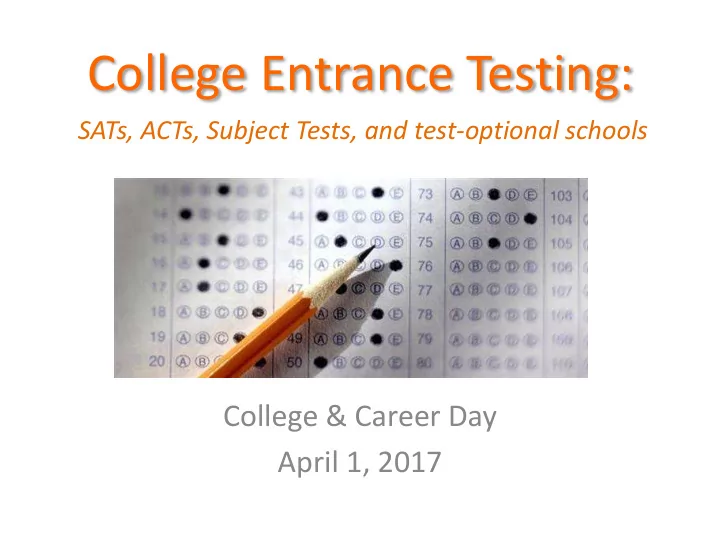
College Entrance Testing: SATs, ACTs, Subject Tests, and test-optional schools College & Career Day April 1, 2017 Todays Workshop Goal: Learn about different college entrance exams to develop a testing timeline and preparation plan.


slide-1
SLIDE 1

College Entrance Testing:

SATs, ACTs, Subject Tests, and test-optional schools

College & Career Day April 1, 2017

slide-2
SLIDE 2

Today’s Workshop

  • Goal: Learn about different college entrance

exams to develop a testing timeline and preparation plan.

  • Topics covered:

– PSAT – SAT – ACT – SAT Subject Tests – Test Optional Schools – Test Preparation – Khan Academy – Individual Timeline and Preparation Plan

slide-3
SLIDE 3
  • PSAT is the Preliminary SAT

– Provides practice for the SAT – Enters you to win the National Merit Scholarship – The beginning of the college process

  • Students take the PSAT in 10th and/or 11th grade

at Somerville High School

– Offered on a Wednesday in October for free

slide-4
SLIDE 4

Components of the PSAT:

  • Evidence-based reading test
  • Evidence-based writing and language test
  • Score ranges will be similar to SAT (320 –

1520)

  • 4 Multiple choice answers (instead of 5)
  • Rights-only scoring: 1 point for correct answer,

no deduction for incorrect or blank answers

  • 2 hours and 45 minutes
slide-5
SLIDE 5

Components of the SAT

  • Total: 3 hours or 3 hours, 50 min (with writing)

– 65 minute Reading section – 35 minute Language & Writing section – 55 minute Math section with calculator – 25 minute Math section with no calculator – 50 minute Essay (optional)

slide-6
SLIDE 6
  • Score ranges from 400 – 1600
  • Rights Only Scoring: No penalty for incorrect

answers

  • 4 Multiple Choice options (instead of 5)
  • Evidence-based reading and writing
  • Deeper focus on fewer math concepts (one

math section without a calculator)

  • Fewer, longer sections

Components of the SAT

slide-7
SLIDE 7

The SAT: When to take it?

  • Students should take the SAT for the first time

in 11th grade.

  • Students should take the test 1-3 times.

Typically it is recommended to take it twice. Taking it a 3rd time is recommended only in certain circumstances. More than 3 times is excessive and generally not necessary.

  • Offered in: January, March, May, June, August,

October, November, December

slide-8
SLIDE 8

Optional SAT Essay

  • Some colleges will require/recommend the essay

and others will not.

  • Most colleges have created and posted their SAT

essay policy. You should research now to find out the policies at schools you are interested in. See handout for some schools’ policies.

  • If even 1 school recommends or requires that you

take it, you should take it.

  • If you don’t have any idea where you might apply, it

is better to take the optional essay.

  • If you take the SAT with the essay, you must send the

essay scores to schools. You cannot choose to send

  • nly the SAT scores without the essay.
slide-9
SLIDE 9
  • Another test to standardized college admissions
  • Score ranges from 1- 36
  • What is on the ACT?

– English: grammar and rhetorical skills – Math: pre-algebra, algebra, coordinate and plane geometry, trigonometry (about 4 questions) – Reading: comprehension of passages – Science: skills required in natural sciences

  • 4 sections, 2 hours 55 minutes (without writing)
  • How many times to take it?

– 1-3 times depending on whether you are also taking the SAT

  • Register at actstudent.org. Cost: $56.50 ($39.50 no writing)

– Fee waivers exist. Talk to your counselor.

slide-10
SLIDE 10
  • But most schools want the SAT right?

– No! Colleges will accept EITHER test.

  • I heard that I have to be good at science to take

the ACT…

– Not necessarily. The ACT tests the skills you need in science – not the knowledge

  • Is the ACT easier?

– No. Different people may prefer different tests but neither one is easier.

slide-11
SLIDE 11

SAT or ACT? Or both?

slide-12
SLIDE 12

SAT Subject Tests

  • What are SAT Subject Tests?

– Hour-long, content-based tests. – Many colleges require them. Test in your best subject – it is a great chance to show off!

  • What subjects are offered?

– Literature, Biology, Chemistry, Physics, U.S. History, World History, Math Level 1, Math Level 2, French**, German**, Spanish**, Modern Hebrew, Italian, Latin, Chinese*, Japanese*, Korean*

slide-13
SLIDE 13
  • When to take them?

– You can take up to 3 in one day (different day than SAT) – Can be in 10th grade after a course was taken

  • Cost: $26 for 1st test; $20 for other tests on

same day

– Fee waivers exist. 2 per student. 1 waiver covers all tests taken on one day (i.e. 3 subject tests in

  • ne day = 1 waiver)

SAT Subject Tests

slide-14
SLIDE 14

Test Optional Schools

  • What are they?

– Colleges that do not require ACT/SAT test scores – No penalty for not sending scores – If you send scores, colleges will evaluate them

  • Where do I find test optional schools?

– www.fairtest.org – See handout for top schools that don’t require test scores

  • Some schools are test-flexible: You don’t have to send

SAT/ACT scores but you probably have to send them something else (an extra essay, etc.)

  • Check the requirements for each school!
slide-15
SLIDE 15

Test Optional Schools

  • Test Optional (or Test Flexible) schools are an

excellent option for many students.

  • You should strongly consider Test

Optional/Test Flexible schools if:

– Your SAT/ACT scores do not “match” the rest of your application (i.e. your grades are high but your scores are not) – Your SAT/ACT scores are going to hold you back from admission to a school

slide-16
SLIDE 16

Other College Standardized Tests

  • TOEFL

– For international students or students who are learning English – Resources in Guidance College & Career Room – See Ms. Artavia for information on how to sign up – Cost is $185. Some fee reductions available.

  • Accuplacer

– Students applying to 2 year/community colleges and state schools – Practice resources in Guidance College & Career Room – Take test at community colleges for free

slide-17
SLIDE 17

How much does SAT/ACT matter?

  • Very important (though not most important)

factor in the college admission process

  • You must prepare for these tests. Do not take

these tests without practice and preparation.

slide-18
SLIDE 18

How to improve your score

  • Test-taking strategies you can start now!
  • Prep courses
  • Online resources
  • Books & Practice tests

– Available in the guidance College & Career Room

  • Create a study plan and test timeline

– Take the test more than once

slide-19
SLIDE 19

Test-taking strategies

  • Take practice tests on your own!

– Figure out your baseline score – Practice testing conditions and pacing – After the test, review the questions and answers. Similar questions will show up on the test! – Online practice tests through Kaplan and Princeton

  • Review. Paper practice tests available in Guidance.
  • Flashcards – make your own
  • Online practice questions

– SAT Question of the Day – ACT Question of the Day

slide-20
SLIDE 20

Prep Courses

  • Kaplan – highly recommended in 11th grade

– Two courses currently offered this spring. – Discount (usually $700, take it for $50-75 at SHS)

  • Let’s Get Ready

– Free test prep organization – Provides SAT coaches that are Tufts students – Also provides college preparation (essays, etc) – Summer course also offered – location & more info TBD

slide-21
SLIDE 21

How to make the most of a prep course

  • Most prep courses offer about 10 hours of
  • instruction. Some assign homework. This is not

enough.

  • The course is only worth something if you put in

twice as much effort outside of it

– Do extra practice problems based on what questions you tend to have trouble with. – Pay attention in class! (its going to be boring…) – Do your homework for your benefit, not to get it done

slide-22
SLIDE 22

Online Options: Khan Academy

In partnership with Khan Academy, the College Board is

  • ffering personalized, free practice resources for all

students.

slide-23
SLIDE 23

How to Use Khan Academy

  • Create a College Board account (save your info, you

will need it to register for SATs)

  • Create a Khan Academy account
  • In College Board account, there will be an option to

link College Board & Khan Academy accounts

  • This will send your scores to Khan Academy, which

will create an individualized practice plan for you.

  • After any other SAT, your scores will be sent to Khan

Academy to continue to individualize your practice.

slide-24
SLIDE 24

Khan Academy SAT Practice

  • Will offer:

– Full Length Practice tests – Shorter Diagnostic Quizzes – Videos and practice for all questions – Daily Practice App – click to play demo

https://www.youtube.com/watch?v=S8f-jif9itg

  • Offers Question of the Day
  • Can take a paper test and upload answer sheet to get

instant scoring

slide-25
SLIDE 25

Khan Academy’s Individualized Plan

  • Based on PSAT scores, SAT scores, practice tests,

diagnostic tests, and performance on practice items, Khan Academy will adapt to provide students with the practice that they need.

  • If a student is doing well on practice items at Level

2, they will move up to Level 3.

  • If they are consistently getting questions incorrect,

they will go down to Level 1, which will help them practice fundamental skills that may not be on the SAT but are necessary to move on to SAT

  • questions. This is perfect for younger students!
slide-26
SLIDE 26

Creating a Plan and Timeline

  • PSAT in 10th and11th
  • SAT in 11th and 12th grade (and/or ACT)
  • 2-3 SAT Subject Tests in 10th, 11th, or 12th grade
  • ACT in 11th or 12th grade (and/or SAT)

Your SAT/ACT Prep plan should align with your desired test dates – don’t jump into a test OR a test prep course without a plan

slide-27
SLIDE 27

Questions?

slide-28
SLIDE 28

Linking College Board and Khan Academy

  • 1. Go to satpractice.org
  • 2. Click the green button

that says: Start Practicing

  • 3. Sign up for a Khan

Academy Account

slide-29
SLIDE 29

Linking College Board and Khan Academy

  • You have logged into

Khan Academy for the first time and will be asked if you would like to send PSAT results

  • If you already have a Khan

Academy account, a prompt will appear asking if you want to send your PSAT results to Khan Academy

  • After choosing that option,

you will be directed to collegeboard.org

slide-30
SLIDE 30

Linking College Board and Khan Academy

  • Sign in to your

College Board account; if you do not have a College Board account, click 'Sign Up' to create

  • ne.
slide-31
SLIDE 31

Linking College Board and Khan Academy

  • After successfully

logging in to your College Board account, you will be asked for permission to link your accounts.

  • After clicking “Send”

you will be redirected to SAT practice on the Khan Academy site.

slide-32
SLIDE 32

Get started practicing!