Collaborative writing online help, manuals, vignettes for packages - - PowerPoint PPT Presentation

collaborative writing
SMART_READER_LITE
LIVE PREVIEW

Collaborative writing online help, manuals, vignettes for packages - - PowerPoint PPT Presentation

Current R documentation is diversified: Collaborative writing online help, manuals, vignettes for packages books about R, contributed web pages, ... of R documentation Mailing lists, R News, JSS, ... using a Wiki has efficient


slide-1
SLIDE 1

Collaborative writing

  • f R documentation

using a Wiki

Philippe Grosjean

phgrosjean@sciviews.org

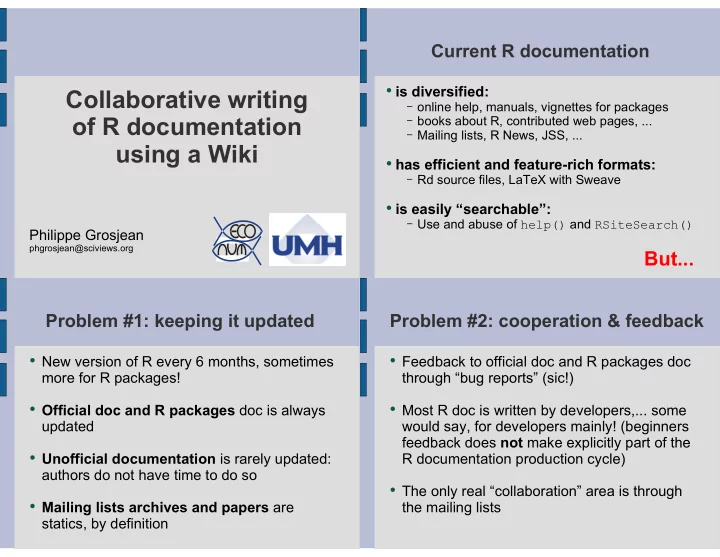
Current R documentation

  • is diversified:

– online help, manuals, vignettes for packages – books about R, contributed web pages, ... – Mailing lists, R News, JSS, ...

  • has efficient and feature-rich formats:

– Rd source files, LaTeX with Sweave

  • is easily “searchable”:

– Use and abuse of help() and RSiteSearch()

But...

Problem #1: keeping it updated

  • New version of R every 6 months, sometimes

more for R packages!

  • Official doc and R packages doc is always

updated

  • Unofficial documentation is rarely updated:

authors do not have time to do so

  • Mailing lists archives and papers are

statics, by definition

Problem #2: cooperation & feedback

  • Feedback to official doc and R packages doc

through “bug reports” (sic!)

  • Most R doc is written by developers,... some

would say, for developers mainly! (beginners feedback does not make explicitly part of the R documentation production cycle)

  • The only real “collaboration” area is through

the mailing lists

slide-2
SLIDE 2

Problem #3: its “technicality”

  • Rd files & LaTeX / Sweave vignettes are

great, but they are technically rather complex formats

  • Beginners / intermediate useRs are often

reluctant to write documents in such formats

  • Yet, they are potentially excellent

documentation writers, especially doc targeting other beginneRs!

Solution: a R Wiki?

A Wiki is:

  • A server of hyperlinked pages
  • Optimized for concurrent and easy edition

by everyone through the Internet, using a simple web browser

  • A simple syntax producing rich-formatted

documents (wiki-wiki means 'quick-quick' in Hawaian) example...

A Wiki page source and result

====== My first Wiki page ====== This is **my first Wiki page** with: * //simple __formattings__//, * an equation: $$sum (x + 1)/alpha$$ * a table: ^ x ^ y ^ | 1.3 | 5.6 | | 4.8 | 7.0 | * and some :R: code: <code r> x <- rnorm(50) # a random sample mean(x) # its mean and his hist(x, main = "my histogram") </code>

Write this... just click 'save'... and you got this!

Efficiency of the Wiki concept

  • Wikipedia is probably the best example:

– more than 1,000,000 articles written by many

volunteers around the wold

– comparable in quality to the Encyclopedia

Britannica according to a recent survey by the journal Nature

slide-3
SLIDE 3

Proposition of a Wiki for R

  • Official launch of http://wiki.r-project.org !
  • for:

– Beginners to start using R (Getting started

section)

– UseRs to contribute documentation: everybody

can contribute -after login- either long (Guides section), or short documents (Tips section)

A tour of the R Wiki

Let's see now what it looks like...

Many thanks to...

Jonathan Baron, Damian Betebenner, Roger Bivand, Ben Bolker, Dan Bolser, Patrick Burns, Nick Drew, Jose Claudio Faria, David Forrest, Romain François, Gregor Gorjanc, Gabor Grothendieck, Frank Harrell, Paul Johnson, Holly Kindsvater, Martin Maechler, John Marsland, Duncan Murdoch, Olivier Powell, Tony Plate, Barry Rowlingson, Paul Sorenson, Detlef Steuer, Daniel Rajdl, Kevin Wright, ... For helping me to set up this R Wiki site! A special thank to:

  • Detlef Steuer, author of a previous version of the R Wiki,
  • Paul Johnson, to accept migrating R Tips to the R Wiki
  • Vincent Zoonekynd, to provide 'Statistics with R' to the Wiki