Collaborating Across Borders: ANZAC Gallipoli Archaeological - - PowerPoint PPT Presentation

collaborating across borders anzac gallipoli
SMART_READER_LITE
LIVE PREVIEW

Collaborating Across Borders: ANZAC Gallipoli Archaeological - - PowerPoint PPT Presentation

Collaborating Across Borders: ANZAC Gallipoli Archaeological Database (AGAD) MICHELLE NEGUS CLEARY & PETER NEISH UNIVERSITY OF MELBOURNE agad.anzac.unimelb.edu.au ANZAC Gallipoli Archaeological Database A key resource for academics,

slide-1
SLIDE 1

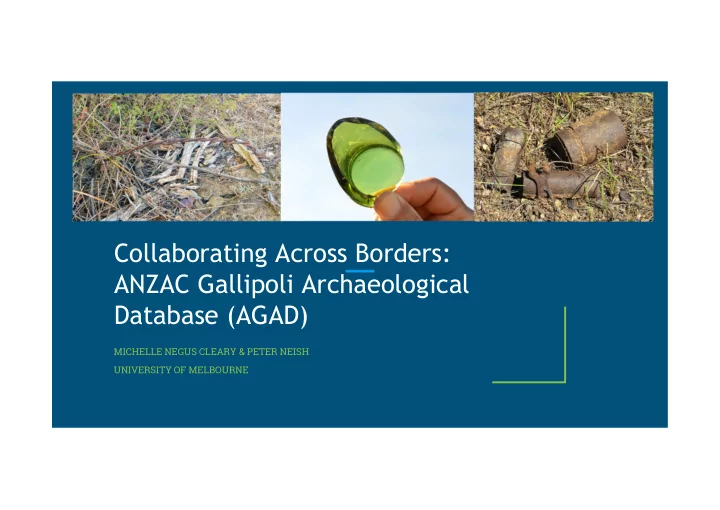
Collaborating Across Borders: ANZAC Gallipoli Archaeological Database (AGAD)

MICHELLE NEGUS CLEARY & PETER NEISH UNIVERSITY OF MELBOURNE

slide-2
SLIDE 2

agad.anzac.unimelb.edu.au

slide-3
SLIDE 3

ANZAC Gallipoli Archaeological Database

➢ A key resource for academics, amateur historians, and the general public ➢ No other online database of WW1 material culture currently exists ➢ An extensive catalogue of all artefacts and features recovered during the 2010 – 2014 surveys ➢ Forms a well-documented archive of artefacts and features from accurately recorded archaeological contexts ➢ Includes descriptions, dimensions, photographs and maps ➢ Ties into the JHAS research outputs (book and exhibition)

slide-4
SLIDE 4

Joint Historical-Archaeological Survey (JHAS) Surveys of the Gallipoli battlefield:

➢ Using archaeological techniques to document the remains of the best preserved World War

1 battlefield.

➢ Aims to identify and record sites and features of significance to Australian, New Zealand,

and Turkish forces during the 1915 campaign.

➢ Integration of archaeological techniques, methods and analysis with historical data. ➢ To record and conserve material culture associated with the 1915 campaign that is visible

  • n the ground surface.

➢ A cultural heritage assessment of the battlefield a century after the conflict.

The ANZAC Gallipoli Archaeological Database (AGAD) is a digital catalogue of all features, finds and sites documented by the JHAS Gallipoli survey project from 2010 – 2014.

slide-5
SLIDE 5

Collaboration

JHAS Project: Tri-national collaboration

  • Australia
  • Turkey
  • New Zealand

Inter-disciplinary:

  • Archaeologists
  • Historians
  • Geophysicists
  • Heritage Managers
  • Resource management

agencies

  • Government agencies
  • Universities
slide-6
SLIDE 6

JHAS

slide-7
SLIDE 7

JHAS surveys

slide-8
SLIDE 8

❑ Earthworks: ❑ trenches ❑ tunnels ❑ terraces ❑ dugouts, pits, & alcoves ❑ strategic positions ❑ Artefacts: ❑ ordnance ❑ ceramics ❑ metal items, tools and containers ❑ glass containers and periscope glass ❑ bricks, barbed wire, personal & utility items ❑ Other: ❑ e.g. water tanks, a boat, pre- and post-1915 structures ❑ Post-1915 cemeteries and monuments

Features

slide-9
SLIDE 9

Trench F769 Trench F748

slide-10
SLIDE 10
slide-11
SLIDE 11
slide-12
SLIDE 12

Lexicon

Feature Type Location Artefact Type Artefact Material Period Alcove 57th Regiment Barbed wire Ceramic Post- 1915 Artefact Baby 700 Brick Concrete

  • c. 1915

Artefact Scatter Battlefield general Ceramic sherd Glass Pre-1915 Boat Boundary Glass shard Leather Modern Boundary Marker Coastal area Glass periscope Metal Early Modern Carpark Courtney's Post Lithic Stone Medieval Cemetery Embarkation Pier Metal container Textile Early Medieval Dugout German Officer's Metal fragment Other Late Antique Monument Holly Ridge Ordnance Antique Pathway Johnston's Jolly Personal Item Classical Pit Lone Pine Shrapnel Iron Age Road Malone's Terraces Tile Late Bronze Age Strategic Position The Nek Utility item Middle Bronze Age Structure built Pope's Hill Other Early Bronze Age Terrace Quinn's Post Unknown Chalcolithic Trench Seaview Terrace Neolithic Tunnel Silt Spur Palaeolithic Water tank Turkish Quinn's Well Walker's Ridge Other Weir Ridge more…

slide-13
SLIDE 13
slide-14
SLIDE 14
slide-15
SLIDE 15

agad.anzac.unimelb.edu.au

slide-16
SLIDE 16

Survey locations

slide-17
SLIDE 17
slide-18
SLIDE 18
slide-19
SLIDE 19
slide-20
SLIDE 20
slide-21
SLIDE 21
slide-22
SLIDE 22
slide-23
SLIDE 23

AGAD Challenges

Challenges inherited from the JHAS Project:

  • Language: translation and difficulty in collaboration in same place
  • Sensitivity of content
  • Political issues

AGAD

  • Need to restrict public access to aspects of the dataset to protect heritage of the Gallipoli

battlefield as a historical landscape

  • Finding a long-term host and custodian for the online resource
slide-24
SLIDE 24

Details of ongoing custodianship

At present the AGAD is hosted by the University of Melbourne. However, there is a limited funding horizon. The primary dataset resides with individual researchers and with the Department of Veterans’ Affairs, Canberra. Future home at the Australian War Memorial?

slide-25
SLIDE 25

Data Curation Activities

  • FileMaker database not preservable in current state
  • Wanted to separate concerns between data and display
  • Wanted data to persist beyond current system

  • exit strategy

○ long-term preservation

  • Created a Data Management Plan

○ Highlighted ongoing custodianship issues ○ Application of cc-by licence for data and images

slide-26
SLIDE 26

Data Manipulation

Database Export to CSV Data Cleaning (open refine) Image File renaming Thumbnail generation Embed metadata

Data Images

CMS Created SQL

slide-27
SLIDE 27

Database structure

slide-28
SLIDE 28

Summary

  • AGAD operates as an unique, interactive appendix that presents the primary data and results
  • f the JHAS project.
  • Provides a comprehensive record of the state of the ANZAC Gallipoli 1915 battlefield one

hundred years after the conflict.

  • Challenges in terms of collaboration across three nations involved in the original conflict:

language; funding and contribution; sensitive information, interpretation and use of terms.

  • Limitation was built into the AGAD to only provide limited spatial information in order to

protect the actual battlefield from looters.

  • Challenges for ongoing funding and long-term host and custodian of the raw dataset. Limited

funding horizon at present.

  • Aims for long-term preservation of the AGAD database.

agad.anzac.unimelb.edu.au

slide-29
SLIDE 29

Acknowledgements

The AGAD website is dedicated to the late Antonio Sagona

  • Contributors: Antonio Sagona, Sarah Midford, Jessie Birkett-Rees, Abby Robinson, Simon

Harrington, Leo Konstantelos and Anna Shadbolt

  • Dr Rebecca Flemming, Department of Veterans’ Affairs, Canberra
  • Department of Veterans’ Affairs, Canberra
  • Manatū Taonga Ministry for Culture and Heritage, New Zealand
  • Onsekiz Mart Universitesi, Canakkale, Turkey
  • Turkish Ministry of Culture and Tourism
  • Turkish Ministry of Foreign Affairs
  • Turkish Ministry of Environments and Forests
  • The University of Melbourne