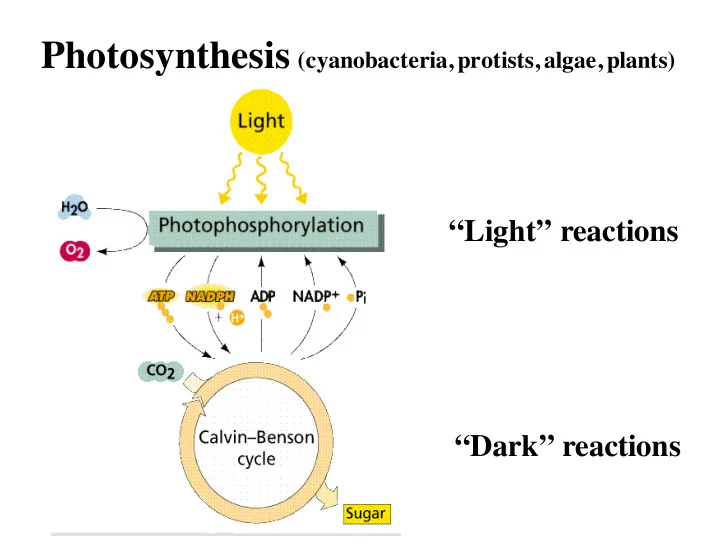
SLIDE 1
Photosynthesis (cyanobacteria, protists, algae, plants)
“Light” reactions “Dark” reactions
SLIDE 2
CO2 + H2O Sugar + O2
light energy
SLIDE 3
- 200 billion tons of CO2 fixed per year
- Different forms of carbohydrates produced
(glucose, starch, cellulose, lignins…)
- Basis of most food chains
- Directly and indirectly supports animals
SLIDE 4 Herbivory: consumption of living plant tissues
for food or water
Similar to predation except:
- generally does not kill the “prey”
- “prey” generally cannot hide
SLIDE 5
- Grazer
- Stem-borer
- Leaf-miner
SLIDE 6
- Grazer
- Stem-borer
- Leaf-miner
SLIDE 7
- Grazer
- Stem-borer
- Leaf-miner
SLIDE 8
- Frugivore
- Xylem-feeder
- Phloem-feeder
SLIDE 9
- Frugivore
- Xylem-feeder
- Phloem-feeder
SLIDE 10
- Frugivore
- Xylem-feeder
- Phloem-feeder
SLIDE 11 Why Is The World Green?
- Plants make lots of sugars
- Plants are abundant
- Plants cannot move
SLIDE 12
Chemical Defense
Primary chemicals/metabolites: essential to plant growth and reproduction; found throughout plant kingdom (e.g. sugars, proteins, DNA, etc.) Secondary chemicals/metabolites: not essential to plant growth and reproduction; not universal throughout plant kingdom
SLIDE 13
“Quantitative” reduced digestibility (high conc.) lignins silica tannins “Qualitative” toxins (low concentration) alkaloids glucosinolates cyanogenic glycosides
SLIDE 14 14
Qualitative Alkaloids
Numerous effects on metabolism & physiology…
SLIDE 15 15
Glucosinolates Qualitative
Releases sulfur groups, found in Brassicaceae…
SLIDE 16 16
Cyanogenic glycosides
Releases HCN, cyanide blocks cellular respiration…
Qualitative
SLIDE 17 17
Milkweeds: sticky latex sap
containing glycosides
SLIDE 19 19
- Prickles
- Spines
- Thorns
- Waxy Cuticles
- Trichomes
Mechanical Defense
SLIDE 20 20
Urtica dioica (Stinging Nettle)
Hollow, brittle hairs:
- 1. Histamine
- 2. Acetocholine
SLIDE 21 21
Constituent Defense: Defense mechanisms
always operating in plant
- many mechanical defenses
- most quantitative chemical defenses
Inducible Defense: Defense mechanisms that
can be turned on by external cue
- many morphological changes
- many physiological changes
- many qualitative chemical defenses
SLIDE 22 Ethnobotany: study of relationships
between plants and people
- Food (wild plants or agricultural)
- Medicine
- Fiber
- Art
- Spiritual
SLIDE 23
- Why are some plants delicious?
- Why are some plants poisonous?
- Why are some plants pokey?
- What does “safe” mean?
SLIDE 24
- Poisonous
- Side effects
- Neutral
- Beneficial
SLIDE 25 Poisonous: immediately
White Snakeroot Castor Bean Deadly Nightshade / Beladonna
SLIDE 26
Poisonous: long term
SLIDE 27 Side Effects
Coca Opium Poppy Tobacco Buckthorn
SLIDE 28 Neutral
Wood Cellulose Grass Kinnikinnick Ponderosa Pine
SLIDE 29
- Sweeteners
- Greens/Vegetables
- Fruits
- Flour
- Flavoring/Tea
Edible Plants of South Dakota
SLIDE 30
Factors Affecting Safety of Edible Plants
SLIDE 32
- Amount consumed
- Details of preparation
SLIDE 33
- Amount consumed
- Details of preparation
- Part of plant consumed
SLIDE 34
- Amount consumed
- Details of preparation
- Part of plant consumed
- Age or location of plant
SLIDE 35
- Amount consumed
- Details of preparation
- Part of plant consumed
- Age or location of plant
- Season of the year
SLIDE 36
- Amount consumed
- Details of preparation
- Part of plant consumed
- Age or location of plant
- Season of the year
- Status of consuming person
SLIDE 37
Sometimes it’s hard to predict…
SLIDE 38
Sometimes it’s hard to predict…
“Into the Wild”
SLIDE 40 40
Wild Potato aka Alpine Sweetvetch Hedysarum alpinum pp. 216-217
SLIDE 41 What killed Chris?
- Theory 1: wrong plant (alkaloids)
- Theory 2: Lathyrism (ODAP)
SLIDE 42 Lathyrism
- Named after genus Lathyrus
- Contains ODAP (protein)
- Grass Pea sometimes consumed
- Can cause leg paralysis
- Young men more affected
SLIDE 43 What killed Chris?
- Theory 1: wrong plant (alkaloids)
- Theory 2: ODAP
- Theory 3: another protein
SLIDE 44 What killed Chris?
- Theory 1: wrong plant (alkaloids)
- Theory 2: ODAP
- Theory 3: another protein
- Theory 4: normal starvation
SLIDE 45
Often there is contradictory info…
SLIDE 46 Safety?????
Black Nightshade
SLIDE 47
Poisonous Plants of South Dakota
SLIDE 48
Dock and Sorrel, Rumex pp. 304-305
Sometimes bad (oxalates)….
SLIDE 49 Milkweeds, Asclepias pp. 60-64
Maybe bad (cardiac glycosides)…
- Boil, don’t boil?
- Change water,
don’t change water?
SLIDE 50 Locoweed, pp. 222-224
- Swainsonine (from a fungus)
- Most widespread problem poisonous
plant in western North America
- Loco disease or ‘pea struck’
- Chemotherapy
- Native
Bad (alkaloids)…
SLIDE 51 Monkshood aka Wolf’s Bane, pp. 310-311
- Aconitum
- One of world’s most toxic plants
- Digestive-cardiac-asphyxiation
- Sometimes used for cardiac issues,
nerve pain, cold feet —don’t use!
Bad (alkaloids)…
SLIDE 52
Jimsonweed (Datura stramonium) (not in book)
SLIDE 53
- Atropine & scopolamine
- CNS & cardiac effects
- Bad trips & death
- Anesthesia & asthma treatment
- Native to Mexico
Bad (alkaloids)…
SLIDE 54 Poison Hemlock, pp. 48-49
- Coniine
- CNS effects
- Medicinal?
- Non-native
Bad (alkaloids)…
SLIDE 55 Water Hemlock, pp. 46-47
- Cicutoxin
- CNS effects
- Most poisonous plant in
North America
Bad (alkaloids)…
SLIDE 56 56
Plant families to be super careful with… Plant families that are usually safe…
SLIDE 57