CMPS 112: Spring 2019 Comparative Programming Languages - - PDF document

cmps 112 spring 2019
SMART_READER_LITE
LIVE PREVIEW

CMPS 112: Spring 2019 Comparative Programming Languages - - PDF document

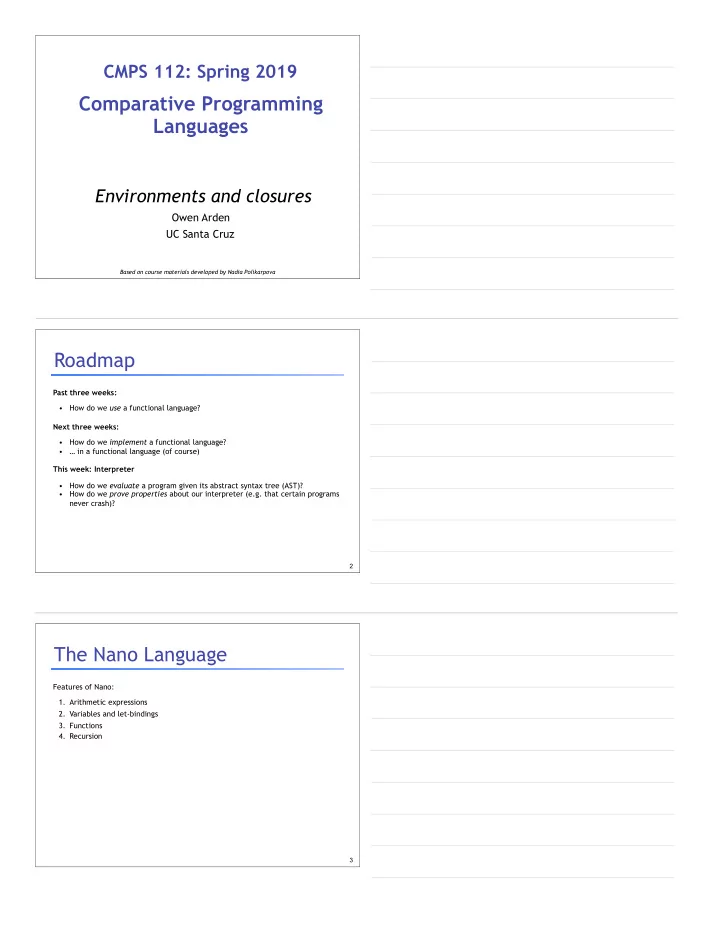
CMPS 112: Spring 2019 Comparative Programming Languages Environments and closures Owen Arden UC Santa Cruz Based on course materials developed by Nadia Polikarpova Roadmap Past three weeks: How do we use a functional


slide-1
SLIDE 1


 CMPS 112: Spring 2019


Comparative Programming Languages


Owen Arden UC Santa Cruz

Environments and closures

Based on course materials developed by Nadia Polikarpova

Roadmap

Past three weeks:

  • How do we use a functional language?

Next three weeks:

  • How do we implement a functional language?
  • … in a functional language (of course)

This week: Interpreter

  • How do we evaluate a program given its abstract syntax tree (AST)?
  • How do we prove properties about our interpreter (e.g. that certain programs

never crash)?

2

The Nano Language

Features of Nano:

  • 1. Arithmetic expressions
  • 2. Variables and let-bindings
  • 3. Functions
  • 4. Recursion

3

slide-2
SLIDE 2

Reminder: Calculator

Arithmetic expressions:

e ::= n | e1 + e2 | e1 - e2 | e1 * e2

Example:

4 + 13 ==> 17

4

Reminder: Calculator

Haskell datatype to represent arithmetic expressions:

data Expr = Num Int | Add Expr Expr | Sub Expr Expr | Mul Expr Expr


 Haskell function to evaluate an expression:

eval :: Expr -> Int eval (Num n) = n eval (Add e1 e2) = eval e1 + eval e2 eval (Sub e1 e2) = eval e1 - eval e2 eval (Mul e1 e2) = eval e1 * eval e2

5

Reminder: Calculator

Alternative representation:

data Binop = Add | Sub | Mul data Expr = Num Int -- number | Bin Binop Expr Expr -- binary expression

Evaluator for alternative representation:

eval :: Expr -> Int eval (Num n) = n eval (Bin Add e1 e2) = eval e1 + eval e2 eval (Bin Sub e1 e2) = eval e1 - eval e2 eval (Bin Mul e1 e2) = eval e1 * eval e2

6

slide-3
SLIDE 3

The Nano Language

Features of Nano:

  • 1. Arithmetic expressions [done]
  • 2. Variables and let-bindings
  • 3. Functions
  • 4. Recursion

7

Extension: variables

Let’s add variables and let bindings!

e ::= n | x | e1 + e2 | e1 - e2 | e1 * e2 | let x = e1 in e2


 Example:

let x = 4 + 13 in -- 17 let y = 7 - 5 in -- 2 x * y ==> 34

8

Extension: variables

Haskell representation:

data Expr = Num Int -- number | ??? -- variable | Bin Binop Expr Expr -- binary expression | ??? -- let expression

9

slide-4
SLIDE 4

Extension: variables

type Id = String data Expr = Num Int -- number | Var Id -- variable | Bin Binop Expr Expr -- binary expression | Let Id Expr Expr -- let expression

Haskell function to evaluate an expression:

eval :: Expr -> Int eval (Num n) = n eval (Var x) = ??? ...

10

Extension: variables

type Id = String data Expr = Num Int -- number | Var Id -- variable | Bin Binop Expr Expr -- binary expression | Let Id Expr Expr -- let expression

Haskell function to evaluate an expression:

eval :: Expr -> Int eval (Num n) = n eval (Var x) = ??? ...

11

How do we evaluate a variable? 
 We have to remember which value it was bound to!

Environment

An expression is evaluated in an environment, which maps all its free variables to values Examples:

x * y =[x:17, y:2]=> 34 x * y =[x:17]=> Error: unbound variable y x * (let y = 2 in y) =[x:17]=> 34

12

  • How should we represent the

environment?

  • Which operations does it support?
slide-5
SLIDE 5

Extension: variables

13

http://tiny.cc/cmps112-vars-ind

Extension: variables

14

http://tiny.cc/cmps112-vars-grp

Environment: API

To evaluate let x = e1 in e2 in env:

  • evaluate e2 in an extended environment env + [x:v]
  • where v is the result of evaluating e1

To evaluate x in env:

  • lookup the most recently added binding for x

type Value = Int data Env = ... -- representation not that important

  • - | Add a new binding

add :: Id -> Value -> Env -> Env

  • - | Lookup the most recently added binding

lookup :: Id -> Env -> Value

15

slide-6
SLIDE 6

Evaluating expressions

Back to our expressions… now with environments!

data Expr = Num Int -- number | Var Id -- variable | Bin Binop Expr Expr -- binary expression | Let Id Expr Expr -- let expression

16

Evaluating expressions

Haskell function to evaluate an expression:

eval :: Env -> Expr -> Value eval env (Num n) = n eval env (Var x) = lookup x env eval env (Bin op e1 e2) = f v1 v2 where v1 = eval env e1 v2 = eval env e2 f = case op of Add -> (+) Sub -> (-) Mul -> (*) eval env (Let x e1 e2) = eval env' e2 where v = eval env e1 env' = add x v env

17

Example evaluation

Nano expression

let x = 1 in let y = (let x = 2 in x) + x in let x = 3 in x + y

is represented in Haskell as:

exp1 = Let "x" (Num 1) (Let "y" (Add (Let "x" (Num 2) (Var x)) (Var x)) (Let "x" (Num 3) (Add (Var x) (Var y))))

18

exp3 exp2 exp4 exp5

slide-7
SLIDE 7

Example evaluation

eval [] exp1 => eval [] (Let "x" (Num 1) exp2) => eval [("x",eval [] (Num 1))] exp2 => eval [("x",1)] (Let "y" (Add exp3 exp4) exp5) => eval [("y",(eval [("x",1)] (Add exp3 exp4))), ("x",1)] exp5 => eval [("y",(eval [("x",1)] (Let "x" (Num 2) (Var "x")) + eval [("x",1)] (Var "x"))), ("x",1)] exp5 => eval [("y",(eval [("x",2), ("x",1)] (Var "x") -- new binding for x + 1)), ("x",1)] exp5 => eval [("y",(2 -- use latest binding for x + 1)), ("x",1)] exp5 => eval [("y",3), ("x",1)] (Let "x" (Num 3) (Add (Var "x") (Var "y")))

19

Example evaluation

=> eval [("y",3), ("x",1)] (Let "x" (Num 3) (Add (Var "x") (Var “y"))) => eval [("x",3), ("y",3), ("x",1)] -- new binding for x (Add (Var "x") (Var "y")) => eval [("x",3), ("y",3), ("x",1)] (Var "x") + eval [("x",3), ("y",3), ("x",1)] (Var "y") => 3 + 3 => 6

20

Example evaluation

Same evaluation in a simplified format (Haskell Expr terms replaced by their “pretty- printed version”): eval [] {let x = 1 in let y = (let x = 2 in x) + x in let x = 3 in x + y} => eval [x:(eval [] 1)] {let y = (let x = 2 in x) + x in let x = 3 in x + y} => eval [x:1] {let y = (let x = 2 in x) + x in let x = 3 in x + y} => eval [y:(eval [x:1] {(let x = 2 in x) + x}), x:1] {let x = 3 in x + y} => eval [y:(eval [x:1] {let x = 2 in x} + eval [x:1] {x}), x:1] {let x = 3 in x + y}

  • - new binding for x:

=> eval [y:(eval [x:2,x:1] {x} + eval [x:1] {x}), x:1] {let x = 3 in x + y}

  • - use latest binding for x:

=> eval [y:( 2 + eval [x:1] {x}), x:1] {let x = 3 in x + y} => eval [y:( 2 + 1) , x:1] {let x = 3 in x + y}

21

slide-8
SLIDE 8

Example evaluation

=> eval [y:( 2 + 1) , x:1] {let x = 3 in x + y} => eval [y:3, x:1] {let x = 3 in x + y}

  • - new binding for x:

=> eval [x:3, y:3, x:1] {x + y} => eval [x:3, y:3, x:1] x + eval [x:3, y:3, x:1] y

  • - use latest binding for x:

=> 3 + 3 => 6

22

Runtime errors

Haskell function to evaluate an expression: eval :: Env -> Expr -> Value eval env (Num n) = n eval env (Var x) = lookup x env -- can fail! eval env (Bin op e1 e2) = f v1 v2 where v1 = eval env e1 v2 = eval env e2 f = case op of Add -> (+) Sub -> (-) Mul -> (*) eval env (Let x e1 e2) = eval env' e2 where v = eval env e1 env' = add x v env How do we make sure lookup doesn’t cause a run-time error?

23

Free vs bound variables

In eval env e, env must contain bindings for all free variables of e!

  • an occurrence of x is free if it is not bound
  • an occurrence of x is bound if it’s inside e2 where let x = e1 in e2
  • evaluation succeeds when an expression is closed!

24

slide-9
SLIDE 9

QUIZ

25

http://tiny.cc/cmps112-free-ind

QUIZ

26

http://tiny.cc/cmps112-free-grp

The Nano Language

Features of Nano:

  • 1. Arithmetic expressions [done]
  • 2. Variables and let-bindings [done]
  • 3. Functions
  • 4. Recursion

27

slide-10
SLIDE 10

Extension: functions

Let’s add lambda abstraction and function application!

e ::= n | x | e1 + e2 | e1 - e2 | e1 * e2 | let x = e1 in e2 | \x -> e -- abstraction | e1 e2 -- application

Example:

let c = 42 in let cTimes = \x -> c * x in cTimes 2 ==> 84

28

Extension: functions

Haskell representation:

data Expr = Num Int -- number | Var Id -- variable | Bin Binop Expr Expr -- binary expression | Let Id Expr Expr -- let expression | ??? -- abstraction | ??? -- application

29

Extension: functions

Haskell representation:

data Expr = Num Int -- number | Var Id -- variable | Bin Binop Expr Expr -- binary expression | Let Id Expr Expr -- let expression | Lam Id Expr -- abstraction | App Expr Expr -- application

30

slide-11
SLIDE 11

Extension: functions

Example:

let c = 42 in let cTimes = \x -> c * x in cTimes 2

represented as:

Let "c" (Num 42) (Let "cTimes" (Lam "x" (Mul (Var "c") (Var "x"))) (App (Var "cTimes") (Num 2)))

31

Extension: functions

Example:

let c = 42 in let cTimes = \x -> c * x in cTimes 2

How should we evaluate this expression?

eval [] {let c = 42 in let cTimes = \x -> c * x in cTimes 2} => eval [c:42] {let cTimes = \x -> c * x in cTimes 2} => eval [cTimes:???, c:42] {cTimes 2}


 What is the value of cTimes???

32

Rethinking our values

Until now: a program evaluates to an integer (or fails)

type Value = Int type Env = [(Id, Value)] eval :: Env -> Expr -> Value

33

slide-12
SLIDE 12

Rethinking our values

What do these programs evaluate to?

(1) \x -> 2 * x ==> ??? (2) let f = \x -> \y -> 2 * (x + y) in f 5 ==> ???

Conceptually, (1) evaluates to itself (not exactly, see later). while (2) evaluates to something equivalent to \y -> 2 * (5 + y)

34

Rethinking our values

Now: a program evaluates to an integer or a lambda abstraction (or fails)

  • Remember: functions are first-class values


 Let’s change our definition of values!

data Value = VNum Int | VLam ??? -- What info do we need to store?

  • - Other types stay the same

type Env = [(Id, Value)] eval :: Env -> Expr -> Value

35

Function values

How should we represent a function value?

let c = 42 in let cTimes = \x -> c * x in cTimes 2

We need to store enough information about cTimes so that we can later evaluate any application of cTimes (like cTimes 2)! 
 First attempt:

data Value = VNum Int | VLam Id Expr -- formal + body

36

slide-13
SLIDE 13

Function values

Let’s try this!

eval [] {let c = 42 in let cTimes = \x -> c * x in cTimes 2} => eval [c:42] {let cTimes = \x -> c * x in cTimes 2} => eval [cTimes:(\x -> c*x), c:42] {cTimes 2}

  • - evaluate the function:

=> eval [cTimes:(\x -> c*x), c:42] {(\x -> c * x) 2}

  • - evaluate the argument, bind to x, evaluate body:

=> eval [x:2, cTimes:(\x -> c*x), c:42] {c * x} => 42 * 2 => 84


Looks good… can you spot a problem?

37

QUIZ

38

http://tiny.cc/cmps112-cscope-ind

QUIZ

39

http://tiny.cc/cmps112-cscope-grp

slide-14
SLIDE 14

Static vs Dynamic Scoping

What we want:

let c = 42 in let cTimes = \x -> c * x in let c = 5 in cTimes 2 => 84

Lexical (or static) scoping:

  • each occurrence of a variable refers to the most recent binding in the

program text

  • definition of each variable is unique and known statically
  • good for readability and debugging: don’t have to figure out where a variable

got “assigned” 


40

Static vs Dynamic Scoping

What we don’t want:

let c = 42 in let cTimes = \x -> c * x in let c = 5 in cTimes 2 => 10

Dynamic scoping:

  • each occurrence of a variable refers to the most recent binding during

program execution

  • can’t tell where a variable is defined just by looking at the function body
  • nightmare for readability and debugging:

41

Static vs Dynamic Scoping

Dynamic scoping:

  • each occurrence of a variable refers to the most recent binding during

program execution

  • can’t tell where a variable is defined just by looking at the function body
  • nightmare for readability and debugging:

let cTimes = \x -> c * x in let c = 5 in let res1 = cTimes 2 in -- ==> 10 let c = 10 in let res2 = cTimes 2 in -- ==> 20!!! res2 - res1

42

slide-15
SLIDE 15

Function values

data Value = VNum Int | VLam Id Expr -- formal + body

This representation can only implement dynamic scoping! let c = 42 in let cTimes = \x -> c * x in let c = 5 in cTimes 2 evaluates as: eval [] {let c = 42 in let cTimes = \x -> c * x in let c = 5 in cTimes 2}

43

Function values

eval [] {let c = 42 in let cTimes = \x -> c * x in let c = 5 in cTimes 2} => eval [c:42] {let cTimes = \x -> c * x in let c = 5 in cTimes 2} => eval [cTimes:(\x -> c*x), c:42] {let c = 5 in cTimes 2} => eval [c:5, cTimes:(\x -> c*x), c:42] {cTimes 2} => eval [c:5, cTimes:(\x -> c*x), c:42] {(\x -> c * x) 2} => eval [x:2, c:5, cTimes:(\x -> c*x), c:42] {c * x}

  • - latest binding for c is 5!

=> 5 * 2 => 10 Lesson learned: need to remember what c was bound to when cTimes was defined!

  • i.e. “freeze” the environment at function definition

44

Closures

To implement lexical scoping, we will represent function values as closures Closure = lambda abstraction (formal + body) + environment at function definition

data Value = VNum Int | VClos Env Id Expr -- env + formal + body

45

slide-16
SLIDE 16

Closures

Our example: eval [] {let c = 42 in let cTimes = \x -> c * x in let c = 5 in cTimes 2} => eval [c:42] {let cTimes = \x -> c * x in let c = 5 in cTimes 2}

  • - remember current env:

=> eval [cTimes:<[c:42], \x -> c*x>, c:42] {let c = 5 in cTimes 2} => eval [c:5, cTimes:<[c:42], \x -> c*x>, c:42] {cTimes 2} => eval [c:5, cTimes:<[c:42], \x -> c*x>, c:42] {<[c:42], \x -> c * x> 2}

  • - restore env to the one inside the closure, then bind 2 to x:

=> eval [x:2, c:42] {c * x} => 42 * 2 => 84

46

QUIZ

47

http://tiny.cc/cmps112-env-ind

QUIZ

48

http://tiny.cc/cmps112-env-grp

slide-17
SLIDE 17

Free vs bound variables

  • An occurrence of x is free if it is not bound
  • An occurrence of x is bound if it’s inside
  • e2 where let x = e1 in e2
  • e where \x -> e
  • A closure environment has to save all free variables of a function definition!

let a = 20 in let f = \x -> let y = x + 1 in let g = \z -> y + z in a + g x -- a is the only free variable! in ...

49

Evaluator

Let’s modify our evaluator to handle functions! data Value = VNum Int | VClos Env Id Expr -- env + formal + body eval :: Env -> Expr -> Value eval env (Num n) = VNum n -- must wrap in VNum now! eval env (Var x) = lookup x env eval env (Bin op e1 e2) = VNum (f v1 v2) where (VNum v1) = eval env e1 (VNum v2) = eval env e2 f = ... -- as before eval env (Let x e1 e2) = eval env' e2 where v = eval env e1 env' = add x v env eval env (Lam x body) = ??? -- construct a closure eval env (App fun arg) = ??? -- eval fun, then arg, then apply

50

Evaluator

Evaluating functions:

  • Construct a closure: save environment at function definition
  • Apply a closure: restore saved environment, add formal, evaluate the body

eval :: Env -> Expr -> Value ... eval env (Lam x body) = VClos env x body eval env (App fun arg) = eval bodyEnv body where (VClos closEnv x body) = eval env fun -- eval function to closure vArg = eval env arg -- eval argument bodyEnv = add x vArg closEnv

51

slide-18
SLIDE 18

Evaluator

Evaluating functions:

  • Construct a closure: save environment at function definition
  • Apply a closure: restore saved environment, add formal, evaluate the body

eval :: Env -> Expr -> Value ... eval env (Lam x body) = VClos env x body eval env (App fun arg) = let vArg = eval env arg -- eval argument let bodyEnv = add x vArg closEnv case (eval env fun) of -- eval function to closure (VClos closEnv x body) -> eval bodyEnv body _ -> ???

52

Quiz

53

http://tiny.cc/cmps112-enveval-ind

Quiz

54

http://tiny.cc/cmps112-enveval-grp

slide-19
SLIDE 19

Evaluator

eval [] {let f = \x -> x + y in let y = 10 in f 5} => eval [f:<[], \x -> x + y>] {let y = 10 in f 5} => eval [y:10, f:<[], \x -> x + y>] {f 5} => eval [y:10, f:<[], \x -> x + y>] {<[], \x -> x + y> 5} => eval [x:5] -- env got replaced by closure env + formal! {x + y} -- y is unbound!

55

Quiz

56 http://tiny.cc/cmps112-enveval2-ind

Quiz

57 http://tiny.cc/cmps112-enveval2-grp

slide-20
SLIDE 20

Evaluator

eval [] {let f = \n -> n * f (n - 1) in f 5} => eval [f:<[], \n -> n * f (n - 1)>] {f 5} => eval [f:<[], \n -> n * f (n - 1)>] {<[], \n -> n * f (n - 1)> 5} => eval [n:5] -- env got replaced by closure env + formal! {n * f (n - 1)} -- f is unbound!

Lesson learned: to support recursion, we need a different way of constructing the closure environment!

58