Classifica)on Example: Spam Filter Input: an email Dear - - PowerPoint PPT Presentation

classifica on example spam filter
SMART_READER_LITE
LIVE PREVIEW

Classifica)on Example: Spam Filter Input: an email Dear - - PowerPoint PPT Presentation

Machine Learning CS 232: Ar)ficial Intelligence Nave Bayes Oct 26, 2015 Part 1 of course: how use a model to make op)mal decisions


slide-1
SLIDE 1

1

CS ¡232: ¡Ar)ficial ¡Intelligence ¡

¡ Naïve ¡Bayes ¡

Oct ¡26, ¡2015 ¡

[These ¡slides ¡were ¡created ¡by ¡Dan ¡Klein ¡and ¡Pieter ¡Abbeel ¡for ¡CS188 ¡Intro ¡to ¡AI ¡at ¡UC ¡Berkeley. ¡ ¡All ¡CS188 ¡materials ¡are ¡available ¡at ¡hPp://ai.berkeley.edu.] ¡

Machine ¡Learning ¡

§ Part ¡1 ¡of ¡course: ¡how ¡use ¡a ¡model ¡to ¡make ¡op)mal ¡decisions ¡(state ¡ space, ¡MDPs) ¡ § Machine ¡learning: ¡how ¡to ¡acquire ¡a ¡model ¡from ¡data ¡/ ¡experience ¡

§ Learning ¡parameters ¡(e.g. ¡probabili)es) ¡ § Learning ¡structure ¡(e.g. ¡Bayesian ¡Nets ¡graphs) ¡ § Learning ¡hidden ¡concepts ¡(e.g. ¡clustering) ¡

§ Today: ¡model-­‑based ¡classifica)on ¡with ¡Naive ¡Bayes ¡

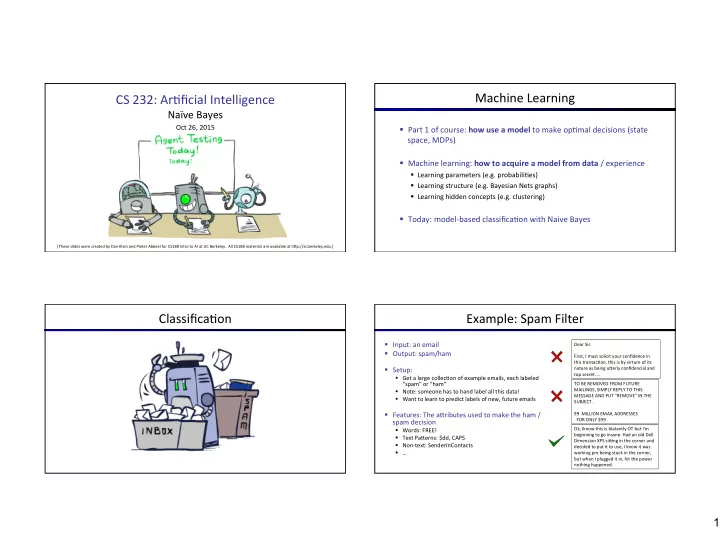
Classifica)on ¡ Example: ¡Spam ¡Filter ¡

§ Input: ¡an ¡email ¡ § Output: ¡spam/ham ¡ § Setup: ¡

§ Get ¡a ¡large ¡collec)on ¡of ¡example ¡emails, ¡each ¡labeled ¡ “spam” ¡or ¡“ham” ¡ § Note: ¡someone ¡has ¡to ¡hand ¡label ¡all ¡this ¡data! ¡ § Want ¡to ¡learn ¡to ¡predict ¡labels ¡of ¡new, ¡future ¡emails ¡

§ Features: ¡The ¡aPributes ¡used ¡to ¡make ¡the ¡ham ¡/ ¡ spam ¡decision ¡

§ Words: ¡FREE! ¡ § Text ¡PaPerns: ¡$dd, ¡CAPS ¡ § Non-­‑text: ¡SenderInContacts ¡ § … ¡

Dear ¡Sir. ¡ ¡ First, ¡I ¡must ¡solicit ¡your ¡confidence ¡in ¡ this ¡transac)on, ¡this ¡is ¡by ¡virture ¡of ¡its ¡ nature ¡as ¡being ¡uPerly ¡confidencial ¡and ¡ top ¡secret. ¡… ¡ TO ¡BE ¡REMOVED ¡FROM ¡FUTURE ¡ MAILINGS, ¡SIMPLY ¡REPLY ¡TO ¡THIS ¡ MESSAGE ¡AND ¡PUT ¡"REMOVE" ¡IN ¡THE ¡

  • SUBJECT. ¡

¡ 99 ¡ ¡MILLION ¡EMAIL ¡ADDRESSES ¡ ¡ ¡FOR ¡ONLY ¡$99 ¡ Ok, ¡Iknow ¡this ¡is ¡blatantly ¡OT ¡but ¡I'm ¡ beginning ¡to ¡go ¡insane. ¡Had ¡an ¡old ¡Dell ¡ Dimension ¡XPS ¡simng ¡in ¡the ¡corner ¡and ¡ decided ¡to ¡put ¡it ¡to ¡use, ¡I ¡know ¡it ¡was ¡ working ¡pre ¡being ¡stuck ¡in ¡the ¡corner, ¡ but ¡when ¡I ¡plugged ¡it ¡in, ¡hit ¡the ¡power ¡ nothing ¡happened. ¡

slide-2
SLIDE 2

2

Example: ¡Digit ¡Recogni)on ¡

§ Input: ¡images ¡/ ¡pixel ¡grids ¡ § Output: ¡a ¡digit ¡0-­‑9 ¡ § Setup: ¡

§ Get ¡a ¡large ¡collec)on ¡of ¡example ¡images, ¡each ¡labeled ¡with ¡a ¡digit ¡ § Note: ¡someone ¡has ¡to ¡hand ¡label ¡all ¡this ¡data! ¡ § Want ¡to ¡learn ¡to ¡predict ¡labels ¡of ¡new, ¡future ¡digit ¡images ¡

§ Features: ¡The ¡aPributes ¡used ¡to ¡make ¡the ¡digit ¡decision ¡

§ Pixels: ¡(6,8)=ON ¡ § Shape ¡PaPerns: ¡NumComponents, ¡AspectRa)o, ¡NumLoops ¡ § … ¡

0 ¡ 1 ¡ 2 ¡ 1 ¡ ?? ¡

Other ¡Classifica)on ¡Tasks ¡

§ Classifica)on: ¡given ¡inputs ¡x, ¡predict ¡labels ¡(classes) ¡y ¡ § Examples: ¡

§ Spam ¡detec)on ¡(input: ¡document, ¡ ¡classes: ¡spam ¡/ ¡ham) ¡ § OCR ¡(input: ¡images, ¡classes: ¡characters) ¡ § Medical ¡diagnosis ¡(input: ¡symptoms, ¡ ¡classes: ¡diseases) ¡ § Automa)c ¡essay ¡grading ¡(input: ¡document, ¡ ¡classes: ¡grades) ¡ § Fraud ¡detec)on ¡(input: ¡account ¡ac)vity, ¡ ¡classes: ¡fraud ¡/ ¡no ¡fraud) ¡ § Customer ¡service ¡email ¡rou)ng ¡ § … ¡many ¡more ¡

§ Classifica)on ¡is ¡an ¡important ¡commercial ¡technology! ¡

Model-­‑Based ¡Classifica)on ¡ Model-­‑Based ¡Classifica)on ¡

§ Model-­‑based ¡approach ¡

§ Build ¡a ¡model ¡(e.g. ¡a ¡Bayesian ¡ network, ¡BN) ¡where ¡both ¡the ¡label ¡ and ¡features ¡are ¡random ¡variables ¡ § Instan)ate ¡any ¡observed ¡features ¡ § Query ¡for ¡the ¡distribu)on ¡of ¡the ¡label ¡ condi)oned ¡on ¡the ¡features ¡

§ Challenges ¡

§ What ¡structure ¡should ¡the ¡BN ¡have? ¡ § How ¡should ¡we ¡learn ¡its ¡parameters? ¡

slide-3
SLIDE 3

3

Naïve ¡Bayes ¡for ¡Digits ¡

§ Naïve ¡Bayes: ¡Assume ¡all ¡features ¡are ¡independent ¡effects ¡of ¡the ¡label ¡ § Simple ¡digit ¡recogni)on ¡version: ¡

§ One ¡feature ¡(variable) ¡Fij ¡for ¡each ¡grid ¡posi)on ¡<i,j> ¡ § Feature ¡values ¡are ¡on ¡/ ¡off, ¡based ¡on ¡whether ¡intensity ¡ ¡is ¡more ¡or ¡less ¡than ¡0.5 ¡in ¡underlying ¡image ¡ § Each ¡input ¡maps ¡to ¡a ¡feature ¡vector, ¡e.g. ¡ § Here: ¡lots ¡of ¡features, ¡each ¡is ¡binary ¡valued ¡

§ Naïve ¡Bayes ¡model: ¡ § What ¡do ¡we ¡need ¡to ¡learn? ¡

Y ¡ F1 ¡ Fn ¡ F2 ¡

General ¡Naïve ¡Bayes ¡

§ A ¡general ¡Naive ¡Bayes ¡model: ¡ § We ¡only ¡have ¡to ¡specify ¡how ¡each ¡feature ¡depends ¡on ¡the ¡class ¡ § Total ¡number ¡of ¡parameters ¡is ¡linear ¡in ¡n ¡ § Model ¡is ¡very ¡simplis)c, ¡but ¡ouen ¡works ¡anyway ¡

Y ¡ F1 ¡ Fn ¡ F2 ¡ |Y| ¡parameters ¡ n ¡x ¡|F| ¡x ¡|Y| ¡ parameters ¡ |Y| ¡x ¡|F|n ¡values ¡

Inference ¡for ¡Naïve ¡Bayes ¡

§ Goal: ¡compute ¡posterior ¡distribu)on ¡over ¡label ¡variable ¡Y ¡

§ Step ¡1: ¡get ¡joint ¡probability ¡of ¡label ¡and ¡evidence ¡for ¡each ¡label ¡ § Step ¡2: ¡sum ¡to ¡get ¡probability ¡of ¡evidence ¡ § Step ¡3: ¡normalize ¡by ¡dividing ¡Step ¡1 ¡by ¡Step ¡2 ¡

+ ¡

General ¡Naïve ¡Bayes ¡

§ What ¡do ¡we ¡need ¡in ¡order ¡to ¡use ¡Naïve ¡Bayes? ¡

§ Inference ¡method ¡ ¡

§ Start ¡with ¡a ¡bunch ¡of ¡probabili)es: ¡P(Y) ¡and ¡the ¡P(Fi|Y) ¡tables ¡ § Use ¡standard ¡inference ¡to ¡compute ¡P(Y|F1…Fn) ¡ ¡ ¡

§ Es)mates ¡of ¡local ¡condi)onal ¡probability ¡tables ¡

§ P(Y), ¡the ¡prior ¡over ¡labels ¡ § P(Fi|Y) ¡for ¡each ¡feature ¡(evidence ¡variable) ¡ § These ¡probabili)es ¡are ¡collec)vely ¡called ¡the ¡parameters ¡of ¡the ¡model ¡ and ¡denoted ¡by ¡θ ¡ § Up ¡un)l ¡now, ¡we ¡assumed ¡these ¡appeared ¡by ¡magic, ¡but… ¡ § …they ¡typically ¡come ¡from ¡training ¡data ¡counts: ¡we’ll ¡look ¡at ¡this ¡soon ¡

slide-4
SLIDE 4

4

Example: ¡Condi)onal ¡Probabili)es ¡

1 0.1 2 0.1 3 0.1 4 0.1 5 0.1 6 0.1 7 0.1 8 0.1 9 0.1 0.1 1 0.01 2 0.05 3 0.05 4 0.30 5 0.80 6 0.90 7 0.05 8 0.60 9 0.50 0.80 1 0.05 2 0.01 3 0.90 4 0.80 5 0.90 6 0.90 7 0.25 8 0.85 9 0.60 0.80

Naïve ¡Bayes ¡for ¡Text ¡

§ Bag-­‑of-­‑words ¡Naïve ¡Bayes: ¡

§ Features: ¡Wi ¡is ¡the ¡word ¡at ¡positon ¡i ¡ § As ¡before: ¡predict ¡label ¡condi)oned ¡on ¡feature ¡variables ¡(spam ¡vs. ¡ham) ¡ § As ¡before: ¡assume ¡features ¡are ¡condi)onally ¡independent ¡given ¡label ¡ § New: ¡each ¡Wi ¡is ¡iden)cally ¡distributed ¡

§ Genera)ve ¡model: ¡ § “Tied” ¡distribu)ons ¡and ¡bag-­‑of-­‑words ¡

§ Usually, ¡each ¡variable ¡gets ¡its ¡own ¡condi)onal ¡probability ¡distribu)on ¡P(F|Y) ¡ § In ¡a ¡bag-­‑of-­‑words ¡model ¡

§ Each ¡posi)on ¡is ¡iden)cally ¡distributed ¡ § All ¡posi)ons ¡share ¡the ¡same ¡condi)onal ¡probs ¡P(W|Y) ¡ § Why ¡make ¡this ¡assump)on? ¡

§ Called ¡“bag-­‑of-­‑words” ¡because ¡model ¡is ¡insensi)ve ¡to ¡word ¡order ¡or ¡reordering ¡

Word ¡at ¡posi/on ¡ i, ¡not ¡ith ¡word ¡in ¡ the ¡dic/onary! ¡

Example: ¡Spam ¡Filtering ¡

§ Model: ¡ § What ¡are ¡the ¡parameters? ¡ § Where ¡do ¡these ¡tables ¡come ¡from? ¡

the : 0.0156 to : 0.0153 and : 0.0115

  • f : 0.0095

you : 0.0093 a : 0.0086 with: 0.0080 from: 0.0075 ... the : 0.0210 to : 0.0133

  • f : 0.0119

2002: 0.0110 with: 0.0108 from: 0.0107 and : 0.0105 a : 0.0100 ... ham : 0.66 spam: 0.33

Spam ¡Example ¡

Word P(w|spam) P(w|ham) Tot Spam Tot Ham (prior) 0.33333 0.66666

  • 1.1
  • 0.4

Gary 0.00002 0.00021

  • 11.8
  • 8.9

would 0.00069 0.00084

  • 19.1
  • 16.0

you 0.00881 0.00304

  • 23.8
  • 21.8

like 0.00086 0.00083

  • 30.9
  • 28.9

to 0.01517 0.01339

  • 35.1
  • 33.2

lose 0.00008 0.00002

  • 44.5
  • 44.0

weight 0.00016 0.00002

  • 53.3
  • 55.0

while 0.00027 0.00027

  • 61.5
  • 63.2

you 0.00881 0.00304

  • 66.2
  • 69.0

sleep 0.00006 0.00001

  • 76.0
  • 80.5

P(spam | w) = 98.9

slide-5
SLIDE 5

5

Training ¡and ¡Tes)ng ¡ Important ¡Concepts ¡

§ Data: ¡labeled ¡instances, ¡e.g. ¡emails ¡marked ¡spam/ham ¡

§ Training ¡set ¡ § Held ¡out ¡set ¡ § Test ¡set ¡

§ Features: ¡aPribute-­‑value ¡pairs ¡which ¡characterize ¡each ¡x ¡

¡

§ Experimenta)on ¡cycle ¡

§ Learn ¡parameters ¡(e.g. ¡model ¡probabili)es) ¡on ¡training ¡set ¡ § (Tune ¡hyperparameters ¡on ¡held-­‑out ¡set) ¡ § Compute ¡accuracy ¡of ¡test ¡set ¡ § Very ¡important: ¡never ¡“peek” ¡at ¡the ¡test ¡set! ¡

§ Evalua)on ¡

§ Accuracy: ¡frac)on ¡of ¡instances ¡predicted ¡correctly ¡

§ Overfimng ¡and ¡generaliza)on ¡

§ Want ¡a ¡classifier ¡which ¡does ¡well ¡on ¡test ¡data ¡ § Overfimng: ¡fimng ¡the ¡training ¡data ¡very ¡closely, ¡but ¡not ¡ generalizing ¡well ¡ § We’ll ¡inves)gate ¡overfimng ¡and ¡generaliza)on ¡formally ¡in ¡a ¡few ¡ lectures ¡

Training ¡ Data ¡ Held-­‑Out ¡ Data ¡ Test ¡ Data ¡

Generaliza)on ¡and ¡Overfimng ¡

2 4 6 8 10 12 14 16 18 20

  • 15
  • 10
  • 5

5 10 15 20 25 30

Degree ¡15 ¡polynomial ¡

Overfimng ¡

slide-6
SLIDE 6

6

Example: ¡Overfimng ¡

2 ¡wins!! ¡

Example: ¡Overfimng ¡

§ Posteriors ¡determined ¡by ¡rela/ve ¡probabili)es ¡(odds ¡ra)os): ¡

south-west : inf nation : inf morally : inf nicely : inf extent : inf seriously : inf ...

What ¡went ¡wrong ¡here? ¡

screens : inf minute : inf guaranteed : inf $205.00 : inf delivery : inf signature : inf ...

Generaliza)on ¡and ¡Overfimng ¡

§ Rela)ve ¡frequency ¡parameters ¡will ¡overfit ¡the ¡training ¡data! ¡

§ Just ¡because ¡we ¡never ¡saw ¡a ¡3 ¡with ¡pixel ¡(15,15) ¡on ¡during ¡training ¡doesn’t ¡mean ¡we ¡won’t ¡see ¡it ¡at ¡test ¡)me ¡ § Unlikely ¡that ¡every ¡occurrence ¡of ¡“minute” ¡is ¡100% ¡spam ¡ § Unlikely ¡that ¡every ¡occurrence ¡of ¡“seriously” ¡is ¡100% ¡ham ¡ § What ¡about ¡all ¡the ¡words ¡that ¡don’t ¡occur ¡in ¡the ¡training ¡set ¡at ¡all? ¡ § In ¡general, ¡we ¡can’t ¡go ¡around ¡giving ¡unseen ¡events ¡zero ¡probability ¡

§ As ¡an ¡extreme ¡case, ¡imagine ¡using ¡the ¡en)re ¡email ¡as ¡the ¡only ¡feature ¡

§ Would ¡get ¡the ¡training ¡data ¡perfect ¡(if ¡determinis)c ¡labeling) ¡ § Wouldn’t ¡generalize ¡at ¡all ¡ § Just ¡making ¡the ¡bag-­‑of-­‑words ¡assump)on ¡gives ¡us ¡some ¡generaliza)on, ¡but ¡isn’t ¡enough ¡

§ To ¡generalize ¡bePer: ¡we ¡need ¡to ¡smooth ¡or ¡regularize ¡the ¡es)mates ¡

Parameter ¡Es)ma)on ¡

slide-7
SLIDE 7

7

Parameter ¡Es)ma)on ¡

§ Es)ma)ng ¡the ¡distribu)on ¡of ¡a ¡random ¡variable ¡ § Elicita/on: ¡ask ¡a ¡human ¡(why ¡is ¡this ¡hard?) ¡ § Empirically: ¡use ¡training ¡data ¡(learning!) ¡

§ E.g.: ¡for ¡each ¡outcome ¡x, ¡look ¡at ¡the ¡empirical ¡rate ¡of ¡that ¡value: ¡ § This ¡is ¡the ¡es)mate ¡that ¡maximizes ¡the ¡likelihood ¡of ¡the ¡data ¡

r ¡ r ¡ b ¡

r b b r b b r b b r b b r b b

Smoothing ¡ Maximum ¡Likelihood? ¡

§ Rela)ve ¡frequencies ¡are ¡the ¡maximum ¡likelihood ¡es)mates ¡ § Another ¡op)on ¡is ¡to ¡consider ¡the ¡most ¡likely ¡parameter ¡value ¡given ¡the ¡data ¡

???? ¡

Unseen ¡Events ¡

slide-8
SLIDE 8

8

Laplace ¡Smoothing ¡

§ Laplace’s ¡es)mate: ¡

§ Pretend ¡you ¡saw ¡every ¡outcome ¡

  • nce ¡more ¡than ¡you ¡actually ¡did ¡

§ Can ¡derive ¡this ¡es)mate ¡with ¡ Dirichlet ¡priors ¡(see ¡cs281a) ¡

r ¡ r ¡ b ¡

Laplace ¡Smoothing ¡

§ Laplace’s ¡es)mate ¡(extended): ¡

§ Pretend ¡you ¡saw ¡every ¡outcome ¡k ¡extra ¡)mes ¡ § What’s ¡Laplace ¡with ¡k ¡= ¡0? ¡ § k ¡is ¡the ¡strength ¡of ¡the ¡prior ¡

§ Laplace ¡for ¡condi)onals: ¡

§ Smooth ¡each ¡condi)on ¡independently: ¡

r ¡ r ¡ b ¡

Es)ma)on: ¡Linear ¡Interpola)on* ¡ ¡

§ In ¡prac)ce, ¡Laplace ¡ouen ¡performs ¡poorly ¡for ¡P(X|Y): ¡

§ When ¡|X| ¡is ¡very ¡large ¡ § When ¡|Y| ¡is ¡very ¡large ¡

§ Another ¡op)on: ¡linear ¡interpola)on ¡

§ Also ¡get ¡the ¡empirical ¡P(X) ¡from ¡the ¡data ¡ § Make ¡sure ¡the ¡es)mate ¡of ¡P(X|Y) ¡isn’t ¡too ¡different ¡from ¡the ¡empirical ¡P(X) ¡ § What ¡if ¡α ¡is ¡0? ¡ ¡1? ¡

Real ¡NB: ¡Smoothing ¡

§ For ¡real ¡classifica)on ¡problems, ¡smoothing ¡is ¡cri)cal ¡ § New ¡odds ¡ra)os: ¡

helvetica : 11.4 seems : 10.8 group : 10.2 ago : 8.4 areas : 8.3 ... verdana : 28.8 Credit : 28.4 ORDER : 27.2 <FONT> : 26.9 money : 26.5 ...

Do ¡these ¡make ¡more ¡sense? ¡

slide-9
SLIDE 9

9

Tuning ¡ Tuning ¡on ¡Held-­‑Out ¡Data ¡

§ Now ¡we’ve ¡got ¡two ¡kinds ¡of ¡unknowns ¡

§ Parameters: ¡the ¡probabili)es ¡P(X|Y), ¡P(Y) ¡ § Hyperparameters: ¡e.g. ¡the ¡amount ¡/ ¡type ¡of ¡ smoothing ¡to ¡do, ¡k, ¡α ¡

§ What ¡should ¡we ¡learn ¡where? ¡

§ Learn ¡parameters ¡from ¡training ¡data ¡ § Tune ¡hyperparameters ¡on ¡different ¡data ¡

§ Why? ¡

§ For ¡each ¡value ¡of ¡the ¡hyperparameters, ¡train ¡ and ¡test ¡on ¡the ¡held-­‑out ¡data ¡ § Choose ¡the ¡best ¡value ¡and ¡do ¡a ¡final ¡test ¡on ¡ the ¡test ¡data ¡

Features ¡ Errors, ¡and ¡What ¡to ¡Do ¡

§ Examples ¡of ¡errors ¡

Dear GlobalSCAPE Customer, GlobalSCAPE has partnered with ScanSoft to offer you the latest version of OmniPage Pro, for just $99.99* - the regular list price is $499! The most common question we've received about this offer is - Is this genuine? We would like to assure you that this offer is authorized by ScanSoft, is genuine and valid. You can get the . . . . . . To receive your $30 Amazon.com promotional certificate, click through to http://www.amazon.com/apparel and see the prominent link for the $30 offer. All details are

  • there. We hope you enjoyed receiving this message. However,

if you'd rather not receive future e-mails announcing new store launches, please click . . .

slide-10
SLIDE 10

10

What ¡to ¡Do ¡About ¡Errors? ¡

§ Need ¡more ¡features– ¡words ¡aren’t ¡enough! ¡

§ Have ¡you ¡emailed ¡the ¡sender ¡before? ¡ § Have ¡1K ¡other ¡people ¡just ¡goPen ¡the ¡same ¡email? ¡ § Is ¡the ¡sending ¡informa)on ¡consistent? ¡ ¡ § Is ¡the ¡email ¡in ¡ALL ¡CAPS? ¡ § Do ¡inline ¡URLs ¡point ¡where ¡they ¡say ¡they ¡point? ¡ § Does ¡the ¡email ¡address ¡you ¡by ¡(your) ¡name? ¡

§ Can ¡add ¡these ¡informa)on ¡sources ¡as ¡new ¡ variables ¡in ¡the ¡NB ¡model ¡ § Next ¡class ¡we’ll ¡talk ¡about ¡classifiers ¡which ¡let ¡ you ¡easily ¡add ¡arbitrary ¡features ¡more ¡easily ¡

Baselines ¡

§ First ¡step: ¡get ¡a ¡baseline ¡

§ Baselines ¡are ¡very ¡simple ¡“straw ¡man” ¡procedures ¡ § Help ¡determine ¡how ¡hard ¡the ¡task ¡is ¡ § Help ¡know ¡what ¡a ¡“good” ¡accuracy ¡is ¡

§ Weak ¡baseline: ¡most ¡frequent ¡label ¡classifier ¡

§ Gives ¡all ¡test ¡instances ¡whatever ¡label ¡was ¡most ¡common ¡in ¡the ¡training ¡set ¡ § E.g. ¡for ¡spam ¡filtering, ¡might ¡label ¡everything ¡as ¡ham ¡ § Accuracy ¡might ¡be ¡very ¡high ¡if ¡the ¡problem ¡is ¡skewed ¡ § E.g. ¡calling ¡everything ¡“ham” ¡gets ¡66%, ¡so ¡a ¡classifier ¡that ¡gets ¡70% ¡isn’t ¡very ¡good… ¡

§ For ¡real ¡research, ¡usually ¡use ¡previous ¡work ¡as ¡a ¡(strong) ¡baseline ¡

Confidences ¡from ¡a ¡Classifier ¡

§ The ¡confidence ¡of ¡a ¡probabilis)c ¡classifier: ¡

§ Posterior ¡over ¡the ¡top ¡label ¡ § Represents ¡how ¡sure ¡the ¡classifier ¡is ¡of ¡the ¡ classifica)on ¡ § Any ¡probabilis)c ¡model ¡will ¡have ¡confidences ¡ § No ¡guarantee ¡confidence ¡is ¡correct ¡

§ Calibra)on ¡

§ Weak ¡calibra)on: ¡higher ¡confidences ¡mean ¡ higher ¡accuracy ¡ § Strong ¡calibra)on: ¡confidence ¡predicts ¡accuracy ¡ rate ¡ § What’s ¡the ¡value ¡of ¡calibra)on? ¡

Summary ¡

§ Bayes ¡rule ¡lets ¡us ¡do ¡diagnos)c ¡queries ¡with ¡causal ¡probabili)es ¡ § The ¡naïve ¡Bayes ¡assump)on ¡takes ¡all ¡features ¡to ¡be ¡independent ¡given ¡the ¡class ¡label ¡ § We ¡can ¡build ¡classifiers ¡out ¡of ¡a ¡naïve ¡Bayes ¡model ¡using ¡training ¡data ¡ § Smoothing ¡es)mates ¡is ¡important ¡in ¡real ¡systems ¡ § Classifier ¡confidences ¡are ¡useful, ¡when ¡you ¡can ¡get ¡them ¡