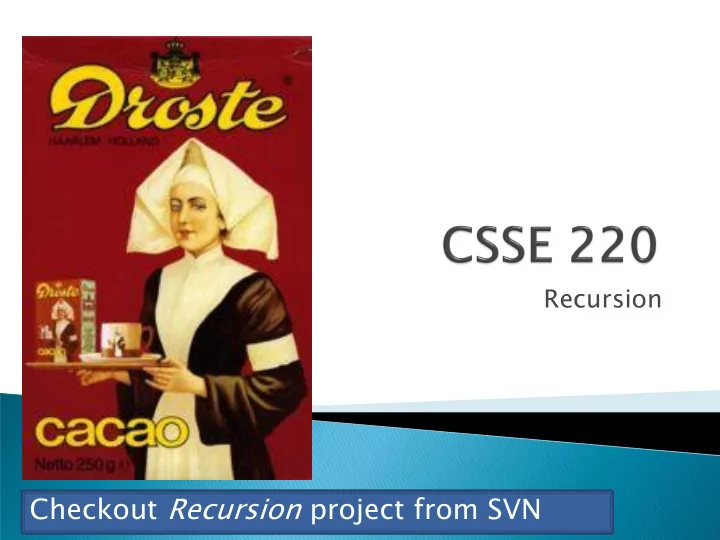
SLIDE 1
Recursion
Checkout Recursion project from SVN
SLIDE 2 Monday 10/28 If you got a D or F on Exam 1, please be
aware of this policy (from the course syllabus):
st earn a C grade on at least one exam in
- rder to earn a C in the course.
- You must
st have a passing average on the exams in
Previous exams (and you know I tend to
follow them closely) are posted on day 21 on the schedule
SLIDE 3
By Douglas
Hofstadter
Argues that a major
component of intelligence is our abilit ity y to think nk about ut thinki nking ng
SLIDE 4 A solution technique where the same
computation occurs rs repeatedly peatedly as the problem is solved
Examples:
- Sierpinski Triangle: tonight’s HW
- Towers of Hanoi:
http://www.mathsisfun.com/games/towerofhanoi.html
- r search for Towers of Hanoi
recurs
SLIDE 5
A solution technique where the same
computation occurs rs repeatedly peatedly as the problem is solved
recurs
SLIDE 6 If each red block has
area 1, what is the area A(n) of the Triangle whose width is n?
A(n) = n + A(n-1)
The above holds for
which n ? What is the answer for other n ?
equation holds for n >= 1. For n = 0, the area is 0.
Triangle with width 1 Triangle with width 2 Triangle with width 3 Triangle with width 4
SLIDE 7 Thanks to David Gries for this technique parameters and local variables method name, line number scope box
- 1. Draw box when method starts
- 2. Fill in name and first line no.
- 3. Write class name (for
static method) or draw reference to object (for non-static method)
and its argument value.
- 5. List every local variable declared
in the method, but no v values ues yet
- 6. Step through the method, update the line number
and variable values, draw new frame for new calls
- 7. “Erase” the frame when the method is done.
Q1-Q2
SLIDE 8
Trace the buil
ildSha dShape pe(MA (MAX_D X_DEPTH PTH) method call in shap apes.Main es.Main’s main method
SLIDE 9 Always have a base
se case e that doesn’t recurse urse
Make sure recursive case always makes
es progre gress ss, by solvi ving ng a smaller ler probl
em
You go
gotta bel elieve eve
- Trust in the recursive solution
- Just consider one step at a time
SLIDE 10
Add a recursive
method to Sentence for computing whether Sentence is a palindrome
Sentence String text String toString() boolean isPalindrome
SLIDE 11
Our isPalindrome() makes lots of new
Sentence objects
We can make it better with a “recursive helper
method”
Many recursive problems require a helper method
public boolean isPalindrome() { return isPalindrome(0, this.text.length() – 1); }
Position of first letter of the remaining String to check Position of last letter of the remaining String to check
SLIDE 12
Reverse a string…recursively! A recursive helper can make this really short!
SLIDE 13
“If you already know what recursion is, just
remember the answer. Otherwise, find someone who is standing closer to Douglas Hofstadter than you are; then ask him or her what recursion is.” —Andrew Plotkin
SLIDE 14
Head to
http://codingbat.com/java/Recursion-1 and solve 5 problems. I personally like bunnyEars, bunnyEars2, count7, fibonacci, and noX
Get help from me if you get stuck Then take a look at the recursion homework
(due tomorrow midnight)
SLIDE 15
Factorial: Ackermann function:
Base Case Recursive step