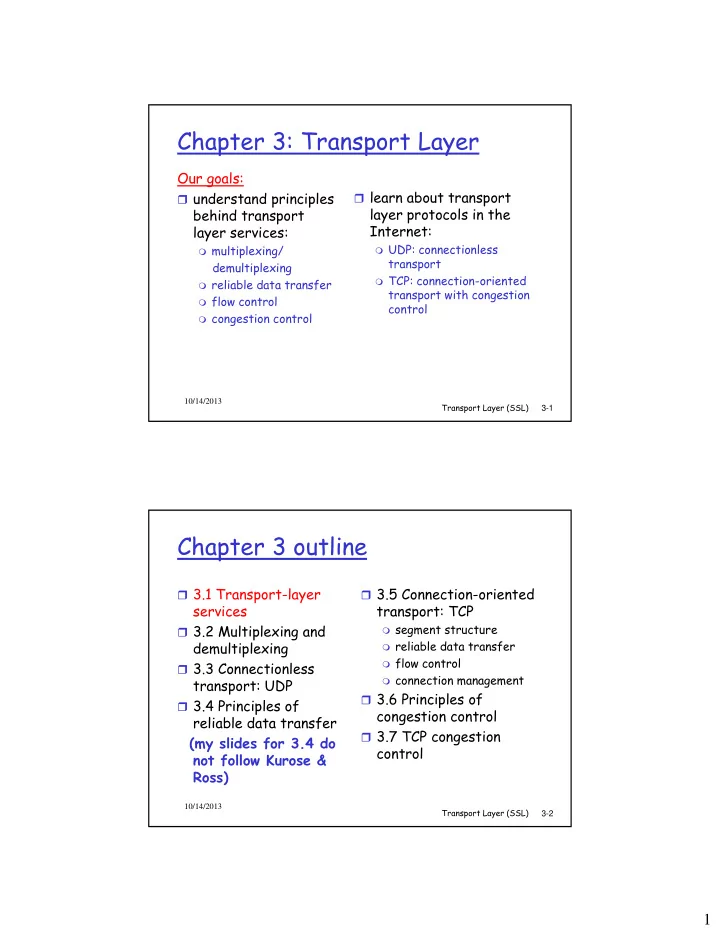
Chapter 3: Transport Layer Our goals: learn about transport - - PDF document

chapter 3 transport layer
SMART_READER_LITE
LIVE PREVIEW

Chapter 3: Transport Layer Our goals: learn about transport - - PDF document

Chapter 3: Transport Layer Our goals: learn about transport understand principles l layer protocols in the t l i th behind transport b h d Internet: layer services: UDP: connectionless multiplexing/ transport


slide-1
SLIDE 1

1

Chapter 3: Transport Layer

Our goals:

 understand principles

b h d

 learn about transport

l t l i th behind transport layer services:

 multiplexing/

demultiplexing

 reliable data transfer  flow control

ti t l

layer protocols in the Internet:

 UDP: connectionless

transport

 TCP: connection-oriented

transport with congestion control

Transport Layer (SSL) 3-1  congestion control 10/14/2013

Chapter 3 outline

 3.1 Transport-layer

services

 3.5 Connection-oriented

transport: TCP services

 3.2 Multiplexing and

demultiplexing

 3.3 Connectionless

transport: UDP

 3.4 Principles of

reliable data transfer transport TCP

 segment structure  reliable data transfer  flow control  connection management

 3.6 Principles of

congestion control

Transport Layer (SSL) 3-2

reliable data transfer (my slides for 3.4 do not follow Kurose & Ross) congest on control

 3.7 TCP congestion

control

10/14/2013

slide-2
SLIDE 2

2

Transport services and protocols

 provide logical communication

between app processes on different hosts

application transport network data link physical

different hosts

 transport protocols run in

end systems (primarily)

 send side: breaks app

messages into segments, passes to network layer

 rcv side: reassembles

segments into messages

application transport network

Transport Layer (SSL) 3-3

segments into messages, passes to app layer

data link physical

10/14/2013

Internet transport-layer protocols

 reliable, in-order byte

delivery by TCP

l

application transport network data link physical network

 congestion control  flow control  connection setup

 unreliable, unordered

delivery by UDP

 no-frills extension of

“best effort” IP

network data link physical network data link physical network data link physical network data link physical network data link physical application

Transport Layer (SSL) 3-4

best-effort IP  services not available:

 delay guarantees  bandwidth guarantees

network data link physical physical pp transport network data link physical

10/14/2013

slide-3
SLIDE 3

3

Chapter 3 outline

 3.1 Transport-layer

services

 3.5 Connection-oriented

transport: TCP services

 3.2 Multiplexing and

demultiplexing

 3.3 Connectionless

transport: UDP

 3.4 Principles of

reliable data transfer transport TCP

 segment structure  reliable data transfer  flow control  connection management

 3.6 Principles of

congestion control

Transport Layer (SSL) 3-5

reliable data transfer congest on control

 3.7 TCP congestion

control

10/14/2013

Multiplexing/demultiplexing

deliver received segments to correct sockets Demultiplexing at rcv host: gather data from multiple sockets, encapsulate data with h d (l d f Multiplexing at send host:

application transport P1 application transport t k application transport P2 P3 P4 P1 process/thread socket

to correct sockets header (later used for demultiplexing)

Transport Layer (SSL) 3-6

network link physical network link physical network link physical

host 1 host 2 host 3

10/14/2013

slide-4
SLIDE 4

4

How demultiplexing works

 host receives IP datagrams source port # dest port # 32 bits  It uses IP addresses & port

numbers to direct segment to appropriate socket

source port # dest port #

application data

  • ther header fields

Transport Layer (SSL) 3-7

(message) TCP/UDP segment format

10/14/2013

Connectionless demultiplexing

 UDP socket identified by

two-tuple:

 IP datagrams from

different sources two tuple: (dest IP address, dest port number)

 When host receives UDP

segment:

 directs UDP segment to

k t ith d ti ti t

different sources directed to same UDP socket

Transport Layer (SSL) 3-8

socket with destination port number

10/14/2013

slide-5
SLIDE 5

5

Connection-oriented demux

 Server has welcome and

connection sockets

 Server may support

many simultaneous TCP

 welcome socket is

identified by server’s IP address and a port number  TCP connection socket

identified by 4-tuple:

 source IP address

y connection sockets with clients:

 each connection socket

and the welcome socket have the same port number in server host

 receiving host uses all

four values to direct

Transport Layer (SSL) 3-9  source port number  dest IP address  dest port number

four values to direct segment to appropriate connection socket

10/14/2013

Connection-oriented demux (cont)

P1 P1 P2 SP: 9157 SP: 9157 P3 SP: 5775 DP: 80 D-IP:C S-IP: B P4

Transport Layer (SSL) 3-10

Client

IP:B

client IP: A server IP: C

SP: 9157 DP: 80 SP: 9157 DP: 80 D-IP:C S-IP: A D-IP:C S-IP: B

10/14/2013

slide-6
SLIDE 6

6

Chapter 3 outline

 3.1 Transport-layer

services

 3.5 Connection-oriented

transport: TCP services

 3.2 Multiplexing and

demultiplexing

 3.3 Connectionless

transport: UDP

 3.4 Principles of

reliable data transfer transport TCP

 segment structure  reliable data transfer  flow control  connection management

 3.6 Principles of

congestion control

Transport Layer (SSL) 3-11

reliable data transfer congest on control

 3.7 TCP congestion

control

10/14/2013

UDP: User Datagram Protocol [RFC 768]

 “best effort” service, UDP

segments (aka datagrams) may be:

Length, in bytes of UDP segment including header 32 bits

 lost  delivered out of order

to appl

 connectionless:

 no handshaking between

UDP sender, receiver

 each UDP segment

source port #

  • dest. port #

32 bits

Application

length checksum

Transport Layer (SSL) 3-12  each UDP segment

handled independently

  • f others

Application data (message) UDP segment format

10/14/2013

slide-7
SLIDE 7

7

UDP (more)

 suitable for streaming

multimedia applications

 loss tolerant  rate sensitive

Advantages of UDP

 rate sensitive

 other UDP uses, e.g.

 DNS  SNMP

 reliable transfer over

UDP? add reliability in

 no connection

establishment (which can add delay)

 simple: no connection state

at sender, receiver  no congestion control: UDP

can blast away as fast as desired

Transport Layer (SSL) 3-13

y application layer

 application-specific

error recovery desired

 small segment header

10/14/2013

Internet checksum

Sender:

 treat segment as a

sequence of 16-bit integers (with checksum field

initialized to zero)

Receiver:

 compute 1’s complement sum

  • f received segment (checksum

field included) initialized to zero)

 add integers using 1’s

complement arithmetic and take 1’s complement

  • f the sum

 put result as checksum

value into UDP checksum field

field included)

 check if computed sum equals

sixteen 1’s:

 NO - error detected  YES - no error detected

But maybe errors nonetheless? More later

Transport Layer (SSL) 3-14

field

 detail: pseudoheader

consisting of protocol no., IP addresses, UDP length field (again) included in checksum calculation

….

10/14/2013

slide-8
SLIDE 8

8

Internet Checksum Example

 Notes

 In ones complement arithmetic, a negative integer -x is

represented as the complement of x, i.e., each bit of x is inverted

 When adding numbers, a carryout from the most

significant bit needs to be added to the result

 Example: add two 16-bit integers

1 1 1 1 0 0 1 1 0 0 1 1 0 0 1 1 0 1 1 1 0 1 0 1 0 1 0 1 0 1 0 1 0 1

Transport Layer (SSL) 3-15

1 1 1 0 1 0 1 0 1 0 1 0 1 0 1 0 1 1 1 0 1 1 1 0 1 1 1 0 1 1 1 0 1 1 1 1 0 1 1 1 0 1 1 1 0 1 1 1 1 0 0 1 0 1 0 0 0 1 0 0 0 1 0 0 0 0 1 1 wraparound sum checksum

10/14/2013

Chapter 3 outline

 3.1 Transport-layer

services

 3.5 Connection-oriented

transport: TCP services

 3.2 Multiplexing and

demultiplexing

 3.3 Connectionless

transport: UDP

 3.4 Principles of

reliable data transfer transport TCP

 segment structure  reliable data transfer  flow control  connection management

 3.6 Principles of

congestion control

Transport Layer (SSL) 3-16

reliable data transfer (my slides do not follow Kurose & Ross) congest on control

 3.7 TCP congestion

control

10/14/2013

slide-9
SLIDE 9

9

Principles of Reliable data transfer

 important in application, transport, link layers  top-10 list of important networking topics!

Transport Layer (SSL) 3-17

 characteristics of unreliable channel will determine

complexity of reliable data transfer protocol (rdt)

10/14/2013

Principles of Reliable data transfer

 important in app., transport, link layers  top-10 list of important networking topics!

Transport Layer (SSL) 3-18

 characteristics of unreliable channel will determine

complexity of reliable data transfer protocol (rdt)

10/14/2013

slide-10
SLIDE 10

10

Principles of Reliable data transfer

 important in app., transport, link layers  top-10 list of important networking topics!

Transport Layer (SSL) 3-19

 characteristics of unreliable channel will determine

complexity of reliable data transfer protocol (rdt)

10/14/2013

Channel Abstractions

 Lossy FIFO channel

 delivers a subsequence in FIFO order  delivers a subsequence in FIFO order  example: delivery service provided by a

physical link  Lossy, reordering, duplicative (LRD)

channel

Transport Layer (SSL) 3-20

channel

 example: delivery service provided by IP layer

10/14/2013

slide-11
SLIDE 11

11

Stop-and-wait ARQ

 Error-free operation

Sender Time

Transport Layer (SSL) 3-21

Receiver

ack ack

10/14/2013

Stop-and-wait ARQ

 Retransmission after timeout  Recovery from loss of frame

timeout retransmission Sender Time Error

Transport Layer (SSL) 3-22

Receiver

ack

10/14/2013

slide-12
SLIDE 12

12

Stop-and-wait ARQ

 Retransmission

timeout retransmission

after timeout to recover from loss of ack

 Receiver gets

duplicate frame

Sender Time Error

Transport Layer (SSL) 3-23

 Sequence number

needed in frame

Receiver

10/14/2013

Stop-and-wait ARQ

 Sequence number also needed in ack

Sender timeout retransmission Sender thinks this is an ack for frame 1

1

Sender Time

1

Transport Layer (SSL) 3-24

Receiver Error

ack ack

10/14/2013

slide-13
SLIDE 13

13

Stop-and-wait ARQ

 Operation with 1-bit sequence numbers in

frames and acks

timeout Discard timeout Sender Time

1 1

ACK ACK

Transport Layer (SSL) 3-25

Receiver Error

10/14/2013

Alternating-Bit Protocol

Sender P1 (initial state = 1a)

1b 1a

  • A1

+D1 Receiver P2 (initial state = 1a)

1a 1b

  • D1

+A1

  • D0 timeout

accept data

 Sender and Receiver specified by

communicating finite-state machines

 Notation for arc labels

1a 2a 4b 4a 2b 3

deliver data deliver data

  • A1

+D0

  • A0

+D1

4b 4a 2a 2b 3b 3a

+A0

  • D1

+A1 +A0

  • D0

accept data timeout

Transport Layer (S. S. Lam) 3-26

 Notation for arc labels

  • m

send m essage m +m receive m essage m if it is waiting to be received

3a 3b

  • A0

+D0

10/14/2013

slide-14
SLIDE 14

14

Alternating-Bit Protocol (cont.)

 Assertion: If Sender and Receiver

communicate via lossy FIFO channels the communicate via lossy FIFO channels, the alternating-bit protocol provides reliable in-order data delivery.

 Assumption: A frame is retransmitted

infinitely many times if it is lost infinitely many times

Transport Layer (SSL) 3-27

many times.

10/14/2013

Stop-and-wait ARQ performance analysis

Sender

2 + TA + TP Tf Time

Transport Layer (SSL) 3-28

Receiver

TP TA  

ack

10/14/2013

slide-15
SLIDE 15

15

Average number of transmissions per frame

1

probability transmission is unsuccessful Prob[success after transmissions] for 1,2,... (1 )

i i i

P b i i b P P

    

1 (1

)

i

f

N i b i P P

  

  

 

1 1 1 1 1

(1 ) (1 ) (1 ) (1 ) 1 1

i i i i i i i i i

f

N i b i P P P i P d d P P P P dP dP d

        

       

    

Transport Layer (SSL) 3-29 2

1 1 (1 ) (1 ) 1 (1 ) 1 1

f

d P P dP P P N P         

10/14/2013

Timeout duration T > 2 +TP +TA Each unsuccessful transmission uses Tf + T Each successful transmission uses Tf + 2 + TP + TA Average time per frame (Nf – 1) (Tf +T) + (Tf + 2 + TP + TA)

  • Max. utilization (throughput) of stop-and-wait

f

T

Transport Layer (SSL) 3-30

U ( ) 2 1

f f f P A

T P T T T T T P        

10/14/2013

slide-16
SLIDE 16

16

U  T f T f  2

Effect of propagation delay & transmission time Assume P = 0, TA = 0, TP = 0

(upper bound)

f

 1 1  2 T f  1 1  2a where a   T f

d i s t a n c e t i d

Note:

Transport Layer (SSL) 3-31

p r o p a g a t i o n s p e e d f r a m e l e n g t h t r a n s m i s s i o n r a t e

f

T 

10/14/2013

Performance of ABP

 ABP works, but performance degrades for channels

with large delay-bandwidth product

 example: 1 Gbps link, 15 ms prop. delay, 1KByte packet Ttransmit = 8Kbits 10**9 bits/sec= 8 microsec U = 8 microsec 30008 microsec = 0.00027

Transport Layer (SSL) 3-32

30008 microsec

 protocol limits use of available bandwidth 10/14/2013

slide-17
SLIDE 17

17

Pipelined protocols

Pipelining: sender allows multiple, “in-flight”, yet-to- be-acknowledged packets

 range of sequence numbers must be increased  buffering at sender and/or receiver  buffering at sender and/or receiver Transport Layer (SSL) 3-33

 Pipelined protocols: (i) concurrent logical channels,

(ii) sliding window protocol

10/14/2013

Concurrent Logical Channels

 multiplex many logical

channels on a link; run ABP for each logical

 ARPANET supported 8

logical channels on each ground link 16 on f g channel (in both directions)

 each side maintains 3

bits of state for each channel indicating

 channel busy

each ground link, 16 on each satellite link

 header of each frame

included a 3-bit channel number and a 1-bit sequence number  This technique

id li bilit

Transport Layer (S. S. Lam) 3-34

y

 seq number sent  seq number expecting

to receive

provides reliability

  • nly -- unordered

delivery, and no flow control

10/14/2013

slide-18
SLIDE 18

18

Sliding Window Protocol

 Consider an infinite array, Source, at the

sender, and an infinite array, Sink, at the receiver.

1 2 a–1 a s–1 s

send window acknowledged unacknowledged

Source:

P1 Sender r + RW – 1 next expected

Transport Layer (S. S. Lam) 3-35

P2 Receiver

1 2

r received delivered receive window

Sink:

p RW receive window size SW send window size (s - a  SW)

10/14/2013

Sliding Windows in Action

 Data unit r has just been received by P2

 Receive window slides forward

P d l k h

 P2 sends cumulative ack with sequence

number it expects to receive next (r+3)

unacknowledged

1 2 a–1 a s–1 s

send window acknowledged

Source: P1 Sender Transport Layer (S. S. Lam) 3-36 1 2

r delivered receive window r + RW – 1

Sink: P2 Receiver

next expected

r+3 10/14/2013

slide-19
SLIDE 19

19

Sliding Windows in Action

 P1 has just received cumulative ack with

r+3 as next expected sequence number

 Send window slides forward

1 2 a–1 a s–1 s

send window acknowledged

Source: P1 Sender Transport Layer (S. S. Lam) 3-37 1 2

r delivered receive window r + RW – 1

Sink: P2 Receiver

next expected

10/14/2013

Sliding Window protocol

 Functions provided

 error control (reliable delivery)  in-order delivery  in order delivery  flow and congestion control (by varying send

window size)  TCP uses cumulative acks (needed for correctness)  Other kinds of acks (to improve performance)

 selective nack

Transport Layer (S. S. Lam) 3-38

 selective nack  selective ack (TCP SACK)  bit-vector representing entire state of receive

window (in addition to first sequence number of window)

10/14/2013

slide-20
SLIDE 20

20

Sliding Windows for Lossy FIFO Channels

 A small number of bits in packet header for

sequence number

 Necessary and sufficient condition for correct

  • peration: SW + RW  MaxSeqNum
  • peration: SW + RW  MaxSeqNum

 Necessity:

P1 Sender 1 2 a–1 a

send window acknowledged unacknowledged

Source:

RW receive window size SW send window size

Transport Layer (S. S. Lam) 3-39 P2 Receiver 1 2

delivered

Sink:

next expected receive window

10/14/2013

Sliding Windows for Lossy FIFO Channels

 Sufficiency can only

be demonstrated by

 Interesting special

cases be demonstrated by using a formal method to prove that the protocol provides reliable in-order

  • delivery. See

cases

 SW = RW = 1

alternating-bit protocol

 SW = 7, RW = 1

  • ut-of-order arrivals

t t d

Transport Layer (S. S. Lam) 3-40

y Shankar and Lam, ACM TOPLAS, Vol. 14, No. 3, July 1992.

not accepted, e.g., HDLC

 SW = RW

10/14/2013

slide-21
SLIDE 21

21

Sliding Windows for LRD Channels

 Assumption: Packets have bounded lifetime L  B

f l h f t b

 Be careful how fast sequence numbers are

consumed (i.e., data are generated for delivery) (consumption rate) L  MaxSeqNum

 TCP 32 bit s b s

Transport Layer (S. S. Lam) 3-41

 32-bit sequence numbers  counts bytes  assumes that datagrams will be discarded by IP

if too old

10/14/2013

Sliding Window Protocol Performance Analysis

 Assumptions

 ack transmission time is negligible, TA = 0  receiver processing time is negligible, TP = 0  send window size is W Go to slide 3-47

send w ndow s ze s W

. . .

WTf Tf 2

ACK

WTf Tf 2

. . .

time

Transport Layer (S. S. Lam) 3-42

(b) WTf < 2 + Tf (a) WTf > 2 + Tf

. .

10/14/2013

slide-22
SLIDE 22

22

Performance for Error-Free Channels

 Maximum utilization

1 WT f  2 Tf  

 Define a = /Tf

U  1 WT f  2 Tf WTf Tf  2 WT f  2 Tf       

Transport Layer (S. S. Lam) 3-43

U  1 W  2a 1 W 1 2a W  2a 1       

10/14/2013

Performance Analysis for Error- Prone Channels

 Define Nf = Average number of transmissions per frame

f

g p  Maximum utilization

U  1 N f W  2a1 W/ N f 1 2a W  2a1       

Transport Layer (S. S. Lam) 3-44

 To determine Nf for two cases

 Selective repeat (optimistic performance)  Go-back-N (pessimistic performance)

10/14/2013

slide-23
SLIDE 23

23

Performance Analysis of Error-Prone Channels

P = probability a transmission is unsuccessful

 Selective repeat (-> upper bound on U)

1 N f  1 1 P U  1 P W  2a 1 W(1P) 1 2a W  2a 1       

Transport Layer (S. S. Lam) 3-45

 Go-back-N (-> lower bound on U) Each lost frame requires the retransmission of N frames where 0  N  W

10/14/2013

(1 ) (1 )

i f

N iN P P

  

 With probability Pi(1–P), a frame requires

iN+1 transmissions to succeed, for i=0,1,...

Go-back-N (cont.)

1

(1 ) (1 ) 1 (1 ) 1 1 (1 ) 1

i i i i i i i

P P NP P i P d NP P P dP d NP P dP P

       

         

  

Transport Layer (S. S. Lam) 3-46

2

1 1 1 (1 ) (1 ) 1 1 dP P NP P P NP P        

10/14/2013

slide-24
SLIDE 24

24

For 2 2 1 2

f f f f

WT T NT T N a        

1 1

f

NP N P   

From previous slide

Go-back-N (cont.)

Got to slide 3-42

(1 2 ) 1 2 1 2 1 1 1 1

f

a P P P aP aP N P P P             For 2

f f

WT T N W   

Transport Layer (S. S. Lam) 3-47

1 1 1 1

f

N W WP P WP N P P        

10/14/2013

 Recall U  1 N f W  2a1 W/ N     

1 2 1

f

aP N P   

1 P WP 

From previous slide

Go-back-N (cont.)

W/ N f 1 2a W  2a1     Maximum utilization

1 2 1 1 2 P W a P      

1 1

f

P WP N P    

Transport Layer (S. S. Lam) 3-48

1 2 (1 ) 2 1 (1 2 )(1 ) aP U W P W a a P WP              

10/14/2013

slide-25
SLIDE 25

25

Chapter 3 outline

 3.1 Transport-layer

services

 3.5 Connection-oriented

transport: TCP services

 3.2 Multiplexing and

demultiplexing

 3.3 Connectionless

transport: UDP

 3.4 Principles of

reliable data transfer transport TCP

 segment structure  reliable data transfer  flow control  connection management

 3.6 Principles of

congestion control

Transport Layer (SSL) 3-49

reliable data transfer congest on control

 3.7 TCP congestion

control

10/14/2013

TCP: Overview

RFCs: 793, 1122, 1323, 2018, 2581  reliable, in-order byte

steam service

 no “message boundaries”

 connection-oriented

 handshaking initializes

sender, receiver state before data exchange g

 send and receive

buffers  pipelined

 send window size

determined by TCP congestion and flow control before data exchange  point-to-point

 two sender-receiver pairs  bi-directional data flows in

same connection  MSS: maximum segment

size

Transport Layer (SSL) 3-50

control

size

 less than MTU of directly

connected network

socket door TCP send buffer TCP receive buffer socket door

segment

application writes data application reads data

10/14/2013

slide-26
SLIDE 26

26

TCP segment structure

source port # dest port #

32 bits

sequence number

URG: urgent data (generally not used) ACK ACK # counting by bytes

  • f data

q m acknowledgement number

Receive window Urg data pnter checksum

F S R P A U

head len not used

Options (variable length)

ACK: ACK # valid PSH: push data now (generally not used) RST, SYN, FIN: connection estab (setup, teardown d ) # bytes rcvr willing to accept

  • f data

(not segments)

Transport Layer (SSL) 3-51

application data (variable length)

commands) Internet checksum (as in UDP)

10/14/2013

Control info for both forward and reverse data transfer

TCP seq. #’s and ACKs

  • Seq. #

 sequence number of

first byte in

Host A Host B

User t

y segment’s data ACK

 seq # of next byte

expected from other side

 cumulative ACK

Q: how receiver handles

types ‘C’ host ACKs receipt host ACKs receipt of ‘C’, echoes back ‘C’

Transport Layer (SSL) 3-52

Q: how receiver handles

  • ut-of-order segments?

TCP spec doesn’t say, up to implementor

p

  • f echoed

‘C’

time simple telnet scenario

10/14/2013

slide-27
SLIDE 27

27

TCP Round Trip Time and Timeout

Q: how to set TCP timeout value?

Q: how to estimate RTT?

 SampleRTT: measured time from

segment transmission until ACK  longer than RTT

 but RTT varies

 too short:

premature timeout

 unnecessary

retransmissions

segment transmission until ACK receipt

 ignore retransmissions

 SampleRTT will vary, want

estimated RTT “smoother”

 average several recent

measurements, not just current SampleRTT

Transport Layer (SSL) 3-53

retransmissions

 too long: slow

reaction to segment loss

current SampleRTT

10/14/2013

TCP Round Trip Time and Timeout

EstimatedRTT = (1- )*EstimatedRTT + *SampleRTT  E

ti l i ht d i

 Exponential weighted moving average  influence of past sample decreases

exponentially fast

 typical value:  = 0.125

Transport Layer (SSL) 3-54 10/14/2013

slide-28
SLIDE 28

28

Example RTT estimation:

RTT: gaia.cs.umass.edu to fantasia.eurecom.fr

350 200 250 300 RTT (milliseconds)

Transport Layer (SSL) 3-55

100 150 1 8 15 22 29 36 43 50 57 64 71 78 85 92 99 106 time (seconnds) SampleRTT Estimated RTT

10/14/2013

Setting the timeout interval

 EstimtedRTT plus “safety margin”

 large variation in EstimatedRTT -> larger safety

margin margin  first estimate of how much SampleRTT deviates

from EstimatedRTT: DevRTT = (1-)*DevRTT + *|SampleRTT-EstimatedRTT|

Transport Layer (SSL) 3-56

TimeoutInterval = EstimatedRTT + 4*DevRTT

(typically,  = 0.25)

Then set timeout interval:

10/14/2013

slide-29
SLIDE 29

29

Chapter 3 outline

 3.1 Transport-layer

services

 3.5 Connection-oriented

transport: TCP services

 3.2 Multiplexing and

demultiplexing

 3.3 Connectionless

transport: UDP

 3.4 Principles of

reliable data transfer transport TCP

 segment structure  reliable data transfer  flow control  connection management

 3.6 Principles of

congestion control

Transport Layer (SSL) 3-57

reliable data transfer congest on control

 3.7 TCP congestion

control

10/14/2013

TCP reliable data transfer

 TCP creates rdt

service on top of IP’s

 Retransmissions are

triggered by: service on top of IP s unreliable service

 Cumulative acks  TCP uses single

i i i triggered by

 timeout events  duplicate acks

 Initially consider

simplified TCP sender:

Transport Layer (SSL) 3-58

retransmission timer

 ignore duplicate acks  ignore flow control,

congestion control

10/14/2013

slide-30
SLIDE 30

30

Sliding Window Protocol

At the sender, a will be pointed to by SendBase, and s by NextSeqNum

1 2 a–1 a s–1 s send window acknowledged unacknowledged Source: P1 Sender P2 1 2 r received r + RW – 1 Sink: next expected Transport Layer (S. S. Lam) 3-59 Receiver 1 2 r delivered receive window

RW receive window size SW send window size (s - a  SW)

10/14/2013

TCP sender

(simplified)

NextSeqNum = InitialSeqNum SendBase = InitialSeqNum loop (forever) { switch(event) event: data received from application above and send window has enough room create TCP segment with sequence number NextSeqNum if (timer currently not running) start timer pass segment to IP NextSeqNum = NextSeqNum + length(data) event: timer timeout retransmit not-yet-acknowledged segment with smallest sequence number start timer event: ACK received with ACK field value = y

Note:

  • y > SendBase

means new data ack’ed

Transport Layer (SSL) 3-60

event: ACK received, with ACK field value = y if (y > SendBase) { SendBase = y if (there are currently not-yet-acknowledged segments) start timer; else stop timer } } /* end of loop forever */

10/14/2013

slide-31
SLIDE 31

31

TCP: retransmission scenario (1)

Host A Host B SendBase = 92

loss

timeout

X lost ACK scenario

Transport Layer (SSL) 3-61

time

SendBase = 100

10/14/2013

TCP retransmission scenario (2)

Host A Host B SendBase = 92

loss

Seq 92 timeout

X

SendBase = 120

Cumulative ACK scenario

Transport Layer (SSL) 3-62

time

10/14/2013

slide-32
SLIDE 32

32

TCP: retransmission scenario (3)

Host A Host B

  • ut

premature timeout scenario

SendBase= 92

Seq=92 timeo

  • ut

SendBase = 120 Sendbase = 100 restart tmer for seq= 100 st

Transport Layer (SSL) 3-63

time timeo

SendBase = 120

10/14/2013

stop timer

TCP ACK generation [RFC 1122, RFC 2581]

Event at Receiver TCP Receiver action

Arrival of in-order segment with expected seq #. All data up to expected seq # already ACKed Arrival of in-order segment with expected seq #. One other segment has ACK pending Arrival of out of order segment Delayed ACK. Wait up to 500ms for next segment. If no next segment, send ACK Immediately send single cumulative ACK, ACKing both in-order segments Immediately send duplicate ACK

Transport Layer (SSL) 3-64

Arrival of out-of-order segment higher-than-expect seq. # . Gap detected Arrival of segment that partially or completely fills gap Immediately send duplicate ACK, indicating seq. # of next expected byte Immediately send ACK, provided that segment starts at lower end of gap

10/14/2013

slide-33
SLIDE 33

33

Fast Retransmit

 Time-out period often

relatively long:

 long delay before

 If sender receives 3

duplicate ACKs for h d i

 long delay before

resending lost packet  Detect lost segments

via duplicate ACKs

 Sender often sends

many segments back-to- back

the same data, it supposes that segment after ACKed data was lost:

 fast retransmit:

Transport Layer (SSL) 3-65  If segment is lost,

there will likely be many duplicate ACKs.

 fast retransmit:

resend segment before timer expires

10/14/2013

Host A Host B

X

timeout

Transport Layer (SSL) 3-66

time Figure 3.37 Resending a segment after triple duplicate ACK

10/14/2013

slide-34
SLIDE 34

34

event: ACK received, with ACK field value = y if (y > SendBase) {

Fast retransmit algorithm:

if (y > SendBase) { SendBase = y if (there is a not-yet-acknowledged segment) start timer } else { increment count of dup ACKs received for y if (count of dup ACKs received for y = 3) {

Transport Layer (SSL) 3-67

( p y ) { resend segment with sequence number y reset timer for y

}

a duplicate ACK for already ACKed segment fast retransmit

10/14/2013

Chapter 3 outline

 3.1 Transport-layer

services

 3.5 Connection-oriented

transport: TCP services

 3.2 Multiplexing and

demultiplexing

 3.3 Connectionless

transport: UDP

 3.4 Principles of

reliable data transfer transport TCP

 segment structure  reliable data transfer  flow control  connection management

 3.6 Principles of

congestion control

Transport Layer (SSL) 3-68

reliable data transfer congest on control

 3.7 TCP congestion

control

10/14/2013

slide-35
SLIDE 35

35

TCP Flow Control

receiver: explicitly informs sender of (dynamically changing) sender won’t overrun receiver’s buffers by

flow control

amount of free buffer space

 RcvWindow field in

TCP segment sender: keeps amount of transmitted, unACKed y transmitting too much, too fast

Transport Layer (SSL) 3-69

data less than most recently received RcvWindow value

buffer at receive side of a TCP connection

10/14/2013

Chapter 3 outline

 3.1 Transport-layer

services

 3.5 Connection-oriented

transport: TCP services

 3.2 Multiplexing and

demultiplexing

 3.3 Connectionless

transport: UDP

 3.4 Principles of

reliable data transfer transport TCP

 segment structure  reliable data transfer  flow control  connection management

 3.6 Principles of

congestion control

Transport Layer (SSL) 3-70

reliable data transfer congest on control

 3.7 TCP congestion

control

10/14/2013

slide-36
SLIDE 36

36

TCP Connection Management

 initialize TCP variables

 seq. #s  buffers, flow control

info (e g RcvWindow)

Three way handshake Step 1: client end system

sends TCP SYN control segment to server - initial seq number chosen at info (e.g. RcvWindow) seq number chosen at random

Step 2: server end system

receives SYN, replies with SYNACK control segment

 allocates buffers  specifies server-to-

Active participant (client) Passive participant (server)

Transport Layer (SSL) 3-71

p receiver initial seq. # (chosen at random)

Step 3: client end system

replies with ack # (may be

piggybacked in data segment)

10/14/2013

TCP Connection Management (cont.)

Closing a connection:

client closes socket

client server

Step 1: client end system

sends TCP FIN control message to server

Step 2: server receives

FIN, replies with ACK. close close it

Transport Layer (SSL) 3-72

Later no more data to

  • send. It closes connection,

sends FIN. closed timed wai

10/14/2013

slide-37
SLIDE 37

37

TCP Connection Management (cont.)

Step 3: client receives FIN,

replies with ACK and enters “timed wait”

client server  will respond with ACK

to a retransmitted FIN

(due to lost of previous ACK)

Step 4: server receives

  • ACK. Its connection is

closed. Step 5: client closes close close it

Transport Layer (SSL) 3-73

Step 5: client closes connection at the end of timed wait

Note: protocol spec allows

simultaneous FINs

10/14/2013

closed timed wai

closed

SYN Flood Attack

 A classic DoS attack – the sender sends a

large number of TCP SYN segments, without completing the third step of the 3- without completing the third step of the 3 way handshake

 Server’s connection resources are allocated for

half-open connections.

 Legitimate users are denied service  SYN Cookie defense

Transport Layer (SSL) 3-74

 DDoS – attack amplified by sending SYNs

from multiple sources (botnet)

10/14/2013

slide-38
SLIDE 38

38

Chapter 3 outline

 3.1 Transport-layer

services

 3.5 Connection-oriented

transport: TCP services

 3.2 Multiplexing and

demultiplexing

 3.3 Connectionless

transport: UDP

 3.4 Principles of

reliable data transfer transport TCP

 segment structure  reliable data transfer  flow control  connection management

 3.6 Principles of

congestion control

Transport Layer (SSL) 3-75

reliable data transfer congest on control

 3.7 TCP congestion

control

10/14/2013

Principles of Congestion Control

Congestion:

 informally: “too many sources sending too much  informally: too many sources sending too much

data too fast for network to handle”

 different from flow control  manifestations:

 long delays (queueing in router buffers)  lost packets (buffer overflow at routers)

Transport Layer (SSL) 3-76

p ( ff f )

 a top-10 problem!

10/14/2013

slide-39
SLIDE 39

39

Causes/costs of congestion: scenario

 four senders  multi-hop paths  Timeout & retransmit

in

Q: what happens as and increase at every sender? 'in sender?

finite shared output link buffers

Host A in : original data

'in : original data plus retransmitted data

Transport Layer (SSL) 3-77 Host B

out

10/14/2013

Causes/costs of congestion: scenario

Host A

out

Cost of congestion

 when a packet is dropped any upstream transmission

Host B

Transport Layer (SSL) 3-78

 when a packet is dropped, any upstream transmission

capacity used for that packet was wasted

 behavior on right side of above graph called

congestion collapse

10/14/2013

slide-40
SLIDE 40

40

Approaches towards congestion control

End-to-end congestion control: Network-assisted congestion control: control:

 no explicit feedback

from network

 congestion inferred

from end-system’s

  • bserved loss (or delay)

congest on control

 routers provide

feedback to end systems

 single bit indicating

congestion (SNA, DECbit, TCP/IP ECN, ATM)

Transport Layer (SSL) 3-79

 approach taken by TCP

ATM)

 explicit sending rate

for sender

10/14/2013

Chapter 3 outline

 3.1 Transport-layer

services

 3.5 Connection-oriented

transport: TCP services

 3.2 Multiplexing and

demultiplexing

 3.3 Connectionless

transport: UDP

 3.4 Principles of

reliable data transfer transport TCP

 segment structure  reliable data transfer  flow control  connection management

 3.6 Principles of

congestion control

Transport Layer (SSL) 3-80

reliable data transfer congest on control

 3.7 TCP congestion

control

10/14/2013

slide-41
SLIDE 41

41

TCP Congestion Control

 end-to-end control (no network

assistance)

 sender limits transmission: LastByteSent-LastByteAcked

How does sender determine CongWin?

 loss event = timeout or

3 duplicate acks

LastByteSent-LastByteAcked  CongWin  Roughly,

where CongWin is in bytes 3 duplicate acks

 TCP sender reduces

CongWin after loss event three mechanisms:

 slow start  reduce to 1 segment

ft tim t t

send rate ≤ CongWin

RTT bytes/sec

Transport Layer (SSL) 3-81

where CongWin is in bytes

after timeout event

 AIMD

Note: Consider RcvWindow to be very large such that the send window size is equal to

  • CongWin. They are referred to as rwnd and cwnd, respectively, in the textbook.

10/14/2013

TCP Slow Start

 Probing for usable bandwidth  When connection begins, CongWin = 1 MSS

 Example: MSS = 500 bytes & RTT = 200 msec  initial rate = 2500 bytes/sec = 20 kbps

l bl b d d h b M /R

Transport Layer (SSL) 3-82

 available bandwidth may be >> MSS/RTT

 desirable to quickly ramp up to a higher rate

10/14/2013

slide-42
SLIDE 42

42

TCP Slow Start (more)

 When connection

begins, increase rate exponentially until first loss event or

Host A

TT

Host B

first loss event or “threshold”

 double CongWin every

RTT

 done by incrementing

CongWin by 1 MSS for every ACK received  Summary: initial rate

R Transport Layer (SSL) 3-83

 Summary: initial rate

is slow but ramps up exponentially fast

time

10/14/2013

Congestion avoidance state & responses to loss events

Q: If no loss, when should the exponential increase switch to linear? A: When CongWin gets to

10 12 14

  • w size

)

TCP Reno

for 3 dup ACKs A: When CongWin gets to current value of threshold

Implementation:

 For initial slow start,

threshold is set to a very large value (e.g., 64 Kbytes)

2 4 6 8 1 2 3 4 5 6 7 8 9 10 11 12 13 14 15

Transmission round congestion windo

(segments

threshold TCP Tahoe

Transport Layer (SSL) 3-84

 Subsequently, threshold is

variable

 At loss event, threshold is set

to 1/2 of CongWin just before loss event

Transmission round Tahoe Reno Notes: 1. For simplicity, CongWin is in number of segments in the above graph. 2. Reno’s window inflation/deflation steps omitted

10/14/2013

slide-43
SLIDE 43

43

Rationale for Reno’s Fast Recovery

 After 3 dup ACKs:

 CongWin is cut in half

(multiplicative decrease)  3 dup ACKs indicate

network capable of

( p )

 window then grows linearly

(additive increase)

 But after timeout event:

 CongWin is set to 1 MSS

instead;

 window then grows

exponentially to a threshold

network capable of delivering some segments

 timeout occurring

before 3 dup ACKs is “more alarming”

Transport Layer (SSL) 3-85

exponentially to a threshold, then grows linearly

10/14/2013

Additive Increase Multiplicative Decrease (AIMD)

Summary: TCP Congestion Control (Reno)

 When CongWin is below Threshold, sender in

slow-start phase, window grows exponentially (until

loss event or exceeding threshold) loss event or exceeding threshold).  When CongWin is above Threshold, sender is in

congestion-avoidance phase, window grows linearly.

 When a triple duplicate ACK occurs, Threshold

set to CongWin/2 and CongWin set to Threshold

Transport Layer (SSL) 3-86

Threshold.

 When timeout occurs, Threshold set to

CongWin/2 and CongWin is set to 1 MSS.

10/14/2013

slide-44
SLIDE 44

44

AIMD in steady state (no timeout)

multiplicative decrease: cut CongWin in half after loss event (3 dup acks) additive increase: increase CongWin by 1 MSS every RTT in the absence of any

16 Kbytes 24 Kbytes congestion window

acks) the absence of any loss event: probing What limits the average window size (or throughput)?

Transport Layer (SSL) 3-87

8 Kbytes time

Long-lived TCP connection

10/14/2013

TCP Throughput limited by loss rate

 TCP average throughput under AIMD

(approximate) in terms of loss rate, L: 1.22 bytes/second MSS throughput 

where MSS is number of bytes per segment  Example: 1500-byte segments, 100ms RTT,

to get 10 Gbps throughput, loss rate needs to be very low bytes/second throughput RTT L 

Transport Layer (SSL) 3-88

to be very low L = 2·10-10

 New version of TCP needed for high-speed

application

10/14/2013

slide-45
SLIDE 45

45

Is TCP fair?

Two competing sessions:

 Additive increase gives slope of 1, as window size increases  multiplicative decrease reduces window size to half

(proportionally) (proportionally)

W

equal window size

l ss: d cr s ind b f ct r f 2 congestion avoidance: additive increase loss: decrease window by factor of 2

Transport Layer (SSL) 3-89

W

Connection 1 window size

congestion avoidance: additive increase loss: decrease window by factor of 2

10/14/2013

Fairness goal: if K TCP sessions share same bottleneck link of bandwidth R, each should have average rate of R/K

Is TCP fair?

TCP connection 1 bottleneck router capacity R TCP connection 2

Transport Layer (SSL) 3-90

AIMD only provides convergence to same window size, not necessarily same throughput rate

capacity R

10/14/2013

slide-46
SLIDE 46

46

No fairness in practice

UDP

 Some multimedia apps use

UDP instead of TCP

 Can tolerate packet loss

Parallel TCP connections

 nothing prevents an app

from opening parallel connections between 2

 Can tolerate packet loss,  do not want rate throttled

by congestion control - pump audio/video at constant rate

connections between 2 hosts.

 Web browsers do this Example: link of rate R supporting 9 connections

 new app asks for 1 TCP, gets

rate R/10

 new app asks for 9 TCPs gets Transport Layer (SSL) 3-91  new app asks for 9 TCPs, gets

rate R/2

10/14/2013

Chapter 3: Summary

 principles behind transport

layer services: l i l i

 multiplexing,

demultiplexing

 reliable data transfer  flow control  congestion control

 instantiation and

Next:

 leaving the network

“edge” (application

Transport Layer (SSL) 3-92

 instantiation and

implementation in the Internet

 UDP  TCP

edge (application, transport layers)

 into the network

“core”

10/14/2013