
SLIDE 1
changing products to the doorsteps of the poor. Four Key Goals - - PowerPoint PPT Presentation
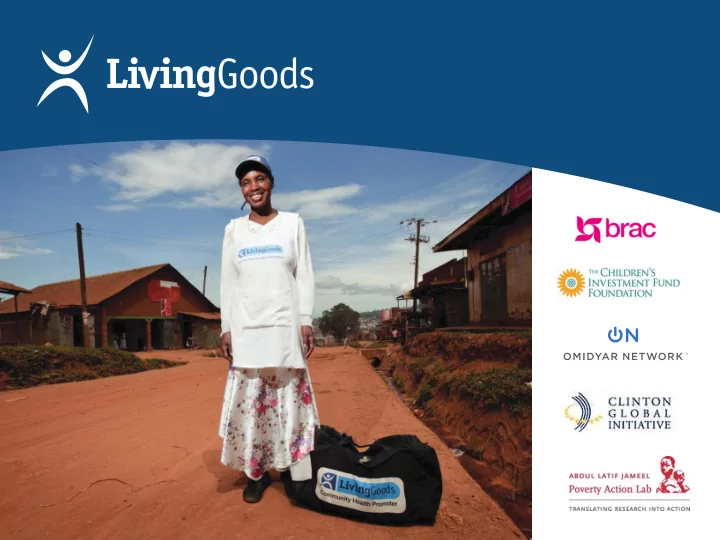
What is Living Goods? Living Goods empowers micro-entrepreneurs to deliver life-saving, life- changing products to the doorsteps of the poor. Four Key Goals Saving Lives Reduce child mortality by focusing on easily preventable and treatable
Reduce child mortality by focusing on easily preventable and treatable diseases.
Save poor families money on essential needs, provide incomes for thousands of entrepreneurs, and keep wage earners healthy and productive.
Increase access to high-impact, money-saving innovations like clean cook stoves, solar lamps, water filters, high yield seeds, and more.
Build a fully sustainable double-bottom-line business serving the Base of the Pyramid.
1. Treating Malaria promptly and properly 2. Treating Diarrhea promptly and properly 3. Treating and Referring for Respiratory Infections promptly and properly 4. Registering and supporting pregnancies – Ensuring facility delivery 5. Newborn Care– encouraging immediate breastfeeding and preventing early infections 6. Ensuring proper Micro Nutrition in the first 1000 days
Manufacturer/ Importer
“By applying business discipline to the fragmented and inefficient landscape of rural retail in Africa, Living Goods is building a scalable delivery system for products designed to fight poverty and disease.”
Living Goods Rural Seller Manufacturer/ Importer National Distributor Regional Distributor Local Distributor Rural Seller
There is a compelling analogy between the conditions that provided the fertile ground for Avon over 100 years ago and the developing world today.
T
ells
in 140 divers e cultures – from P eru to the Philippines .
1. Recruiting and Selection: Referral incentives, rigorous
testing and enforced standards.
2. Training: Practical learn-by-doing, 2 weeks initial training,
monthly refresher trainings, all free.
3. Branded Business in a Bag: Uniforms, bag, signage,
health flip books, record books, cell phone.
4. Multiple Marketing Modes: Door-to-door direct selling,
mobile phone marketing, community groups, home storefront, weekly markets, product promotions.
5. Smart Mobile Tools: On demand call for help system, SMS
health education and sales promotion, real time treatment tracking, automated treatment reminders.
6. Broad Product Assortment: Combines high-impact,
low-velocity products with fast moving consumer goods.
7. Branch Distribution System: Branches support 30-80+
agents within ~7km, agents re-supply weekly.
8. Creative Financial Tools: MFI-like loans, micro-
consignment, 1,3, and 7 day credit, free- trial.
Branded Signage Whistle Training Certificate Branded Apron Branded Tee Shirt Price List Sales Register 2 Pocket Money Pouch Umbrella Medication Instructions Form Referral Form Locking Storage and Display Cell phone Measuring Tape Thermometer Breath Timer for ARI Diagnosis Visual Referral Guide Visual Dosage Guide Visual Training Tools on 17 Key Health Behaviors Shoulder Bag
*Fortified maize, millet, Vitamin enriched sugar, Micro-nutrient powders, Iodized salt ACT ORS/ Zinc Amoxicillin De-worming Pain, cough & cold Sanitary pads Laundry soap Toothpaste Diapers Solar lamps / chargers Clean burning cook stoves Water filters Efficient Cooking Fuels Future > Ag Innovations
Fortified foods* Vitamin A, Iron, Zinc Contraceptives Water treatment Insecticide treated nets
Branches
upport 25 -150+ Agents
in S tock
system + S mart phone
Micro-Entrepreneurs
upport 80-200 homes
imple home store
groups
Clients
segments
product/ service delivery
HQ
Increas es S ales
Broadcast product promotions drive up demand and improve agent sales.
Delivers Health Education
Weekly text messages educate clients on key health behaviors and timely reminders.
Drives Prompt Treatment
Clients are encouraged to call or text their CHP at first sign of disease symptoms. Creates an on-call health worker system.
R einforces key behaviors and adherence
Automated tailored SMS to drive key pregnancy/newborn behaviors and treatment adherence
Improves Monitoring
LG uses text and voice calls to improve treatment follow up and reduce monitoring costs.
Key Performance Indicators (monthly) 2012 Target Treatments for Children under 5 (malaria, diarrhea)/CHP 20 16 Pregnant women supported per CHP 20 18 % facility delivery 98% 92% % newborn visit in 48 hours by a CHP 93% 85% Retail Sales/CHP $98 $108 Distribution level sustainability (transport, rent, labor) 100% 94%
14
Public health-oriented NGOs and governments Create sustainable cadres of community health workers Expand products, services and integrate delivery across impact areas Deepen the reach and impact of fixed-location clinics or franchises Integrate mobile tools to drive impact and efficiency Economic opportunity-focused NGOs/MFIs Create business opportunities for micro-entrepreneurs Build sustainable distribution platforms for high impact products Expand into new products and services Consumer Businesses Grow business into underserved markets Expand product offering to meet needs of BoP consumers
Optimizing Product and Service Mix
Identifying opportunities where impact and economics align; product testing; pricing strategies
Building and Managing Micro Entrepreneur Networks
Tools for recruitment, selection, training and ongoing performance management
Strengthening Supply Chain & Inventory Management
Forecasting, negotiating with suppliers, optimizing turns
Developing Smart Marketing & Behavior Change Strategies
Optimizing marketing mix across door-to-door, mobile/SMS, social, retail, clinical
Developing Smart Mobile Tools
Support the design and development of mobile marketing and data collection systems
Integrating Agent and Consumer Financing
Helping design the right financial tools to drive demand and minimize risk
Building Impact & Financial Planning Models
Helping build tools to support vital decisions for driving scale, impact and sustainability
15
Living Goods brings expertise designing effective distribution systems along with practical know how and tools
BRAC Goals: Increase sustainability and deepen impacts
Scaling in Uganda MSI Goals: Bolt on networks of financially sustainable community health entrepreneurs to franchise system to drive increased health outcomes in family planning and MNCH . Scale across MSI countries. Piloting in Kenya Clinton Foundation Goals: Build a commercially successful BoP distribution business that creates jobs and can scale
PSI Goals: Create de novo system of financially sustainable micro entrepreneurs providing broad range of essential health products and services. Piloting in Mozambique
Call Us: +1.415.430.3575 Email Us: info@livinggoods.org Follow Us: @Living_Goods
“A lot of programs give lip service to ‘sustainability’ — this is the real deal. Living Goods is one of few models with the potential for game- changing scale.”
ecret ariat Direct or, US AID Global Development Alliance
Board of Directors
Board of Advisors
system of micro franchised clinics serving the poor in Kenya. Chuck currently serves on the boards of The Initiative for Global Development, the Horace W. Goldsmith Foundation, Living Goods, and is a former board member of Spiegel Brands. He is a recipient of the Ernst & Young Entrepreneur of the Year Award and is a Draper Richards Fellow. He has spoken at many venues including the Clinton Global Initiative, Global Philanthropy Forum, World Affairs Council, and Skoll World Forum. Chuck earned both a BA and a Master’s in Public and Private Management from Yale.
21
Chuck Slaughter is the Founder and CEO of Living Goods. Prior to launching Living Goods, Chuck founded TravelSmith and grew it to over two million customers and $100 million in sales. After selling TravelSmith in 2004, Chuck devoted his entrepreneurial instincts to building vibrant enterprises in both the private and social
Golden Gate Capital he participated in the acquisition and turn-around of 10 major apparel brands with combined sales over $2
Proving and scaling a model that has the potential for broad transformative change in community-based health care, that yields significantly greater health impacts at much lower costs than the current dominant paradigms.
diseases reduces the work burden, wait times and stock outs at public health centers.
to the public health system (eg high risk pregnancy, VCT).
– 2 weeks of FREE initial training & materials – Ongoing monthly training, testing and coaching
– Field agents meet with health promoters at least once a week to re-supply, review records, collect health and sales data, and create outreach plans. – Staff also periodically interview community members to measure quality of service and accuracy of diagnoses.
+ in stock position at all times. We have maintained this performance for 4 years running.
quality.
products are promptly and safely disposed.
audit every year.
public.
And must pass written tests.
Health promoters keep detailed records of patient visits, diseases diagnosed, product sales and referrals to the public health system. Every pregnant mother is registered and monitored. Key product volumes are tracked vs monthly targets.
Randomized control trials
– S
tudy designed and lead by Poverty Action Lab affiliate
– Will measure changes in behaviors, morbidity and mortality – Recent RCT proved LG improves product quality and reduces prices