
SLIDE 1
London Ambulance Service NHS Trust
Central London Suicide Bombings 7th July 2005
David Whitmore DIMC RCSEd Senior Clinical Advisor to the Medical Director London Ambulance Service NHS Trust
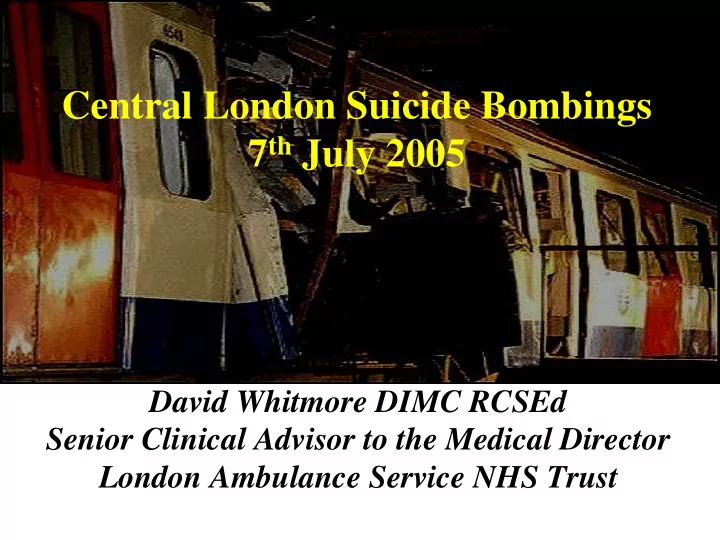
Central London Suicide Bombings 7 th July 2005 David Whitmore DIMC - - PowerPoint PPT Presentation
London Ambulance Service NHS Trust Central London Suicide Bombings 7 th July 2005 David Whitmore DIMC RCSEd Senior Clinical Advisor to the Medical Director London Ambulance Service NHS Trust London Ambulance Service NHS Trust This talk will
London Ambulance Service NHS Trust
David Whitmore DIMC RCSEd Senior Clinical Advisor to the Medical Director London Ambulance Service NHS Trust
London Ambulance Service NHS Trust
This talk will cover:
examination of all four sites
London Ambulance Service NHS Trust
The busiest emergency ambulance service in the world, that is; Free at the point of delivery. The only London-wide NHS Trust. The frontline of the NHS in the capital.
London Ambulance Service NHS Trust
70 Ambulance Stns 3,822 clinical staff 254 Ambulances 96 Response Cars 10 Motorcycles 14 Pushbikes 1 Helicopter (45 Station Pets)
Population 7.51M (2005)
Chelsea Barracks Bomb – October 1981. 50 injured, 1 dead Hyde Park Bomb
injured, 3 dead. Regents Park Bomb - July
6 dead Harrods Bomb - December 1983. 90 injured, 5 dead King’s Cross Underground Fire - November 1987. 60+ injured, 31 dead Clapham Train Crash - December 1988. 123 injured, 35 dead River Thames (Marchioness) - August 1989. 80 injured, 51 dead Heathrow Airport Bomb - April
injured Putney Gas Explosion - January 1985. 10 injured, 8 dead Battersea Train Crash
injured Wembley Train Crash - October
injured, 6 dead Liverpool Street Train Crash - May 1984. 40 injured
Earls Court Concert, Seating Collapse - October 1994. 89 injured Southall Train Crash - September 1997. 40+ injured 7 Dead Poll Tax Demonstration - October 1990. 587 injured Cannon Street Train Crash - January 1991. 265 injured, 2 dead. Criminal Justice Bill Demonstration - October 1994. 28 injured Smithfield Cinema Fire - February
dead. Aldwych Bomb - February 1996. 9 injured, 1 dead Brixton Nail Bomb - April
Compton Street Nail Bomb - April 1999. 73 injured, 3 dead J18 City of London Civil disturbance - June 1999. 41 injured Ladbroke Grove Train crash - October 1999. 126 injured. 31 dead
Waterloo Train crash - March 2000. Approx. 30 injured Tsunami Relief (Operation Bracknell) – ? injured, Alexandra Palace Fairground accident – June
Ikea Store, Edmonton – February 2005. 10 injured. Camden Town Underground – July
Highbury Underground incident - July
Royal Marsden Fire 2008 Chancery Lane Underground derailment – March 2003. 33 injured 7/7 Attacks London – July 2005 – 800+ Injured, 53 Dead Heathrow Plane Crash 2008
London Ambulance Service NHS Trust
Lessons identified prior to, and during the London Assembly Enquiry (2006) and HM Coroner’s Inquest 2010/11
London Ambulance Service NHS Trust
One plan for all London Emergency Services Without it it would have been a lot worse! EVERYONE MUST know about it, understand it and have the capability to put it into practice Staff turnover is the enemy of such plans!
London Ambulance Service NHS Trust
BRONZE Operational SILVER Tactical
GOLD Strategic
London Ambulance Service NHS Trust
Soho Pub Bombing, London April 1999
Motorcycle paramedic 1st LAS resource on scene He took on Silver role Supported in role as
Frontline staff get there first! Train them. Trust them. Lead them.
London Ambulance Service NHS Trust
Action Cards / Aide Memoire have been personal issue to all LAS staff since 2002
London Ambulance Service NHS Trust
Triage cards on 7th July (A large number used)
Action cards Tabard Paperwork specific to role That’s all!!
London Ambulance Service NHS Trust
6
London Ambulance Service NHS Trust 08:51 09:47 09:17 08:56
xxx 6.4 Km
When the bombs exploded there were:
system
The whole system was evacuated within 1 hour
London Ambulance Service NHS Trust 08:51 09:47 09:17 08:56
6.4 Km
London Ambulance Service NHS Trust
Command Structure
London Ambulance Service NHS Trust
Command Structure
London Ambulance Service NHS Trust
Keeping a service to the remainder of London still equated to 70 calls/hour resulting in 50 patients/hour: (estimate average 1.4 calls/patient)
23
London Ambulance Service NHS Trust
16
We now deploy the following Pre-Determined Attendances (PDAs)
Six ambulances and six officers are deployed upon identification of the incident or incidents, without waiting for reports from the scene.
20 ambulances, 10 officers, all available Mass Casualty Equipment Vehicles, an Emergency Command Vehicle with Forward Command TEam, a Medical Emergency Response Incident Team. Ambulance liaison officers should also be deployed to designated hospitals.
London Ambulance Service NHS Trust
Testament to the success of Triage principles, multi- disciplinary teamwork (none of whom had ever met each
to give up if there was even a slight chance. Although I made a number of Triage decisions regarding Gill, I always assumed that she had not survived overall. My joy on seeing a newspaper article about her some months later, literally gave me palpitations.
London Ambulance Service NHS Trust
Gill’s own words And then I heard two words, two of the best words that I could ever hear - “P(riority) One” - and a tag of some sort was placed on me. That sounded fantastic! One man held my hand. He didn’t let go. I was so cold but I could feel his warmth.
Primary Triage Officer Formalised as a bronze role responsible for the initial triage of patients at the forward incident
Secondary Triage Officer Formalised as a bronze role responsible for the triage sort of patients in the Casualty Clearing Station. Amendment to Bronze Triage made 2005
London Ambulance Service NHS Trust
London Ambulance Service NHS Trust
Governance Day – 18 pre-hospital doctors available +12 Paramedics – Able to provide good medical support on each site.
Conference -100 managers in one place
Association) – Many experienced doctors on site
Appoint Patient Liaison Officer
To communicate with patients and members of the public, throughout the incident
28
Information overload – critical messages
structure
Silver and Bronze Teams deployed to multiple sites We will now look at a Silver Command Team remote from the Incident(s) in the Incident Control Room
30
Critical Incident Loggist New role responsible for maintaining the critical incident log - a list of critical entries taken from the overall incident log highlighting those requiring urgent action.
32
29
Incidents at multiple sites
Delay in despatching resources
Close location of secondary incident
Resources sent to wrong location
Lack of information to local hospitals
Clinical staff self deploy
London Ambulance Service NHS Trust
London Ambulance Service NHS Trust
Realism - Must stretch / test - Use professional actors Exercise Again Again Again Again
48
Do you know how they can help you? Do you know how they can operate? Exercise together Frequently and at all levels / roles
BUT: Do I know enough about you?
London Ambulance Service NHS Trust
– LINC
and ongoing mental welfare
London Ambulance Service NHS Trust
“on edge”
London Ambulance Service NHS Trust
34
News Team have remarkable response times! Initial Actions of Communications Department Team Roles – Pre Planned Joint Agency Working – Will they say the same thing Managing Interviews Days that follow – interviews, visits, tributes
London Ambulance Service NHS Trust
London Ambulance Service NHS Trust
– “Role not Rank” needs extensive exercising
London Ambulance Service NHS Trust
david.whitmore@lond-amb.nhs.uk Hicks, G. (2007) One Unknown. London: Rodale International Ltd http://www.london.gov.uk/who-runs-london/the-london-assembly/publications/safety- policing/report-7-july-review-committee http://7julyinquests.independent.gov.uk/ http://www.leslp.gov.uk/docs/Major_incident_procedure_manual_7th_ed.pdf
London Ambulance Service NHS Trust