CB European Quality Fund Quarterly update 30 September 2015 - - PowerPoint PPT Presentation

cb european quality fund
SMART_READER_LITE
LIVE PREVIEW

CB European Quality Fund Quarterly update 30 September 2015 - - PowerPoint PPT Presentation

CB European Quality Fund Quarterly update 30 September 2015 Included in Morningstar Morningstar Sweden and Swedens model portfolio Dagens Industri: Best for the Swedish Pension portfolio manager in the European equity category system


slide-1
SLIDE 1

CB European Quality Fund

Quarterly update 30 September 2015

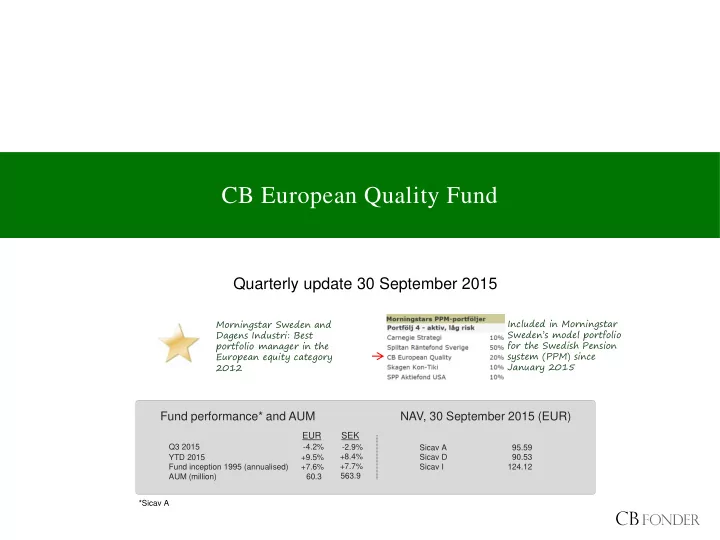
Morningstar Sweden and Dagens Industri: Best portfolio manager in the European equity category 2012 Included in Morningstar Sweden’s model portfolio for the Swedish Pension system (PPM) since January 2015

Q3 2015

  • 4.2%

YTD 2015 +9.5% Fund inception 1995 (annualised) +7.6% AUM (million) 60.3.

Fund performance* and AUM NAV, 30 September 2015 (EUR)

  • 2.9%

+8.4% +7.7% 563.9.

EUR SEK

Sicav A 95.59 Sicav D 90.53 Sicav I 124.12 *Sicav A

slide-2
SLIDE 2

The strategy and the team

CB European Quality Fund

  • Company founded in 1994
  • Family owned, acting under the supervision of the Swedish

Financial Supervisory Authority

  • Guidelines: active, ethical and long-term
  • An ethical and sustainable framework is applied in the portfolio

management

  • The team is based in Stockholm, Sweden; all fund administration

is performed in Luxembourg

Overview - CB Fonder

  • A long-only equity fund with a focus on European quality growth

companies

  • The strategy was launched in 1995
  • Concentrated portfolio (20-33 holdings) and a long-term perspective
  • Benchmark: MSCI Europe Net
  • Objective: Lower standard deviation than benchmark
  • Objective: Outperform benchmark over 12 months

Overview - CB European Quality Fund

2

The team

Carl Bernadotte

Portfolio manager & owner >25 years’ experience Born 1955 Owns shares in CB European Quality Fund

Marcus Grimfors

Portfolio manager 7 years’ experience Born 1981 Owns shares in CB European Quality Fund

Alexander Jansson

Portfolio manager & CEO 7 years’ experience Born 1983 Owns shares in CB European Quality Fund

Erik Allenius Somnell

Business development 3 years’ experience Born 1984 Owns shares in CB European Quality Fund

slide-3
SLIDE 3

Strategy: Investment criteria

CB European Quality Fund

3

Large/mid caps

  • Min. market cap EUR 1 bn -

Primary

Mature industries

  • Proven management -

Resilient profit growth

  • In any econ. environment -

Secondary

Stable dividend yield

  • Not necessarily high -

Conservative valuation

  • History & peers -

Internal recruiting

  • Subject to tradition -
slide-4
SLIDE 4

Strategy: Structural growth is more value creating than cyclical growth

CB European Quality Fund

4

Credit: Allianz GI Design: CB Fonder

  • And less dependent of the economic cycle

Stable profit growth Structural growth is independent of the economic cycle Drivers:

  • Secular trends
  • Leading business model
  • Technical leadership

Strong multiple expansion relative to the market Structural growth component Cyclical growth component

Purely driven by macro factors

Limited multiple expansion relative to the market

Structural vs. cyclical growth

Cyclical model Structural model

slide-5
SLIDE 5

Strategy: High barriers to entry protected growth

CB European Quality Fund

5

Competetiveness: Porter’s 5 forces-model

Competitive rivalry among incumbents

Threat of new entrants Threat of substitute products or services Bargaining power of customers (buyers) Bargaining power

  • f suppliers

Barriers to entry

  • Cost, time, knowledge
  • Economies of scale
  • Technologies, patents etc.

Customer/client relationship

  • Degree of customer loyalty
  • Switching costs
  • Pricing power

Barriers to substitution

  • Brand recognition
  • Product complexity, patents etc.

Negotiating power versus suppliers

  • Fragmentation of suppliers
  • monopoly to perfect competion
  • Degree of specialisation

Source: Competitive Strategy: Techniques for Analyzing Industries and Competitors, Michael E. Porter, 1980. Design: CB Fonder

slide-6
SLIDE 6

Strategy: Stock selection according to a bottom-up-strategy

CB European Quality Fund

6

Fundamental analysis Quantitative analysis Technical analysis

  • Structural growth and barriers to

entry/moat – see p. 4 and 5.

  • Business idea – robust enough to deliver

stable profit growth over an entire economic cycle?

  • Management – do they deliver as

promised?

  • Internally developed models for

screening and ranking based on quantitative variables.

  • Valuation: in comparison to peers and

the company's own history and growth rate.

  • Main multiples: P/E, P/B and PEG.
  • Momentum factors – is the short-term

trend supportive of the sector/style?

  • No target prices: ”let the trend be your

friend”.

  • Timing for entry and exit levels;

increasing and reducing portfolio positions.

The fundamental and quantitative analysis forms the investment universe. The technical analysis plays a crucial role for the weighting of the portfolio.

slide-7
SLIDE 7

0% 2% 4% 6% 8% 10% 12% 14% Sep-14 Dec-14 Mar-15 Jun-15 Sep-15 CB European Quality Fund Sicav A vs MSCI Europe Net 85 90 95 100 105 110 115 120 125 130 Sep-14 Dec-14 Mar-15 Jun-15 Sep-15 CB European Quality Fund Sicav A MSCI Europe Net

  • 2%
  • 1%

0% 1% 2% 3% 4% 5% 6% 7% 8% Jun-15 Jul-15 Aug-15 Sep-15 CB European Quality Fund Sicav A vs MSCI Europe Net 85 90 95 100 105 110 Jun-15 Jul-15 Aug-15 Sep-15 CB European Quality Fund Sicav A MSCI Europe Net

Performance: The fund and the index

CB European Quality Fund

7

  • The fund returned -4% in the third quarter; during the last 12 months the fund has returned +14%.
  • The fund has outperformed MSCI Europe Net in four consecutive quarters. We have seen a trend reversal in the

sense that the fund’s quality growth strategy has outperformed in a sharply rising market in Q4 2014 and Q1 2015 (+4.7% and +0.5% outperformance respectively) as well as in a falling market in Q2 and Q3 2015 (+0.8% and +5.1% outperformance respectively).

The fund and the benchmark index, 1 year (EUR) The fund and the benchmark index, Q3 2015 (EUR)

+11.5% +14.4% +2.6%

  • 4.2%
  • 8.9%

+5.1% Source: MSCI, CB Fonder

slide-8
SLIDE 8

50 75 100 125 150 175 200 Sep-05 Sep-06 Sep-07 Sep-08 Sep-09 Sep-10 Sep-11 Sep-12 Sep-13 Sep-14 Sep-15 MSCI Europe Net (EUR) CB European Quality Fund Sicav A (EUR)

Key ratios (10 years) EQF Index

Performance, % Standard deviation, % Sharpe (0%) Max drawdown, % Beta against MSCI Europe Alpha against MSCI Europe, % p.a. Consistency with MSCI Europe, % Tracking error, % Information ratio +52.8 12.84 +0.34

  • 45.78

+0.70 +1.47 51.67 8.69 +0.02 +49.6 15.02 +0.27

  • 54.10

Performance: The fund and the index

CB European Quality Fund

8

The fund (EQF) and the benchmark index, 10 years (EUR)

Source: MSCI, CB Fonder

The fund has – mostly due to the strong risk-on rally in the market between the summer

  • f 2012-summer of 2014 –

performed in-line with the benchmark index, but has a positive alpha due to the low beta (0,70). The fund’s risk- adjusted return, Sharpe, is higher than that of the index.

slide-9
SLIDE 9

The Portfolio: Contributors and detractors

CB European Quality Fund

9

  • 0,8%
  • 0,6%
  • 0,4%
  • 0,2%

0,0% 0,2% 0,4% 0,6% 0,8%

Company

Orpea AAK Fresenius GEA Group Spirax-Sarco Shire +0.54 +0.33 +0.22

  • 0.50
  • 0.56
  • 0.62

Contr./Detr. %

  • Avg. weight*, %

Performance, %

+14.7 +9.1 +4.3

  • 14.4
  • 20.7
  • 15.0

4.1 4.5 6.4 2.1 2.4 4.1

Top three quarterly contributors and detractors, Q3 2015 (EUR)

  • The French company Orpea is a European leader in dependency care, a structural growth business due to demography. The company reported strong

revenue growth for the second quarter (+26%) and announced that they will acquire the German dependency care operator Residenz Gruppe Bremen, which is fully in-line with Orpea’s objective of consolidating the European dependency care market. The stock gained 15% during Q3, in EUR.

  • The Swedish based vegetable oils refiner AAK – previously AarhusKarlshamn – once again reported strong quarterly numbers, fully in-line with consensus
  • estimates. Earnings increased by 16% YoY and the company confirmed that the new factories in Brazil and China – which are of great importance to the

future growth of the company – are on schedule. The stock gained 9% during Q3, in EUR.

  • The German group Fresenius – the largest holding in the fund and active in dialysis, clinical nutrition, hospital operation and biotech – is, due to it’s

defensive and diversified growth profile, excellently positioned in today’s low growth environment. The company targets organic growth >2x global GDP growth; the average has been 6% since 1999. The stock gained 4% during Q3, in EUR.

  • .
  • .
  • Both German GEA Group and Brittish Spirax-Sarco were negatively affected by the development in China, and the former was also negatively affected by

the development in Russia and within the dairy industry. GEA Group was completely sold out of the portfolio while the holding in Spirax-Sarco was

  • reduced. GEA Group lost 14% and Spirax-Sarco 21% during the quarter, respectively.
  • The UK specialty pharma group Shire – with a strong position within treatment of ADHD, Short Bowel Syndrome and other rare genetic disorders – was

negatively affected by a general correction within the biotech sector. The stock looks attractively valued but the general trend within the sector is a bit

  • worrying. We have not made any changes to our position. The stock lost 15% during the quarter, in EUR.

*Average values during Q3 2015. Source: Bloomberg, CB Fonder

slide-10
SLIDE 10

8% 9% 5% 7% 11% 8% 6% 7% 4%

  • 2%
  • 1%
  • 1%

1% 4%

  • 4%
  • 2%

0% 2% 4% 6% 8% 10% 12% 2011 2012 2013 2014 2015E Average 11-15E 2016E CB European Quality Fund Stoxx600

The Portfolio: Holdings

CB European Quality Fund

10

Source: MSCI, Bloomberg, FTSE, Dow Jones, STOXX, CB Fonder

The portfolio as of 30 September 2015 Revenue growth, the portfolio and Stoxx600 EPS-growth, the portfolio and Stoxx600

Included in one or more of the following sustainability indices:

  • FTSE4Good Index
  • Dow Jones Sustainability Europe Index
  • STOXX Europe Sustainability Index

14% 16% 11% 10% 14% 13% 10% 1%

  • 6%
  • 6%

2% 3%

  • 1%

10%

  • 10%
  • 5%

0% 5% 10% 15% 20% 2011 2012 2013 2014 2015E Average 11-15E 2016E CB European Quality Fund Stoxx600

Company Country Sector Market cap € bn Share of AUM Share of MSCI Europe Fresenius AG Germany Healthcare 32 6.3% 0.3% Next UK Consumer Discr. 16 5.4% 0.2% Orpea France Healthcare 4 4.9% 0.0% AAK Sweden Consumer Staples 3 4.6% 0.0% Novo Nordisk Denmark Healthcare 125 4.4% 1.4% Reckitt Benckiser UK Consumer Staples 58 4.3% 0.8% Continental Germany Consumer Discr. 40 4.2% 0.3% Sampo Finland Financials 25 4.1% 0.3% Legrand France Industrials 13 3.9% 0.2% Kerry Ireland Consumer Staples 12 3.9% 0.2% Handelsbanken Sweden Financials 27 3.8% 0.3% Assa Abloy Sweden Industrials 18 3.7% 0.2% Halma UK IT 4 3.6% 0.0% Shire UK Healthcare 35 3.6% 0.5% Dignity UK Consumer Discr. 2 3.5% 0.0% Henkel Germany Consumer Staples 37 3.4% 0.3% Bunzl UK Industrials 8 3.0% 0.1% Geberit Switzerland Industrials 11 3.0% 0.2% Nestlé Switzerland Consumer Staples 216 2.9% 3.1% Prudential UK Financials 53 2.6% 0.7% Capita Group UK Industrials 11 2.2% 0.2% Novozymes Denmark Materials 12 2.0% 0.1% Intrum Justitia Sweden Financials 2 2.0% 0.0% Ingenico Group France IT 6 1.8% 0.1% Wirecard Germany IT 5 1.6% 0.0% Spirax Sarco UK Industrials 3 1.1% 0.0% Total/Average 30 89.7% 9.4%

slide-11
SLIDE 11

0% 10% 20% 30% 40% 50% 60% 70% 80% 90% 100% Oct-12 Jan-13 Apr-13 Jul-13 Oct-13 Jan-14 Apr-14 Jul-14 Oct-14 Jan-15 Apr-15 Jul-15 Cash IT Consumer Discr. Health Care Materials Industrials Consumer Staples Financials

14% 11% 14% 11% 23% 4% 7% 7% 4% 4% 19% 17% 19% 13% 12% 7% 2% 0% 0% 0% 10% 0% 10% 20% 30% MSCI Europe CB European Quality Fund

0% 10% 20% 30% 40% 50% 60% 70% 80% 90% 100% Oct-12 Jan-13 Apr-13 Jul-13 Oct-13 Jan-14 Apr-14 Jul-14 Oct-14 Jan-15 Apr-15 Jul-15 Cash Finland Ireland Denmark Netherlands Sweden Switzerland Germany France UK

The Portfolio: Exposure, share of AUM

CB European Quality Fund

11

Source: MSCI, Ishares, CB Fonder

Geographical exposure, 36 months Sector exposure, 36 months Geographical exposure, as of 30 September 2015 Sector exposure, as of 30 September 2015

31% 13% 4% 15% 3% 15% 1% 1% 29% 16% 14% 11% 6% 6% 4% 4% 10% 0% 10% 20% 30% 40% MSCI Europe CB European Quality Fund

slide-12
SLIDE 12

Case: Fresenius

Among other things, the leading private operator of hospitals in Germany

  • A global health care group with operations in dialysis, clinical nutrition, hospital management and project/management

business of health care facilities.

  • Defensive growth: all business are exposed to structural growth trends supported by demographics and growing per-

capita healthcare consumption.

  • Diversified growth: the company derives it’s earnings from numerous business that have quite distinct dynamics – that

brings diversification and a quite unique profile within the sector.

  • 22 consecutive years with increased dividend!

CB European Quality Fund

12

Source: Fresenius

Revenues, total and by region Organic growth – track record

slide-13
SLIDE 13

Case: Orpea

  • European leader in dependency care (with attractive

real estate holdings) – a structural growth sector due to demographics.

  • Opportunity, and aim, to consolidate a fragmented

sector.

  • Pricing power owing to local regulation.

CB European Quality Fund

13

Source: Orpea, CB Fonder

Number of beds Revenues, m€ Geographic exposure – focus on Europe Organic growth – track record

14% 11% 15% 11% 9% 9% 8% 7% 6% 0% 5% 10% 15% 20% 2006 2007 2008 2009 2010 2011 2012 2013 2014 Organic growth

slide-14
SLIDE 14

39 47 58 69 94 120 127 146 169 156 189 222 255 298 366 420

100 200 300 400 500 1999 00 01 02 03 04 05 06 07 08 09 10 11 12 13 2014

Underlying EPS, pence

Case: Next

CB European Quality Fund

14

Source: Next, Bernstein, CB Fonder

”H&M in UK”

  • British clothing retailer founded in 1982. Offers clothing

for women, men and children as well as a Home collection (furnishing).

  • >500 stores in UK and Ireland and almost 200 stores in

more than 40 countries worldwide

  • Has been offering next day delivery for online

customers since 2001; 80% of the Home segment is sold online.

  • 7.4 % EPS CAGR and 7.9 % DPS CAGR over the last

10 years. Very consistent EPS-growth

Source: Next, CB Fonder

UK consumer confidence is strong

Source: Bernstein, CB Fonder

slide-15
SLIDE 15

0.0 0.2 0.4 0.6 0.8 1.0 1.2 0.0 0.2 0.4 0.6 0.8 1.0 1.2 Oct-12 Jan-13 Apr-13 Jul-13 Oct-13 Jan-14 Apr-14 Jul-14 Oct-14 Jan-15 Apr-15 Jul-15 0% 10% 20% 30% 0% 10% 20% 30% Oct-12 Jan-13 Apr-13 Jul-13 Oct-13 Jan-14 Apr-14 Jul-14 Oct-14 Jan-15 Apr-15 Jul-15 CB European Quality Fund MSCI Europe

Risk profile: Standard deviation and beta

CB European Quality Fund

15 28.6% 22.4% +0.76

The fund’s standard deviation is consistently lower/in line with that of the benchmark, MSCI Europe. This becomes particularly evident when the risk in the market is rising.

Standard deviation*

The fund’s beta is consistently below 1

Beta against MSCI Europe*

*36 months data on a 60-day rolling basis (EUR); Source: MSCI, CB Fonder

slide-16
SLIDE 16

0% 20% 40% 60% 80% 100% Active share

CB European Quality Fund

16

Active Share Tracking error, 60-day rolling basis

  • Active share for the portfolio is

consistently above 90%, which indicates that the portfolio, composition-wise, deviates more than 90% from the benchmark index.

  • Also the fund’s tracking error is high and

has been above 6% on average the past years.

Hence, the fund is located in the top right corner in the management type-matrix

*Model by Cremers och Petajisto (2009)

Risk profile: Deviation from index

High Low

Active share Tracking error

Low High

Diversified stock picks Closet indexing Concentrated stock picks Factor bets

CB European Quality Fund

Types of management*

0% 2% 4% 6% 8% 10% Tracking error

slide-17
SLIDE 17

40 60 80 100 120 140 MSCI Europe Net

Period

1.

2007-07-16 - 2009-03-09

  • 58.5%
  • 45.3%

13.2%

2.

2010-04-15 - 2010-05-25

  • 13.7%
  • 10.8%

2.9%

3.

2011-02-17 - 2011-09-22

  • 24.3%
  • 14.1%

10.2%

4.

2012-03-16 - 2012-06-04

  • 12.8%
  • 6.7%

6.1%

5.

2014-09-04 - 2014-10-16

  • 11.0%
  • 9.0%

2.0%

6.

2015-04-15 - 2015-08-24

  • 17.6%
  • 11.8%

5.8% Index Fund Outperformance Drawdown

Risk profile: The fund’s ability to preserve capital

CB European Quality Fund

17

The fund has consistently outperformed the index during drawdowns

  • The fund’s objective is to marketperform in a rising market and outperform during drawdowns; that will over

time generate alpha. The fund compared to MSCI Europe Net during the largest drawdowns (EUR)

1 2 3 4 6 5

The fund

  • utperformed also

during the last drawdown, this time by +5.8%

Source: MSCI, CB Fonder

slide-18
SLIDE 18

Analysis: Europe – the recovery is on track (in Europe)

CB European Quality Fund

18

Europe is benefitting from a low oil price and a weak euro Consumer confidence in Europe is rising

  • A weak euro and a low oil price is a tailwind for Europe, which is reflected in an improved economic

indicator such as the PMI (red line) and increased retail trade (black line), see left graph below.

  • Rising real wages  better consumer confidence  higher consumption. See right graph below.

Source: Deutsche Bank Research Source: Deutsche Bank Research

slide-19
SLIDE 19

Analysis: Europe – the recovery is on track (in Europe)

CB European Quality Fund

19

  • German factory orders from outside

the Euro area (yellow line) – a reasonable good estimate

  • f

the activity in Emerging Markets – is down 3.7% YoY – the largest decline since

  • 2009. But factory orders from inside

the Euro area (grey line) has held up well.

  • In UK – an economy in a similar phase

as the US economy – the unemployment is back at levels seen before the financial crisis  wage inflation  rising consumer spending.

Export to Emerging Markets – share of GDP, 2014

  • In Europe, Germany is most exposed

to a slowdown in Emerging Markets; UK least exposed.

  • Approximately 3-4% of total exports

from the Euro area is consumed by China, why a slowdown in China – important as it is – shall not be exaggerated.

Exports to China, share of total UK: Low unemployment and rising wages

Source: Redburn

Orders from outside the Eurozone Orders from the Eurozone German goods exports

Source: Deutsche Bank Research Source: Deutsche Bank Research Source: Deutsche Bank Research

German factory orders and goods exports (2m rolling average, YoY)

slide-20
SLIDE 20

Analysis: Allocation – Europe versus the world

CB European Quality Fund

20

  • 100%
  • 80%
  • 60%
  • 40%
  • 20%

0% 20% 40% 60% 1969 1974 1979 1984 1989 1994 1999 2004 2009 2014 MSCI Europe vs MSCI Japan

  • 80%
  • 60%
  • 40%
  • 20%

0% 20% 1998 2000 2002 2004 2006 2008 2010 2012 2014 MSCI Europe vs MSCI EM

  • MSCI Sweden has been an amazing

market for many years and has

  • utperformed the MSCI Europe index

massively.

  • Part of the explanation is to be found in

the many and successful exporting companies, that prospered during the boom years in Emerging Markets (2002-2012).

  • Since 2012 – when the boom in the

Emerging Markets started to fade – Sweden has underperformed Europe.

MSCI Sweden relative to MSCI Europe, same currency

  • 100%
  • 80%
  • 60%
  • 40%
  • 20%

0% 20% 40% 60% 1969 1974 1979 1984 1989 1994 1999 2004 2009 2014 MSCI Europe vs MSCI Japan

  • MSCI Europe seems to be forming a

bottom pattern against MSCI Emerging Markets – and the formation is very similar to the bottom for MSCI Europe against MSCI Japan during the late 1980s/early 1990s.

  • Europe has shown a clear positive

trend against Japan since the beginning of the 1990s.

MSCI Europe relative to MSCI Emerging Markets, same currency MSCI Europe relative to MSCI Japan, same currency

  • 50%

0% 50% 100% 150% 200% 250% 300% 350% dec-69 dec-74 dec-79 dec-84 dec-89 dec-94 dec-99 dec-04 dec-09 dec-14 MSCI Sweden vs MSCI Europe Source: MSCI, CB Fonder

slide-21
SLIDE 21

Analysis: Allocation – Europe versus the U.S.

CB European Quality Fund

21

0% 20% 40% 60% 80% 100% 120% 6 12 18 24 30 36 42 48 54 60 66 72 78 84 90 96 1976-10-31 1985-02-28 1999-06-30 2014-12-31

MSCI Europe relative to MSCI USA. Periods of out-/underperformance Since 1969 there have been three periods of outperformance for Europe relative to the U.S. – now we are seeing the start of a fourth? MSCI Europe relative to MSCI USA, same currency

  • Europe has performed better than the

U.S., with data going back to 1969.

  • Europe has four pronounced periods of

underperformance against the U.S., all

  • f

which have bottomed when the accumulated underperformance reached ~40% - the same level that was reached at year-end 2014.

  • We

argue that a new period

  • f
  • utperformance has started for Europe

– and so far you have missed almost nothing (+0.4% since the trough at year-end 2014/2015).

  • The three periods of outperformance for

Europe relative to the U.S. lasted between 24 and 101 months and resulted in an accumulated relative

  • utperformance
  • f

between 75 and 102 percent (see graph).

  • The current period of outperformance (red

line) mostly reminds of the period starting in 1999 (dark blue line). It could therefore be argued that there is no rush to buy Europe. On the other hand, with the same logic one could say that there is only upside risk for Europe…

Number of months Outperformance, Europe relative USA

  • 40%
  • 20%

0% 20% 40% 60% 80% 100% 1969 1974 1979 1984 1989 1994 1999 2004 2009 2014 MSCI Europe vs MSCI USA

Start date for

  • utperformance

for Europe

Source: MSCI, CB Fonder

From To

1 975- 02- 28 1 976- 1 0- 29

  • 1

8% 30%

  • 37%

1 976- 1 0- 29 1 978- 1 0- 31 76%

  • 4%

84% 1 978- 1 0- 31 1 985- 02- 28 34% 1 32%

  • 42%

1 985- 02- 28 1 990- 1 0- 31 283% 90% 1 02% 1 990- 1 0- 31 1 999- 06- 30 224% 451 %

  • 41

% 1 999- 06- 30 2007- 1 1

  • 30

1 02% 1 5% 75% 2007- 1 1

  • 30

201 4- 1 2- 31

  • 8%

56%

  • 41

% 201 4- 1 2- 31 201 5- 09- 30

  • 5.2%
  • 5.6%

0.4%

Time period Absolute return, USD MSCI Europe MSCI USA Relative return
slide-22
SLIDE 22

Analysis: Allocation – Europe versus the U.S.

CB European Quality Fund

22

Source: Deutsche Bank Research

  • Based on market expectations (overnight indexed swap) the Fed will start hiking interest rates in June

2016 and ECB in October 2018; at the beginning of 2014 the market expected that both the Fed and ECB would start hiking rates in the summer of 2015 (where the curves converge in the graph below)!

  • Fed ended its QE at year-end 2014; ECB launched it in the beginning of 2015 (and may increase it at

year-end 2015).

  • The substantial divergence in monetary policy suggests continued good performance for Europe and that

the pendulum (after more than seven years of expansive US monetary policy) swings in favour of European equities compared to U.S. equities.

Source: Deutsche Bank Research

Monthly asset purchases by Fed, ECB, BoJ and BoE

Note: 12m rolling average

The market expects the Fed to hike interest rates in June 2016 and ECB to hike in October 2018

slide-23
SLIDE 23
  • 60%
  • 50%
  • 40%
  • 30%
  • 20%
  • 10%

0% 50 100 150 200 250 300 350 400 450 500 550 600 650 1999-07-05 2000-09-04 2006-05-09 2007-07-16 2010-04-15 2011-02-17 2012-03-16 2013-05-22 2014-09-04 2015-04-15

Analysis: The market – Historical drawdowns

CB European Quality Fund

23

Source: MSCI, CB Fonder

Number of days

Study of historical drawdowns for MSCI Europe Net (in EUR)

Most drawdowns has been 10% in a short time period and recovered within 100 days. After another 100 days the market has, historically, either turned up or sharply down. We have passed the critical 100- day time point and the index (black line) has fallen through the first interval of 10%; in the next interval a bottom at -25% from the previous top has been formed.

= we are here (as of 19 October 2015)

Our take: MSCI Europe Net has entered the second phase of the drawdown that according to the model implies a trough -25% from the top (red horizontal line); as of 29 September the market was down 18%, but has now recovered to -11%. The trough – that we may have seen on 29 September – have been followed by a rally of ~15% during a two month period (+8% as of today), but that rally has told us nothing about the trend as the rally took place in bear markets (2000 and 2007) as well as in 2011. We do not believe that this is 2000 (red line) nor 2007 (purple line). Drawdown Market peaks

slide-24
SLIDE 24
  • 60%
  • 50%
  • 40%
  • 30%
  • 20%
  • 10%

0% 50 100 150 200 250 300 350 400 450 500 550 600 650 1998-07-20 2015-04-15

Analysis: The market – Historical drawdowns

CB European Quality Fund

24

Source: MSCI, CB Fonder

Number of days

= we are here (as of 19 October 2015)

Drawdown Market peaks

LTCM-bailout 23 September 1998 That triggered a fall of another 10%

Study of historical drawdowns for MSCI Europe Net (in EUR)

  • Maybe it isn’t different this time. In fact there are many similarities with 1998: ”Asian crisis”, sharply appreciated USD and falling commodity prices,

FED’s interest rate policy (during the fall of 1998 they lowered the interest rate; this time they refrained from hiking) as well as a strong start to the year for equities both 1998 and 2015.

  • That time the market fell sharply in a short time, whereas the drawdown has been more prolonged this time. The drawdown in 1998 amounted to

31%, compared with 18% this time (so far).

  • BUT, the decline from -20% to -30% in 1998 was triggered by a black swan in the form of LTCM – this time, that kind of event has not materialized

(so far).

Will we see another Santa Claus Rally?

slide-25
SLIDE 25

25 50 100 200 400 800 1600 1969 1971 1973 1975 1977 1979 1981 1983 1985 1987 1989 1991 1993 1995 1997 1999 2001 2003 2005 2007 2009 2011 2013 2015 25 50 100 200 400 800 1600 1969 1971 1973 1975 1977 1979 1981 1983 1985 1987 1989 1991 1993 1995 1997 1999 2001 2003 2005 2007 2009 2011 2013 2015 25 50 100 200 400 800 1600 1969 1971 1973 1975 1977 1979 1981 1983 1985 1987 1989 1991 1993 1995 1997 1999 2001 2003 2005 2007 2009 2011 2013 2015 25 50 100 200 400 800 1600 1969 1971 1973 1975 1977 1979 1981 1983 1985 1987 1989 1991 1993 1995 1997 1999 2001 2003 2005 2007 2009 2011 2013 2015

Analysis: The market – long-term trend

CB European Quality Fund

25

Real return (inflation adjusted) and long-term trend (local curr., incl. div.)*

MSCI USA MSCI United Kingdom MSCI France MSCI Switzerland

Source: MSCI, inflation.eu, CB Fonder *Logarithmic scale

= Year before large drawdown

+6.0%

+X.X% = Long-term trend. Return p.a.

+6.6% +6.7% +6.4%

slide-26
SLIDE 26
  • 100%
  • 50%

0% 50% 100% 150% 1969 1971 1973 1975 1977 1979 1981 1983 1985 1987 1989 1991 1993 1995 1997 1999 2001 2003 2005 2007 2009 2011 2013 2015 MSCI USA MSCI UK MSCI France MSCI Switzerland

Analysis: The market – long-term trend

CB European Quality Fund

26

Deviation from trend for each respective market

Source: MSCI, inflation.eu, CB Fonder

Our take: The year before prior large drawdowns (here: 1972, 1986, 1989, 1999, 2006), we have seen a positive deviation from the long- term trend (>0% on the y-axis) in 80% of the cases above. This suggests that we are not facing a significant drawdown, given that the US as well as the three largest markets in MSCI Europe are below the long-term trend (i.e. a negative deviation, <0% on the y-axis).

slide-27
SLIDE 27

What can go wrong? A lot, as always…

CB European Quality Fund

27

1 2 3 5 6 7 4 Small Medium Big Huge

Impact

Low Medium High

Probability

1 2 3 4 5 6

Downside risks

Unknown unknowns (black swans etc.) The expectations in the market cannot be met; low oil price, a weak euro and expansionary fiscal and monetary policy is not enough – what then? Hard landing in China Brexit A strong USD and/or prematurely interest rate hikes (compare 1937) suppresses the U.S economy. Geopolitics: Russia, Japan/China, North Korea, IS etc.

7

Grexit

slide-28
SLIDE 28
  • 2%
  • 1%

0% 1% 2% 3% 4% 5% 6% 7% 8% 9% Jan-15 Mar-15 May-15 Jul-15 Sep-15 CB European Quality Fund Sicav A vs MSCI Europe Net 95 100 105 110 115 120 125 Jan-15 Mar-15 May-15 Jul-15 Sep-15 CB European Quality Fund Sicav A (EUR) MSCI Europe Net (EUR)

The investment case for CB European Quality Fund

CB European Quality Fund

28

Source: MSCI, CB Fonder

  • Long-term structural growth in mature industries; proven

management and stable profit growth.

  • Competitive returns and lower risk than the benchmark,

MSCI Europe Net. Consistent outperformance against the index during drawdowns.

  • An ethical and sustainable framework: no exposure to

alcohol, pornography, gambling, tobacco, weapon and fossil energy (stranded assets).

  • Concentrated portfolio: 26 holdings today; Active Share 91%.
  • The distributing share class, SICAV D, pays a dividend

amounting to 6% of the NAV each year (ex date: October 31).

The fund vs index, YTD as of 30 September (EUR)

+6.5% +9.5% +2.8%

slide-29
SLIDE 29

Share classes

CB European Quality Fund

29

CB European Quality Fund, SICAV A

  • Management Fee: 1.5%
  • Performance Fee: No
  • Dividend: No
  • ISIN: LU0112589485

CB European Quality Fund, SICAV I

  • Management Fee: 0.5%
  • Performance Fee: 20% of outperformance vs. MSCI Europe Net, with collective, eternal and

relative High-Water Mark; the share class is 9% below HWM as of 30 September 2015

  • Dividend: No
  • ISIN: LU0806934948

CB European Quality Fund, SICAV D

  • Management Fee: 1.5%
  • Performance Fee: No
  • Dividend: Yes, 6% of NAV as of 31 October each year
  • ISIN: LU1179404386
slide-30
SLIDE 30

Fund facts

CB European Quality Fund

30

  • Fund name:

CB European Quality Fund

  • Manager:

CB Asset Management AB

  • Domicile:

Luxembourg

  • Fund company/Custodian:

Luxcellence / CACEIS Investor Services, Luxembourg

  • Auditor:

PricewaterhouseCoopers S.ár.I.

  • UCITS-classification:

UCITS IV

  • Currency:

EUR

  • Liquidity/NAV:

Daily/Daily

  • Subscription/redemption fee:

SICAV A: No/Yes*, SICAV I: No/No, SICAV D: No/Yes*

  • Strategy launch:

November 1995

  • Minimum investment:

No

  • ISIN-code/Lipper/Bloomberg:

SICAV A: LU0112589485 / 60079755 / EUREUEA LX SICAV I: LU0806934948 / 68168046 / EUREQIC LX SICAV D: LU1179404386 / 68325079 / CEQEEFD LX

*Max 1%, dependent on client relationship

slide-31
SLIDE 31

Disclaimer

CB European Quality Fund

31

This document is neither an offer to sell nor a solicitation to invest. Such offers or solicitations must be preceded or accompanied by a current offering document of the funds. This document is submitted to you confidentially solely in connection with your consideration of an investment in the funds. The preceding/upcoming pages constitute a summary only. No assurance can be given that the investment objective will be achieved, and investment results may vary substantially over any given time period. Past performance is not necessarily indicative of future results. The funds involve a degree of risk. An investor in the funds could lose all or a substantial amount of his or her investment. The funds has fees that will reduce

  • returns. The funds performance may be volatile. Key investor information documents, fund

prospectus, semi-annual and annual reports are available on our webpage, www.cbfonder.se.

slide-32
SLIDE 32

EQF Europe Europe Large Cap Europe Mid Cap Europe Small Cap EQF 1.00 0.73 0.71 0.78 0.74 Europe 1.00 1.00 0.96 0.89 Europe large cap 1.00 0.94 0.87 Europe mid cap 1.00 0.95 Europe small cap 1.00 EQF Europe Europe Value Europe Growth EQF 1.00 0.73 0.57 0.85 Europe 1.00 0.96 0.95 Europe Value 1.00 0.84 Europe Growth 1.00 EQF Europe World BRIC EQF 1.00 0.73 0.75 0.51 Europe 1.00 0.82 0.60 World 1.00 0.60 BRIC 1.00

  • Appendix. Correlations

CB European Quality Fund

32

The fund’s (EQF) correlation with different MSCI indices, 5 years*

Regional and country indices Investment style indices Market cap indices

With a relatively low correlation compared to its benchmark index, MSCI Europe, as well as other important indices, the fund will add diversification to most

  • portfolios. The fund has the

highest correlation with MSCI Europe Growth.

*Monthly data for the period 30 September 2010 – 30 September 2015 (EUR) Source: MSCI, CB Fonder

slide-33
SLIDE 33