Carcross HMP Working Group, April 8, 2015: 2015 04 10 Hal Kalman - - PDF document

carcross hmp working group april 8 2015 2015 04 10 hal
SMART_READER_LITE
LIVE PREVIEW

Carcross HMP Working Group, April 8, 2015: 2015 04 10 Hal Kalman - - PDF document

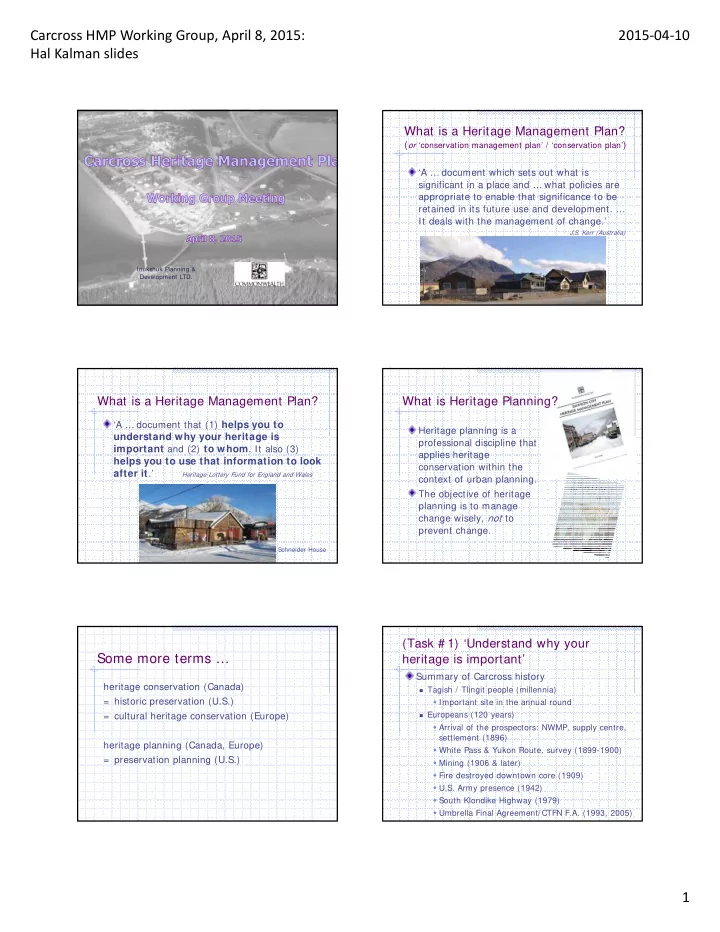
Carcross HMP Working Group, April 8, 2015: 2015 04 10 Hal Kalman slides What is a Heritage Management Plan? ( or conservation management plan / conservation plan ) A document which sets out what is significant in a


slide-1
SLIDE 1

Carcross HMP Working Group, April 8, 2015: Hal Kalman slides 2015‐04‐10 1

Inukshuk Planning & Development LTD.

What is a Heritage Management Plan?

(or ‘conservation management plan’ / ‘conservation plan’) ‘A … document which sets out what is significant in a place and … what policies are appropriate to enable that significance to be retained in its future use and development. … It deals with the management of change.’

J.S. Kerr (Australia)

What is a Heritage Management Plan?

‘A … document that (1) helps you to

understand why your heritage is important and (2) to whom. It also (3) helps you to use that information to look after it.’

Heritage Lottery Fund for England and Wales Schneider House

What is Heritage Planning?

Heritage planning is a professional discipline that applies heritage conservation within the context of urban planning. The objective of heritage planning is to manage change wisely, not to prevent change.

Some more terms …

heritage conservation (Canada) = historic preservation (U.S.) = cultural heritage conservation (Europe) heritage planning (Canada, Europe) = preservation planning (U.S.)

(Task # 1) ‘Understand why your heritage is important’

Summary of Carcross history

 Tagish / Tlingit people (millennia)

 Important site in the annual round

 Europeans (120 years)

 Arrival of the prospectors: NWMP, supply centre, settlement (1896)  White Pass & Yukon Route, survey (1899-1900)  Mining (1906 & later)  Fire destroyed downtown core (1909)  U.S. Army presence (1942)  South Klondike Highway (1979)  Umbrella Final Agreement/CTFN F.A. (1993, 2005)

slide-2
SLIDE 2

Carcross HMP Working Group, April 8, 2015: Hal Kalman slides 2015‐04‐10 2

Changes in the primary economy

Subsistence & trade Mining & supply Defence Tourism

What is Carcross’s identity?

Histories of Carcross call the town a:

 Tagish / Tlingit trade route  Stopover & supply centre for the Klondike  Staging & logistics site for mining  Staging camp for the Alaska Highway  ‘Gateway to the Southern Lakes’  ‘Caribou Crossing’ – even caribou were transients!

What is Carcross’s identity?

… other than as somewhere between here and there!

What is Carcross’s identity?

Are you 1 hour south

  • f Whitehorse?

Or are you 2 hours north of Skagway? Or are you ‘Carcross’? We shall work with you to identify the community’s identity

What is Carcross’s identity?

We’ll help define the community’s identity The Heritage Management Plan (HMP) will build

  • n that identity to present the distinct character
  • f Carcross.

(Task # 1) ‘Understand why your heritage is important’

Social & cultural reasons Economic reasons Environmental reasons

Social and cultural reasons

We have a fundamental need to retain connections with our heritage, our identity, and our collective memory Destruction of familiar places can cause us to lose our way

 ‘heritage dementia’

Re-using historic places draws

  • n traditional skills

Hollow Tree, Stanley Park, Vancouver

slide-3
SLIDE 3

Carcross HMP Working Group, April 8, 2015: Hal Kalman slides 2015‐04‐10 3

Economic benefits

Conservation and development are partners, not adversaries

 Conservation is a form of development; generates

economic activity

Conservation is an investment, not a subsidy Re-using old buildings is often less expensive than new construction Rehabilitation is labour-intensive and more likely to use local / regional materials

Economic benefits: heritage tourism

Conserving historic character supports heritage tourism Heritage tourism generates economic activity

 Goods & services should attract visitors’ money,

relate to community identity

Tombstone, Arizona

Environmental reasons

Rehabilitation has a smaller carbon footprint than new construction ‘The greenest building is the one that is already built.’

What makes up our heritage?

Tangible heritage Intangible heritage

Tangible heritage: Historic places

(Immoveable heritage)

Types of historic places:

 Buildings, structures  Historic areas / districts  Cultural landscapes

Tangible heritage: Moveable heritage

Northern Airways Fokker Universal c.1934 & restored ‘The Duchess’ (1878), WPYR service 1900 SS Tutshi, 1917 Burned 1990

slide-4
SLIDE 4

Carcross HMP Working Group, April 8, 2015: Hal Kalman slides 2015‐04‐10 4

Intangible cultural heritage (‘ICH’)

Preparing sourdough Singing and dancing Legends and stories

Best conservation practices

We encourage use of best practices Follow Canadian adaptation of international conservation standards

Best practices: Conservation charters

  • ICOMOS (International

Council on Monuments and Sites)

  • Charters set international

standards for Best Practices

  • www.icomos.org

‘Charters and other Doctrinal texts’

The Venice Charter, 1964

‘The International Charter for the Conservation and Restoration of Monuments and Sites’

The Burra Charter, 1979-2013

‘Cultural significance means aesthetic, historic, scientific, social or spiritual value for past, present or future generations.’ (Article 1.2) ‘The aim of conservation is to retain the cultural significance of a place.’ (Article 2.2)

 Conservation is NOT intended to prevent change!

‘Conservation is based on a respect for the existing fabric, use, associations and meanings.’ (Article 3.1) Places may have a range of values for different individuals or groups.’ (Article 1.2)

Conflicting values: Uluru

slide-5
SLIDE 5

Carcross HMP Working Group, April 8, 2015: Hal Kalman slides 2015‐04‐10 5

Conflicting values

‘One man’s ceiling is another man’s floor.’ Paul Simon

Best practices: Conservation treatments Heritage values

Values are embodied in the asset and its use, association, and meanings We practice ‘values-centred conservation’

Recommendations respect the values of the community

Public meeting, Dawson HMP

Heritage significance

A historic place or an intangible asset has significance if it is valued by its community.

‘A value is a characteristic that is valued.’ ‘Significance is a synthesis of those values.’

Significance may occur at any level

 Local, regional, territorial / provincial,

national, or global

Local / regional / territorial significance

Johnny Johns house, Carcross

National significance

Dredge No. 4 National Historic Site, nr. Dawson

slide-6
SLIDE 6

Carcross HMP Working Group, April 8, 2015: Hal Kalman slides 2015‐04‐10 6

Global significance: Kluane World Heritage Site

‘The Kluane/Wrangell-St. Elias/Glacier Bay/Tatshenshini-Alsek national parks and protected areas along the boundary of Canada and the United States of America are the largest non-polar icefield in the world and contain examples of some of the world’s longest and most spectacular glaciers.’

All of them have heritage significance

Why? … because they’re valued by their communities.

  • The difference is in the scale of

the community.

(Task # 2) ‘To whom is your heritage important?’

Carcross residents (400+ ) Carcross property owners Visitors (100-125,000), most via Skagway

 85% seek ‘authentic cultural and heritage

experiences’; 85% stay fewer than 3 hours

Your heritage is important to all 3 groups

(Task # 3) ‘How do you use the information to look after your heritage?’

Heritage planning is the management of change

 Change is inevitable

 May be done well or badly

 One of our tasks is to recommend ways to

help bring about appropriate change.

 Do this with Planning Tools & Conservation Tools

 Another task is to recommend ways to balance

heritage values with other community values

Planning tools: Local Area Plan

Vision Values Policies Priorities

Planning tools

Zoning and development regulations Land-use regulations (Local Area Plan) Heritage management policies & procedures New planning tools?

slide-7
SLIDE 7

Carcross HMP Working Group, April 8, 2015: Hal Kalman slides 2015‐04‐10 7

Conservation tools

Heritage management provides both

  • pportunities and constraints

Use conservation tools to maximize the

  • pportunities, mitigate the constraints

Conservation tools:

Public awareness: Walking tour booklet

Conservation tools: Public awareness: Walking tour app Conservation tools: Interpretation (aka Story-telling) Conservation tools: Heritage recognition (‘listing’)

Yukon Historic Sites Inventory

 Recognition increases awareness/appreciation

 … both the owner and the public

Conservation tools: Heritage designation (protection)

Territorial protection

 Caribou Hotel

Federal protection

 WPYR Station

Designation controls change; does not prevent change Changes that retain heritage character are okay, and benefit the community

slide-8
SLIDE 8

Carcross HMP Working Group, April 8, 2015: Hal Kalman slides 2015‐04‐10 8

Conservation tools: Heritage areas / zones

Currently five heritage areas identified

South Carcross: Inventoried sites

Conservation tools: Technical assistance Conservation tools: Design guidelines

Respect, not imitation!

Conservation tools: Infill development

Vacant lots Back / side yards

Conservation tools: Conservation of buildings & landscapes

Skagway George Simmons properties

Conservation tools: Financial incentives

Grants

 Historic Properties Assistance Program  Yukon Historic Resources Fund

Tax incentives

 Income tax incentives

 Rejected by federal government

 Property tax incentives

 Victoria, Calgary  Yukon Historic Sites Property Tax Exemption

 Sales tax incentives

 E.g., waive tax on building supplies for rehabilitation

Oriental Hotel, Victoria

slide-9
SLIDE 9

Carcross HMP Working Group, April 8, 2015: Hal Kalman slides 2015‐04‐10 9

Conservation tools: Non-financial incentives

Mostly used in large urban areas

 E.g., Density bonus, transfer

  • f density

Also applicable to small communities

 E.g., land-use & zoning

relaxations

Shangri-la, Vancouver YCGC House, Dawson

Planning and conservation tools

The Heritage Management Plan will recommend using some or all of these tools Likely also other solutions

Heritage Management Plan (‘HMP’)

Success will depend largely on:

 Analysis of community resources  Stakeholder consultation  Public meeting / workshop  Input from the Working Group  Commitment of Working Group, property

  • wners, and governments to help gain

acceptance and implementation of HMP

Implementation

Next steps:

 Consultants prepare the HMP  The two governments (YG and CTFN) adopt

the HMP and its recommendations

 Prepare and adopt amendments to area

development regulation

 Establish mechanism for ongoing public input

into development review process (SKLAC)

 Ensure regulations are followed

Questions? Discussion?

Inukshuk Planning & Development LTD.