Canadian Sales Tax Audits: Preparation Strategies Canadian Sales Tax - - PowerPoint PPT Presentation

canadian sales tax audits preparation strategies canadian
SMART_READER_LITE
LIVE PREVIEW

Canadian Sales Tax Audits: Preparation Strategies Canadian Sales Tax - - PowerPoint PPT Presentation

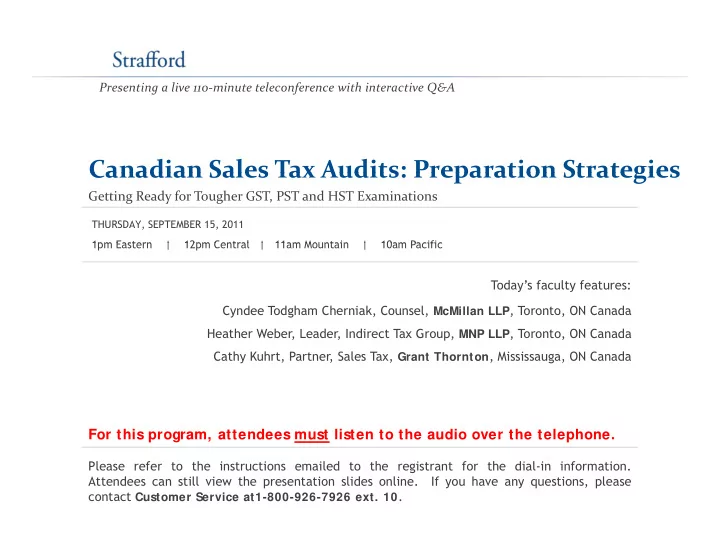
Presenting a live 110 minute teleconference with interactive Q&A Canadian Sales Tax Audits: Preparation Strategies Canadian Sales Tax Audits: Preparation Strategies Getting Ready for Tougher GST, PST and HST Examinations THURSDAY, SEPTEMBER


slide-1
SLIDE 1

Presenting a live 110‐minute teleconference with interactive Q&A

Canadian Sales Tax Audits: Preparation Strategies Canadian Sales Tax Audits: Preparation Strategies

Getting Ready for Tougher GST, PST and HST Examinations

1pm Eastern | 12pm Central | 11am Mountain | 10am Pacific THURSDAY, SEPTEMBER 15, 2011

Today’s faculty features:

1pm Eastern | 12pm Central | 11am Mountain | 10am Pacific

Cyndee Todgham Cherniak Counsel McMillan LLP Toronto ON Canada Cyndee Todgham Cherniak, Counsel, McMillan LLP, Toronto, ON Canada Heather Weber, Leader, Indirect Tax Group, MNP LLP, Toronto, ON Canada Cathy Kuhrt, Partner, Sales Tax, Grant Thornton, Mississauga, ON Canada

For this program, attendees must listen to the audio over the telephone.

Please refer to the instructions emailed to the registrant for the dial-in information. Attendees can still view the presentation slides online. If you have any questions, please contact Customer Service at1-800-926-7926 ext. 10.

slide-2
SLIDE 2

Conference Materials

If you have not printed the conference materials for this program, please complete the following steps:

  • Click on the + sign next to “Conference Materials” in the middle of the left-

hand column on your screen hand column on your screen.

  • Click on the tab labeled “Handouts” that appears, and there you will see a

PDF of the slides for today's program.

  • Double click on the PDF and a separate page will open.

Double click on the PDF and a separate page will open.

  • Print the slides by clicking on the printer icon.
slide-3
SLIDE 3

Continuing Education Credits

FOR LIVE EVENT ONLY

Attendees must listen to the audio over the telephone. Attendees can still view

the presentation slides online but there is no online audio for this program. Please refer to the instructions emailed to the registrant for additional

  • information. If you have any questions, please contact Customer Service

at 1-800-926-7926 ext. 10. at 1 800 926 7926 ext. 10.

slide-4
SLIDE 4

Tips for Optimal Quality

S d Q lit S

  • und Qualit y

For this program, you must listen via the telephone by dialing 1-866-873-1442 and entering your PIN when prompted. There will be no sound over the web connection. co ect o . If you dialed in and have any difficulties during the call, press *0 for assistance. You may also send us a chat or e-mail sound@straffordpub.com immediately so we can address the problem. Viewing Qualit y To maximize your screen, press the F11 key on your keyboard. To exit full screen, press the F11 key again press the F11 key again.

slide-5
SLIDE 5

C di S l T A dit P ti Canadian Sales Tax Audits: Preparation Strategies Seminar

  • Sept. 15, 2011

Cathy Kuhrt, Grant Thornton LLP

cathy.kuhrt@ca.gt.com

Heather Weber, MNP LLP

heather.weber@mnp.ca

Cyndee Todgham Cherniak, McMillan LLP

cyndee@mcmillan.ca

slide-6
SLIDE 6

Today’s Program

A dit P ti A d R liti Slid 7 Slid 30 Audit Preparation And Realities [Heat her Weber] Audit Preparation Best Practices Slide 7 – Slide 30 Slide 31 – Slide 40 [Cat hy Kuhrt ] Voluntary Disclosures [Cat hy Kuhrt ] Slide 41 – Slide 46 Objections Phase [Heat her Weber] l l d l d Slide 47 – Slide 54 Rulings [Cyndee Todgham Cherniak] Slide 55 – Slide 59 Appeals Phase [C d T d h Ch i k] Slide 60 – Slide 74 [Cyndee Todgham Cherniak]

slide-7
SLIDE 7

AUDIT PREPARATION AND

Heather Weber, MNP LLP

AUDIT PREPARATION AND REALITIES

slide-8
SLIDE 8

K l B C Th Ok Kelowna, B.C. : The Okanagan

8

slide-9
SLIDE 9

Canadian Sales Tax Audits: GST/HST And PST

I. Audit preparation and realities I. Audit issues II GST/HST dit II. GST/HST audits I. What is different with HST? III PST audits

  • III. PST audits

I. BC and Ontario – After HST came into place II. BC now that we are going back to a PST and GST II. BC now that we are going back to a PST and GST system

  • III. Manitoba and Saskatchewan
  • IV. Ongoing transactions and reporting requirements

9

slide-10
SLIDE 10

A di P i Audit Preparation

  • An audit is unfortunately inevitable; it is part of doing

business.

  • Do you have the right controls in place?

Do you have the right controls in place? ― Have you ever reviewed your sales tax processes? ― Are there the right checks and balances in place? How g p

  • ften are your processes checked to ensure that they are

working properly? As the GST/HST and PST are transaction based taxes ― As the GST/HST and PST are transaction-based taxes, they are dependent on a good processing system to ensure the correct rate of tax is calculated.

10

slide-11
SLIDE 11

A di P i (C ) Audit Preparation (Cont.)

  • As a non-resident, when you registered for sales tax, did you

agree to keep your records in Canada or outside of Canada?

  • Controlling the audit process is very important. When the

auditor calls, it is useful to do a quick review to see where there may be issues. Having your own accountants identify any potential audit

  • Having your own accountants identify any potential audit

issues and then manage the audit process can save thousands

  • f dollars.

11

slide-12
SLIDE 12

Th A di C ll The Auditor Calls

  • If you have not elected to keep your records at a location in Canada,

y p y , you will be required to fly the auditor to your place of business

  • utside of Canada, at your own expense.
  • If you live in California, Florida or another warm state, don’t be

If you live in California, Florida or another warm state, don t be surprised if the auditors want to schedule audits in the middle of the winter.

  • Although your information may be kept at your head office it may
  • Although your information may be kept at your head office, it may

be preferable to send your records to your Canadian accountant’s

  • ffice. The auditor can work on the audit at the accountant’s office,

and the entire process can be controlled and monitored as to what and the entire process can be controlled and monitored as to what the auditor copies, whom they speak with, etc.

  • As nice as the auditors may seem, they are always looking for

something (I should know as I was one in my former life) something (I should know, as I was one in my former life).

12

slide-13
SLIDE 13

GST/HST A di GST/HST Audits

  • As you know, BC and ON moved to an HST system on July 1, 2010.

This brought about many changes to the legislation, including place-

  • f-supply rules, which Cathy will cover later.
  • BC has just held a referendum on the HST, and residents voted 54.7%

to move back to a GST 5%/PST 7% system. This will take place over the next 18 months. ― There will be new transition rules to account for the change back to a PST system. ― This will have a huge impact on our clients Currently under an This will have a huge impact on our clients. Currently under an HST system, for most businesses all of the tax is recoverable. Once BC goes back to a PST system, the 7% PST paid will form part of the cost of doing business. p g

13

slide-14
SLIDE 14

HST In BC: Soon To Be GST And PST

There is an opportunity for businesses operating in BC to do some planning before the PST comes back. As examples:

  • Capital expenditures are 7% cheaper under the HST

Capital expenditures are 7% cheaper under the HST system.

  • Software contracts are 7% cheaper under the HST system.

Under the current HST system, contractors are able to bid competitively on work in other provinces that do not have a PST p y p system, such as Alberta, Ontario, New Brunswick, Nova Scotia and Newfoundland.

14

slide-15
SLIDE 15

GST/HST Th A di A i GST/HST: The Auditor Arrives

  • The auditors are becoming more aggressive.
  • It is important to start the process off properly.

Auditors will typically send out an initial letter to request information to start the review.

  • These letters can be very detailed, starting with a summary of

your business operations, including who owns the business and an y p , g

  • rganization chart.

15

slide-16
SLIDE 16

GST/HST: The Auditor Arrives (Cont.)

Typically, the auditor will want to review the: ― General ledger, ― Adjusting journal entries, and ― Financial statements ― From there, he or she will verify a sample of invoices or expenses. The auditor is able to request this information. However, it is important to question the requests if they seem unreasonable. For example, if the auditor is doing a GST audit and then starts to ask questions about a unrelated business that is one of your suppliers

16

slide-17
SLIDE 17

GST/HST A di GST/HST Audits

There is the ability to keep your records in your own currency. However, this must be requested, and of course the records must be consistent. As the expenses would be incurred in Canadian currency, there would h t b bl h t t b k have to be a reasonable approach to convert back. Most businesses choose to report transactions in Canadian dollars, for purposes of the filing requirements here. For their U.S. reporting, everything is converted to U.S. dollars. This does require a separate spreadsheet. Canada does get concerned when something is paid in Canadian dollars, converted to U.S. dollars and then converted back to Canadian dollars, all at different rates.

17

slide-18
SLIDE 18

GST/HST A di (C ) GST/HST Audits (Cont.)

The sampling process used in a GST/HST audit is very different from the sampling process in a PST audit. With the GST/HST audit, generally if the sample of the larger invoices are supportive of what has been claimed, then generally everything will be fine If the sample yields a number of errors everything will be fine. If the sample yields a number of errors, the audit will be expanded. This is where the audits can become very costly, either from the time advisors are required to spend with the auditors or the cost to the company in pulling the information needed. p y p g

18

slide-19
SLIDE 19

PST A di S li PST Audits: Sampling

PST audits are done strictly by sampling. The auditor will often review a two-to-three-year period and request every invoice for several months throughout the period. The taxpayer does have a say in choosing the sample period, so it is important to think about when your busiest times are. Did you have a time with a high staff turnover or introduction of a new product or a new g p computer system? They may be months that you would like included or not. The results of the sample are then extended over the entire

  • period. Because the sample is very detailed, it is important to

ensure that there are no flaws in the samples.

19

slide-20
SLIDE 20

HST A di I BC A d O i HST Audits In BC And Ontario

What is happening with HST in BC and ON? There have not been any significant audits to date The Canada There have not been any significant audits to date. The Canada Revenue Agency (CRA) has been involved in a campaign to phone taxpayers to check how they are applying the new rules. Specifically with regard to recapture for large businesses (and associated groups) that have $10 million or more of sales

20

slide-21
SLIDE 21

HST Audits In BC And Ontario (Cont.)

Just because the CRA is calling your business does not mean that you are required to recapture HST. However, they think that you may be. It is important to verify whether these rules apply to you so that you can advise the CRA. The auditors are just beginning to now learn the new rules So The auditors are just beginning to now learn the new rules. So, we expect to see more HST audits over the upcoming year, now that the tax has been in place for awhile now.

21

slide-22
SLIDE 22

PST Audits: Saskatchewan And Manitoba

Surprisingly, there has not been a huge number of PST audits in BC and ON. The very large companies have had their routine audit; however, there was not a big push as we were expecting. The auditors in SK and Man have been increasing their audit force, and consequently the number of audits has also increased and consequently the number of audits has also increased. We are seeing audits of companies that are not resident in these provinces but have been doing business there.

22

slide-23
SLIDE 23

PST Audits: Saskatchewan And Manitoba (Cont.)

One of the major issues that comes up in these PST audits is the temporary use rules.

  • Anything brought into a PST province, even if only for a

temporary basis (if taxable), is subject to PST.

  • There are special formulas for items like equipment and

vehicles that will not be staying in the province. The auditors in these two provinces have become very aggressive. The case law regarding PST matters is not as prevalent as it is with GST/HST matters, and the auditors tend to apply administrative positions, which may or may not correspond to what the legislation says. pos t o s, w c ay o ay ot co espo d to w at t e leg slat o says.

23

slide-24
SLIDE 24

PST A di E l PST Audit: Example

An example of how a PST audit can take on a life of its own. A client was just audited This audit was initiated as a result of a A client was just audited. This audit was initiated as a result of a voluntary disclosure. In the voluntary disclosure, the client had identified all of the areas where it felt it had not complied, including:

24

slide-25
SLIDE 25

PST A di E l (C ) PST Audit: Example (Cont.)

  • Sales of taxable property to clients in the province
  • Temporary use tax on equipment brought into the

province to provide the sales p ov ce to p ov de t e sales

  • The audit focused on:
  • Sales of goods vs. services to real property
  • Freight from outside vs. inside the province

25

slide-26
SLIDE 26

A di I P Audits In Process

As mentioned earlier, it is very important to monitor the audit and help it to stay on track. It is not in anyone’s interest to have the auditor decide to expand the audit. By providing information on a timely basis, the auditor can be kept focused and spending minimal time on site. But, what happens when the auditor has found what he or she thinks is an issue? thinks is an issue?

26

slide-27
SLIDE 27

A di I P (C ) Audits In Process (Cont.)

Sometimes, the auditor will decide that something is a big issue. Sometimes, the auditor will decide that something is a big issue. If there is another position to be taken that the auditor is not illi id h i b h willing to consider, then it may be necessary to contact the auditor’s supervisor. When possible, it is best to wrap up everything at the audit stage. The costs multiply when something has to be appealed, and then there will be an additional cost if the matter has to go before the there will be an additional cost if the matter has to go before the courts. The time to resolve these matters increases exponentially the longer a matter is in dispute.

27

slide-28
SLIDE 28

A di I P (C ) Audits In Process (Cont.)

Ways to resolve matters at the audit stage

  • Meeting with the auditor to review issues is often helpful
  • Meeting with the auditor to review issues is often helpful.
  • Involving their team leader and technical advisor as soon

as there appears to be a difference of opinion is also helpful.

28

slide-29
SLIDE 29

B i i Th A di T A Cl Bringing The Audit To A Close

Despite everyone’s attempts to resolve something at the audit stage, sometimes this is not possible. Sometimes it is important to know when to move something to the next level. This may be necessary when it is clear that there is a difference of

  • pinion between the auditor and the advisor.
  • When the issue is very contentious and could have a huge dollar

When the issue is very contentious and could have a huge dollar impact on the client

  • When the issue is something that is worth setting a precedent
  • ver, as it affects a large number of taxpayers – may not
  • ve , as t a ects a la ge u

be o ta paye s ay ot necessarily be a huge dollar amount

29

slide-30
SLIDE 30

U d di Th R l Understanding The Rules

When you discover that your business is not compliant on all issues, what ti ? are your options?

  • Depending on the situation, you may be able to do a voluntary

disclosure program. Voluntary disclosures in Canada are different th di l t th IRS C th ill th h thi i than a disclosure to the IRS. Cathy will go through this in more detail

  • Fix the situation - Amend prior returns

Regardless of what you decide to do, there are accounting reporting requirements that require you to account for a potential liability. This may be necessary when you are waiting for something to work through appeals.

  • Often. companies will set up a liability but do nothing. This is a signal

that something is not correct – for the CRA auditor and for a new comptroller.

30

slide-31
SLIDE 31

AUDIT PREPARATION

Cathy Kuhrt, Grant Thornton LLP

AUDIT PREPARATION BEST PRACTICES

slide-32
SLIDE 32

N ifi i Of A di Notification Of Audit

  • Notification from CRA or province

― Outlines the items CRA or provincial authority will want you to have ready or receive in advance you to have ready or receive in advance ― General ledger ― GST/HST or provincial tax account p ― GST/HST ITC or QST ITR account ― Sample of invoices ― Sample contracts and agreements

32

slide-33
SLIDE 33

Books And Records Outside Of Canada

  • Frequent questions we get when the books and records are

situated outside of Canada: ― Do you send all the records or just the Canadian transactions? ― In what exchange are the records? ― For what did you sign up when you registered?

33

slide-34
SLIDE 34

T A di Tax Audits

“The art of t axat ion is so t o pluck t he goose t hat t he maximum

number of feat hers are obt ained wit h t he minimum amount of hissing.”

Jean Colbert (1665) — Jean Colbert (1665)

34 34

slide-35
SLIDE 35

R i i Y L A di Reviewing Your Last Audit

  • Think back to that last audit
  • Think back to that last audit

― How long ago was it, and what were the findings? ― Is it the same auditor? H d h d fi i i ? ― Have you made any changes to correct any deficiencies? ― Has legislation changed that could affect the business? ― Have there been any new business purchases or other reorganizations? ― Any aggressive filing positions that you are aware of? ― Any new rulings or interpretations? y g p ― Have your systems changed? ― Any new personnel administering the tax? ― Any new product lines or services? ― Any new product lines or services? ― Any new divisional reporting?

35

slide-36
SLIDE 36

Frequent Traps: Place Of Supply q p pp y

  • Place of supply rules
  • Place of supply rules

― Lack of audit trail ― Reasonability test ― Understanding terms of delivery ― Nature of supply – is it a good, a service or an intangible? D bl t ith i i l l t i lit ― Double-tax with provincial sales tax is a reality ― Imported services and intangibles

36

slide-37
SLIDE 37

F T D i Frequent Traps: Documentation

  • Lack of documentation

― Wrong name – any agency relationships ― Wrong employee or contractor Wrong employee or contractor ― Lack of or wrong GST registration number ― Commissions payable ― None on hand before claiming ITC or ITR ― GST registry Cannot find the election drop shipment certificate or ― Cannot find the election, drop shipment certificate or purchase exemption certificate; or, improper use

37

slide-38
SLIDE 38

Frequent Traps: Conversion And Refunds

  • Conversion issues
  • Conversion issues

― Customs GST on import in Cdn dollars and converted to foreign currency and converted back

  • Inability to claim refund

― Importer of record and de fact o importer ― Importer of record and de fact o importer ― Four-year or lesser time limit ― Restricted amounts, e.g. meals and entertainment, memberships ― Exempt revenue – not commercial activity ― System or coding issues and PST claimed as a refund for System or coding issues, and PST claimed as a refund for ITC

38

slide-39
SLIDE 39

Frequent Traps: RITCs And Electronic Filing

  • Recaptured ITCs or restricted ITRs

― Large business definition Large business definition ― CRA phone calls to review reporting

  • Electronic filing requirement

― Problem inputting the RITC

39

slide-40
SLIDE 40

F t T P t i Frequent Traps: Potpourri

  • Non-resident security posting
  • Transitional issues

a s t o al ssues ― PST conversion in Ontario and British Columbia and charging the right rate of tax

  • Failure to charge tax on supplies between related parties
  • Taxable benefits
  • Failure to register for the GST – not a small supplier

40

slide-41
SLIDE 41

VOLUNTARY DISCLOSURES

Cathy Kuhrt, Grant Thornton LLP

VOLUNTARY DISCLOSURES

slide-42
SLIDE 42

Recap of Harmonization

With the HST in place in BC and Ontario for just over a year we expect to see an increase in audits of HST transactions. CRA has done the first phase which consisted mostly of phone calls to gage compliance CRA has done the first phase which consisted mostly of phone calls to gage compliance with the new rules. They will now begin to review the transactions. Businesses operating in BC will have two transition periods to worry about

42

slide-43
SLIDE 43

V l Di l Voluntary Disclosures

  • Some provinces have a voluntary disclosure program.

C d R A h l t di l

  • Canada Revenue Agency has a voluntary disclosure

program for GST/HST.

  • Saves penalty
  • Must pay sales tax owing and interest

43

slide-44
SLIDE 44

V l Di l C di i Voluntary Disclosure Conditions

1) Disclosure MUST be voluntary.

  • Taxpayer not aware of upcoming audit
  • Taxpayer did not receive communication from CRA
  • Taxpayer did not receive communication from CRA
  • Taxpayer not aware of enforcement action against

related party 2) Disclosure is complete. 3) Problem involves a penalty. 4) The disclosure must include information at least one year past due, or correct a previously filed return. 5) Previous disclosure of issue has not been made. )

44

slide-45
SLIDE 45

V l Di l Ti Voluntary Disclosure Tips

  • DO be complete
  • DO NOT try to hide evidence/information
  • DO the work an auditor would do
  • DO the work an auditor would do
  • DO make your presentation of information easy to follow and

agree with

  • DO anticipate a audit (on site or a desk audit)
  • DO get help to break the ice

45

slide-46
SLIDE 46

B P d T Sh A d T ll Be Prepared To Show And Tell

46

slide-47
SLIDE 47

OBJECTIONS PHASE

Heather Weber, MNP LLP

OBJECTIONS PHASE

slide-48
SLIDE 48

Obj i Ph Objections Phase

Further elaborating on our earlier discussions, sometimes an issue is not able to be resolved at the audit stage, and it becomes inevitable that an objection will need to be filed. It is important to review why an objection is necessary. I it i t t ti i ?

  • Is it an interpretation issue?
  • Clashing of personalities?
  • Is there a precedent issue?

p Depending on why an objection is going to be filed, it is important t id h th l d t b i l d to consider whether a lawyer needs to be involved.

48

slide-49
SLIDE 49

Obj i Fili Objections: Filing

The objection is the basis for your argument.

  • Must be filed within 90 days of the notice of

assessment/reassessment

  • Can be filed by way of a letter saying that you object. However,

typically the prescribed form is completed. Form GST 159 Regardless of which method is chosen, there is certain prescribed information that must be included: ― Taxpayer’s name and identification number – GST/HST Taxpayer s name and identification number GST/HST number ― Amount in dispute ― Period to which the disputed amount relates Period to which the disputed amount relates ― Issue in dispute

49

slide-50
SLIDE 50

Objections: The Basis Of Your Argument

As the objection is forming, it is important that your argument of why something should be assessed differently is handled properly. This is often where a lawyer becomes involved. Cyndee will talk shortly about the actual appeal process. If there is a thought that a lawyer may be needed for the appeal then it is beneficial to a lawyer may be needed for the appeal, then it is beneficial to have him or her involved in the objection. If the objection is not framed properly, the lawyer may not have much room for putting together an argument.

50

slide-51
SLIDE 51

Obj i (C ) Objections (Cont.)

The objection must lay out the reasons for objecting and the relevant facts. It must be clear to the appeals office to what is being objected. The appeal process is very focused on the specific items being

  • bjected to; it is not a review of the business operations, or

another audit.

51

slide-52
SLIDE 52

Obj i Fil d A d Th Objections: Filed, And Then …

Once you have filed a notice of objection, you should receive y j , y confirmation within 30 days that the objection has been received. It then may take six months to a year before an appeals officer is It then may take six months to a year before an appeals officer is assigned to the file. It does not hurt to follow the progress of your file with CRA periodically It does not hurt to follow the progress of your file with CRA periodically by calling to check on the status of the appeal. O fil h b i d t l ffi h h ill Once your file has been assigned to an appeals officer, he or she will send you a letter and often give you a call identifying themselves. They usually ask you at this time if you have any further information to submit.

52

slide-53
SLIDE 53

Obj i PST A di Objections: PST Audits

There is a similar process when objecting to a PST assessment. Most provinces have a 90-day timeline to file the notice of objection. The timeline for having a PST appeal reviewed is much faster than under the GST/HST system. As soon as you are aware of whom has been assigned to your file, it is important to make contact with the PST appeals officer. It is much more likely when dealing with a PST audit to have a decision sent out without any opportunity for further dialogue. This is why it is so important to lay out the objection properly. po ta t to lay out t e object o p ope ly.

53

slide-54
SLIDE 54

Obj i A d A di R i Objections And Audit Review

As there have been so many changes to the GST/HST legislation over the past year, and more to come with the transition back to PST in BC, there is a great deal of uncertainty among taxpayers as to what they should be d i doing. There is also a great deal of uncertainty among the auditors. CRA has brought on many new auditors from the province governments in BC and ON. They will face a steep learning curve. BC and ON have very few provincial auditors left, so the crews that they do have may not have the time needed to properly review a topic. do ave ay ot ave t e t e eeded to p ope ly ev ew a top c.

54

slide-55
SLIDE 55

RULINGS

Cyndee Todgham Cherniak, McMillan LLP

RULINGS

slide-56
SLIDE 56

l f h Important Principles Of The Process

  • Be proactive!
  • Be prepared!
  • Be prepared!
  • Be interactive!

56 56

slide-57
SLIDE 57

Ad R li Advance Rulings

I. Advance rulings may be requested before a dispute arises.

  • Good evidence during audit

C t l

t ll t th it h t t thi k

  • Control – tell tax authority what to think

2 Auditors may request rulings during an audit 2. Auditors may request rulings during an audit.

  • To the extent possible, get involved in the process and

tell tax authority what to think.

57

slide-58
SLIDE 58

Ad R li (C ) Advance Rulings (Cont.)

  • Issued by GST/HST Rulings Directorate
  • Issued by Ontario Ministry of Revenue Tax Advisory (ORST)

I d b BC C T ti B h

  • Issued by BC Consumer Taxation Branch
  • Assist taxpayers with complying voluntarily
  • Two types:
  • Two types:

1. Binding ruling 2. Non-binding interpretation 2. Non binding interpretation

58 58

slide-59
SLIDE 59

R li D i A di Rulings During Audit

  • Often, a government authority will not accept a ruling

request from a taxpayer during audit/appeal.

  • Possible to work with auditor to clarify legal issue
  • Ask to participate in process

59 59

slide-60
SLIDE 60

APPEALS PHASE

Cyndee Todgham Cherniak, McMillan LLP

APPEALS PHASE

slide-61
SLIDE 61

Notice Of Objection/Appeals: Limitation Periods

Which Sales Tax? Notice of Objection Deadline Extension Deadline after Maximum Extension Notice of Appeal Deadline Extension Deadline After Maximum Extension GST/HST

90 days after notice of assessment Possible if ask 1 year of deadline Minister has discretion to set new deadline 90 days after notice of confirmation of assessment by CRA Possible if ask TCC within 1 year of deadline TCC has discretion to set new deadline

ORST

180 days after notice of assessment Possible if ask within 180 days Minister has discretion to set new deadline 90 days after decision of Ministry Possible if requested before expiry

  • f time limit

to file appeal Minister has discretion to set new deadline

BC SST

90 days after notice of assessment No statutory extension N/A 90 days after notice of confirmation of assessment No statutory extension N/A

61 61

slide-62
SLIDE 62

Notice Of Objection/Appeals: j pp Limitation Periods (Cont.)

Which Sales Tax? Notice of Objection Deadline Extension Deadline after Maximum Extension Notice of Appeal Deadline Extension Deadline After Maximum Extension Manitoba RST

90 days after notice of assessment N/A N/A 90 days after Commission’s decision N/A N/A One month f d f Board has One month after Granting Saskatchewan

RST

after date of service of notice of estimate Possible Board has discretion to set new deadline One month after date of Board decision Possible Granting extensions is at discretion

  • f Court

Minister has 90 days after Possible if ask Court of

Quebec Sales Tax

90 days after notice of assessment Possible if ask 1 year of deadline Minister has discretion to set new deadline notice of confirmation of assessment by Minister Court of Quebec within 1 year of deadline Quebec has discretion to set new deadline

62 62

slide-63
SLIDE 63

Notice Of Objection (Cont.) Not ce O Object o (Co t.)

  • Notice of objection shall:
  • Clearly describe each issue raised by way of objection
  • Fully set out the facts and the reasons on which you

are relying to argue that the assessment is incorrect are relying to argue that the assessment is incorrect

  • Taxpayer may be prevented from raising issues in appeal

if they are not raised at the objection stage. y j g

63 63

slide-64
SLIDE 64

Notice Of Appeal: Contents Notice Of Appeal: Contents

  • If you do not agree with the decision of the appeals officer, then

you can file a notice of appeal.

  • A notice of appeal cannot include issues that were not raised in

the notice of objection. E ception: The notice of appeal can incl de an iss e forming the

  • Exception: The notice of appeal can include an issue forming the

basis of a fresh assessment or a variation of an assessment.

64 64

slide-65
SLIDE 65

Notice Of Appeal Tips: Organization Notice Of Appeal Tips: Organization

  • DO start to plan the appeal from the day of the first

DO start to plan the appeal from the day of the first

disagreement with the auditor

  • DO keep record of every document provided to auditor
  • DO organize all relevant documents immediately after

audit summary, with proposed assessment

  • DO write contemporaneous notes of all conversations with

DO write contemporaneous notes of all conversations with

auditor/appeals officer

  • DO put as much in writing as possible
  • DO keep list of issues, with dates of discussions
  • DO buy binders
  • DO NOT leave anything out (it may be needed)

65

  • DO NOT leave anything out (it may be needed)

65

slide-66
SLIDE 66

Notice Of Appeal (Cont.) pp ( )

  • Prescribed form

Prescribed form

  • Tax statute contains instructions as to what is to be

included: 1. Facts 2. Issues 3. Law 4. Reasons 5 Requests 5. Requests

  • Options

1 Detailed 1. Detailed 2. Not detailed (risky)

66 66

slide-67
SLIDE 67

The Appeal The Appeal

  • An appeal

– What is it all about for you? Th t ’ l i d fti th ti f l

  • The taxpayer’s role in drafting the notice of appeal

67 67

slide-68
SLIDE 68

Types Of Appeal

  • GST/HST

1. Formal appeal 2 I f l l 2. Informal appeal

  • PST
  • PST

  • 1. Formal appeal to court
  • Judicial review (not an appeal per se)

Judicial review (not an appeal per se)

68

slide-69
SLIDE 69

Appeal Process pp

1 N ti f l t 1. Notice of appeal - taxpayer 2. Reply - counsel for governmental authority 3 Procedural motions 3. Procedural motions 4. Production of documents 5. Discovery 5. Discovery 6. Pre-hearing conferences (to narrow issues) 7. Agreed statement of fact 8. Hearing

69 69

slide-70
SLIDE 70

Litigation t gat o

  • Production of documents
  • Production of documents
  • Partial production
  • Full production
  • Examinations for discovery
  • What are they?
  • What is their purpose?
  • Wh i th

?

  • Who is there?
  • Preparation?
  • Use of the results?

70 70

slide-71
SLIDE 71

Li i i (C ) Litigation (Cont.)

  • Best opportunity for a

settlement

  • Crown counsel often more

C ow cou sel o te

  • e

reasonable than auditors

  • Pre-hearing conferences

with real judge helps with real judge helps narrow the issues

  • Drafting agreed statement
  • f fact narrows issues
  • Settlements save $$$$ and

stress of trial

71

slide-72
SLIDE 72

Litigation (Cont.) t gat o (Co t.)

  • The courtroom
  • Who is present
  • Opening
  • Witnesses
  • Witnesses
  • Argument
  • What is the taxpayer’s role at trial?

72 72

slide-73
SLIDE 73

Wh I K I A H i ? What Is Key In A Hearing?

  • Real evidence

C dibl it

  • Credible witnesses
  • Testimony of credible third parties
  • Testimony of credible third parties
  • Arguments in support of your position

Arguments in support of your position

73

slide-74
SLIDE 74

What Kind Of Witnesses Will Y E l B ? Your Employees Be?

  • Nun
  • Joker

74

slide-75
SLIDE 75

Thank you! Thank you!

Cyndee Todgham Cherniak C l Counsel McMillan LLP 181 Bay Street, Suite 4400 Toronto, ON M5J 2T3 Phone: 416-307-4168 Fax: 416-304-3871 E il d @ ill Email: cyndee@mcmillan.ca Twitter: @CyndeeLaw www.mcmillan.ca th h tbl www.thehstblog.com www.tradelawyersblog.com www.canadalawblog.com

slide-76
SLIDE 76

Thank you! Thank you!

Cathy Kuhrt, CA T P t Tax Partner Grant Thornton LLP Suite 401 350 Burnhamthorpe Road W Mi i ON L5B 3J1 Mississauga, ON L5B 3J1 Phone: 416-360-4986 Fax: 905-804-0509 Email: Cathy.Kuhrt@ca.gt.com

slide-77
SLIDE 77

Thank you!

Heather Weber, CGA Indirect Tax Partner MNP LLP 600 – 1628 Dickson Ave Kelowna, BC V1Y 9X1 Phone: 250-979-2575 Fax: 250-763-8919 E il h h b Email: heather.weber@mnp.ca