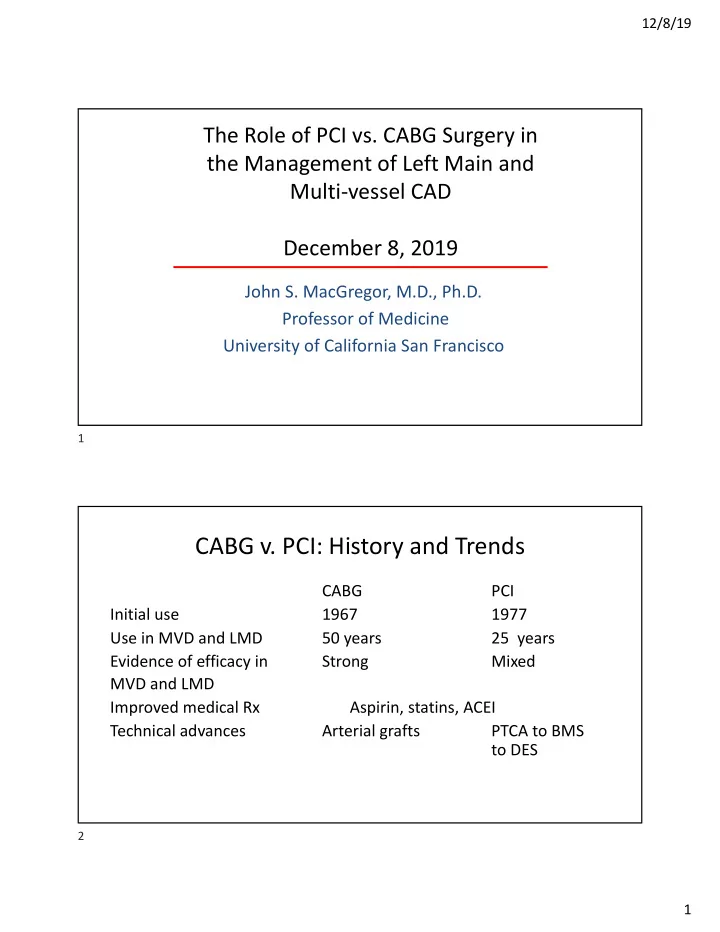
CABG v. PCI: History and Trends CABG PCI Initial use 1967 1977 - - PDF document
12/8/19 The Role of PCI vs. CABG Surgery in the Management of Left Main and Multi-vessel CAD December 8, 2019 John S. MacGregor, M.D., Ph.D. Professor of Medicine University of California San Francisco 1 CABG v. PCI: History and Trends
12/8/19 2
Limitations of Studies Comparing CABG and PCI
- Highly selected patients
- Less severe CAD
- Limited duration of follow-up
- Surgical patients often receive inferior medical therapy
- Crossover
3
Prospective, Randomized, Controlled Trials Comparing CABG to PCI
Doenst et al.
J Am Coll Cardiol. (2019) 73(8):964-976.
4
12/8/19 3
Mechanistic Differences Between PCI v. CABG
Doenst et al.
J Am Coll Cardiol. (2019) 73:964-976.
5
SYNTAX Score
A measure of the severity and complexity of coronary disease. Coronary arteries divided into over 25 segments and the assessment includes: location and severity of stenosis, CTO, calcification, presence of thrombus, lesion length, tortuosity of artery, caliber of artery, bifurcation or trifurcation, aorto-ostial lesion. Higher scores indicate more severe and complex coronary disease.
6
12/8/19 4
SYNTAX Study
4337 patients with 3VD or LM disease were screened. 1800 randomized to either CABG (897) or PCI (903). Recruitment from March 2005 through April 2007. 1287 patients (29.4%) excluded based on heart team review. Primary end point: MACCE at one year (death, CVA, MI, revasc.). Non-inferiority (pre-specified delta value 6.6%). Result: Taxus stent failed to meet non-inferiority v. CABG. Medical Rx in CABG group was significantly inferior to PCI group.
Serruys et al., NEJM (2009) 360: 961-72.
7
SYNTAX Trial: 5 Year MACCE for Patients with 3-VD According to SYNTAX Score
Doenst et al.
J Am Coll Cardiol. (2019) 73(8):964-976.
8
12/8/19 5
SYNTAX Trial: Probability of Death up to 10 Years
Thuijs et al.
Lancet, (2019) 394:1325-1334.
9
SYNTAX Trial: Probability of death at maximum follow up
Thuijs et al.
Lancet, (2019) 394:1325-1334.
10
12/8/19 6
SYNTAX Trial: Probability of Death up to 10 Years In Patients with 3-Vessel (A) and LM (B) Disease
Thuijs et al.
Lancet, (2019) 394:1325-1334.
11
SYNTAX Trial: Probability of Death up to 10 Years In Patients With (C) and Without (D) Diabetes
Thuijs et al.
Lancet, (2019) 394:1325-1334.
12
12/8/19 7
SYNTAX Trial: Probability of Death up to 10 Years, SYNTAX Score 22 or Less
Thuijs et al.
Lancet, (2019) 394:1325-1334.
13
SYNTAX Trial: Probability of Death up to 10 Years, SYNTAX Score 23 through 32
Thuijs et al.
Lancet, (2019) 394:1325-1334.
14
12/8/19 8
SYNTAX Trial: Probability of Death up to 10 Years, SYNTAX Score 33 or Greater
Thuijs et al. Lancet, (2019) 394:1325-1334.
15
SYNTAX Trial: Subgroup Analysis of 10 Year Mortality
Thuijs et al.
Lancet, (2019) 394:1325-1334.
16
12/8/19 9
FREEDOM Trial: Probability of Survival, CABG v. PCI
Farkouh et al.
J Am Coll Cardiol. (2019) 73(6):629-638.
17
NOBLE Trial (LM Disease): MACCE at 5 Years
Mäkikallio et al.
- Lancet. (2016) 388:2743-2752.
18
12/8/19 10
NOBLE Trial (LM Disease): Individual Components
- f MACCE at 5 Years
Mäkikallio et al.
- Lancet. (2016) 388:2743-2752.
19
EXCEL Trial: PCI v. CABG in left main disease
Primary end-point: Death stroke, MI at 3 years Secondary end-point: Primary plus repeat revascularization Non-inferiority trial (non-inferiority margin 4.2%) Result: PCI CABG Primary end-point 15.4% 14.7% Secondary end-point 23.1 19.1 (4% difference) Study concluded – Non-inferior.
Stone et al., NEJM (2016), 375:2223-35.
20
12/8/19 11
SYNTAX Trial: Probability of death at 10 years
Thuijs et al. Lancet, (2019) 394:1325-1334
21
NYS Cardiac Registry
Between 1/1/1997 and 12/31/2000 37,212 patients with MVD had CABG 22,102 patients with MVD had PCI Compared with PCI patients, CABG patients were older, had lower EF, more CVD, diabetes, renal failure, 3 VD, CHF, COPD.
Hannan et al., NEJM, 2005
22
12/8/19 12
NYS cardiac registry:
Kaplan-Meier curves adjusted for comorbidity (Hannan et al., NEJM, 2005)
nn an et al. NE J M 20 05 . Three-Vessel HannanmDisease with Disease of the Proximal LAD Artery
23
Survival for DES v. CABG: New York State Clinical Registries for PCI and CABG Surgery
Hannan et al.
Ann Thorac Surg. (2015) 100(6):2227-36.
24
12/8/19 13
Survival for DES v. CABG: New York State Clinical Registries for PCI and CABG Surgery
Hannan et al.
Ann Thorac Surg. 2015 Dec;100(6):2227-36.
25
MASS II: Probability of Event-Free Survival at 10 Years With Medical Rx. v. PCI v. CABG Surgery
Hueb et al.
- Circulation. (2010)122(10):949-57.
26
12/8/19 14
MASS II: Hazard ratios for MACE CABG v. MT
Hueb et al. Circulation. (2010)
122(10):949-57.
27
MASS II: Hazard ratios for MACE CABG v. PCI
Hueb et al.
- Circulation. (2010)
122(10):949-57.
28
12/8/19 15
MASS II: Hazard ratios for MACE MT v. CABG
Hueb et al.
- Circulation. (2010)
122(10):949-57.
29
ACC/AHA PRACTICE GUIDELINE Revascularization in Stable CAD Patients
For Symptom Relief: Class I, Level of Evidence A CABG or PCI to improve symptoms is beneficial in patients with 1
- r more significant (70% or more diameter) coronary artery
stenosis amenable to revascularization and unacceptable angina despite GDMT (JACC 60: (2012) 2564- 2603).
30
12/8/19 16
ACC/AHA PRACTICE GUIDELINE Revascularization in Stable CAD Patients
For Improved survival.: Class I, Level of Evidence B CABG to improve survival is recommended for patients with significant (50% or more diameter stenosis) left main coronary artery stenosis. CABG to improve survival is beneficial in patients with significant (70% or more diameter) stenosis in 3 major coronary arteries, or the proximal LAD plus one other major artery. (JACC 60: (2012) 2564- 2603).
31
ACC/AHA Practice Guidelines
“No study to date has demonstrated that PCI in patients with SIHD improves survival rates.” (JACC 58:e44-122 (2011)). Class IIa – PCI to improve survival is reasonable as an alternative to CABG in LM CAD with low (22 or less) SYNTAX score. Class IIb – PCI may be reasonable to improve survival as an alternative to CABG in LM CAD with low to intermediate (less than 33) SYNTAX score. Class IIb – The usefulness of PCI to improve survival is uncertain in patients with 2 or 3-vessel CAD (with or without proximal LAD involvement) or 1-vessel proximal LAD disease.
32
12/8/19 17
Conclusion: Factors Favoring CABG
Clinical characteristics: Diabetes, Reduced LV function (EF <35%), Contraindication to DAPT, Recurrent diffuse in- stent restenosis, patient preference. Anatomical and MVD with SYNTAX score greater than 22, Anatomy technical factors: likely to result in incomplete revascularization with PCI (CTOs), Severely calcified lesions. Need for Ascending aorta pathology with indication for concomitant surgery: surgery, indication for valve surgery or other cardiac surgery.
33
Conclusion: Factors Favoring PCI
Clinical characteristics: Severe co-morbidity, advanced age, frailty, reduced life expectancy, restricted mobility and conditions that affect rehabilitation process, patient preference. Anatomical and MVD with low SYNTAX score (0 to 22), low quality technical factors:
- r missing conduits for CABG, severe chest
deformity or scoliosis, sequelae of chest radiation, porcelain aorta.
34
12/8/19 18
35
MAIN-COPMPARE Study: Mortality at 10 Years
Park et al.
J Am Coll Cardiol. (2018) 72:2813-2822.