C# Types Let me know if you have not received CMS emails First - - PDF document

c types
SMART_READER_LITE
LIVE PREVIEW

C# Types Let me know if you have not received CMS emails First - - PDF document

1/25/2008 Administration CMS student list populated C# Types Let me know if you have not received CMS emails First assignment released Mingsheng Hong Due on Feb. 1 CS 215, Spring 2008 Write a C# program that takes as


slide-1
SLIDE 1

1/25/2008 1

C# Types

Mingsheng Hong CS 215, Spring 2008

Administration

 CMS student list populated

 Let me know if you have not received CMS emails

 First assignment released

 Due on Feb. 1  Write a C# program that

 takes as input regular English text  returns the transpose

 Use C# style

 much of what we discussed so far will be useful  should be short

Review

 Visual C# 2008 Express walkthrough  .NET framework, CLR, CTS, CLS

.NET Based Frameworks

 ASP.NET: web application framework

 Use .NET languages in server-side web pages  Now supports AJAX!

 ADO.NET: Use the CLR to access databases

 in the manner of ODBC  provides classes for access

 Microsoft XNA: game design framework

 GDIAC at http://gdiac.cis.cornell.edu  CIS 300: Introduction to Computer Game Design

Roadmap for Today’s Lecture

 C# types

 Reference types  Value types  Boxing and unboxing

 Basic C# features

 Arrays

 OO features  Function parameters  Iterators

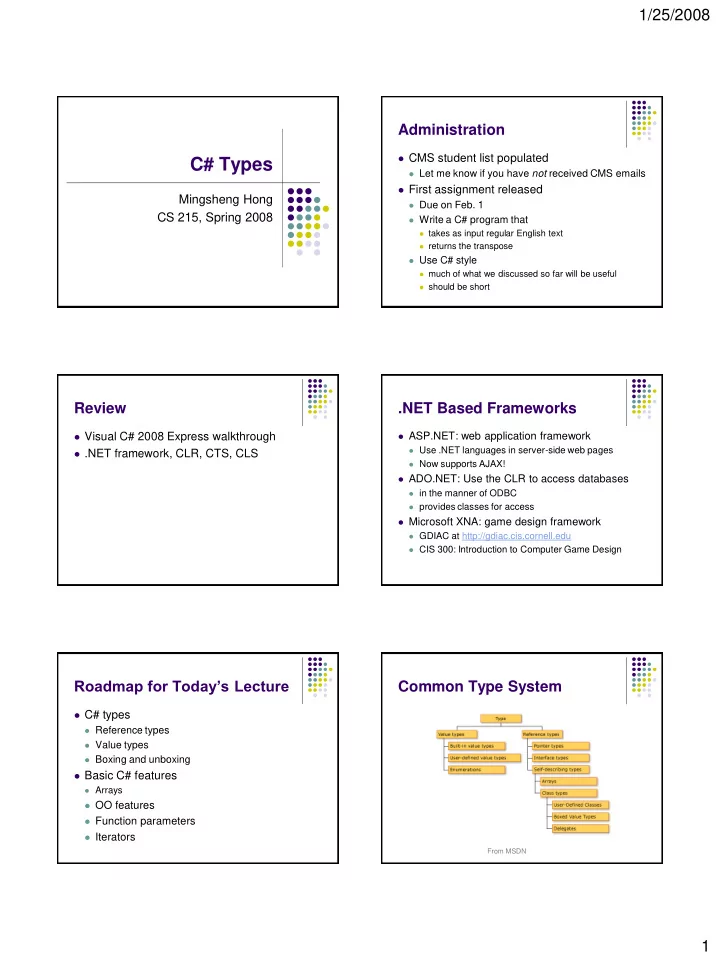
Common Type System

From MSDN

slide-2
SLIDE 2

1/25/2008 2

Common Value Types

 Integer types:

 signed: sbyte, int, short, long  unsigned: byte, uint, ushort, ulong

 Floating point: float, double, decimal  Everything in C# inherits from object

 regular objects are heavy-weight  for efficiency, need primitive types

Common Reference Type

 string type: string

 can index like char array  has methods such as Split

 e.g.,

 string s = “Hello”;

char third = s[2]; string[] split = s.Split(third);

Common Types

 What is the difference between string and double?

 reference types vs. value types  two families of types in C#

Reference Types

 Single inheritance in class hierarchy, rooted

in object

 Simple to Java classes

 Implement arbitrarily many interfaces

 Similar to Java interfaces

 C# classes can be abstract

 must be explicitly marked as abstract (contrast

with C++)

 May contain non-method non-data members

Reference Types: Memory Layout

 Refer to a memory location

 very much like pointers in other languages like

C/C++

 Can be set to null

memory

}

var of class A

{ A a = new A(); A b = a; }

a b

Value Types: Memory Layout

 Contain the actual value, not the location  Inherit from System.ValueType

 treated specially by the runtime: no subclassing

 Copies of value types make a real copy

memory

{ int a = 137; int b = a; }

a b 137 137

slide-3
SLIDE 3

1/25/2008 3

Boxing and Unboxing

 Value types not objects

 performance gain in common case  but can become objects on demand  called “boxing”. Reverse is “unboxing”

 Note: boxing still copies

{ int a = 137;

  • bject o1 = a;
  • bject o2 = o1;

int b = (int)o2; }

memory a b

  • 1
  • 2

137 137 int 137

Differences between Types

 Copy semantics for assignment:

 MyClass a = new MyClass();

MyClass b = a; b.X = 10; Console.WriteLine(a.X); //output ?

 int a = 1;

int b = a; b = 10; Console.WriteLine(a); //output ?

 Important for parameter passing, too

Common Value Types

 Simple types (i.e., integer and floating point)  Enum types

 has a corresponding underlying type (default: int)

Enum Example

 Definition enum Color

{ Red, Green, Blue }

 Instantiation

Color c = Color.Red;

Common Value Types

 Simple types (i.e., integer and floating point)  Enum types

 has a corresponding underlying type (default: int)

 Struct types

 user-defined value types  can contain arbitrary data  non-extensible (sealed subclasses)  examples: Point, KeyValuePair

Struct Example

 Definition struct Point {

public int x, y; public Point(int x, int y) { this.x = x; this.y = y; } }

 Instantiation

Point a = new Point(10, 10); a.x = 20;

slide-4
SLIDE 4

1/25/2008 4

C# Variables

 Definite assignment

 int i; //i is a local variable  Console.WriteLine(i); //error CS0165: Use

  • f unassigned local variable 'i'

 Default values

 only for instance variables, static variables, and array elts

 eg.

 string s; // s == null  double x; // x == 0.0

Basic C# Features

  • Arrays
  • OO features
  • Accessibility
  • Class members
  • Property
  • Indexer
  • Operator
  • Function parameters
  • Iterators

C# Arrays

 Can have standard C arrays

 int[] array = new int[30];  int[][] array = new int[2][];

array[0] = new int[100]; array[1] = new int[1];

 Called “jagged” arrays  Stored in random parts of the heap

 Can have arbitrary dimensions  Recall that an array is an object

C# Arrays

 Multidimensional

 stored sequentially

 int[,] array = new int[10,30];

array[3,7] = 137;