C OMPUTING ? [Mark Weiser 1991] PART 1 : R EQUIREMENTS , TRENDS , - - PowerPoint PPT Presentation

c omputing
SMART_READER_LITE
LIVE PREVIEW

C OMPUTING ? [Mark Weiser 1991] PART 1 : R EQUIREMENTS , TRENDS , - - PowerPoint PPT Presentation

R AINBOW RESEARCH GROUP T RENDS IN M IDDLEWARE FOR T RENDS IN M IDDLEWARE FOR U BIQUITUOUS C OMPUTING : WC OMP S OLUTION S OLUTION HMI Ubiquitous User Interaction Computing DAAD Summer CTDS 09, 24th 26th September Tunis Reactive and HMI


slide-1
SLIDE 1

TRENDS IN MIDDLEWARE FOR TRENDS IN MIDDLEWARE FOR UBIQUITUOUS COMPUTING : WCOMP SOLUTION SOLUTION

DAAD Summer CTDS 09, 24th ‐ 26th September ‐ Tunis

  • Ass. Prof. Jean‐Yves Tigli – http://www.tigli.fr

at the University of Nice Sophia Antipolis, delegated at INRIA in the team PULSAR at INRIA in the team PULSAR In collaboration with S. Lavirotte and G. Rey Our experimental platform is as a

DAAD Summer CTDS 09 ‐ JY Tigli – tigli@polytech.unice.fr 09/09/22

Our experimental platform is as a Sharpdevelop Addon on .Net Framework. http://rainbow.i3s.unice.fr/wikiwcomp/

RAINBOW RESEARCH GROUP

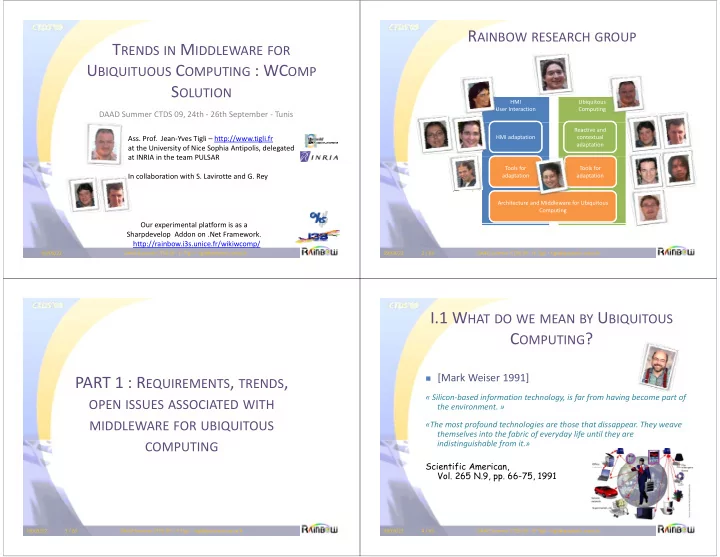
HMI User Interaction Ubiquitous Computing HMI adaptation Reactive and contextual adaptation Tools for adaptation Tools for adaptation Architecture and Middleware for Ubiquitous Computing

09/09/22 2 / 63 DAAD Summer CTDS 09 ‐ JY Tigli – tigli@polytech.unice.fr

PART 1 : REQUIREMENTS, TRENDS,

OPEN ISSUES ASSOCIATED WITH MIDDLEWARE FOR UBIQUITOUS COMPUTING

09/09/22 3 / 63 DAAD Summer CTDS 09 ‐ JY Tigli – tigli@polytech.unice.fr

I.1 WHAT DO WE MEAN BY UBIQUITOUS COMPUTING?

[Mark Weiser 1991]

« Silicon‐based information technology, is far from having become part of f gy, f f g p f the environment. » «The most profound technologies are those that dissappear. They weave themselves into the fabric of everyday life until they are themselves into the fabric of everyday life until they are indistinguishable from it.» Scientific American Scientific American,

  • Vol. 265 N.9, pp. 66-75, 1991

09/09/22 4 / 63 DAAD Summer CTDS 09 ‐ JY Tigli – tigli@polytech.unice.fr

slide-2
SLIDE 2

I.1 EVOLUTION OF COMPUTING I.1 EVOLUTION OF COMPUTING

  • Since

Since Von Neumann … Von Neumann …

COM

E/S

CPU

DATA

Energy

Pervasion 1990 2000 1960 1970 Temps Temps Nanocomputers & Swarm Intelligence, John Wiley & Sons - ISTE, London, 2008, ISBN 9781847040022

I.1 VARIATIONS OF UBICOMP I.1 VARIATIONS OF UBICOMP

  • Embedding for smart control

Embedding for smart control

– Embedded systems for cars, airplanes, etc.

  • Creating new computing devices

g p g

– Hi‐tech, silicon‐based gadgetry, e.g. PDAs, cell phones, mp3 players, active displays

  • Connecting the existing physical world to a

computational infrastructure

– Ordinary objects and tasks re‐evaluated and extended with computational/communication capabilities

09/09/22 6 / 63 DAAD Summer CTDS 09 ‐ JY Tigli – tigli@polytech.unice.fr

II.2 NEW CHALLENGE DUE TO MOBILITY AND HETEROGENEITY OF DEVICES

  • An ubiquitous environment
  • Spheres of interaction of devices, from Personal

Area Network to World Wide Web

  • S. Arbanowski, M. Lipka, K.

Mössner, K. Ott, R. Pabst, P. Pulli,

  • A. Schieder, M. A. Uusitalo. The

WSI Reference Model for the Wireless World Proceedings of Wireless World. Proceedings of IST Mobile Summit 2003.

09/09/22 7 / 63 DAAD Summer CTDS 09 ‐ JY Tigli – tigli@polytech.unice.fr

II.2 NEW CHALLENGE DUE TO MOBILITY AND

  • Dynamicity
  • Interoperability

HETEROGENEITY OF DEVICES

– Mobility – Discoverability – Heterogeneity of devices

09/09/22 8 / 63 DAAD Summer CTDS 09 ‐ JY Tigli – tigli@polytech.unice.fr

slide-3
SLIDE 3

1.3 MAIN UBIQUITOUS COMPUTING CHARACTERISTICS

Software Applications Environment Software Infrastructure

  • Three main characteristics are :

– Use embedded devices in a real environment – Deal with Multiple Heterogeneous Devices – Deal with Highly Dynamic variation at Runtime

09/09/22 9 / 63 DAAD Summer CTDS 09 ‐ JY Tigli – tigli@polytech.unice.fr

I.4 MAIN UBIQUITOUS COMPUTING REQUIREMENTS

  • Main requirements are :

a equ e e ts a e :

– Real Environment => Event based interaction from devices – Heterogeneous Devices => Discovery of new software entitites and devices – Highly Dynamic at Runtime => Deal with dynamic – Highly Dynamic at Runtime => Deal with dynamic appareance and dispareance of devices – Highly Dynamic at Runtime => Deal with dynamic composition (at runtime) – Highly Dynamic at Runtime => Deal with dynamic adaptation (self‐ adaptation) adaptation (self adaptation)

09/09/22 10 / 63 DAAD Summer CTDS 09 ‐ JY Tigli – tigli@polytech.unice.fr

I.5 NEW CHALLENGE AND OPEN ISSUES

  • Ubiquitous Computing applications are continuously

interacting with a real world, partly unknown at design time and, always changing at runtime in uncountable manner manner

  • We witness to a kind of inversion in the classical software

methodology where the software applications levels are much more stable and stationary than the software infrastructure level.

Application level Middleware level

09/09/22 11 / 63 DAAD Summer CTDS 09 ‐ JY Tigli – tigli@polytech.unice.fr

Infrastructure level

I 6 MULTI‐DOMAIN ADAPTATION AS OPEN ISSUE I.6 MULTI DOMAIN ADAPTATION AS OPEN ISSUE

  • Ubiquitous Middleware must continuously adapt at

q y p runtime, application requirements to changing computing environment (due to mobility) in multiple domains :

HMI – HMI, – Power, – Network bandwidth, – Devices availability, …

09/09/22 12 / 63 DAAD Summer CTDS 09 ‐ JY Tigli – tigli@polytech.unice.fr

slide-4
SLIDE 4

I 7 REACTIVE ADAPTATION AS OPEN ISSUE I.7 REACTIVE ADAPTATION AS OPEN ISSUE

  • Reactive adaptation is defined the ability for the

p y Ubiquitous applications to perceive the environment and adapt to changes in that environment in a timely fashion.

  • Ubiquitous Middleware must provide reactive adaptation

mecanism to changing operational environment. g g p

09/09/22 13 / 63 DAAD Summer CTDS 09 ‐ JY Tigli – tigli@polytech.unice.fr

I 8 SEMANTIC ADAPTATION AS OPEN ISSUE I.8 SEMANTIC ADAPTATION AS OPEN ISSUE

  • Ubiquitous Middleware must match at run‐

Ubiquitous Middleware must match at run time the current operational environment and application requirements and application requirements.

09/09/22 14 / 63 DAAD Summer CTDS 09 ‐ JY Tigli – tigli@polytech.unice.fr

PART II : OUR SOLUTION, CALLED WCOMP

1. Software Infrastructure based on Web services for Device 2. Local composition (LCA model), 3. Distributed composition (SLCA model) and 4. Reactive adaptation using Aspects of Assembly (AA)

09/09/22 15 / 63 DAAD Summer CTDS 09 ‐ JY Tigli – tigli@polytech.unice.fr

II.1 SERVICE ORIENTED ARCHITECTURE II.1 SERVICE ORIENTED ARCHITECTURE

  • Standard service cycle of use

Service broker broker Service publishing Service producer

contract 09/09/22 16 / 63 DAAD Summer CTDS 09 ‐ JY Tigli – tigli@polytech.unice.fr

slide-5
SLIDE 5

II.1 SERVICE ORIENTED ARCHITECTURE II.1 SERVICE ORIENTED ARCHITECTURE

  • Standard service cycle of use

Service broker broker Service

contract

publishing Service producer

09/09/22 17 / 63 DAAD Summer CTDS 09 ‐ JY Tigli – tigli@polytech.unice.fr

II.1 SERVICE ORIENTED ARCHITECTURE II.1 SERVICE ORIENTED ARCHITECTURE

  • Standard service cycle of use

Service broker broker Service

contract

discovering Service producer Service consumer

09/09/22 18 / 63 DAAD Summer CTDS 09 ‐ JY Tigli – tigli@polytech.unice.fr

II.1 SERVICE ORIENTED ARCHITECTURE II.1 SERVICE ORIENTED ARCHITECTURE

  • Standard service cycle of use

Service broker broker Service producer Service consumer Interaction

contract

Interaction

09/09/22 19 / 63 DAAD Summer CTDS 09 ‐ JY Tigli – tigli@polytech.unice.fr

II.1 WEB SERVICE ORIENTED ARCHITECTURE II.1 WEB SERVICE ORIENTED ARCHITECTURE

  • Web Services using Web technologies

XML / WSDL XML / SOAP HTTP Service broker

XML / WSDL XML / WSDL

HTTP TCP IP broker Service publishing Service discovering Service producer Service consumer Interaction

contract

XML / SOAP

Interaction

09/09/22 20 / 63 DAAD Summer CTDS 09 ‐ JY Tigli – tigli@polytech.unice.fr

slide-6
SLIDE 6

II.1 WEB SERVICES FOR DEVICES II.1 WEB SERVICES FOR DEVICES

  • New challenges for multi‐device and mobile

sytems

Service broker broker Service producer Service consumer Interaction Interaction

09/09/22 21 / 63 DAAD Summer CTDS 09 ‐ JY Tigli – tigli@polytech.unice.fr

II.1 WEB SERVICES FOR DEVICES II.1 WEB SERVICES FOR DEVICES

  • New challenges for multi‐device and mobile sytems

– Decentralized Dynamic Discovery

Service broker broker Service searching and advertising Service producer Service consumer g Interaction

contract

Interaction

09/09/22 22 / 63 DAAD Summer CTDS 09 ‐ JY Tigli – tigli@polytech.unice.fr

II.1 WEB SERVICES FOR DEVICES II.1 WEB SERVICES FOR DEVICES

  • New challenges for multi‐device and mobile sytems

– Traditional interactions: invocations

Service searching and advertising

contract

Service producer Service consumer Request

contract

Response

09/09/22 23 / 63 DAAD Summer CTDS 09 ‐ JY Tigli – tigli@polytech.unice.fr

II.1 WEB SERVICES FOR DEVICES II.1 WEB SERVICES FOR DEVICES

  • New challenges for multi‐device and mobile sytems

– New ways of interacting: Eventing (Event‐Driven Architecture)

Service searching and advertising

contract

Service producer Service consumer Subscription

contract

Event notification

09/09/22 24 / 63 DAAD Summer CTDS 09 ‐ JY Tigli – tigli@polytech.unice.fr

slide-7
SLIDE 7

II.1 SOFTWARE INFRASTRUCTURE BASED ON WEB D

SERVICES FOR DEVICE

  • Meet Service for Device characteristics

E l UP P d DPWS d d – Example : UPnP and DPWS standards

  • Three main evolutions from Web Services :

– Distributed Service Publication / Discovery – Appareance / Disappearance Management – Eventing interaction model

contrat

Subscription Service producteur Client Eventing producteur

09/09/22 25 / 63 DAAD Summer CTDS 09 ‐ JY Tigli – tigli@polytech.unice.fr

II.1 DEMO : SERVICES FOR PHYSICAL DEVICES IN WCOMP

09/09/22 26 / 63 DAAD Summer CTDS 09 ‐ JY Tigli – tigli@polytech.unice.fr

II.1 DEMO : SERVICES FOR VIRTUAL DEVICES IN WC WCOMP

09/09/22 27 / 63 DAAD Summer CTDS 09 ‐ JY Tigli – tigli@polytech.unice.fr

II.2 BOTH COMPOSITION LEVELS

  • Contrarly to most middleware approaches, distribution

must be explicit to deal with the evolution of the f infrastructure

  • We need to distinguish between always available

t d i / di i t components and appearing / disappearing components

We distinguish : We distinguish :

  • Local Composition : LCA (Lightweight Component Model)

for each application execution node for each application execution node.

  • Distributed Composition : SLCA (SLCA (Service Lightweight

Component Model) to enable application execution node Component Model) to enable application execution node to communicate between them.

09/09/22 28 / 63 DAAD Summer CTDS 09 ‐ JY Tigli – tigli@polytech.unice.fr

slide-8
SLIDE 8

II.2 MAIN FEATURES OF LCA MODEL : II.2 MAIN FEATURES OF LCA MODEL :

  • Goal :

– Allow to compose Services for Device between them towards a multiple devices ubiquitous application.

  • Principles

– LightWeight Components Approach : LightWeight Components Approach :

  • Like OpenCom [204], JavaBeans [96], PicoContainer [205]

– On the same execution node F h ti d t i d i ll – For each execution node, a container dynamically manage the assembly of components – Event‐based interaction between components – Blackbox LightWeight Components

09/09/22 29 / 63 DAAD Summer CTDS 09 ‐ JY Tigli – tigli@polytech.unice.fr

II.2 LCA COMPONENTS, PORTS AND

CONNECTORS

LCA components

complex méthods events properties simple

Connectors

Simple Event based Connector

C1.Event (param) C2.Method (param)

Complex Event based Connector

C1.Event (param) C2.Method ( C1.GetAProperty())

09/09/22 30 / 63 DAAD Summer CTDS 09 ‐ JY Tigli – tigli@polytech.unice.fr

II.2 METAMODEL OF LCA II.2 METAMODEL OF LCA

09/09/22 31 / 63 DAAD Summer CTDS 09 ‐ JY Tigli – tigli@polytech.unice.fr

II.2 LCA PROXY COMPONENTS TO ACCESS TO SERVICES FOR DEVICES

Proxy Component Service for Device

09/09/22 32 / 63 DAAD Summer CTDS 09 ‐ JY Tigli – tigli@polytech.unice.fr

slide-9
SLIDE 9

II.2 DEMO : LCA IN WCOMP

09/09/22 33 / 63 DAAD Summer CTDS 09 ‐ JY Tigli – tigli@polytech.unice.fr

II.2 APPLICATION USING WEB SERVICES FOR DEVICES

  • Service orchestrations create service‐based

applications for a specific task

Service orchestration, application Services from the infrastructure application Device Infrastructure infrastructure Environment Infrastructure 09/09/22 34 / 63 DAAD Summer CTDS 09 ‐ JY Tigli – tigli@polytech.unice.fr

II.2 APPLICATIONS USING WEB SERVICES FOR DEVICES

  • Applications are specific and not reusable

– Lots of applications need to be created

Service orchestration, application Applications Services from the infrastructure application Applications Device Infrastructure infrastructure Environment Infrastructure 09/09/22 35 / 63 DAAD Summer CTDS 09 ‐ JY Tigli – tigli@polytech.unice.fr

II.2 DISTRIBUTED COMPISTION : FROM LCA TO SLCA SLCA

Application

  • n an execution Node

Assembly of Components Proxy component Always available components

09/09/22 36 / 63 DAAD Summer CTDS 09 ‐ JY Tigli – tigli@polytech.unice.fr

slide-10
SLIDE 10

II.3 DISTRIBUTED COMPISTION : FROM LCA TO SLCA SLCA

Functional Interface Structural Interface Interface Composite Service to Service to Encapsulate a Container Proxy component Probe component

09/09/22 37 / 63 DAAD Summer CTDS 09 ‐ JY Tigli – tigli@polytech.unice.fr

II.3 COMPOSITE SERVICE : SLCA II.3 COMPOSITE SERVICE : SLCA

  • Probe Components

Probe Components

Structural

Event Method(int i)

Functional Probe Probe

Method(int i) Probe emitter : Local event Service Event

B A

Probe receiver :

Composite Service Components Assembly – Container

Probe receiver : Service Method Invocation Local Event (Request)

09/09/22 38 / 63 DAAD Summer CTDS 09 ‐ JY Tigli – tigli@polytech.unice.fr

II.3 METAMODEL OF SLCA II.3 METAMODEL OF SLCA

Service f LCA M d l interface Model

09/09/22 39 / 63 DAAD Summer CTDS 09 ‐ JY Tigli – tigli@polytech.unice.fr

II.3 DISTRIBUTED AND DYNAMIC COMPOSITION

WITH SLCA, DEMO IN WCOMP

The Ubiquitous Applications are spreading in a graph of Composite Services for Devices

09/09/22 40 / 63 DAAD Summer CTDS 09 ‐ JY Tigli – tigli@polytech.unice.fr

slide-11
SLIDE 11

II.3 SLCA DEMO IN WCOMP : CONTROL

INTERFACE

09/09/22 41 / 63 DAAD Summer CTDS 09 ‐ JY Tigli – tigli@polytech.unice.fr

II.3 SLCA DEMO IN WCOMP : FUNCTIONNAL

INTERFACE

09/09/22 42 / 63 DAAD Summer CTDS 09 ‐ JY Tigli – tigli@polytech.unice.fr

II.4 REACTIVE ADAPTATION: ASPECT OF ASSEMBLY

  • Aspect of Assembly

Aspect of Assembly

  • Demo : AA in WComp

i d l

  • Experiments and Results

09/09/22 43 / 63 DAAD Summer CTDS 09 ‐ JY Tigli – tigli@polytech.unice.fr

II.4 REMINDER : AOP PRINCIPLES

public class HelloWorld { public static void main (String[ ] args) { pointcut salutation(): i (*H ll W ld H ll ( ) p ( g[ ] g ) { new HelloWorld().sayHello(); } public void sayHello () { system.out.println("Hello World!"); } } execution(*HelloWorld.sayHello(..) ); after():salutation(){ System.out.println(« Au revoir ..."); } pointcut Two(): execution(*HelloWorld.sayHello(..)); before():Two() { System.out.println( "Hello One ..."); }

Pointcuts Matching Advices Application

Weaver

1 2

public class HelloWorld { public static void main (String[ ] args) { System.out.println("Hello One..."); H ll W ld() H ll ()

2

new HelloWorld().sayHello(); System.out.println("Hello Two..."); } public void sayHello () { system.out.println("Hello World!"); } }

09/09/22 44 / 63 DAAD Summer CTDS 09 ‐ JY Tigli – tigli@polytech.unice.fr

slide-12
SLIDE 12

II.4 ASPECT OF ASSEMBLY PRINCIPLES

A* E

Pointcut

A*

Advice

AA1

A2 B1 C3 A1

B*

Pointcut

W AA2

B* D

Advice

Weaver

Pointcuts Matching Advices Application

09/09/22 45 / 63 DAAD Summer CTDS 09 ‐ JY Tigli – tigli@polytech.unice.fr

II.4 ASPECT OF ASSEMBLY PRINCIPLES

A* E

Pointcut

A*

Advice

AA1

A2 B1 C3 A1

B*

Pointcut

W AA2

B* D

Advice

Weaver

Pointcuts Matching

B1 A2 A1 Jointpoints

Advices Application

09/09/22 46 / 63 DAAD Summer CTDS 09 ‐ JY Tigli – tigli@polytech.unice.fr

II.4 ASPECT OF ASSEMBLY PRINCIPLES

Pointcut

A*

AA1

A2 B1 A1

A* E

Advice

C3

B* D B*

Advice Pointcut

Weaver

Pointcuts Matching

AA2

Advices Application

B1 A2 A1 Jointpoints A2 B1 A1 E1 E2 C3 D1

09/09/22 47 / 63 DAAD Summer CTDS 09 ‐ JY Tigli – tigli@polytech.unice.fr

II.4 ASPECT OF ASSEMBLY PRINCIPLES

Point de coupe

A*

AA1

A2 B1 A1

A* E

Greffon d’adaptation

C3

B* D B*

Greffon d’adaptation Point de coupe

Tisseur

Calcul du point de coupe

AA2

Application des greffons

B1 A2 A1 Points de jonction A2 B1 A1 E1 E2 b a a C3 D1

09/09/22 48 / 63 DAAD Summer CTDS 09 ‐ JY Tigli – tigli@polytech.unice.fr

slide-13
SLIDE 13

II.4 INTERNAL ARCHITECTURE OF THE AA WEAVER

Pointcut

AA

Pointcut

AA

Pointcut

AA

Jointpoints Adaptation Advice Adaptation Advice Pointcut Advice Jointpoints Instances of Initial Assembly Advices Final Assembly Assembly 09/09/22 49 / 63 DAAD Summer CTDS 09 ‐ JY Tigli – tigli@polytech.unice.fr

II.4 AA: A FIRST POINTCUT LANGUAGE

PCut

T*

O* Advice

ct3 ct2 ct1 ct3, ct2, ct1, …

A2 B1 A1

Regular expression based Syntactic Matching

C3

09/09/22 50 / 63 DAAD Summer CTDS 09 ‐ JY Tigli – tigli@polytech.unice.fr

II.4 AA: I‐ADVICES, COMPOSITION, AND CONFLITS , ,

IAdvice 1

  • External Composition :

A2 B1 C3

IAdvice 1 IAdvice 2 Before After

Before After

A2 B1 A2 C3 B1 A2

  • I‐Advices are « blackbox »
  • I‐Advices are scheduled
  • Before, After, Around …

IAdvice 2

  • Internal Composition with

Merge :

– I‐Advice are « whitebox » – Conflicted I‐Advices can be

A2 B1 C3

IAdvice 12

A2 B1 C3 A2 B1 C3 A2 B1 C3 A2 B1 C3 A2 B1

merged according to a specific logic and its properties (ex. ISL [Berger 01] , ISL4WComp, BSL IAdvice 1 IAdvice 2 IAd i 12 [Cheung 09] …) IAdvice 12

=

09/09/22 51 / 63 DAAD Summer CTDS 09 ‐ JY Tigli – tigli@polytech.unice.fr

AA : EXAMPLE OF SPECIFIC MERGING LOGIC AND ITS

PROPERTIES

  • Merging logic is based on rules modified according to the

g g g g Advice language

  • example of prooved properties in the composition /

i l i merging logic :

Commutativity : AA0 AA1 = AA0 AA1 Associativity : (AA0 AA1) AA2 = AA0 (AA1 AA2)

  • Weaving mecanism became « Symmetric »

Associativity : (AA0 AA1) AA2 = AA0 (AA1 AA2) Idempotence : AA0 AA0 = AA0

g y

  • Designer can apply a set of AA without caring of the their
  • rder.

09/09/22 52 / 63 DAAD Summer CTDS 09 ‐ JY Tigli – tigli@polytech.unice.fr

slide-14
SLIDE 14

II.4 DEMO : AA IN WCOMP

09/09/22 53 / 63 DAAD Summer CTDS 09 ‐ JY Tigli – tigli@polytech.unice.fr

II.5 REACTIVITY AND WEAVING CYCLE II.5 REACTIVITY AND WEAVING CYCLE

AA AA

Pointcut Adaptation Advice Pointcut Adaptation Advice

AA

Pointcut Adaptation Advice

AA

Pointcut Advice

AA 09/09/22 54 / 63 DAAD Summer CTDS 09 ‐ JY Tigli – tigli@polytech.unice.fr

II.5 COST OF THE WEAVING CYCLE : POINTCUT MATCHING

k

  • Parameter

( )

∑ + + =

= k i i

a c a D

1 2 2 1

. 1 . δ

indentification

– : nb of applications of the advice i

i

δ

the advice i – c : nb of components

9 1

10 . 280

= a

k=10 1 3 2

10 . 2

= a

  • Depend on the size of

the initial assembly and the number of AA the number of AA

Size of the Assembly 09/09/22 55 / 63 DAAD Summer CTDS 09 ‐ JY Tigli – tigli@polytech.unice.fr

II.5 COST OF THE WEAVING CYCLE : WEAVING AND MODIFICATION

  • Parameter Identification

( ) ( )

=

+ =

N i i i i

g g C p n n b K

1

, . 1 . .

C : merging cost n : number of rules

fusion proba :

i

p

n : number of rules N : number of I‐advices

  • Only depend on the

6

10 . 6 , 2

= b

O y depe d o t e number of weaved AA

Size of the Assembly

Nb components => Nb weaved AA

09/09/22 56 / 63 DAAD Summer CTDS 09 ‐ JY Tigli – tigli@polytech.unice.fr

slide-15
SLIDE 15

II.5 REACTIVITY AND ADAPTATION : EXPERIMENTS AND RESULTS

Energy management

  • n

Energy management (Home Automation System) d Adaptatio AA oriente HMI A Robotics System (IAm)

Nb components

(strong interaction)

50 p Nb weaved i.advices 70 150

09/09/22 57 / 63 DAAD Summer CTDS 09 ‐ JY Tigli – tigli@polytech.unice.fr

III CONCLUSION AND FUTURE WORKS

09/09/22 58 / 63 DAAD Summer CTDS 09 ‐ JY Tigli – tigli@polytech.unice.fr

III.1 CONCLUSION III.1 CONCLUSION

Reactive adaptation Semantic adaptation Multi‐Domain adaptation WComp Event based Dynamic composition Dynamic publication AA composition

  • low
  • interactions

(at runtime) (at runtime) LCA composition

  • SLCA composition
  • WComp

Event based interactions Discovery of devices at runtime Deal with appareance and dispareance of devices at runtime Software

  • 09/09/22

59 / 63 DAAD Summer CTDS 09 ‐ JY Tigli – tigli@polytech.unice.fr

Software Infrastructure

  • III.2 FUTURE WORKS IN WCOMP
  • Multi‐Domain weaving for AA to adapt Mobile

Workers applications (Cf. CONTINUUM project of the French National Research Agency towards « Continuity of Service »)

  • From AA to AOM (Aspect oriented Modelling) : a way

to generalize Aspect to Adapt target architectures according to their model

  • Improving of Pointcut Matching algorithms from

Improving of Pointcut Matching algorithms from Ontology‐Based Metadata and mapping between

  • ntologies (Cf. CONTINUUM project of the French

National Research Agency towards « Continuity of g y y Service »)

09/09/22 60 / 63 DAAD Summer CTDS 09 ‐ JY Tigli – tigli@polytech.unice.fr

slide-16
SLIDE 16

III.3 QUESTIONS ? III.3 QUESTIONS ?

  • Ass. Prof. Jean‐Yves Tigli

www tigli fr www.tigli.fr tigli@polytech.unice.fr

09/09/22 61 / 63 DAAD Summer CTDS 09 ‐ JY Tigli – tigli@polytech.unice.fr

III.4 HISTORICAL REFERENCES III.4 HISTORICAL REFERENCES

  • Mark Weiser. "The Computer for the 21th Century."

Scientific American, September 1991.

  • Mark Weiser. "Some computer science issues in

ubiquitous computing." Communications of the ACM, q p g , 36(7):75‐85, July 1993.

  • Mark Weiser, John S. Brown. "The Coming Age of

Calm Technology." 1996. Calm Technology. 1996.

  • M. Satyanarayanan. "Fundamental Challenges in

Mobile Computing." Fifteenth ACM Symposium on Principles of Distributed Computing May 1996 Principles of Distributed Computing, May 1996.

  • M. Satyanarayanan. "Pervasive Computing: Vision

and Challenges." IEEE Personal Communications, August 2001 August, 2001.

09/09/22 62 / 63 DAAD Summer CTDS 09 ‐ JY Tigli – tigli@polytech.unice.fr

III.5 WCOMP REFERENCES III.5 WCOMP REFERENCES

  • J.‐Y. Tigli, S. Lavirotte, G. Rey, V. Hourdin, D. Cheung, E.

C ll i M Ri ill “WC iddl f bi it Callegari, M. Riveill “WComp middleware for ubiquitous computing: Aspects and composite event‐based Web services” in the journal Annals of Telecommunications, Springer Paris editor, ISSN 0003‐4347 (Print) 1958‐9395 (Online), Vol. 64, No , ( ) ( ), , 3‐4, March‐April 2009

  • Vincent Hourdin, Jean‐Yves Tigli, Stéphane Lavirotte, Gaëtan

Rey, Michel Riveill, “SLCA, Composite Services for Ubiquitous C ti ” i I t ti l C f M bil Computing”, in International Conference on Mobile Technology, Applications and Systems, Sep 2008.

  • Daniel Cheung‐Foo‐Wo, Jean‐Yves Tigli, Stéphane Lavirotte et

Michel Riveill « Self‐adaptation of event‐driven component‐ Michel Riveill. « Self adaptation of event driven component

  • riented Middleware using Aspects of Assembly ». Dans 5th

International Workshop on Middleware for Pervasive and Ad‐ Hoc Computing (MPAC), California, USA, novembre 2007.

09/09/22 63 / 63 DAAD Summer CTDS 09 ‐ JY Tigli – tigli@polytech.unice.fr