Building the First Orbiting Spaceport John Blincow Gateway - - PowerPoint PPT Presentation

building the first orbiting spaceport
SMART_READER_LITE
LIVE PREVIEW

Building the First Orbiting Spaceport John Blincow Gateway - - PowerPoint PPT Presentation

Building the First Orbiting Spaceport John Blincow Gateway Foundation Thomas R. Spilker Chief Architect January 13, 2016 KISS Open Lecture Lees-Kubota Lecture Hall It takes 3 essential things to build a Gateway Spaceport: 1. The Money

slide-1
SLIDE 1

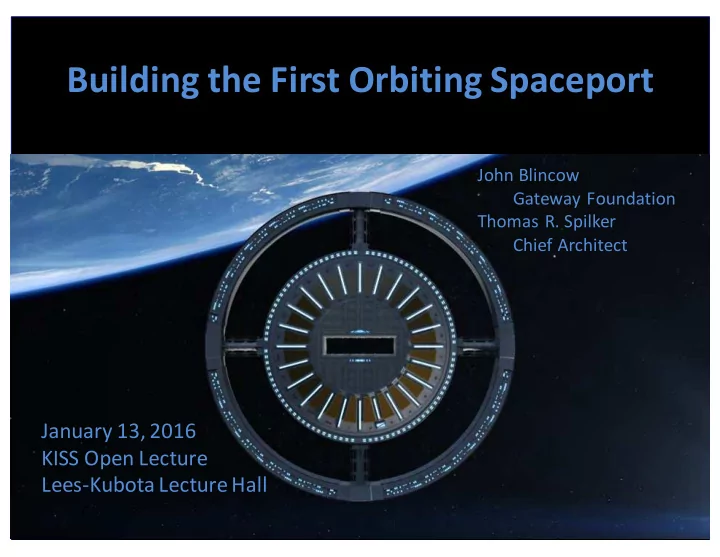
Building the First Orbiting Spaceport

John Blincow Gateway Foundation Thomas R. Spilker Chief Architect

January 13, 2016 KISS Open Lecture Lees-Kubota Lecture Hall

slide-2
SLIDE 2
slide-3
SLIDE 3
slide-4
SLIDE 4
slide-5
SLIDE 5
slide-6
SLIDE 6
slide-7
SLIDE 7
slide-8
SLIDE 8
slide-9
SLIDE 9
slide-10
SLIDE 10
slide-11
SLIDE 11
slide-12
SLIDE 12
slide-13
SLIDE 13
slide-14
SLIDE 14
slide-15
SLIDE 15
slide-16
SLIDE 16
slide-17
SLIDE 17
slide-18
SLIDE 18
slide-19
SLIDE 19
slide-20
SLIDE 20
slide-21
SLIDE 21
slide-22
SLIDE 22

It takes 3 essential things to build a Gateway Spaceport:

  • 1. The Money – proper funding that is

there every year, regardless of economic climate.

  • 2. Advanced construction techniques and

technology.

  • 3. People with the will to build a Gateway
slide-23
SLIDE 23

How to pay for it?

slide-24
SLIDE 24
slide-25
SLIDE 25
slide-26
SLIDE 26
slide-27
SLIDE 27
slide-28
SLIDE 28
slide-29
SLIDE 29
slide-30
SLIDE 30

Is this creative financing?

slide-31
SLIDE 31
slide-32
SLIDE 32
slide-33
SLIDE 33
slide-34
SLIDE 34
slide-35
SLIDE 35
slide-36
SLIDE 36
slide-37
SLIDE 37
slide-38
SLIDE 38
slide-39
SLIDE 39
slide-40
SLIDE 40
slide-41
SLIDE 41
slide-42
SLIDE 42
slide-43
SLIDE 43
slide-44
SLIDE 44
slide-45
SLIDE 45
slide-46
SLIDE 46
slide-47
SLIDE 47
slide-48
SLIDE 48
slide-49
SLIDE 49
slide-50
SLIDE 50
slide-51
SLIDE 51
slide-52
SLIDE 52
slide-53
SLIDE 53
slide-54
SLIDE 54
slide-55
SLIDE 55
slide-56
SLIDE 56
slide-57
SLIDE 57
slide-58
SLIDE 58
slide-59
SLIDE 59
slide-60
SLIDE 60
slide-61
SLIDE 61
slide-62
SLIDE 62
slide-63
SLIDE 63
slide-64
SLIDE 64

Do you want to work in space?

slide-65
SLIDE 65
slide-66
SLIDE 66
slide-67
SLIDE 67
slide-68
SLIDE 68

Gateway Technical Aspects

  • Highest-level goals: what are we trying to

accomplish?

  • System requirements flow from goals

– “Form Follows Function” (Louis Sullivan)

  • Physical realities set some requirements and

influence others

  • Build in accommodation for obvious extensions
slide-69
SLIDE 69

High-Level Requirements from Goals

  • Artificial Gravity

– How Much? Lunar? ¼ gee? Mars? ½ gee? – Little is known about gravity magnitude needed to prevent long- term health issues – Opportunity for groundbreaking research on the Gateway

  • Provide for human survival and comfort needs

– Air (Pressure? Composition?) – Water (Distribution system? Recycling?) – Food – Living quarters

  • Avoid designs that induce space-related illnesses

– Limits on rotation rates – Radiation shielding

slide-70
SLIDE 70

High-Level Requirements from Goals

  • Artificial Gravity

– How Much? Lunar? ¼ gee? Mars? ½ gee? – Little is known about gravity magnitude needed to prevent long- term health issues – Opportunity for groundbreaking research on the Gateway

  • Provide for human survival and comfort needs

– Air (Pressure? Composition?) – Water – Food – Living quarters

  • Avoid designs that induce space-related illnesses

– Limits on rotation rates – Radiation shielding

slide-71
SLIDE 71

High-Level Requirements from Goals

  • How Much Artificial Gravity? Limits on rotation rates?

R

! a

c = Ω × Ω × R

( ) = ω 2 R

slide-72
SLIDE 72

High-Level Requirements from Goals

  • How Much Artificial Gravity? Limits on rotation rates?

R

! a

c = Ω × Ω × R

( ) = ω 2 R

R = ! a ω 2

slide-73
SLIDE 73

High-Level Requirements from Goals

  • How Much Artificial Gravity? Limits on rotation rates?

R

! a

c = Ω × Ω × R

( ) = ω 2 R

R = ! a ω 2

Mars |ac| & ω = 1 RPM? R = 338 m

slide-74
SLIDE 74

High-Level Requirements from Physical Realities

  • Orbit option limits

– Altitude

  • Lower à less energy for launches, but more atmospheric drag
  • Higher à less atmospheric drag, but higher energy for launches

and more intense radiation

– Inclination

  • Equatorial à less energy for launches, but long eclipses
  • Sun-synchronous (i ~97°) à continuous sunlight option, but

high launch energy

  • Intermediate?
  • Mitigate orbital debris collision hazard
slide-75
SLIDE 75

Accommodate Extensions

  • Wide range of other potential uses

– Science, research

  • Human
  • Animal, plant
  • On-orbit assembly and testing of large, complex spacecraft
  • On-orbit servicing of upper stages for high-energy trajectories

– Exploration

  • Large, complex spacecraft & re-usable upper stages
  • Waypoint for travel to more distant destinations

– Industry

  • On-orbit manufacturing requiring low-gee environment
  • Use of extraterrestrial materials

– Commercial

  • Entertainment and advertising industries
  • Athletics
  • Gateway provides infrastructure for these activities
slide-76
SLIDE 76
slide-77
SLIDE 77

“Falcon Heavy is the world’s most powerful rocket, With the ability to lift into

  • rbit a 737 jetliner

loaded with passengers, crew, luggage and fuel.

  • Elon Musk
slide-78
SLIDE 78
slide-79
SLIDE 79

If you can dream it, you can do it.

  • Walt Disney