BU CS 332 Theory of Computation Lecture 24: Reading: Final review - - PowerPoint PPT Presentation

bu cs 332 theory of computation
SMART_READER_LITE
LIVE PREVIEW

BU CS 332 Theory of Computation Lecture 24: Reading: Final review - - PowerPoint PPT Presentation

BU CS 332 Theory of Computation Lecture 24: Reading: Final review Sipser Ch 7.1 8.3, 9.1 Mark Bun April 29, 2020 Final Topics 5/5/2020 CS332 Theory of Computation 2 Everything from Midterms 1 and 2 Midterm 1 topics: DFAs,


slide-1
SLIDE 1

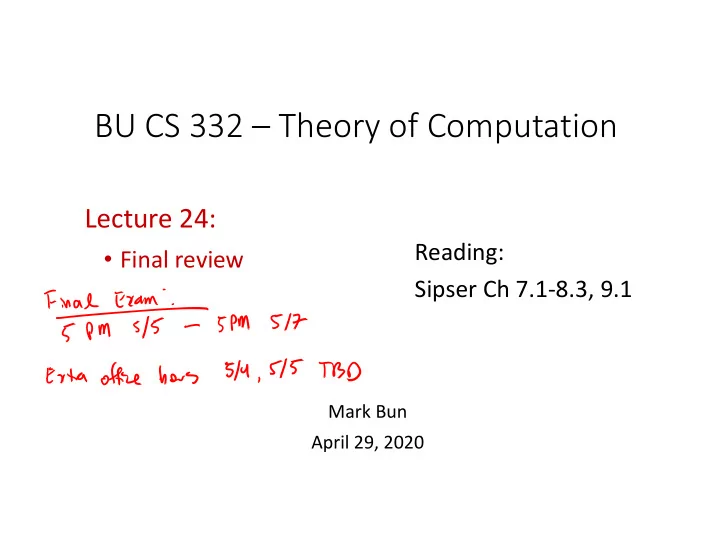
BU CS 332 – Theory of Computation

Lecture 24:

  • Final review

Reading: Sipser Ch 7.1‐8.3, 9.1

Mark Bun April 29, 2020
slide-2
SLIDE 2

Final Topics

5/5/2020 CS332 ‐ Theory of Computation 2

slide-3
SLIDE 3

Everything from Midterms 1 and 2

  • Midterm 1 topics: DFAs, NFAs, regular expressions,

pumping lemma, context‐free grammars, pushdown automata, pumping lemma for CFLs

(more detail in lecture 9 notes)

  • Midterm 2 topics: Turing machines, TM variants, Church‐

Turing thesis, decidable languages, countable and uncountable sets, undecidability, reductions, unrecognizability, mapping reductions

(more detail in lecture 17 notes)

5/5/2020 CS332 ‐ Theory of Computation 3

slide-4
SLIDE 4

Time Complexity (7.1)

  • Asymptotic notation: Big‐Oh, little‐oh, Big‐Omega, little‐
  • mega, Theta
  • Know the definition of running time for a TM and of

time complexity classes (TIME / NTIME)

  • Understand how to simulate multi‐tape TMs and NTMs

using single‐tape TMs and know how to analyze the running time overhead

5/5/2020 CS332 ‐ Theory of Computation 4

slide-5
SLIDE 5

P and NP (7.2, 7.3)

  • Know the definitions of P and NP as time complexity

classes

  • Know how to analyze the running time of algorithms to

show that languages are in P / NP

  • Understand the verifier interpretation of NP and why it

is equivalent to the NTM definition

  • Know how to construct verifiers and analyze their

runtime

  • Understand the surprising implications of P = NP, esp.

how to show that search problems can be solved in poly‐time

5/5/2020 CS332 ‐ Theory of Computation 5

slide-6
SLIDE 6

NP‐Completeness (7.4, 7.5)

  • Know the definition of poly‐time reducibility
  • Understand the definitions of NP‐hardness and NP‐

completeness

  • Understand the statement of the Cook‐Levin theorem

(don’t need to know its proof)

  • Understand several canonical NP‐complete problems

and the relevant reductions: SAT, 3SAT, CLIQUE, INDEPENDENT‐SET, VERTEX‐COVER, HAMPATH, SUBSET‐ SUM

5/5/2020 CS332 ‐ Theory of Computation 6

slide-7
SLIDE 7

Space Complexity (8.1)

  • Know the definition of running space for a TM and of

space complexity classes (SPACE / NSPACE)

  • Understand how to analyze the space complexity of

algorithms (including SAT, NFA analysis)

5/5/2020 CS332 ‐ Theory of Computation 7

slide-8
SLIDE 8

PSPACE and PSPACE‐Completeness (8.2, 8.3)

  • Know the definitions of PSPACE and NPSPACE
  • Know why they’re equivalent (statement of Savitch’s

Theorem)

  • Understand how to show that languages are in PSPACE
  • Know the definition of PSPACE‐completeness
  • You will not be asked anything about the PSPACE‐

complete language TQBF, or to show that any specific language is PSPACE‐complete

5/5/2020 CS332 ‐ Theory of Computation 8

slide-9
SLIDE 9

Hierarchy Theorems (9.1)

  • Know that we can prove, unconditionally, that P ≠ EXP

and that PSPACE ≠ EXPSPACE

  • You will not be asked about the formal statements of the

time/space hierarchy theorems, but should understand how they generalize the above statements

5/5/2020 CS332 ‐ Theory of Computation 9

slide-10
SLIDE 10

Things we didn’t get to talk about

  • Additional classes between NP and PSPACE (polynomial

hierarchy)

  • Logarithmic space
  • Relativization and the limits of diagonalization
  • Boolean circuits
  • Randomized algorithms / complexity classes
  • Interactive proof systems
  • Complexity of counting

https://cs‐people.bu.edu/mbun/courses/535_F20/

5/5/2020 CS332 ‐ Theory of Computation 10

slide-11
SLIDE 11

Tips for Preparing Exam Solutions

5/5/2020 CS332 ‐ Theory of Computation 11

slide-12
SLIDE 12

Designing (nondeterministic) time/space‐ bounded deciders

5/5/2020 CS332 ‐ Theory of Computation 12

  • Key components: High‐level description of algorithm, analysis of

running time and/or space usage

  • A good idea: Explain correctness of your algorithm

slide-13
SLIDE 13

Designing NP verifiers

5/5/2020 CS332 ‐ Theory of Computation 13

  • Key components: Description of certificate, high‐level description of

algorithm, analysis of running time

  • A good idea: Explain correctness of your algorithm
slide-14
SLIDE 14

NP‐completeness proofs

5/5/2020 CS332 ‐ Theory of Computation 14

To show a language is NP‐complete: 1) Show is in NP (follow guidelines from previous two slides) 2) Show is NP‐hard (usually) by giving a poly‐time reduction

  • for some NP‐complete language
  • High‐level description of algorithm computing reduction
  • Explanation of correctness: Why is

iff for your reduction ?

  • Analysis of running time
slide-15
SLIDE 15

Practice Problems

5/5/2020 CS332 ‐ Theory of Computation 15

slide-16
SLIDE 16

5/5/2020 CS332 ‐ Theory of Computation 16

slide-17
SLIDE 17

5/5/2020 CS332 ‐ Theory of Computation 17

slide-18
SLIDE 18

5/5/2020 CS332 ‐ Theory of Computation 18

slide-19
SLIDE 19

5/5/2020 CS332 ‐ Theory of Computation 19

slide-20
SLIDE 20

5/5/2020 CS332 ‐ Theory of Computation 20

slide-21
SLIDE 21

P

5/5/2020 CS332 ‐ Theory of Computation 21

slide-22
SLIDE 22

Give examples of the following languages: 1) A language in P. 2) A decidable language that is not in P. 3) A language for which it is unknown whether it is in P.

5/5/2020 CS332 ‐ Theory of Computation 22

slide-23
SLIDE 23

Give an example of a problem that is solvable in polynomial‐time, but which is not in P

5/5/2020 CS332 ‐ Theory of Computation 23

slide-24
SLIDE 24

Let

  • .

Show that

5/5/2020 CS332 ‐ Theory of Computation 24

slide-25
SLIDE 25

Which of the following operations is P closed under? Union, concatenation, star, intersection, complement.

5/5/2020 CS332 ‐ Theory of Computation 25

slide-26
SLIDE 26

5/5/2020 CS332 ‐ Theory of Computation 26

slide-27
SLIDE 27

NP and NP‐completeness

5/5/2020 CS332 ‐ Theory of Computation 27

slide-28
SLIDE 28

Prove that is in NP

5/5/2020 CS332 ‐ Theory of Computation 28

slide-29
SLIDE 29

Prove that is NP‐hard

5/5/2020 CS332 ‐ Theory of Computation 29

slide-30
SLIDE 30

Which of the following operations is NP closed under? Union, concatenation, star, intersection, complement.

5/5/2020 CS332 ‐ Theory of Computation 30

slide-31
SLIDE 31

Show that if P = NP, there is a polynomial‐time decider for

5/5/2020 CS332 ‐ Theory of Computation 31

slide-32
SLIDE 32

5/5/2020 CS332 ‐ Theory of Computation 32

slide-33
SLIDE 33

Space Complexity

5/5/2020 CS332 ‐ Theory of Computation 33

slide-34
SLIDE 34

Which of the following statements are true?

  • =
  • =
  • =
  • 5/5/2020

CS332 ‐ Theory of Computation 34

slide-35
SLIDE 35

Consider the inheritance problem from HW9, except Alice and Bob now take turns drawing bags from boxes. Alice’s goal is to assemble a complete collection of marbles, and Bob’s is to thwart her. Prove that determining whether Alice has a winning strategy is in PSPACE.

5/5/2020 CS332 ‐ Theory of Computation 35

slide-36
SLIDE 36

5/5/2020 CS332 ‐ Theory of Computation 36

slide-37
SLIDE 37

5/5/2020 CS332 ‐ Theory of Computation 37